
By Open Chronicle Newsdesk with agencies
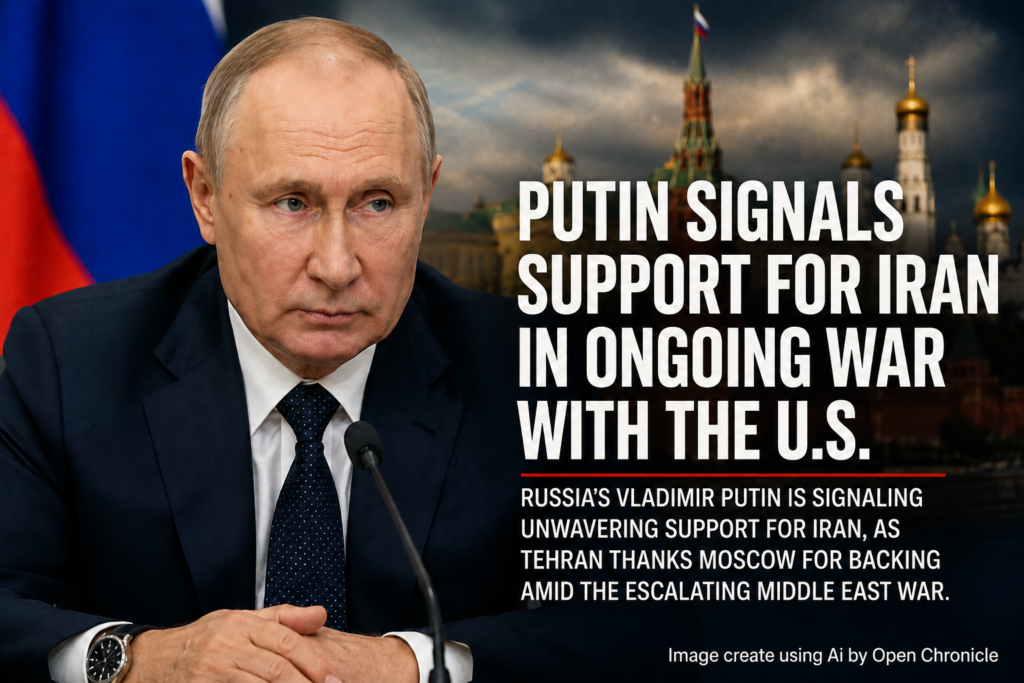
Russian President Vladimir Putin has signaled continued support for Iran as Tehran confronts an escalating military conflict with the United States, reinforcing the increasingly close strategic relationship between Moscow and the Islamic Republic.
Iranian officials have welcomed Russia’s position, thanking Moscow for its backing at a time when fighting involving US and Iranian forces has intensified across the Middle East.
Putin’s stance highlights the broader geopolitical consequences of the conflict, which is increasingly drawing major powers into competing diplomatic and strategic alignments even when they are not directly participating in the fighting.
Moscow Stands Behind Tehran
Russia and Iran have developed increasingly close political, military and economic relations in recent years, driven in part by their shared confrontation with Western governments.
Moscow’s latest expressions of support come as Iran faces sustained pressure from the United States and as the conflict threatens to destabilize the wider region.
For Tehran, Russian diplomatic backing is particularly important because Moscow is a permanent member of the United Nations Security Council and remains one of the world’s major military and nuclear powers.
Iran has publicly expressed gratitude for Russia’s support during the crisis, presenting Moscow as an important partner as it attempts to resist American pressure.
Putin’s position also reinforces Russia’s argument that Middle Eastern security cannot be determined solely by Washington and its allies.
A Strategic Partnership Under Pressure
The relationship between Russia and Iran has deepened considerably against the background of the war in Ukraine and the deterioration of both countries’ relations with the West.
Their cooperation encompasses diplomacy, trade, energy and defence, although the precise limits of Russian assistance to Tehran during the current conflict remain important.
Political support does not automatically mean direct Russian military intervention.
Moscow must balance its partnership with Iran against its other strategic relationships across the Middle East and the danger that deeper involvement could bring Russia into a direct confrontation with the United States.
Nevertheless, Putin’s support sends an important political message that Tehran is not entirely isolated internationally.
War Reshapes Middle East Geopolitics
The conflict is increasingly affecting relationships far beyond Iran and the United States.
Countries throughout the Gulf are confronting threats to military bases, energy infrastructure and commercial shipping, while disruption around the Strait of Hormuz has added another layer of international concern.
Russia has substantial interests in the outcome.
A prolonged disruption to Middle Eastern energy supplies could influence global oil markets, while a weakened or fundamentally transformed Iran would alter the strategic balance across a region where Moscow has spent years attempting to maintain influence.
The crisis also intersects with Russia’s broader confrontation with the United States and NATO.
From Moscow’s perspective, American military commitments in the Middle East have implications for Washington’s ability to sustain resources and attention elsewhere, including Europe and Ukraine.
Tehran Values Russian Diplomatic Backing
Iran’s public thanks to Moscow underline the importance Tehran places on support from major international partners.
With military pressure increasing and diplomatic efforts struggling to produce a durable settlement, Iran is seeking to demonstrate that it retains significant relationships outside the Western political system.
Russia is central to that effort.
Moscow can provide diplomatic support in international institutions and maintain economic relations with Iran despite Western pressure.
China is another crucial part of the equation, particularly because of its economic weight and dependence on stable energy supplies from the region.
Together, the positions adopted by Russia and China could significantly influence international efforts either to contain the conflict or negotiate an eventual settlement.
Limits of Russian Support Remain Crucial
The central question is how far Putin is prepared to translate political support into practical assistance.
There is a substantial difference between diplomatic backing, economic cooperation, intelligence sharing, military supplies and direct participation in a conflict against American forces.
Any Russian decision to become directly involved would dramatically increase the risk of confrontation between nuclear armed powers.
For that reason, Moscow has strong incentives to support Tehran while attempting to avoid crossing thresholds that could produce an uncontrolled escalation with Washington.
Russia can also use diplomatic channels to position itself as both an Iranian partner and a potential participant in negotiations over the conflict.
A Conflict With Global Consequences
Putin’s support for Iran demonstrates how the war is becoming part of a much broader competition over international influence.
What began as a confrontation centered on Iran, Israel and the United States increasingly intersects with Russian and Chinese strategic interests, European security concerns, Gulf energy supplies and the future of global maritime trade.
For Iran, Moscow’s backing provides valuable diplomatic support during one of the most serious crises facing the Islamic Republic.
For Russia, supporting Tehran allows it to reinforce an important strategic partnership while challenging American influence in the Middle East.
The critical issue will be whether that support remains primarily political and diplomatic or develops into deeper forms of assistance as the conflict continues.