
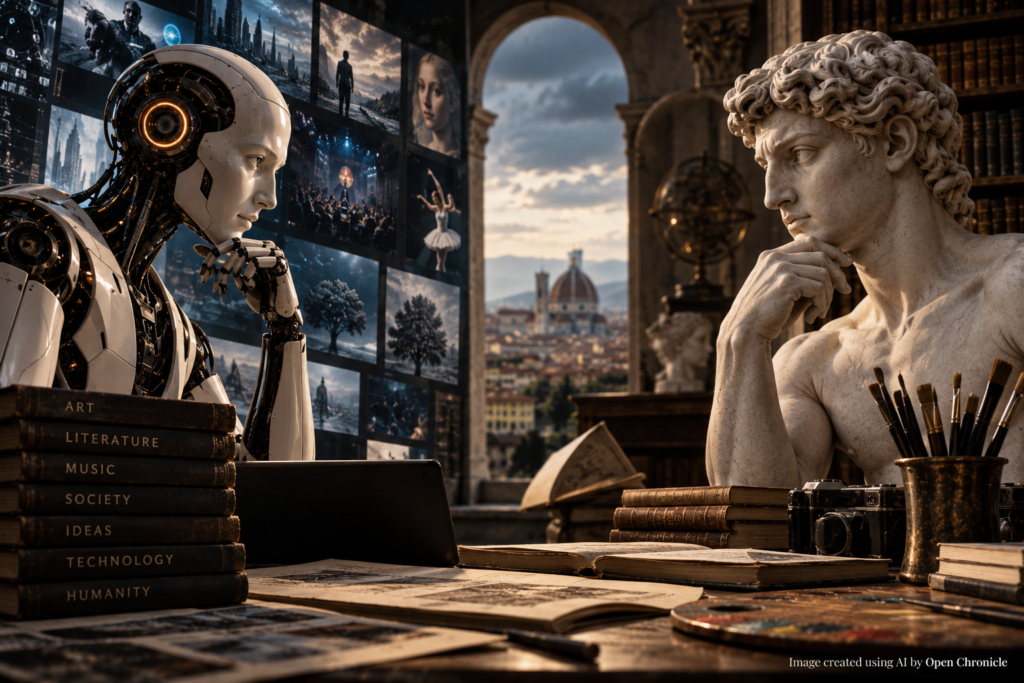
AI can already write stories, compose music, generate images and imitate almost any artistic style. But producing creative work and creating culture may be two very different things.
By Open Chronicle Culture & Ideas
Artificial intelligence has crossed a threshold that would have seemed improbable only a few years ago.
A person can type a sentence into a computer and receive an illustration within seconds. A few instructions can produce music, poetry, photography, dialogue, animation or prose. Systems trained on enormous collections of human work can reproduce styles, combine influences and generate material that sometimes feels surprisingly original.
The technological question is increasingly easy to answer.
Yes, machines can create things.
The cultural question is considerably harder.
Can machines create culture?
The distinction matters because culture has never simply been the accumulation of paintings, books, songs, films and other objects. Culture emerges from the relationship between those things and the people who make, interpret, reject, imitate and remember them.
A song becomes culturally important because people attach meaning to it. A novel can become the voice of a generation because readers recognise something of themselves within it. A painting can provoke outrage because it challenges assumptions held by a particular society at a particular moment.
Culture exists not only in the object.
It exists in the meaning surrounding it.
And that creates one of the most fascinating questions of the artificial intelligence age.
Creativity Is Not the Same as Culture
Human civilisation has always produced creative objects with technology.
The printing press transformed literature. Photography transformed painting. Recorded sound transformed music. Cinema created an entirely new artistic language. Radio and television produced mass culture. Digital technology changed almost every creative industry.
Each technological revolution initially created anxiety about what might disappear.
Photography was once perceived as a threat to painting. Recorded music changed the economic and social meaning of musical performance. Television was accused of destroying older forms of entertainment. Digital tools transformed photography, filmmaking, design and publishing.
Yet these technologies ultimately became part of culture because humans used them to express ideas.
Artificial intelligence may be different in one fundamental respect.
The machine is no longer merely helping to produce the work.
It appears to be participating in the creative act itself.
Ask an AI system for a painting of a futuristic city influenced by Renaissance architecture and it can produce one. Ask for a melancholy piano composition inspired by winter and it can generate something recognisably musical. Ask it to imagine a conversation between two fictional characters and it can construct the dialogue.
The result may look creative.
But where does its meaning come from?
The Problem of Experience
Human creativity begins long before anyone picks up a brush, opens a notebook or touches an instrument.
It begins with experience.
A novelist writes after having lived among other people. A musician carries memories of sounds heard during childhood. A filmmaker has experienced fear, desire, loneliness, love, embarrassment, ambition and loss.
Even imagination is partly constructed from experience.
This is one reason biographies matter when we interpret art. Knowing something about the life of Vincent van Gogh changes how many people encounter his paintings. Understanding the political world surrounding George Orwell adds another dimension to Nineteen Eighty Four. The personal history of an artist can become inseparable from the way society understands the work.
Artificial intelligence has no childhood to remember.
It has never fallen in love, feared death, watched a parent grow old, belonged to a neighbourhood, migrated to another country or experienced the strange sensation of remembering a place that no longer exists.
It can describe these things because humans have described them before.
That is not necessarily the same as experiencing them.
And yet this apparent limitation may not settle the question.
Does the Creator Need to Understand the Work?
Suppose an AI generates a piece of music that profoundly moves a million people.
Listeners play it at weddings. Someone hears it during the final months of a parent’s life. Another person associates it with the beginning of a relationship. Years later, the melody evokes memories for people who heard it when they were young.
At what point does its origin cease to determine its cultural significance?
The machine may never have understood the music.
But the listeners did.
This suggests something uncomfortable for the argument that machines cannot create culture.
Perhaps cultural meaning does not have to originate entirely with the creator.
Audiences have always interpreted works in ways their creators never intended. Books acquire meanings their authors did not foresee. Songs become associated with political movements that musicians never anticipated. Films can become symbols of generations decades after their release.
Culture is partly created by reception.
If humans give meaning to an AI generated work, that work may enter culture regardless of whether the machine understood what it produced.
Culture Has Always Been Built From Other Culture
There is another complication.
Human creativity itself is deeply dependent on what came before.
Writers learn by reading writers. Musicians absorb other musicians. Filmmakers inherit visual languages developed by previous filmmakers. Architects borrow, reject and reinvent historical forms.
No artist begins from nothing.
Culture is an enormous conversation across generations.
Shakespeare borrowed plots. Renaissance artists rediscovered classical forms. Rock music emerged from earlier musical traditions. Hip hop transformed sampling into an artistic language capable of building something new from existing recordings.
Artificial intelligence also learns from existing cultural material, although on a scale no individual human could approach.
This leads to a difficult boundary.
When does influence become imitation?
When does recombination become creation?
And are we applying a standard to machines that human creativity itself could not satisfy?
There are important differences. Human artists operate within lives, communities and historical circumstances. Their influences pass through personal experience before becoming new work.
AI operates differently.
But the boundary between originality and recombination was complicated long before artificial intelligence arrived.
The Question of Intention
Perhaps the strongest distinction lies in intention.
A human being creates for reasons.
To communicate.
To remember.
To protest.
To seduce.
To entertain.
To understand something.
Sometimes simply because an idea refuses to disappear.
Behind the work exists a person who wanted, however imperfectly, to bring something into the world.
Current AI systems do not want their paintings to be seen. They do not hope their novels will survive them. They do not worry whether an audience understands their music.
They have no artistic career to pursue and no reputation to defend.
The intention generally comes from somewhere else.
From the person giving the instructions.
This may mean that the most useful way to think about AI creativity is not human versus machine, but something more complicated.
Human intention may increasingly operate through machine generation.
The cultural actor may still be human, even when much of the production process is automated.
The Rise of the AI Director
This could produce a new kind of creator.
For much of artistic history, skill and execution were closely connected. A painter needed to know how to paint. A musician needed some ability to perform or compose. A photographer needed to understand a camera.
Digital tools gradually loosened this relationship.
AI could separate them much further.
A future filmmaker might describe scenes rather than photograph them. A musician might shape an album through language without playing every instrument. A visual artist might generate hundreds of possibilities and build the final work through selection, direction and refinement.
In such a world, creative skill does not necessarily disappear.
It moves.
Judgement becomes more important.
Taste becomes more important.
Knowing what to reject may become as important as knowing what to produce.
The artist begins to resemble a director of possibilities.
That raises another question: if millions of people have access to the same generative capabilities, what distinguishes one creator from another?
Perhaps precisely what distinguished artists before AI.
Not simply the ability to make something.
The ability to know what is worth making.
The Danger of Cultural Averaging
There is, however, another possible future.
AI systems trained on vast quantities of existing culture may become extraordinarily good at producing things that feel familiar.
A song can sound approximately like the music audiences already enjoy. A photograph can reproduce established visual conventions. A story can follow structures that have succeeded thousands of times before.
That could create an enormous quantity of competent cultural material.
And very little surprise.
Culture does not advance only through competence.
It often advances through mistakes, eccentricity, rebellion and work that initially appears strange.
New artistic movements frequently emerge because someone violates the conventions of the previous generation.
A system optimised around patterns extracted from existing culture could therefore produce a paradox.
More creative material than humanity has ever possessed, but potentially less genuine cultural difference.
The greatest threat may not be that AI produces bad culture.
It may be that it produces endlessly acceptable culture.
When Everything Can Be Created
Generative technology also changes scarcity.
For most of history, creating cultural material required significant time, skill or resources.
A novel might take years.
A film required hundreds of people.
A recording demanded musicians, equipment and studio time.
AI can dramatically reduce those barriers.
This democratisation could be extraordinary. People who could never afford filmmaking equipment may create visual stories. Someone without traditional musical training may explore composition. Languages and communities overlooked by major cultural industries may gain new production tools.
But abundance creates another problem.
If billions of images, songs, videos and stories can be generated almost instantly, human attention becomes the scarce resource.
The challenge of culture may shift from creation to discovery.
The important question may no longer be:
Who can make something?
It may become:
Who can make something that another human being cares about?
Culture Requires a Community
This may ultimately be the most important point.
Culture is collective.
A private object nobody encounters may be creative, but it has little cultural existence.
Culture forms when ideas move between people.
When they are discussed.
Copied.
Criticised.
Loved.
Parodied.
Remembered.
Passed from one generation to another.
Artificial intelligence can already participate in the production of cultural objects.
But whether those objects become culture still depends largely on humans.
Humans decide what matters.
Humans build communities around works.
Humans attach memories to them.
Humans argue about their meaning.
Humans decide what survives.
At least for now.
Perhaps We Are Asking the Wrong Question
The question “Can AI create culture?” assumes that human culture and artificial intelligence will remain separate things.
That separation may not survive.
AI is already entering writing, design, music, filmmaking, advertising, education and everyday communication. Its influence may eventually become so ordinary that distinguishing between purely human culture and AI influenced culture becomes difficult.
Photography did not remain outside culture.
Cinema did not remain outside culture.
The internet did not remain outside culture.
They changed culture from within.
Artificial intelligence may do the same.
The difference is that this technology can imitate aspects of the creative process itself.
That makes the transformation potentially deeper.
Future historians may not identify a moment when machines suddenly began creating culture independently.
Instead, they may describe an era in which human culture gradually became inseparable from machines capable of generating it.
And perhaps that leads to the most unsettling answer to our question.
Artificial intelligence does not need consciousness, memory or even an understanding of beauty to change culture.
It only needs humans to care about what it creates.
That may already be happening.
Who, then, is the creator?