
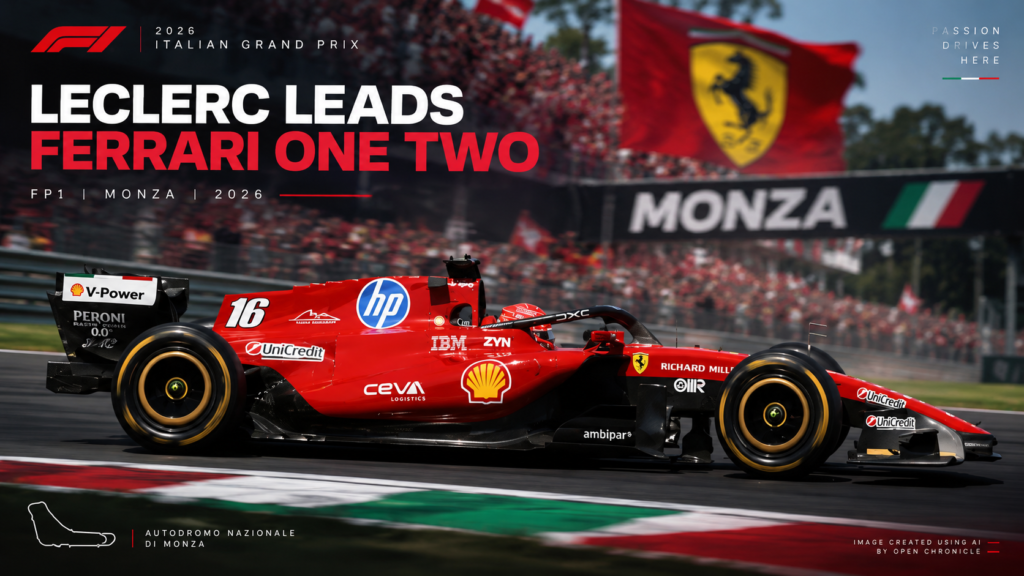
Charles Leclerc set the pace in FP1 for the 2026 Italian Grand Prix, leading Lewis Hamilton in a Ferrari one two as the Scuderia opened its home weekend strongly. George Russell was third for Mercedes, while Gabriel Bortoleto placed Audi eighth in a session interrupted by a red flag for Colton Herta.
By Open Chronicle News Desk with Agencies
Charles Leclerc gave Ferrari the start it wanted at Monza by topping the first free practice session for the 2026 Italian Grand Prix, setting a best lap of 1:23.008 in intense heat and heading teammate Lewis Hamilton by 0.173 seconds.
George Russell finished third for Mercedes on 1:23.312, with Liam Lawson fourth and championship leader Kimi Antonelli fifth.
Lando Norris took sixth for McLaren, Arvid Lindblad was seventh for Racing Bulls, and Gabriel Bortoleto put Audi into eighth after a gradual improvement through the session.
Franco Colapinto and Alpine rookie Paul Aron completed the top 10.
The session was interrupted by a red flag after Colton Herta stopped his Cadillac on circuit with a technical problem.
Ferrari Opens Strongly at Home
The significance of an FP1 result should never be overstated, particularly at Monza where teams often run very different fuel loads, wing levels and tyre programmes.
Still, Ferrari’s opening hour was encouraging.
Leclerc and Hamilton finished first and second on a weekend carrying enormous emotional weight for the Scuderia, with Ferrari racing in front of the Tifosi and marking 30 years since Michael Schumacher’s first Monza victory for the team.
Leclerc’s final benchmark of 1:23.008 was enough to keep Hamilton behind, while Ferrari also showed competitive long run pace during the closing phase of the session.
That combination, rather than the one lap result alone, will have been the more encouraging sign inside the garage.
Extreme Heat Adds Another Variable
Conditions were already demanding before the pit lane opened.
Track temperature had climbed to approximately 48°C, placing tyre behaviour and thermal management at the centre of the programme.
Monza’s low downforce configuration creates a very different engineering challenge from most circuits.
Teams need minimum drag on the long straights while still finding enough stability under braking and traction through the chicanes.
Energy management also becomes particularly important because of the circuit’s prolonged full throttle sections.
With the 2026 cars placing even greater emphasis on electrical deployment and recovery, teams were carefully evaluating where energy could be spent and where it needed to be harvested.
Four Rookies Get FP1 Running
The opening session also featured four reserve or junior drivers replacing regular race drivers.
Ayumu Iwasa took Max Verstappen’s Red Bull.
Luke Browning drove Alexander Albon’s Williams.
Paul Aron replaced Pierre Gasly at Alpine.
Colton Herta took Sergio Pérez’s Cadillac.
Iwasa was the first driver onto the circuit and immediately began aerodynamic data collection work.
Most of the field initially ran hard tyres, although several drivers used mediums and Lawson was among the early runners to appear on softs.
The Times Fall Quickly
Mercedes established an early presence near the front, but the order changed repeatedly as the track evolved.
Leclerc moved to the top with 1:24.482, while Piastri climbed to second with 1:25.333 before improving further.
Tsunoda also appeared near the front during the early running.
Lawson then briefly placed his car at the top, while Norris and Lindblad also featured prominently.
Hamilton moved ahead with a 1:24.291, but Norris immediately pushed the benchmark lower.
The McLaren driver recorded 1:24.194.
Russell then produced 1:23.802, before Hamilton improved to 1:23.891.
Norris responded once more with 1:23.719.
The order remained highly fluid.
Audi Starts on the Back Foot
Audi came to Monza expecting a difficult weekend.
The circuit’s long straights place enormous importance on aerodynamic efficiency and power unit performance, areas in which the team believed its car could be vulnerable relative to some of its midfield rivals.
The first laps appeared to support those concerns.
Bortoleto initially completed only a preparation lap before returning to the garage.
Hülkenberg recorded 1:26.337, leaving him well away from the early pace of Racing Bulls and Alpine.
When Bortoleto eventually began his proper programme, he posted 1:26.307, moving from 20th to 13th.
Hülkenberg improved to 1:25.926.
Audi was still some distance from where it wanted to be.
That would change later.
Herta Stops and Brings Out the Red Flag
The session was interrupted when Herta stopped his Cadillac shortly before the halfway point.
Race control initially deployed a Virtual Safety Car.
Marshals attempted to move the car but were unable to do so, suggesting that the Cadillac had become locked because of the technical failure.
The VSC was therefore upgraded to a red flag so that a recovery vehicle could remove the car safely.
The interruption created an opportunity for teams to reassess their programmes.
Audi used the stoppage to discuss setup changes with Bortoleto.
The Brazilian was instructed to complete further performance runs on medium tyres once the session resumed.
Leclerc Takes Control
Several drivers returned immediately after the restart.
Russell, Antonelli, Lawson, Norris, Colapinto and Piastri appeared on soft tyres.
Russell moved to the front with 1:23.312.
Then Leclerc responded.
The Ferrari driver produced 1:23.008 and moved decisively to the top.
It was a particularly interesting lap because Leclerc had achieved the time on mediums while Russell’s benchmark had come on softs.
Although fuel loads and engine modes remain unknown, the comparison provided Ferrari with an encouraging early reference.
Hamilton Completes the Ferrari One Two
Hamilton also continued improving.
The British driver first produced 1:23.561 before finding another significant step.
His eventual 1:23.181 moved him into second.
Ferrari now occupied the top two positions at its home Grand Prix.
Lawson also delivered an impressive session, recording 1:23.433 to finish fourth.
Antonelli placed the second Mercedes fifth on 1:23.644.
Norris, who entered Monza after consecutive victories in Hungary and the Netherlands, finished sixth on 1:23.719.
Bortoleto Moves Forward
Bortoleto’s session became significantly more competitive after the red flag.
He initially improved to 1:24.599, moving into the top 10.
At that point, Hülkenberg had recorded 1:24.924, putting Bortoleto more than three tenths ahead of his teammate.
Audi then returned the Brazilian to the garage for further setup work.
One of the specific targets was improving rotation through Monza’s chicanes, where the car needed to change direction more effectively without compromising traction on exit.
The team chose a different programme for Bortoleto during the closing phase.
He was one of the first drivers to return to the circuit on a new set of soft tyres.
That gave him an opportunity to complete something closer to a qualifying simulation.
He took it.
Bortoleto improved to 1:24.006 and climbed to eighth.
Audi’s Eighth Place Requires Context
The position was encouraging.
The raw gap still underlined the challenge Audi expects at Monza.
Bortoleto finished almost one second behind Leclerc.
However, direct comparison is complicated by the session programmes.
Many drivers did not complete a fresh soft tyre run at the end of FP1, while Bortoleto did.
The eighth place therefore does not necessarily mean Audi possesses the eighth fastest car.
What it does demonstrate is that the team made progress with the setup over the course of the hour.
Bortoleto also finished comfortably ahead of Hülkenberg, who ended FP1 in 13th.
Long Runs Become the Priority
The second half of the session increasingly shifted towards race preparation.
Medium and soft tyres became the dominant compounds, while only a small number of drivers continued using the hard tyre.
With approximately 15 minutes remaining, several leading drivers returned on mediums for longer runs.
The early long stint evidence suggested that Ferrari, Mercedes and McLaren were relatively close.
That will likely be the most important dataset the teams take from FP1.
Monza qualifying can be distorted by slipstreaming and track evolution.
Race pace provides a more stable indication of the underlying competitive picture.
Aron Leads the Rookie Group
Paul Aron finished as the quickest of the four rookie drivers.
The Alpine reserve improved late in the session to 1:24.177, enough for tenth.
Browning was 15th for Williams.
Iwasa finished 17th for Red Bull.
Herta ended 22nd after his technical problem, his best lap a 1:29.922.
Difficult Opening for Aston Martin
Aston Martin endured a quiet first session.
Lance Stroll finished 20th.
Fernando Alonso was 21st.
Neither driver featured meaningfully in the top half of the classification, leaving the team with significant work before FP2.
Cadillac also struggled, with Bottas 19th and Herta last after the stoppage.
FP1 Classification, 2026 Italian Grand Prix
| Pos. | Driver | Team | Time |
|---|---|---|---|
| 1 | Charles Leclerc | Ferrari | 1:23.008 |
| 2 | Lewis Hamilton | Ferrari | 1:23.181 |
| 3 | George Russell | Mercedes | 1:23.312 |
| 4 | Liam Lawson | Red Bull Racing | 1:23.433 |
| 5 | Kimi Antonelli | Mercedes | 1:23.644 |
| 6 | Lando Norris | McLaren | 1:23.719 |
| 7 | Arvid Lindblad | Racing Bulls | 1:23.802 |
| 8 | Gabriel Bortoleto | Audi | 1:24.006 |
| 9 | Franco Colapinto | Alpine | 1:24.028 |
| 10 | Paul Aron | Alpine | 1:24.177 |
| 11 | Oscar Piastri | McLaren | 1:24.184 |
| 12 | Yuki Tsunoda | Racing Bulls | 1:24.571 |
| 13 | Nico Hülkenberg | Audi | 1:24.626 |
| 14 | Oliver Bearman | Haas | 1:24.646 |
| 15 | Luke Browning | Williams | 1:24.740 |
| 16 | Carlos Sainz | Williams | 1:24.827 |
| 17 | Ayumu Iwasa | Red Bull Racing | 1:24.873 |
| 18 | Esteban Ocon | Haas | 1:25.852 |
| 19 | Valtteri Bottas | Cadillac | 1:25.984 |
| 20 | Lance Stroll | Aston Martin | 1:26.066 |
| 21 | Fernando Alonso | Aston Martin | 1:26.072 |
| 22 | Colton Herta | Cadillac | 1:29.922 |
What FP1 Really Tells Us
Ferrari has every reason to be encouraged.
Leclerc was fastest.
Hamilton was second.
The car looked competitive over both single laps and longer runs.
The fact that Leclerc’s benchmark came on a medium tyre only adds intrigue.
Mercedes remains firmly in the picture.
Russell was third, Antonelli fifth, and the team’s pace appeared strong throughout the hour.
McLaren’s sixth and 11th positions should be treated with caution. Norris and Piastri were not necessarily running programmes designed to chase headline lap times throughout the session.
Audi improved considerably, with Bortoleto extracting a useful eighth place after setup changes.
And Lawson’s fourth place was another interesting result for Red Bull after a difficult Zandvoort weekend.
The opening practice session has therefore produced an enticing early picture.
Ferrari leads at home.
Mercedes is close.
McLaren has yet to show its full hand.
And Monza’s extreme heat, low drag demands and strategic slipstream battle have only begun to shape the weekend.
Formula One returns later on Friday for FP2, when the fuel loads will fall, the representative tyre runs should become more frequent and the competitive order may begin to reveal itself more clearly.
For now, though, the Tifosi have exactly the result they wanted.
Ferrari is one two at Monza.