
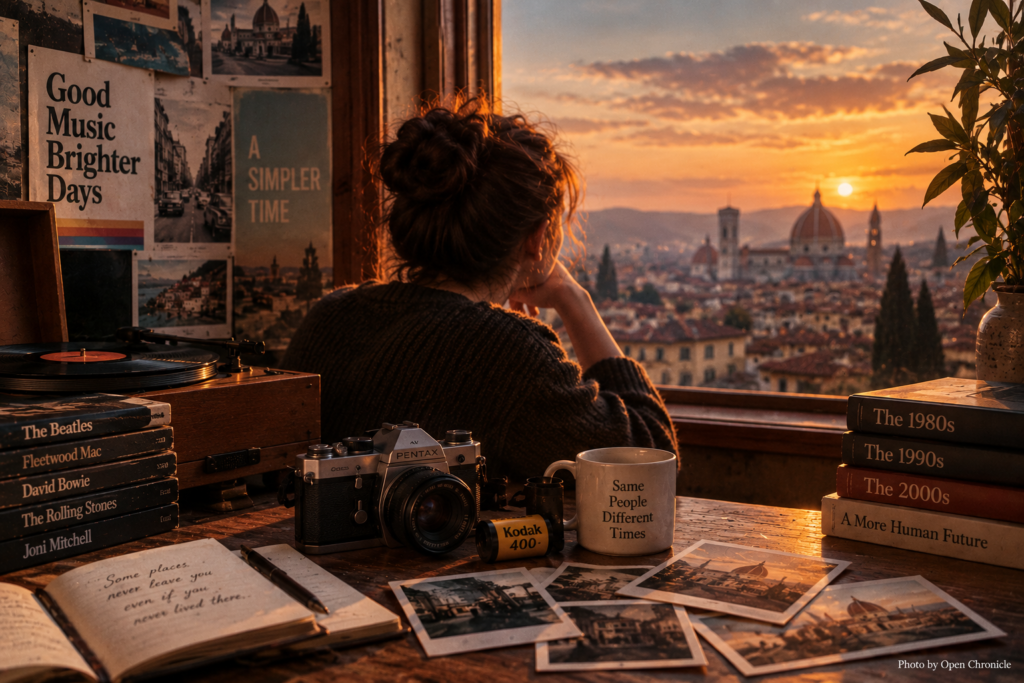
From analogue cameras and vinyl records to 1980s fashion and imagined versions of earlier decades, nostalgia increasingly reaches beyond personal memory. Why do people long for times they never actually experienced?
By Open Chronicle Culture & Ideas
Nostalgia used to be simple.
It belonged to memory.
A childhood street. A song from adolescence. A family kitchen. A summer that seemed longer than summers do now. An old television programme. A first car. A school corridor. A place that existed before someone realised it might one day disappear.
But contemporary nostalgia has become something stranger.
Increasingly, people feel emotionally attached to periods they never lived through.
Teenagers collect vinyl records released decades before they were born. Social media is filled with images designed to resemble photographs from the 1970s, 1980s or 1990s. Young adults romanticise analogue cameras, cassette tapes, old shopping centres, early internet aesthetics, mid century interiors and cities they know largely through films and photographs.
Entire eras have become emotional destinations.
We are nostalgic not only for our own past.
We are becoming nostalgic for other people’s pasts.
And that raises a surprisingly difficult question.
How can we miss something we never experienced?
Nostalgia Is No Longer Just Memory
The word nostalgia has traditionally implied a personal connection to the past.
You remember something because you lived it.
Yet cultural nostalgia works differently.
A person can develop a deep emotional relationship with a period through films, music, photographs, books, family stories, fashion and architecture.
The past becomes something encountered indirectly.
A teenager may never have experienced the 1980s, but can still recognise an imagined version of the decade: neon lights, cassette players, synth music, arcades, boxy televisions and late night city streets.
That version is not necessarily historically accurate.
But emotional accuracy is different from historical accuracy.
The past we long for is often not the past as it really existed.
It is the past as culture remembers it.
Every Generation Inherits Memories
Human beings do not begin life culturally empty.
We inherit stories.
Families tell stories about earlier generations. Countries construct national memories. Films recreate historical moments. Music carries the emotional atmosphere of previous decades.
A child growing up surrounded by the records of a parent’s youth can develop an attachment to those songs without having experienced the world in which they were released.
A city can create nostalgia through architecture. A building from another century can feel strangely familiar because it belongs to a visual language absorbed through books, photographs and cinema.
Memory therefore exists at more than one level.
There is personal memory.
There is family memory.
There is collective memory.
And there is cultural memory.
Nostalgia increasingly moves across all four.
The Past Has Become Accessible
For most of history, much of the past disappeared.
Music vanished when performances ended. Everyday photographs were relatively scarce. Television programmes could be broadcast once and never seen again. Films were difficult to access outside cinemas or specialist collections.
Digital technology changed this dramatically.
Almost every decade now exists simultaneously online.
A teenager can listen to music recorded in 1959, watch television advertisements from 1987, browse photographs of New York in 1974 and purchase clothes inspired by 1990s streetwear within the same afternoon.
The past is no longer distant.
It is searchable.
And when every era becomes permanently available, generations begin consuming history almost as if it were another form of contemporary media.
This creates something culturally unprecedented.
We live not only among the styles of our own time, but among the recovered styles of nearly every recent period.
Algorithms Have Learned Nostalgia
Social media has accelerated this process.
Platforms quickly learn what generates emotional engagement.
Nostalgia is extremely effective.
A photograph of an old neighbourhood.
A forgotten television theme.
A collection of obsolete technology.
A video titled “What life felt like in 1997.”
These things encourage people to stop scrolling.
They provoke comments.
They produce recognition.
Even when the viewer was not alive in 1997.
Algorithms therefore do something curious.
They repeatedly present idealised fragments of earlier eras because those fragments attract attention.
Over time, users begin encountering a highly edited version of the past.
The ordinary disappears.
The memorable remains.
A decade becomes its music, clothes, cars, interiors, nightlife and iconic imagery.
The boring parts are rarely included.
Neither are the anxieties.
This is how nostalgia becomes aesthetic.
We Rarely Miss the Whole Past
People who say they wish they had lived in another decade usually do not mean they want everything that came with it.
Someone attracted to the elegance of the 1950s may not want its social restrictions.
Someone romanticising the 1970s may not want its economic crises.
Someone fascinated by the 1990s probably does not want slower communications, limited access to information or many of the inconveniences that disappeared with smartphones.
Nostalgia selects.
It removes unpleasant details.
It compresses an era into its most attractive characteristics.
This is not entirely irrational.
Memory itself behaves similarly.
Even personal nostalgia often edits the past.
Childhood summers seem endless partly because memory removes most ordinary days.
We remember moments.
Not calendars.
Cultural nostalgia performs the same operation on history.
Why Analogue Things Feel So Powerful
One of the most visible forms of contemporary nostalgia is the return of analogue technology.
Vinyl records.
Film cameras.
Mechanical watches.
Typewriters.
Printed books.
Physical notebooks.
These objects are not always more efficient than their digital replacements.
Often they are dramatically less efficient.
That may be precisely their attraction.
Digital life has made countless activities instant.
Music arrives immediately.
Photographs cost nothing to take.
Messages cross continents in seconds.
Information is permanently available.
Analogue objects reintroduce friction.
A vinyl record must be placed on a turntable.
Film photographs cannot immediately be reviewed.
A handwritten notebook cannot send notifications.
Their limitations create rituals.
And rituals create meaning.
The resurgence of analogue culture may therefore tell us less about technology itself and more about what people feel is missing from digital life.
Nostalgia as a Response to Speed
Modern life changes quickly.
Technology, jobs, media, cities and social habits can transform within a few years.
The faster the present changes, the more stable the past can appear.
Even an imagined past.
Earlier decades feel finished.
Their stories already have endings.
Their styles can be recognised.
Their technologies make sense because we know what replaced them.
The present offers none of that certainty.
We do not yet know which technologies will survive.
We do not know which cultural trends will matter.
We do not know what today’s world will look like in historical memory.
The past feels complete.
The present feels unfinished.
Nostalgia may therefore be partly a desire for a world that has already resolved itself.
The Myth of a Simpler Time
Almost every generation eventually develops the feeling that life used to be simpler.
It rarely was.
People in previous eras dealt with uncertainty, political tension, economic difficulty, social change, war, technological disruption and cultural anxiety.
But complexity is easier to recognise when we are living through it.
From a distance, history becomes organised.
Events acquire causes and consequences.
Decades acquire identities.
The future disappears because we already know what happened.
This creates the illusion of simplicity.
Looking backward, we see a story.
Living forward, we see uncertainty.
That difference matters.
Nostalgia Can Become a Form of Escape
There is nothing inherently unhealthy about nostalgia.
It can preserve memory, create continuity and help people understand where they come from.
But nostalgia can become seductive when the imagined past begins to appear more real than the present.
Culture has always created alternative worlds.
Historical fiction, period dramas and retro aesthetics allow people to temporarily inhabit another time.
The problem begins when aesthetic attraction becomes historical certainty.
The past was rarely as coherent as nostalgic culture makes it seem.
There was no single 1960s experience.
No single 1980s.
No universal 1990s.
Different countries, classes, communities and generations experienced the same years very differently.
Nostalgia tends to flatten those differences.
It turns history into atmosphere.
The Past Has Become a Design Language
Perhaps the most interesting development is that previous decades are increasingly treated less as history and more as visual languages.
The 1970s can become a colour palette.
The 1980s become typography and neon.
The 1990s become grainy photography and early digital design.
The early 2000s become metallic surfaces, translucent plastic and primitive internet aesthetics.
Designers continuously recycle these visual codes.
But each revival changes the original.
The 1980s imagined today are not the actual 1980s.
They are a twenty first century interpretation of the 1980s.
The past becomes raw material.
Culture remembers, edits and rebuilds.
Nostalgia Can Create Things That Never Existed
This is where the phenomenon becomes particularly fascinating.
Sometimes nostalgia does not recreate the past.
It creates a past that never existed at all.
An image generated to look like a forgotten European railway station in 1978 may depict no real station.
A playlist can evoke an imaginary late night city from 1985 even though none of its listeners experienced such a place.
A film can construct an idealised 1960s small town assembled from cultural references rather than historical reality.
These invented memories can still feel emotionally convincing.
Human beings are remarkably capable of responding to atmosphere without requiring autobiography.
That means nostalgia can operate almost like fiction.
We know the world is constructed.
We feel something anyway.
What Are We Actually Longing For?
Perhaps nostalgia for an unlived past is rarely about wanting to return to a specific year.
It may be a longing for qualities we associate with that year.
Slowness.
Community.
Mystery.
Physical objects.
Less surveillance.
Less constant communication.
More local identity.
Clearer boundaries between work and private life.
Or simply the possibility of experiencing the world before everything became permanently documented.
The historical period is sometimes only a symbol.
When someone says they wish they had lived before smartphones, they may not actually want the technology of 1985.
They may want freedom from being permanently reachable.
When someone romanticises vinyl records, they may not reject streaming.
They may miss the ritual of paying attention to one album.
Nostalgia can therefore reveal dissatisfaction with the present.
We Are Building Tomorrow’s Nostalgia Now
There is an irony in all this.
While people romanticise earlier decades, someone in the future may eventually romanticise ours.
They may miss the early age of smartphones.
The strange visual language of today’s internet.
The first generation of artificial intelligence.
Streaming platforms.
Electric cars.
Social media before whatever replaces it.
Places we consider ordinary may eventually become emotionally powerful photographs.
Technologies we barely notice may become collectibles.
Today’s frustrations may disappear from memory.
The aesthetic will remain.
This happens because nostalgia is not simply about history.
It is about distance.
Once enough time passes, ordinary life becomes atmosphere.
The Past We Never Lived
So why are we nostalgic for a past we never experienced?
Because culture allows us to inherit memory.
Because technology gives us unprecedented access to previous eras.
Because algorithms repeatedly present the most attractive fragments of history.
Because the uncertainty of the present makes completed decades feel reassuring.
And because when we imagine another time, we are often expressing something about our own.
The most powerful nostalgia may therefore not be a desire to return.
It may be a way of asking what we feel we have lost.
Perhaps we do not really miss the past.
Perhaps we miss qualities we believe the past contained.
Slowness.
Attention.
Community.
Mystery.
Presence.
And sometimes, by imagining another era, we discover what we want to recover in our own.