
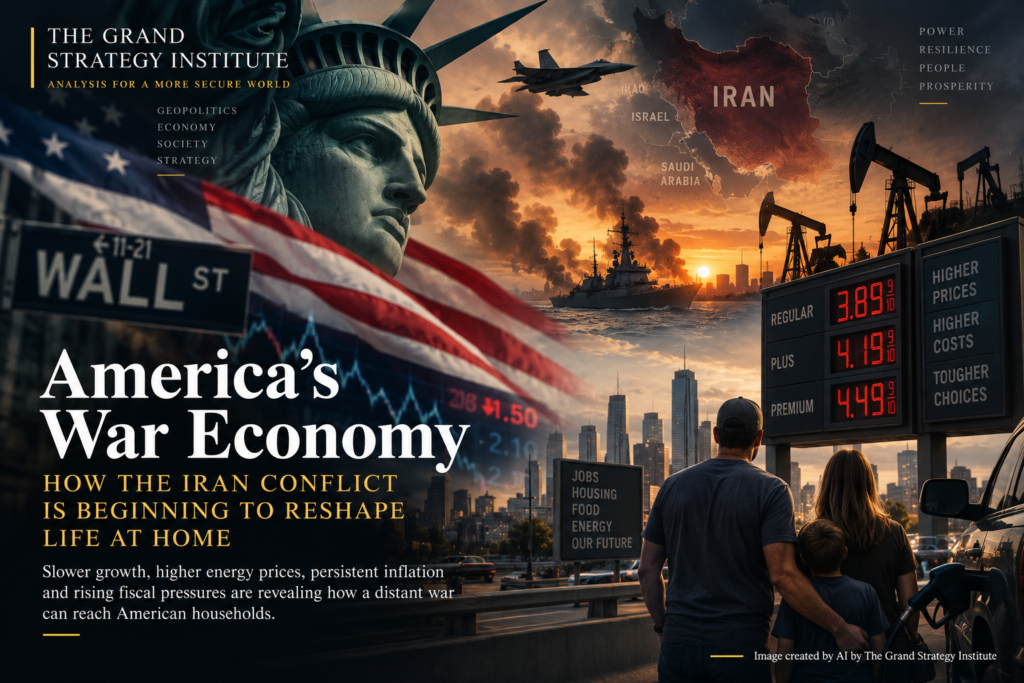
The United States remains economically powerful, but slower growth, expensive energy, persistent inflation and rising fiscal pressures are revealing how a distant war can gradually reach American households
By The Grand Strategy Institute Research Division
For the United States, the war with Iran is being fought thousands of miles from most American homes.
Its economic consequences are not.
They arrive through the price of fuel.
They appear in transportation costs, electricity bills and the price of goods moving through global supply chains.
They influence interest rates, mortgages and business investment.
They appear in federal borrowing and defence expenditure.
And, eventually, they affect the fundamental economic calculation facing millions of households: how much income remains after paying for housing, food, energy, credit and other necessities.
The American economy remains enormously powerful. It continues to create jobs, household consumption remains resilient, investment in areas such as artificial intelligence is considerable, and there is little evidence that the United States is approaching anything resembling an economic crisis.
But that is not the most important question.
The strategic question is whether a prolonged conflict with Iran is beginning to impose costs that, when combined with tariffs, high interest rates, federal debt and existing structural pressures, gradually reduce America’s economic freedom of action.
The latest economic evidence suggests that this process deserves serious attention.
Growth Is Slowing
The clearest warning comes from economic growth.
According to the latest data supplied for this analysis, US gross domestic product expanded at an annualised rate of approximately 1.5 per cent during the second quarter of 2026, down from 2.1 per cent during the first three months of the year.
The figure was also weaker than economists had expected.
A single quarter does not establish a recession.
Nor does 1.5 per cent growth indicate economic contraction.
But the composition of that slowdown matters.
The American economy is attempting to absorb several shocks simultaneously: disruption associated with the Middle East conflict, higher energy prices, continuing trade tensions, tariffs and elevated borrowing costs.
This creates a more complicated economic environment than the headline GDP figure alone suggests.
America is still growing.
It is simply becoming more expensive to keep growing.
The American Consumer Is Holding the Line
There is, however, an important counterweight.
The American consumer remains remarkably resilient.
The figures supplied for this analysis indicate that private consumption accelerated from approximately 0.5 per cent in the first quarter to 3.2 per cent in the second.
That matters enormously.
Consumer expenditure represents the principal engine of the US economy. As long as households continue spending, economic weakness in other sectors can be partially absorbed.
Business investment has also remained relatively strong despite some deceleration.
This means the United States is not experiencing a broad collapse in domestic demand.
Quite the opposite.
The economy contains significant underlying strength.
The danger is that households are now being asked to absorb another external shock.
And energy is the transmission mechanism through which war can reach them most quickly.
Oil Is the War’s Economic Front Line
The strategic importance of Iran cannot be understood without energy.
The Persian Gulf remains one of the most important energy corridors in the international economy, and the Strait of Hormuz has historically carried roughly one fifth of global oil consumption.
A conflict involving Iran therefore carries consequences far beyond the battlefield.
Recent renewed military exchanges pushed Brent crude above $90 per barrel, while West Texas Intermediate moved above $85.
For American consumers, higher oil prices do not remain confined to financial markets.
They travel through the economy.
Oil becomes petrol.
Petrol becomes transportation costs.
Transportation becomes distribution costs.
Distribution costs eventually become consumer prices.
Airlines pay more for fuel.
Trucking companies face higher operating expenses.
Farmers pay more to operate machinery and transport produce.
Manufacturers encounter higher logistics and input costs.
Families pay more to drive to work.
The economic effect of the war therefore does not require Iranian missiles to reach American territory.
The global energy market performs the transmission.
The Gas Pump Is Where Geopolitics Becomes Personal
For policymakers, a movement in crude oil prices is a macroeconomic variable.
For households, it is considerably more tangible.
It is the number displayed on the petrol pump.
This distinction matters politically.
American households do not experience GDP.
They experience prices.
They experience monthly mortgage payments.
They experience grocery bills.
They experience insurance premiums.
They experience electricity bills.
They experience the cost of financing a car.
That means an economy can remain technically healthy while significant numbers of citizens feel economically insecure.
The war with Iran could deepen that divergence.
If energy prices remain elevated, households will have to allocate more income to unavoidable expenditure.
Money spent filling a fuel tank cannot simultaneously be spent in a restaurant, shop or local business.
That is how an energy shock gradually spreads through domestic demand.
The Inflation Problem Returns
This is where the Iran conflict intersects with the Federal Reserve.
The United States entered this period already dealing with an unusually complicated inflation environment.
Energy shocks make that task more difficult.
The Federal Reserve cannot produce oil.
It cannot reopen a shipping route.
It cannot end a war.
It can only influence demand through monetary policy.
If war-driven energy costs begin feeding more broadly into prices, the Fed faces an uncomfortable choice.
Raise interest rates or maintain restrictive policy for longer, and economic growth may weaken further.
Ease policy too quickly, and inflation could accelerate again.
Recent data illustrate why the dilemma is becoming more acute.
The labour market has just produced a much stronger employment report than expected. US employers added 162,000 jobs in August, while unemployment remained at 4.1 per cent. Average hourly earnings increased 3.1 per cent from a year earlier.
That is good news for American workers.
But it also means the Federal Reserve has less reason to prioritise economic stimulus if inflation remains elevated.
Financial markets consequently increased expectations that the Fed could raise rates again.
The war therefore creates a peculiar economic contradiction.
It can weaken growth while simultaneously creating inflationary pressure.
The Interest Rate Battlefield
For households, this matters far beyond Wall Street.
Higher interest rates affect mortgages.
They affect credit cards.
They affect car loans.
They affect business financing.
They affect construction.
They affect the federal government’s cost of servicing its enormous debt.
This creates one of the central strategic economic problems confronting Washington.
The government is financing military operations at the same time that borrowing itself is becoming expensive.
The United States possesses advantages Russia, Iran and almost every other state cannot replicate.
The dollar remains the principal international reserve currency.
US Treasury securities occupy a unique position in global finance.
The American economy is enormous.
Its capital markets are exceptionally deep.
Washington therefore has extraordinary borrowing capacity.
But extraordinary is not the same as unlimited.
The $40 Trillion Question
America’s federal debt has now crossed $40 trillion, adding another dimension to the economic consequences of prolonged conflict.
The Iran war did not create America’s debt problem.
That distinction is essential.
The debt reflects decades of fiscal decisions made by administrations and Congresses controlled by both major political parties, together with structural pressures from ageing, healthcare expenditure, taxation and entitlement programmes.
But war adds another layer.
Reuters recently reported that rising federal expenditure, the continuing Iran conflict and higher bond yields are increasing borrowing costs at a time when Washington is already confronting extraordinary debt levels.
This is where economics becomes grand strategy.
Military power requires fiscal power.
A country capable of financing crises without destabilising its domestic economy possesses greater strategic freedom.
A country increasingly forced to choose between defence, social expenditure, investment and debt servicing possesses less.
The United States remains firmly in the first category.
But the direction of travel deserves attention.
Tariffs Are Adding Another Shock
The Iran conflict is not occurring in economic isolation.
Washington is simultaneously pursuing an aggressive trade policy.
Tariffs can serve strategic purposes.
They can protect particular industries, reduce dependence on geopolitical competitors, incentivise domestic production and become instruments of economic statecraft.
But tariffs also have costs.
Importers initially pay them.
Those costs can subsequently be absorbed by companies, transferred to suppliers or passed to consumers.
The economic consequences therefore depend heavily on the product, market structure and ability of businesses to reorganise supply chains.
Combined with an energy shock, however, tariffs create an important risk.
Businesses can face higher import costs and higher transportation costs simultaneously.
Consumers may ultimately encounter both.
Trade Is Already Weighing on Growth
Recent trade figures illustrate the complexity.
The US trade deficit widened sharply in July to approximately $88.6 billion, with imports reaching $399.3 billion.
Some of this reflects economic strength rather than weakness.
Capital-goods imports surged, including computers and semiconductors associated with America’s enormous investment in artificial intelligence.
That is potentially positive for future productivity.
But trade had already subtracted roughly 1.14 percentage points from second-quarter GDP growth, according to Reuters’ assessment of the latest data.
This is another reason why interpreting the American economy through a single headline is dangerous.
A widening trade deficit can indicate strong domestic demand.
Rising imports can reflect productive investment.
But they can also reduce measured GDP and expose continuing dependence on global supply chains at a time of geopolitical fragmentation.
Artificial Intelligence Is the Counterweight
There is another America developing simultaneously.
While war, energy and tariffs generate economic friction, the United States is experiencing an extraordinary investment cycle associated with artificial intelligence.
Data centres.
Semiconductors.
Cloud infrastructure.
Electricity generation.
Software.
Advanced computing.
Automation.
These investments could produce substantial long-term productivity gains.
Recent US trade data already show record capital-goods imports, partly associated with computers and semiconductors supporting AI investment.
This creates an extraordinary historical juxtaposition.
The United States is simultaneously financing the technologies that may define the next industrial era and fighting a major Middle Eastern conflict capable of consuming enormous fiscal and political resources.
One process builds future productive capacity.
The other consumes resources to achieve immediate geopolitical objectives.
How Washington balances those two demands will matter far beyond the current business cycle.
Jobs Complicate the Story
The labour market demonstrates why claims of an American economic crisis would currently be misleading.
August produced 162,000 new payroll jobs, substantially stronger than recent months. The unemployment rate remained 4.1 per cent.
But beneath the headline, the economy remains uneven.
Food services and drinking places added approximately 59,000 jobs, while local government education added 42,000. The information sector lost employment.
The longer-term trend also deserves attention. The 162,000 increase was far stronger than the average gain of only 31,000 per month over the preceding twelve months.
America therefore has neither a collapsing labour market nor an uncomplicated boom.
It has a resilient economy operating under increasingly unusual pressures.
What Does the War Mean for an American Family?
Grand strategy becomes meaningful when translated into ordinary life.
Consider a hypothetical middle-income household.
The war pushes oil higher.
The family’s weekly fuel bill increases.
Higher transportation costs begin appearing in food and retail prices.
Inflation remains sufficiently persistent that the Federal Reserve keeps interest rates elevated.
The family wants to move house, but mortgage rates remain expensive.
Its car needs replacing, but financing costs are high.
Insurance and utility costs have also increased.
The parents remain employed.
Their nominal wages may even rise.
Yet their sense of prosperity deteriorates because more income is consumed by unavoidable expenses.
Nothing in this scenario resembles economic collapse.
That is precisely the point.
The economic cost of war in a wealthy country often arrives not as catastrophe but as erosion.
The Hidden Cost: What America Does Not Build
There is another cost that households rarely see directly.
Opportunity cost.
Every additional dollar allocated to military operations is a dollar unavailable for another purpose unless the government taxes, cuts or borrows to replace it.
America can afford both defence and domestic investment at scales unavailable to most states.
But resources are still finite.
Infrastructure requires capital.
The electrical grid requires modernisation.
Artificial intelligence requires enormous energy investment.
Semiconductor manufacturing requires subsidies and industrial capacity.
Healthcare requires resources.
Social Security and Medicare face demographic pressure.
Defence modernisation must simultaneously prepare the United States for strategic competition with China.
The Iran war therefore cannot be assessed purely according to the cost of bombs, missiles, aircraft operations and deployed personnel.
Its strategic cost includes what America might otherwise have done with the resources consumed by the conflict.
The China Question
This may ultimately be the most consequential dimension.
Iran is dangerous.
China is potentially systemic.
American grand strategy has increasingly identified the Indo-Pacific as the principal theatre of long-term strategic competition.
Yet a prolonged Middle Eastern war absorbs military attention, air-defence interceptors, precision weapons, naval deployments, intelligence resources, logistics capacity and political focus.
It also consumes money.
The economic and military dimensions therefore converge.
The question is not merely whether the United States can defeat or contain Iran.
It is whether doing so strengthens or weakens America’s position in the wider international system.
A tactically successful war can still impose strategic opportunity costs.
America Can Afford the War. That Is Not the Same as Saying It Is Free.
The United States is not Russia.
It is not Iran.
Its economic base, financial system, technological capacity and ability to borrow remain extraordinary.
The country can sustain levels of military expenditure that would destabilise most other economies.
The evidence currently available does not suggest that the Iran war threatens America’s fundamental economic stability.
But that sets the analytical threshold far too low.
The relevant question is not:
Can America pay for the war?
It is:
What does America sacrifice by continuing to pay for it?
That distinction changes the entire analysis.
GSI Strategic Assessment
The American economy in September 2026 presents an unusual combination of strength and vulnerability.
Growth has slowed.
Yet consumers continue spending.
The labour market remains resilient.
AI investment is creating potentially transformative productive capacity.
At the same time, the Iran conflict has increased energy uncertainty.
Tariffs are complicating international trade.
Federal debt has exceeded $40 trillion.
Interest rates remain economically consequential.
And the government must finance growing strategic commitments in an increasingly fragmented international system.
The danger is therefore not an imminent American economic crisis.
It is strategic accumulation.
One additional military deployment is manageable.
One additional increase in oil prices is manageable.
One additional tariff is manageable.
One additional trillion dollars of debt is financeable.
One additional year of elevated interest rates can be absorbed.
But grand strategy concerns what happens when individually manageable burdens begin interacting.
That is where the Iran war becomes economically important.
If the conflict is short, energy markets stabilise and military expenditure recedes, much of the current pressure could prove temporary.
If the conflict becomes prolonged, the economic calculation changes.
Higher defence expenditure becomes structural.
Energy uncertainty persists.
Borrowing continues.
Interest payments rise.
Businesses adapt investment decisions.
Households absorb higher costs.
And Washington loses resources and attention that could otherwise be directed toward America’s principal long-term strategic challenges.
For the United States, therefore, the economic danger of the Iran war is unlikely to arrive as a dramatic collapse.
It will arrive through the gradual reduction of strategic choice.
That is precisely why the economic front of the war deserves to be studied now.
Key Judgements
- The United States is not approaching an economic crisis. Second-quarter weakness should be interpreted alongside resilient consumer expenditure, investment and a labour market that added 162,000 jobs in August.
- The Iran conflict represents a significant external economic shock primarily through energy. Renewed fighting has pushed Brent crude back above $90, creating risks for transportation costs, inflation and household purchasing power.
- American households are likely to experience the economic consequences of war primarily through prices and financing costs rather than direct taxation for the conflict.
- The Federal Reserve faces an increasingly difficult policy environment. Resilient employment allows it to remain focused on inflation, while an energy shock can simultaneously increase prices and restrain economic growth.
- Tariffs and the Iran conflict can reinforce one another economically, because businesses may face higher import costs at the same time as higher energy and transportation costs.
- The $40 trillion federal debt is not a product of the Iran war, but prolonged military expenditure and elevated borrowing costs intensify an already significant structural fiscal problem.
- AI investment represents an important countervailing force. Strong investment in computing infrastructure and advanced technology could increase future American productivity even while geopolitical conflict creates near-term economic friction.
- The strategic cost of the Iran war must include opportunity costs, particularly resources that might otherwise support infrastructure, industrial modernisation or military preparation for the Indo-Pacific.
- The duration of the conflict is the decisive variable. The United States can absorb a short-lived economic shock far more easily than a multi-year combination of elevated energy prices, military expenditure and high borrowing costs.
- America’s central economic vulnerability is therefore not exhaustion but accumulation: the possibility that multiple individually manageable pressures gradually constrain household prosperity and national strategic freedom.
The Grand Strategy Institute
Continue Exploring Strategic Analysis
Return to The Grand Strategy Institute for strategic assessments, long-form analysis and research examining geopolitics, military affairs, international security, emerging technologies and the changing international order.
← Back to The Grand Strategy Institute