
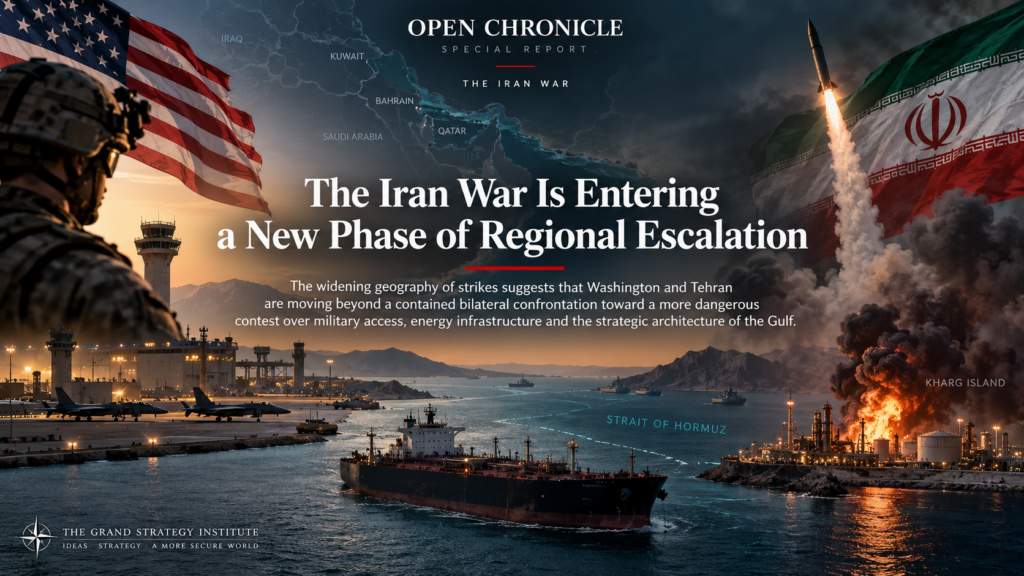
The widening geography of strikes suggests that Washington and Tehran are moving beyond a contained bilateral confrontation toward a more dangerous contest over military access, energy infrastructure and the strategic architecture of the Gulf
By The Grand Strategy Institute Research Division
Grand Strategy Analysis | 5 September 2026
The most important development in the Iran war is no longer the intensity of individual strikes. It is the expanding geography of the conflict.
Six months after the United States and Iran entered direct war, the confrontation is showing signs of becoming something more structurally dangerous than an exchange of attacks between two adversaries. Military operations are increasingly intersecting with the security of Gulf states, the American regional basing network, maritime commerce, energy infrastructure and the Strait of Hormuz.
The latest escalation illustrates that transformation.
On 1 September, U.S. Central Command confirmed a new wave of strikes against Iranian military targets. According to CENTCOM, the operation targeted Islamic Revolutionary Guard Corps capabilities including air defence systems, radars, maritime assets, mine-laying capabilities and communications infrastructure.
Iran subsequently retaliated against American military positions across the region. Reuters reported attacks involving U.S. facilities or positions in Bahrain, Jordan, Kuwait and Iraq. Further Iranian missile and drone attacks were reported against bases in Kuwait and elsewhere in the Gulf.
Then came a potentially significant development around Kharg Island.
On 5 September, Iran’s semi-official Tasnim news agency reported that an Iranian oil tanker near the island had been struck by four U.S. missiles. There were no reported casualties and the crew was being evacuated. At the time of reporting, however, neither Iranian authorities nor U.S. Central Command had officially confirmed American responsibility. That distinction matters. The incident should therefore be treated as a reported attack rather than an established U.S. operation.
Taken individually, these events represent another cycle of escalation.
Taken together, they point toward something larger.
The Iran war is beginning to migrate outward from a predominantly U.S.-Iranian military confrontation into a regional contest over geography itself.
And that may ultimately prove more consequential than any individual strike.
A War That Is Expanding Outward
Wars can expand in two fundamentally different ways.
The first is vertical escalation: adversaries employ increasingly powerful weapons, attack increasingly important targets or accept progressively greater levels of destruction.
The second is horizontal escalation: the geographical and political space in which the conflict occurs becomes wider.
The Iran war increasingly contains both.
American attacks have sought to degrade Iranian military capabilities, particularly those connected with the Strait of Hormuz and Iran’s ability to threaten regional maritime traffic. Iran, meanwhile, possesses a powerful strategic incentive to prevent the United States from treating the conflict as a geographically contained campaign in which American forces can strike Iranian territory while remaining protected behind a network of bases across neighbouring states.
Tehran’s response therefore has a strategic logic.
If the United States possesses regional military depth, Iran will attempt to turn that depth into vulnerability.
American forces operate through an extensive network of facilities, access agreements, logistical nodes, airfields, naval installations and partnerships across the Middle East.
In peacetime, this architecture provides Washington with extraordinary strategic reach.
In wartime, many of those same advantages become potential targets.
This produces one of the central paradoxes of American power in the Gulf:
The infrastructure that allows the United States to project military power into Iran simultaneously creates a distributed network that Iran can threaten in response.
That does not eliminate America’s enormous military superiority.
But it changes the cost structure of the conflict.
The Gulf Is Becoming the Battlefield
For decades, Gulf states attempted to manage a difficult strategic contradiction.
They relied heavily on the United States for external security while simultaneously seeking workable political and economic relationships with Iran.
The Iran war makes that balance increasingly difficult.
Bahrain hosts the headquarters of the U.S. Fifth Fleet. Kuwait has long provided facilities and logistical access to American forces. Qatar hosts Al Udeid Air Base, one of the most important American military facilities in the region. Other states provide different forms of access, cooperation and infrastructure.
Iranian attacks against American positions in these countries therefore carry significance beyond their immediate military effect.
They challenge the assumption that states hosting American forces can remain geographically outside the war.
For Tehran, this creates leverage.
For Gulf governments, it creates a strategic dilemma.
Their partnership with Washington remains an important component of their security architecture. Yet the deeper American military infrastructure becomes involved in attacks against Iran, the greater the danger that their own territories become part of the Iranian target set.
This is precisely how a bilateral confrontation becomes regional without requiring formal declarations of war between Iran and America’s Gulf partners.
Geography does the work.
Iran’s Strategy: Expanding the Cost of American Power
Iran cannot realistically match the United States platform for platform.
It does not need to.
A weaker power confronting a militarily superior adversary often seeks not to reproduce that adversary’s capabilities but to change the strategic equation around them.
Iran can attempt this by increasing the number of things Washington must defend.
American forces must conduct offensive operations while protecting bases, personnel and logistical infrastructure.
Washington must reassure regional allies while attempting to prevent those allies from being drawn deeper into the conflict.
It must defend maritime navigation while avoiding the appearance that the Gulf has become permanently militarised.
It must preserve stocks of expensive precision weapons while maintaining readiness for contingencies elsewhere.
And it must do all of this while ensuring that escalation does not produce consequences in global energy markets severe enough to undermine political support for the campaign.
Iran therefore does not necessarily need to defeat American forces in conventional battle.
It needs to make American military superiority increasingly expensive to exercise.
This is a strategy of cost imposition.
The Vulnerability of America’s Regional Military Architecture
The United States possesses advantages Iran cannot easily replicate: advanced aircraft, intelligence and surveillance systems, long-range precision weapons, naval power, global logistics and a network of allied facilities.
Yet distributed military infrastructure creates a defensive burden.
Every additional installation that becomes operationally relevant to the war may require air and missile defence, force protection, dispersal, hardened infrastructure, redundancy and rapid repair capacity.
The arithmetic is important.
An attacker does not necessarily have to destroy a base to create strategic effects.
Repeated attacks can force aircraft to disperse, interrupt operations, increase defensive ammunition consumption, alter deployment patterns, impose construction and repair costs and compel commanders to allocate resources to protection rather than offensive operations.
This creates an asymmetric exchange.
The relevant measurement is therefore not simply how many Iranian missiles or drones are intercepted.
It is how much American defensive capacity must be committed to ensuring that Iranian attacks do not meaningfully disrupt the regional military system.
The longer the war continues, the more important this becomes.
The Strait of Hormuz Has Become a Strategic Weapon
No geographical feature better illustrates the internationalisation of the conflict than the Strait of Hormuz.
The waterway is not merely a shipping route.
It is a mechanism through which a regional war can transmit economic consequences to countries that are thousands of kilometres from the battlefield.
Recent shipping data demonstrate the scale of the disruption.
According to Kpler data cited by Reuters, only four observed commodity vessels crossed the strait on 3 September, compared with a ten-day average of 15. Before the war, roughly 125 commercial vessels passed through Hormuz each day. Some vessels may be operating without transmitting Automatic Identification System signals, meaning observed traffic does not capture every movement, but the contraction is nevertheless substantial.
Iran has also expanded its efforts to regulate or punish shipping it considers non-compliant, adding vessels to blacklists that expose them to potential fines, detention or confiscation.
Meanwhile, alternative logistical routes are already benefiting. Jordan’s Aqaba port has experienced increased transit cargo as businesses seek ways around disruption in Hormuz.
This reveals the strategic importance of the strait.
Iran does not have to close Hormuz completely to weaponise it.
It needs only to create enough uncertainty that shipping companies, insurers, commodity traders and vessel operators begin pricing military risk into their decisions.
The battlefield then expands through markets.
Kharg Island and the Energy Threshold
Kharg Island occupies a particularly sensitive position in this strategic equation.
Historically, the island has been the central hub of Iranian crude oil exports. Reuters notes that it once handled approximately 90 percent of the country’s crude exports. Iran’s ability to export oil has already been severely constrained by the conflict and American maritime pressure.
That makes any military activity around Kharg strategically significant.
If the reported 5 September tanker strike is confirmed as an American operation, it would indicate increasing military pressure close to one of the most economically consequential locations in Iran.
But the significance extends beyond Iranian export revenues.
Kharg sits close to the intersection between military coercion and global energy security.
There is therefore an important escalation threshold.
Attacking military systems that threaten shipping is one thing.
Conducting sustained operations around infrastructure central to Iranian oil exports is another.
The latter increases the possibility that Tehran will conclude that its remaining energy assets are becoming part of the American target set.
If that perception becomes entrenched, Iran’s incentives to threaten regional energy infrastructure could increase.
This is the danger of reciprocal vulnerability.
Iranian energy infrastructure is exposed to American military power.
Gulf energy infrastructure and maritime traffic are exposed to Iranian retaliation.
That relationship can become self-reinforcing.
Energy Markets Are Already Registering the Conflict
The economic consequences are not theoretical.
Renewed U.S.-Iranian exchanges pushed oil prices higher this week as traders incorporated greater supply risk into energy markets. Reuters reported Brent crude above $96 per barrel during the latest escalation, while prices ended the week substantially higher amid concerns about renewed attacks and disruption.
This matters because energy represents the principal mechanism through which the Iran war can become globally systemic.
Higher oil prices raise transportation costs.
Transportation costs influence food and manufactured goods.
Higher energy prices can complicate inflation.
Persistent inflation can constrain monetary policy.
Higher interest rates can weaken investment and increase borrowing costs.
Governments then face additional fiscal pressure.
A missile launched in the Gulf can therefore eventually influence the mortgage payment of a household on another continent without ever approaching that household physically.
The global energy market performs the transmission.
This is why the Strait of Hormuz cannot be analysed as a purely military theatre.
It is simultaneously a military geography, an economic chokepoint and a source of political leverage.
The Gulf States’ Strategic Dilemma
The Gulf monarchies have strong incentives to prevent this conflict from becoming structurally regional.
Their economies have undergone major diversification efforts.
Saudi Arabia, the United Arab Emirates, Qatar and others have invested heavily in tourism, finance, logistics, aviation, technology, infrastructure and international business.
A prolonged regional war threatens these strategies even when physical destruction remains limited.
Capital responds to risk.
Insurance responds to risk.
Tourism responds to risk.
Shipping responds to risk.
Foreign investment responds to risk.
Gulf governments therefore want two things that are becoming increasingly difficult to reconcile.
They want the strategic protection associated with the United States.
And they want their territories and economies insulated from the consequences of America’s war with Iran.
The longer American forces use regional infrastructure for operations connected with the conflict, the harder that insulation becomes.
This may eventually generate political pressure for new restrictions on how American bases and facilities can be used.
If so, Iran could achieve a strategic effect without militarily defeating the United States: weakening Washington’s freedom to operate from the regional basing architecture on which much of American Middle Eastern power depends.
The Munitions and Endurance Problem
There is another dimension to the conflict that receives less public attention.
Modern high-intensity warfare consumes expensive weapons at extraordinary rates.
Air defence interceptors, precision-guided munitions, long-range missiles and sophisticated drones are not unlimited resources.
A prolonged Iran war therefore creates an industrial question as well as a military one.
The United States must evaluate ammunition expenditure not only against Iran but against its global requirements.
Washington simultaneously faces commitments in Europe, deterrence requirements in the Indo-Pacific, defence obligations toward allies and the need to maintain reserves for unforeseen crises.
Every precision weapon consumed in one theatre has an opportunity cost.
Every air defence interceptor committed to protecting a Gulf installation is an interceptor unavailable elsewhere until production replaces it.
This is where tactical superiority meets grand strategy.
The United States can possess overwhelming military advantages over Iran while still facing difficult questions about how much high-end capacity should be consumed in a prolonged regional conflict.
Strategic endurance is not simply the ability to keep fighting.
It is the ability to keep fighting without weakening the capacity to respond somewhere else.
Why Escalation Does Not Necessarily Produce Victory
A persistent temptation in military strategy is to assume that additional force will eventually resolve a political problem.
Sometimes it does.
Often it changes the problem.
The United States can destroy Iranian military infrastructure faster than Iran can destroy comparable American infrastructure.
That does not automatically mean Washington can translate destruction into the political outcome it seeks.
Iran possesses geography, population, dispersed military capabilities, institutional resilience and a political system accustomed to operating under external pressure.
More importantly, Tehran can respond horizontally.
If direct military competition becomes increasingly unfavourable, Iran can attempt to shift costs into maritime commerce, regional bases, energy markets and allied political calculations.
This produces an escalation paradox.
Greater American military pressure can reduce Iranian capabilities while simultaneously increasing Tehran’s incentives to broaden the conflict.
Military success and strategic success therefore cannot be treated as synonymous.
The decisive question is not simply:
How much of Iran’s military capacity can the United States destroy?
It is:
What political order emerges after that destruction?
The Risk of Horizontal Escalation
Horizontal escalation is now arguably the central strategic danger.
The conflict already touches multiple states through military infrastructure, maritime routes and economic consequences.
Several additional pathways could widen it further.
Iran could intensify attacks against American facilities across the region.
The United States could broaden its target set inside Iran.
Maritime incidents could escalate into sustained naval combat.
Iranian-aligned actors elsewhere in the region could increase operations.
Energy infrastructure could become increasingly exposed.
Gulf states could become more directly involved, deliberately or through retaliation against attacks launched from or directed toward their territory.
The Red Sea could become more closely connected to the Gulf theatre.
None of these developments is inevitable.
But war changes probabilities.
The more military actors, bases, ships, missiles and political interests that become entangled, the greater the possibility that an incident produces escalation neither side originally intended.
That is the structural danger.
What Washington Is Trying to Achieve
American strategy appears to combine several objectives.
Washington wants to constrain Iran’s nuclear and military capabilities.
It wants to preserve freedom of navigation through the Strait of Hormuz.
It wants to demonstrate that attacks on American forces will carry significant consequences.
It wants to reassure regional partners.
And it wants to impose sufficient military and economic pressure that Tehran concludes continued confrontation is more costly than accommodation.
These objectives are individually understandable.
Their interaction is more complicated.
Pressure intended to compel Iran may simultaneously strengthen Iranian incentives to widen the costs of the conflict.
Protecting Hormuz can require military operations that increase the danger to Hormuz.
Using Gulf bases to project American power can increase Iranian pressure on those bases.
Damaging Iranian oil capacity can strengthen incentives to threaten the energy exports of others.
This does not mean coercion cannot work.
It means coercion produces reactions.
Grand strategy must account for both.
What Tehran Is Trying to Preserve
Iran’s immediate challenge is survival under conditions of substantial American military and economic pressure.
Its objectives are therefore different.
Tehran needs to preserve enough military capability to deter unrestricted escalation.
It needs to maintain political cohesion.
It needs to demonstrate that Iran cannot be attacked indefinitely without consequences for American interests.
It needs to preserve some capacity to influence maritime access through Hormuz.
And it needs eventually to create conditions under which negotiation does not resemble unconditional capitulation.
This explains why regional retaliation is strategically attractive despite the risks.
Iran cannot easily impose equivalent destruction on the continental United States.
It can, however, threaten the infrastructure through which the United States exercises power in the Middle East.
That distinction is fundamental.
Iran’s most important strategic target may therefore not be an individual American base.
It may be American confidence that regional military access can remain politically and militarily sustainable throughout a prolonged war.
The Emerging Strategic Balance
The resulting balance is deeply asymmetric.
The United States dominates the conventional military dimension.
Iran retains significant capacity for geographical disruption and cost imposition.
Washington can destroy.
Tehran can complicate.
Washington can strike at range.
Tehran can exploit proximity.
Washington possesses global military reach.
Iran sits beside the world’s most strategically important energy corridor.
Neither form of power cancels the other.
This helps explain why a war characterised by enormous disparities in military capability can nevertheless become prolonged.
The stronger actor controls much of the escalation ladder.
The weaker actor attempts to change the shape of the ladder.
GSI Strategic Assessment
The Grand Strategy Institute assesses that the current escalation represents a potentially important transition in the Iran war.
The conflict should increasingly be understood not simply as a campaign between the United States and Iran, but as a contest over the regional infrastructure that makes American power possible and the economic geography that gives Iran leverage.
This transformation has three major strategic implications.
First, American military superiority does not guarantee geographical containment.
The United States can dominate conventional engagements while Iran expands the political and economic perimeter of the conflict.
Second, the regional basing architecture is becoming part of the strategic contest.
American access to facilities across the Gulf is an enormous advantage, but sustained Iranian attacks could increase both the military cost of protecting those facilities and the political cost for governments hosting them.
Third, energy geography gives the conflict global reach.
Hormuz converts regional military escalation into international economic pressure. Even without complete closure, persistent insecurity can affect shipping behaviour, oil prices, insurance, supply chains and inflation expectations.
The central strategic question is therefore changing.
At the beginning of the conflict, much of the debate concerned whether the United States could successfully destroy or degrade Iranian capabilities.
After six months of war, the more consequential question is whether Washington can convert military superiority into a sustainable political outcome without allowing the conflict to reorganise the Gulf around permanent confrontation.
That is a considerably more difficult objective.
Key Judgements
- The Iran war is entering a more geographically dispersed phase. Recent attacks demonstrate that the conflict increasingly encompasses American military infrastructure across several Middle Eastern states.
- Iran is attempting to transform America’s regional presence from an advantage into a source of vulnerability. The objective is unlikely to be conventional military parity. It is cost imposition.
- The Strait of Hormuz has become both a military theatre and an instrument of economic warfare. Observed commercial traffic remains dramatically below pre-war levels.
- Complete closure of Hormuz is not necessary for Iran to generate strategic effects. Uncertainty alone can alter shipping, insurance, investment and commodity pricing.
- Kharg Island represents a potentially dangerous escalation threshold. Any sustained campaign around Iran’s principal oil-export infrastructure could increase Tehran’s incentives to retaliate against regional energy interests. The reported 5 September tanker strike remains unconfirmed by U.S. authorities at the time of writing.
- Gulf states face an increasingly difficult strategic dilemma. Their dependence on American security relationships must be balanced against their desire to prevent their territory and economic development strategies from becoming entangled in a prolonged U.S.-Iranian war.
- American military superiority remains substantial, but the relevant measure is increasingly strategic endurance rather than battlefield dominance. Washington must consider regional requirements alongside commitments and contingencies elsewhere.
- Military escalation may degrade Iranian capabilities without producing political resolution. Tactical effectiveness should not be confused with strategic success.
- Energy remains the principal mechanism through which the conflict can become globally systemic. Oil prices and shipping disruption transmit regional military risk into the wider international economy.
- The greatest long-term danger is that regionalisation becomes permanent. If military confrontation becomes embedded in Gulf basing arrangements, maritime security, energy flows and alliance politics, ending individual cycles of strikes will no longer be sufficient to restore the pre-war regional order.
Conclusion
The Iran war is no longer defined solely by what the United States strikes inside Iran or what Iran launches in response.
Its strategic centre of gravity is beginning to widen.
American bases across the Gulf, commercial vessels passing through Hormuz, Iranian energy infrastructure, Gulf state calculations and global commodity markets are becoming interconnected components of the same conflict.
That changes the meaning of escalation.
The United States remains overwhelmingly more powerful in conventional military terms. Iran nevertheless possesses something Washington cannot eliminate through air power alone: geography.
Iran sits at the centre of the Gulf, beside one of the world’s most consequential maritime chokepoints and within striking distance of much of the infrastructure supporting American regional power.
That geography gives Tehran options even as its conventional capabilities are degraded.
For Washington, the strategic challenge is therefore becoming larger than the destruction of Iranian military assets. The United States must determine whether continued military pressure is moving the conflict toward a sustainable political settlement or merely expanding the geographical system through which Iran can impose costs.
For Tehran, the challenge is equally severe. Horizontal escalation may increase the price Washington pays, but every expansion of the battlefield also increases the possibility of substantially greater American retaliation and deeper damage to Iran’s economy and infrastructure.
Both sides therefore confront a dangerous strategic contradiction.
Each can make escalation more expensive for the other.
Neither has yet demonstrated that it can use escalation to create a stable end state.
The strategic danger is not simply that the Iran war becomes larger. It is that the war becomes structurally regional, embedding military confrontation into the security, energy and political architecture of the Gulf long after the current cycle of strikes has ended.
Suggested Reading and Sources
U.S. Central Command, “CENTCOM Completes Strikes on IRGC Targets in Iran,” 1 September 2026.
U.S. Central Command report
Reuters, “US-Iran strikes raise fears of renewed war across the Middle East,” 2 September 2026.
Reuters report on the regional escalation
Reuters, “Gulf shipping traffic via Hormuz keeps below 10-day average,” 4 September 2026.
Reuters report on Strait of Hormuz traffic
Reuters, “Iranian tanker hit by US attack near Iran’s Kharg Island, Tasnim says,” 5 September 2026.
Reuters report on the reported Kharg Island tanker strike
Reuters, “Blockade succeeds where sanctions failed as Iran oil exports stall,” 1 September 2026.
Reuters analysis of Iranian oil exports
Reuters, “Oil ends week higher on renewed US-Iran strikes, diesel hits record,” 4 September 2026.
Reuters energy-market report
The Grand Strategy Institute
Continue Exploring Strategic Analysis
Return to The Grand Strategy Institute for strategic assessments, long-form analysis and research examining geopolitics, military affairs, international security, emerging technologies and the changing international order.
← Back to The Grand Strategy Institute