
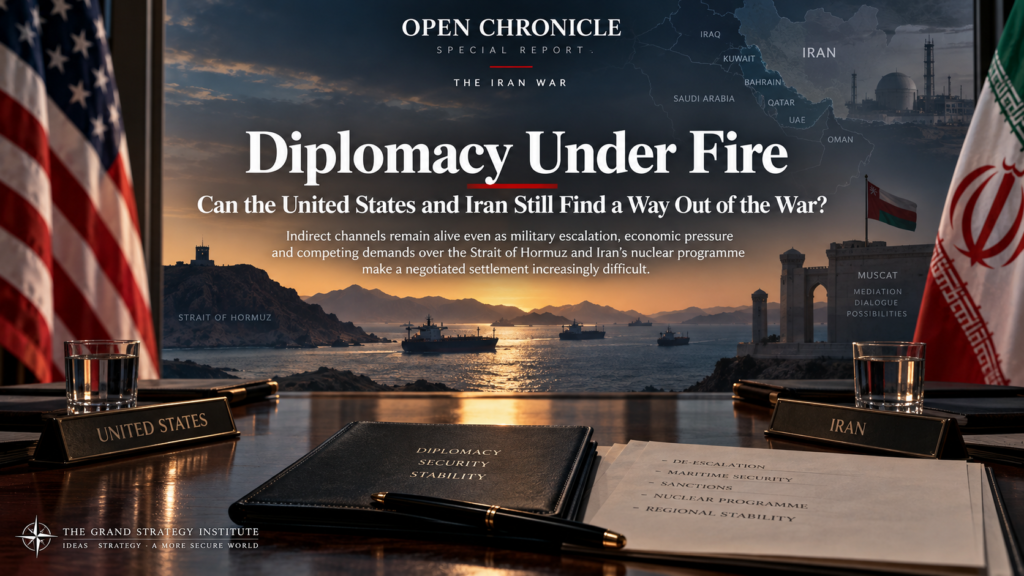
Indirect channels remain alive even as military escalation, economic pressure and competing demands over the Strait of Hormuz and Iran’s nuclear programme make a negotiated settlement increasingly difficult
By The Grand Strategy Institute Research Division
Grand Strategy Analysis | 5 September 2026
Wars do not necessarily become easier to negotiate as their costs increase.
Sometimes the opposite happens.
As casualties accumulate, infrastructure is destroyed, economic pressure intensifies and governments invest political credibility in their stated objectives, compromise becomes progressively more difficult. Concessions that might have been possible before the fighting began can later be interpreted as evidence that the sacrifices of war achieved nothing.
The United States and Iran are approaching precisely this problem.
After months of confrontation, the diplomatic architecture surrounding the Iran war has not disappeared. Mediators continue to search for formulas capable of restoring negotiations, and Oman remains particularly important to efforts concerning the Strait of Hormuz. But the current situation should not be confused with a functioning peace process. On 3 September, U.S. Vice President JD Vance said Washington was not negotiating with Tehran while Iranian attacks on shipping continued.
Behind that public impasse, however, diplomatic activity has not vanished.
The Financial Times reports that mediators continue to maintain back channels and that there has been movement in Iran-Oman discussions. The problem is that Washington and Tehran increasingly disagree not merely over the terms of an agreement, but over what the agreement itself should encompass.
That distinction is critical.
The diplomatic challenge is no longer simply to stop the shooting.
It is to determine whether two adversaries with fundamentally different conceptions of the post-war settlement can construct an agreement before battlefield developments make compromise politically impossible.
Diplomacy Has Not Ended. It Has Fragmented
The Iran war has produced an unusual diplomatic environment.
Formal negotiations can stop while diplomacy continues.
Messages can move through intermediaries. Governments can test proposals without publicly endorsing them. Mediators can determine which concessions are politically possible before putting them into formal documents. Temporary arrangements can emerge around shipping, energy infrastructure, prisoner issues or military deconfliction even when a comprehensive peace settlement remains distant.
This is particularly important in relationships where direct political contact carries domestic costs.
Washington and Tehran have decades of experience communicating indirectly.
Oman has repeatedly played an important role in this architecture. Qatar and, at different stages of the conflict, Pakistan have also participated in mediation efforts.
These states do more than transmit messages.
They provide political distance.
An Iranian government can explore an American proposal through Muscat without publicly appearing to capitulate to Washington. An American administration can test Tehran’s willingness to compromise without granting Iran the diplomatic symbolism of an immediate high-level bilateral negotiation.
Indirect diplomacy therefore performs a strategic function.
It creates ambiguity where ambiguity is useful.
But it also has limitations.
Messages transmitted through intermediaries can be misunderstood. Governments can use unofficial channels to delay rather than compromise. Mediators cannot impose agreements on parties that fundamentally disagree about the desired end state.
The current diplomatic impasse increasingly reflects that deeper problem.
The June Understanding Matters
One of the most important elements in the current negotiations is the legacy of the interim understanding reached earlier in the conflict.
Iranian President Masoud Pezeshkian said on 1 September that Tehran would reciprocate immediately if Washington returned to commitments contained in the interim agreement signed in June. His statement followed renewed direct exchanges of fire between American and Iranian forces.
That tells us something important about Tehran’s negotiating position.
Iran does not appear to view diplomacy as beginning from a blank sheet of paper.
It wants previous commitments to retain political meaning.
Washington increasingly appears to want something broader.
According to reporting on the diplomatic effort, the earlier memorandum was focused heavily on restoring navigation through Hormuz and creating conditions for renewed talks. The Trump administration has subsequently sought a wider arrangement encompassing both the strait and Iran’s nuclear programme.
The difference is substantial.
For Tehran, the question can be framed as implementation.
For Washington, it can be framed as renegotiation.
That creates a classic diplomatic problem:
The two sides may be negotiating not only over the terms of peace, but over the baseline from which negotiations should begin.
Hormuz Is Both Battlefield and Bargaining Chip
The Strait of Hormuz sits at the centre of this diplomatic contest.
For Washington, restoring predictable commercial navigation is an immediate strategic objective. The disruption has affected international energy markets, required substantial American military resources and increased political pressure at home.
For Iran, however, maritime pressure provides one of its most important remaining sources of leverage.
This produces an obvious bargaining asymmetry.
Washington wants Iran to reduce its leverage before negotiations progress.
Iran wants concessions in return for surrendering that leverage.
If Tehran completely restores freedom of navigation before obtaining meaningful sanctions relief or other guarantees, it gives away one of the strongest instruments available to it.
If Washington grants substantial economic relief before Iran changes its behaviour in Hormuz, it risks appearing to reward military coercion.
Both positions possess internal strategic logic.
Together they create deadlock.
The central diplomatic challenge is therefore sequencing.
Who moves first?
Does Iran restore maritime access before sanctions are eased?
Does Washington relax economic pressure before Iran changes its behaviour?
Do both sides act simultaneously?
Or can mediators construct a phased mechanism in which each concession automatically triggers a reciprocal action?
These technical questions often determine whether negotiations succeed.
Peace agreements are rarely sustained by trust alone.
They are sustained by structures that reduce the amount of trust required.
The Nuclear Question Has Returned
Hormuz is not the only obstacle.
Iran’s nuclear programme remains a fundamental component of American strategy.
This week, Washington, Britain, France and Germany began pushing for an International Atomic Energy Agency resolution that would refer Iran to the United Nations Security Council over unresolved safeguards issues. Iran has restricted IAEA access to facilities damaged during the war and information concerning its enriched uranium stockpile remains incomplete.
This creates another negotiation problem.
A maritime agreement can potentially be constructed around observable behaviour.
Ships either move through Hormuz or they do not.
Attacks either stop or they continue.
The nuclear question is much more complicated.
It involves enrichment levels, uranium inventories, centrifuge capabilities, inspection regimes, damaged facilities, verification, sanctions relief and ultimately the question of how much latent nuclear capability Iran will be permitted to retain.
The war may have damaged Iranian nuclear infrastructure.
It has not eliminated the political problem surrounding Iran’s nuclear programme.
Indeed, military destruction can make verification more difficult if inspectors lose access to facilities or governments cannot establish the location and condition of nuclear material.
The diplomatic challenge therefore extends far beyond a ceasefire.
Washington wants a post-war arrangement that prevents the nuclear issue from simply re-emerging after military operations end.
Tehran wants to avoid an agreement that transforms military defeat into permanent strategic subordination.
Those objectives remain difficult to reconcile.
The American Strategy: Coercion Before Negotiation
Washington’s current strategy increasingly resembles coercive diplomacy.
Military force, economic sanctions and maritime pressure are being used simultaneously to alter Tehran’s calculations.
The United States has intensified sanctions and pressure on Iranian oil exports. Reuters reports that the economic consequences inside Iran are becoming increasingly severe, with trade disrupted, inflation extremely high, the currency under intense pressure and Tehran’s ability to circumvent sanctions becoming more costly.
The strategic logic is straightforward.
Pressure reduces Iran’s alternatives.
Reduced alternatives increase the attractiveness of negotiation.
Negotiation under worsening conditions should theoretically produce greater Iranian concessions.
This logic has a long history in international relations.
It also contains a major risk.
Pressure does not automatically produce compliance.
At some point, a government can conclude that further concessions threaten regime survival, national sovereignty or political legitimacy more than continued resistance does.
When that threshold is reached, additional coercion may produce escalation rather than compromise.
The question for Washington is therefore not simply whether pressure is hurting Iran.
It clearly is.
The relevant strategic question is:
Is pressure changing Tehran’s willingness to accept American terms, or merely increasing Iran’s willingness to impose costs in return?
Those are very different outcomes.
Tehran’s Problem: Negotiating Without Appearing to Capitulate
Iran faces an equally difficult political calculation.
Its economy is under severe pressure.
Its military infrastructure has sustained substantial damage.
Its ability to export oil has been constrained.
Its regional position has weakened.
Continued confrontation imposes enormous costs.
These conditions should theoretically favour negotiation.
But Iran’s leadership must also consider the political meaning of an agreement.
If Tehran accepts American conditions immediately after sustained military pressure, the settlement could be portrayed domestically and internationally as capitulation.
That creates incentives to demonstrate resistance before compromise.
This is one reason wars can paradoxically intensify shortly before serious negotiations.
A government may seek to improve its bargaining position, demonstrate that it retains military options or establish that further escalation will remain costly before accepting an agreement.
Military escalation and diplomacy are therefore not always opposites.
Sometimes they occur simultaneously.
The battlefield becomes part of the negotiation.
The Mediators Matter More Than Ever
This environment gives regional mediators unusual strategic importance.
Oman is particularly well positioned.
Its foreign policy has long emphasised what Muscat describes as constructive neutrality, maintaining relationships with actors that are frequently unable or unwilling to communicate directly.
Oman’s foreign minister has recently reiterated the importance of diplomacy and international law while highlighting his country’s determination to seek a peaceful solution concerning navigation through Hormuz.
This role should not be underestimated.
Small and medium powers can sometimes perform diplomatic functions that great powers cannot.
They can provide neutral territory.
They can transmit confidential proposals.
They can clarify whether statements represent genuine red lines or negotiating positions.
They can design sequencing mechanisms.
Most importantly, they can allow adversaries to explore compromise without immediately paying the political price of publicly negotiating with one another.
Qatar has performed similar functions during earlier stages of the conflict.
Pakistan has also attempted mediation.
A durable diplomatic process may ultimately require several such channels.
The Regional States Want an Exit
There is another reason diplomacy remains viable.
Many of the states surrounding Iran have powerful incentives to end the war.
A prolonged confrontation threatens Gulf energy infrastructure, maritime commerce, aviation, investment and economic diversification.
It also places governments hosting American military facilities in an increasingly uncomfortable position.
The longer the conflict continues, the greater the possibility that their territory becomes directly connected to military operations.
This means Gulf states do not simply have humanitarian reasons to support diplomacy.
They have strategic and economic ones.
A negotiated settlement would reduce threats to their infrastructure, restore greater predictability to energy markets and diminish the danger that U.S.-Iranian confrontation becomes permanently embedded in Gulf security politics.
Regional governments can therefore become an important source of diplomatic pressure on both sides.
The Problem of Trust
Even if Washington and Tehran eventually agree on the broad outline of a settlement, implementation will be extraordinarily difficult.
The fundamental problem is credibility.
Iran will ask whether sanctions relief can survive future changes in American policy.
Washington will ask whether Iranian nuclear commitments can be verified.
Iran will want guarantees against renewed military attack.
The United States will want guarantees concerning Hormuz, regional military activity and potentially Iran’s missile capabilities.
Both governments can point to decades of failed agreements, abandoned understandings and mutual accusations as reasons not to trust the other.
A successful agreement therefore cannot depend primarily on political goodwill.
It will require verification.
It will require sequencing.
It will require third-party mediation.
It may require international monitoring.
And it will require mechanisms for resolving violations before those violations automatically produce renewed warfare.
The more ambitious the agreement becomes, the harder this architecture will be to construct.
The Danger of Negotiating Everything
Washington’s desire for a comprehensive settlement is understandable.
A ceasefire that leaves the nuclear issue unresolved could merely postpone another confrontation.
A Hormuz agreement that ignores missiles or regional security could leave other sources of escalation intact.
An economic agreement without verification could prove politically unsustainable.
But comprehensiveness has a price.
Every additional issue creates another potential veto point.
Hormuz.
Sanctions.
Nuclear enrichment.
IAEA inspections.
Ballistic missiles.
Regional armed groups.
American military presence.
Oil exports.
Security guarantees.
Prisoners.
Each issue has its own domestic constituencies and strategic sensitivities.
Trying to solve all of them simultaneously could make agreement impossible.
Diplomacy may therefore confront a choice between a comprehensive settlement that is extremely difficult to negotiate and a limited settlement that stops the war without resolving its underlying causes.
History suggests that imperfect agreements sometimes create the political space necessary for more ambitious diplomacy later.
But they can also become merely pauses between wars.
A Ceasefire Is Not a Peace Settlement
This distinction is fundamental.
Stopping military operations would be an enormous achievement.
It would not resolve the U.S.-Iranian strategic competition.
Washington and Tehran would still disagree over the regional balance of power.
Iran’s nuclear programme would remain contested.
American forces would remain across the Middle East.
Sanctions would remain politically contentious.
The future of Hormuz would remain strategically important.
Iran’s relationships with armed groups elsewhere in the region would continue to concern Washington and its allies.
The objective of diplomacy should therefore be understood in stages.
The first task is to stop uncontrolled escalation.
The second is to stabilise the military relationship.
The third is to construct mechanisms capable of managing the disputes that survive the war.
The fourth, and most ambitious, would be to create a regional security architecture in which recurring U.S.-Iranian military confrontation becomes less likely.
That final objective could take years.
What a Possible Diplomatic Sequence Might Look Like
A viable pathway would probably require reciprocal steps rather than a single grand bargain.
A theoretical sequence could begin with a verified reduction in attacks on commercial shipping and American forces.
Washington could respond with limited, reversible economic measures.
A maritime monitoring mechanism could then be established around Hormuz with Omani or broader international participation.
Military strikes could be formally suspended.
IAEA access could gradually resume under a separately negotiated verification framework.
Further sanctions relief could be linked to nuclear compliance.
Only after these immediate issues were stabilised would negotiations expand toward broader questions of regional security.
Such a sequence would not satisfy maximalists on either side.
That may be precisely why it could work.
Diplomacy succeeds when governments discover that an imperfect agreement is preferable to the available alternatives.
The Spoiler Problem
Even if Washington and Tehran move toward compromise, they will not control every actor capable of affecting the process.
Regional warfare creates spoilers.
An attack by an Iranian-aligned group could trigger American retaliation.
An Israeli operation could alter Tehran’s calculations.
A maritime incident could be interpreted as deliberate escalation.
Domestic political factions could oppose concessions.
Military commanders could perceive threats differently from diplomats.
Misinformation could turn an accident into a crisis.
This means a diplomatic process needs mechanisms for crisis communication before a settlement is reached.
Without them, a single event can destroy weeks of indirect negotiation.
The more geographically dispersed the war becomes, the greater this danger.
Time Is Becoming a Strategic Variable
Both sides may believe time works in their favour.
Washington can argue that economic pressure is increasingly constraining Iran. Recent reporting indicates sanctions and the blockade are having significant effects on Iranian trade, currency stability and domestic economic conditions.
Tehran may calculate that the United States faces its own pressures.
The war contributes to higher energy costs.
A prolonged military deployment consumes resources.
American domestic politics matter.
Other global strategic commitments remain.
Iran may therefore believe Washington’s willingness to sustain pressure is not unlimited.
This creates another bargaining problem.
If both sides believe the opponent will become weaker tomorrow, neither has sufficient incentive to compromise today.
Wars often continue not because negotiation is impossible, but because both belligerents remain optimistic that waiting will improve their bargaining position.
Changing those expectations is one of diplomacy’s hardest tasks.
GSI Strategic Assessment
The Grand Strategy Institute assesses that diplomacy remains possible, but the current environment should not be described as a conventional peace process.
Formal U.S.-Iranian negotiations are presently stalled. What survives is a diplomatic ecosystem composed of indirect communications, regional mediation, earlier agreements, exploratory proposals and continuing efforts to identify conditions under which formal negotiations could resume.
This distinction is important.
The survival of diplomatic channels means escalation has not eliminated political alternatives.
But channels are not agreements.
Three obstacles are particularly significant.
First, Washington and Tehran disagree over sequencing.
The United States wants changes in Iranian behaviour, particularly around maritime security, before meaningful negotiations advance. Iran wants Washington to honour previous commitments and provide reciprocal concessions.
Second, the scope of the proposed settlement is expanding.
What might have been negotiated as a limited arrangement concerning Hormuz and de-escalation is increasingly connected to Iran’s nuclear programme and wider strategic questions.
Third, battlefield developments continuously alter the bargaining environment.
Every new strike creates incentives for retaliation, modifies perceptions of strength and makes compromise politically more difficult.
Yet the same escalation also increases the costs of diplomatic failure.
That is the paradox now defining the Iran war.
The military situation is making negotiations harder at precisely the moment when negotiations are becoming more necessary.
Key Judgements
- There is currently no functioning formal U.S.-Iranian peace negotiation. Washington has publicly stated that talks are not underway while Iranian attacks on shipping continue.
- Indirect diplomacy nevertheless remains alive. Regional mediators and back channels continue to explore pathways toward renewed negotiations.
- Oman is likely to remain central to any diplomatic breakthrough, particularly concerning the Strait of Hormuz and the transmission of proposals between Washington and Tehran.
- The June interim understanding remains politically significant. Tehran has publicly indicated willingness to reciprocate if Washington returns to its commitments.
- Washington appears to seek a broader settlement than the earlier maritime understanding, connecting Hormuz with the nuclear issue. This increases the strategic value of an agreement but also makes one harder to negotiate.
- Economic pressure is strengthening Washington’s bargaining position but does not guarantee Iranian capitulation. Severe pressure can produce either compromise or escalation.
- Iran cannot easily surrender its leverage over Hormuz without reciprocal concessions. Doing so before receiving economic or security benefits would weaken Tehran’s negotiating position.
- The nuclear issue is becoming increasingly difficult to separate from the war. Renewed international pressure over IAEA safeguards and verification will complicate any comprehensive settlement.
- A phased agreement is more plausible than an immediate grand bargain. De-escalation, maritime arrangements, limited sanctions relief and nuclear verification could potentially proceed through reciprocal stages.
- The greatest immediate diplomatic danger is a spoiler event. A regional strike, maritime incident or action by another actor could collapse negotiations before formal talks resume.
- Regional states possess increasingly powerful incentives to promote a settlement because prolonged confrontation threatens their economic development and security.
- The central diplomatic problem is no longer merely communication. It is incompatible expectations about the post-war order.
Conclusion
The Iran war has reached one of diplomacy’s most difficult moments.
The costs of continued confrontation are increasingly visible.
Iran faces intense economic and military pressure.
The United States faces the burden of sustaining a widening regional military commitment while protecting shipping, allies and its broader global strategic position.
Gulf states face growing risks to infrastructure, investment and regional stability.
Energy markets transmit the consequences far beyond the battlefield.
There are therefore strong reasons to negotiate.
But incentives for negotiation are not the same thing as conditions for agreement.
Washington wants Iranian behaviour to change before relieving pressure.
Tehran wants reciprocal concessions before surrendering the leverage that still gives it bargaining power.
The United States increasingly seeks a settlement that addresses not merely Hormuz but the nuclear question.
Iran seeks to avoid converting military pressure into political capitulation.
Between them stand mediators attempting to construct a sequence in which neither side has to trust the other enough to move first.
That may ultimately determine whether diplomacy succeeds.
The most realistic path out of the war may not begin with a comprehensive peace treaty. It may begin with something considerably less dramatic: ships moving safely, missiles remaining in their launchers, inspectors returning to facilities, limited sanctions measures being reversed and intermediaries quietly ensuring that each side fulfils its next obligation.
Such arrangements would not resolve the rivalry between the United States and Iran.
They could, however, transform an uncontrolled military confrontation into a managed strategic competition.
For the moment, even that would constitute a major achievement.
The decisive question is no longer whether diplomacy exists. It is whether diplomacy can move faster than escalation.
The Grand Strategy Institute
Continue Exploring Strategic Analysis
Return to The Grand Strategy Institute for strategic assessments, long-form analysis and research examining geopolitics, military affairs, international security, emerging technologies and the changing international order.
← Back to The Grand Strategy Institute