
By Open Chronicle News Desk
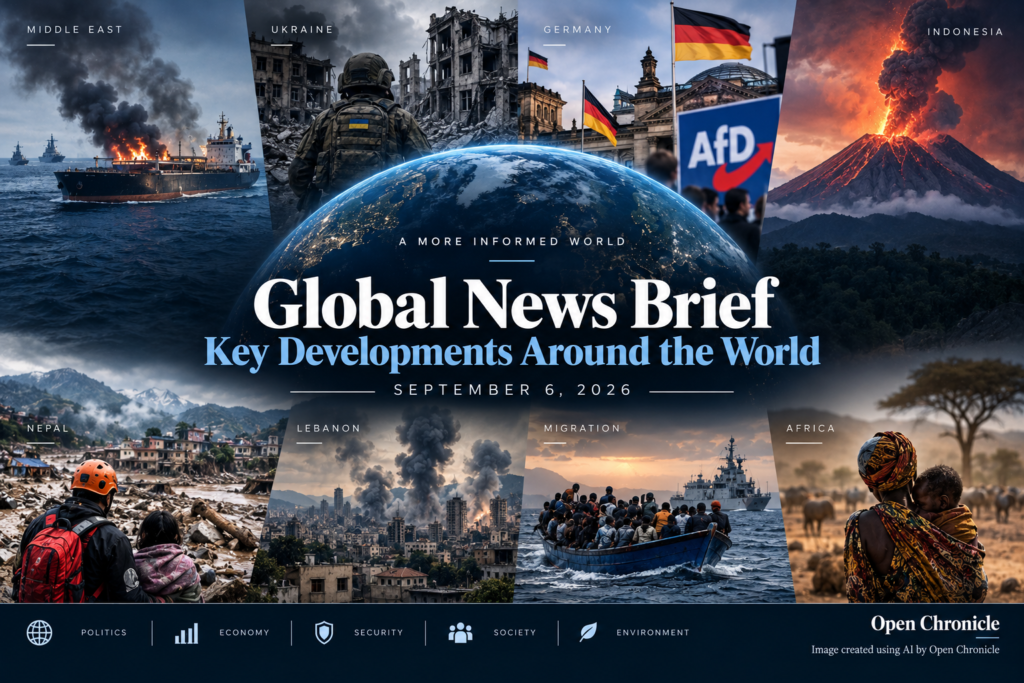
The global news agenda on September 6 is being dominated by renewed military confrontation between the United States and Iran, another diplomatic attempt to break the deadlock over Ukraine, a potentially historic election in Germany, escalating violence in Lebanon and the Palestinian territories, and major natural disasters across Asia.
From the Strait of Hormuz to Kyiv, Saxony Anhalt and the slopes of Anak Krakatau, these are the major developments shaping the international agenda. The picture is drawn from the latest reports available to Open Chronicle, including developments continuing to emerge during the morning of September 6.
Middle East
U.S. and Iran exchange fire as confrontation intensifies at sea
The confrontation between Washington and Tehran has entered another dangerous phase, with American and Iranian forces exchanging attacks against vessels in and around the Strait of Hormuz.
Iran said its forces targeted an unmanned U.S. naval vessel attempting to enter the strait, while other reports described Iranian attacks against U.S. linked shipping. American forces, meanwhile, were reported to have struck Iranian oil tankers after attacks on U.S. warships.
The latest exchanges underline the growing importance of the Strait of Hormuz as one of the central arenas of the conflict. The waterway is critical to global energy supplies, meaning that further escalation could have consequences extending well beyond the region.
Iran’s Islamic Revolutionary Guard Corps has warned that Washington’s blockade strategy could ultimately impose greater costs on the United States than on Tehran. Iranian officials have also promised a faster and heavier response to further American attacks.
Tehran is simultaneously attempting to contain the economic consequences of war and sanctions, establishing what Iranian officials have described as an “economic war headquarters” to coordinate the response to mounting disruption.
Diplomatic efforts continue despite Iran confrontation
Even as military operations intensify, attempts to reopen diplomatic channels remain active.
Egypt and Pakistan are reportedly seeking renewed U.S. Iranian negotiations aimed at limiting further escalation, while Turkish and Iranian foreign ministers have discussed the continuing diplomatic track.
The parallel movement of military escalation and diplomacy illustrates the increasingly unstable nature of the conflict. Both sides continue to signal that they are prepared for further confrontation while leaving open the possibility of negotiations.
Israeli strikes deepen tensions in Lebanon
Israeli attacks on southern Lebanon reportedly killed four people following what Israel described as a Hezbollah drone launch.
Additional Israeli strikes were subsequently reported, raising further questions about the durability of the U.S. brokered arrangements intended to contain hostilities along the Israeli Lebanese frontier.
Hezbollah has blamed the Lebanese state for failing to prevent the escalation, while reports suggest Israel is considering establishing a security zone extending several kilometres inside Lebanese territory.
The developments risk reopening another major front at a time when the wider Middle East is already under severe military pressure.
Gaza and West Bank violence continues
Israeli operations were also reported across Gaza and the occupied West Bank.
Palestinians reported injuries during Israeli raids and strikes, including children among the wounded. Israeli forces also raided schools in the West Bank as the academic year began.
Meanwhile, families in Gaza held funerals for around 100 Palestinians whose remains had reportedly been recovered from the rubble of destroyed buildings.
The continuing violence comes alongside growing international pressure over Israeli policy, with Britain preparing measures against Israeli settlers and several countries condemning proposals concerning the displacement of Palestinians.
Yemen fighting displaces thousands
Fighting involving Houthi forces has intensified in Yemen, particularly around strategically important areas in the west of the country.
Yemeni forces claimed control of a strategic district amid the clashes, while the United Nations reported that around 1,800 families had been displaced within two days.
The renewed fighting adds another layer of instability to a Middle East already confronting multiple overlapping conflicts.
Europe
U.S. envoys move from Moscow to Kyiv in renewed Ukraine peace effort
Washington has launched another diplomatic push aimed at finding a possible route toward ending the war in Ukraine.
U.S. envoys Steve Witkoff and Jared Kushner held approximately three hours of discussions with Russian President Vladimir Putin in Moscow before travelling to Kyiv for talks with Ukrainian President Volodymyr Zelenskyy.
The discussions with Putin were described as substantive, although there was no immediate indication that Moscow had made major concessions.
Zelenskyy convened Ukrainian negotiators ahead of the American delegation’s arrival and said Kyiv had prepared proposals for the discussions. Ukraine has also indicated that it could consider halting attacks against cities as part of a reciprocal arrangement.
Despite the renewed diplomacy, expectations remain cautious. Ukrainian military intelligence chief Kyrylo Budanov was reported as saying negotiations could resume this month but that agreement on ceasefire terms might not emerge before spring 2027.
War continues while diplomacy accelerates
The diplomatic activity has not stopped military operations.
Ukrainian drones were reported to have struck Russian energy and military targets, including facilities around Sochi, Ryazan and Rostov. Another report claimed that a Russian vessel carrying Iranian weapons was hit by multiple drone strikes.
Russia, meanwhile, continues operations against Ukrainian territory, including frequent attacks around Zaporizhzhia.
The simultaneous diplomacy and battlefield escalation suggest both sides are seeking to strengthen their positions before any serious negotiating process develops.
Germany votes as AfD seeks historic breakthrough
Germany’s Saxony Anhalt election has become one of Europe’s most closely watched political contests.
The Alternative for Germany entered election day leading opinion polls and seeking what could become the first state government led by the far right in postwar Germany.
The vote is significant far beyond Saxony Anhalt. A decisive AfD victory could challenge the political firewall maintained by Germany’s mainstream parties and intensify pressure on Chancellor Friedrich Merz and his Christian Democratic Union.
The election is therefore being watched as a potential indicator of whether the AfD can transform growing electoral support into executive power.
Germany strengthens response to hybrid threats
Separately, Germany is reportedly developing new measures to protect critical infrastructure against sabotage following the drone incident at Leipzig/Halle Airport.
The issue has become part of a wider European debate about Russian hybrid operations. Poland has called for a substantial reduction in the number of Russian diplomats operating across EU countries, while a U.S. representative to NATO warned that the alliance would not tolerate hybrid attacks against its members.
European commercial spaceflight reaches a milestone
Germany also produced one of the day’s major technological developments as a commercial rocket successfully reached orbit.
The achievement has been described as a milestone for Europe’s private space industry and could strengthen efforts to reduce European dependence on foreign launch providers.
Asia Pacific
Anak Krakatau eruption causes widespread aviation disruption
Indonesia is dealing with a major eruption of Anak Krakatau, with volcanic ash rising high into the atmosphere and disrupting aviation.
Authorities suspended operations at several airports, while hundreds of flights were reportedly cancelled or affected. Schools and fishing activities in some areas were also disrupted.
The eruption has renewed concerns surrounding one of Indonesia’s most closely monitored volcanic systems.
Anak Krakatau emerged from the remnants of Krakatoa, whose catastrophic 1883 eruption and resulting tsunami killed tens of thousands of people.
Nepal and China confront devastating flood disaster
The scale of the flood catastrophe affecting Nepal and neighbouring parts of China continues to grow.
Reports put the combined death toll at more than 1,300, while thousands of people remained missing. Search teams continue to work through devastated communities and difficult terrain.
In Nepal, the disaster has created severe humanitarian problems, particularly for children, pregnant women and families living in temporary shelters. DNA testing has begun as authorities attempt to identify victims.
Across the border, Chinese authorities raised the death toll from a major landslide in Tibet while hundreds remained missing.
China has also provided satellite monitoring assistance to Nepal as rescue teams attempt to understand the extent of the disaster.
Japan maintains male only imperial succession
Prince Hisahito turned 20 amid renewed attention to the future of Japan’s imperial family.
His milestone comes as the Japanese government continues to support the country’s male only succession rules, despite long running concerns about the shrinking number of eligible heirs.
South Korea strengthens European diplomacy
South Korea’s president has begun a four day visit to France, reflecting Seoul’s continuing effort to deepen political, economic and security cooperation with European partners.
Africa
Cape Verde bus disaster kills at least 21
At least 21 people were reported dead after a bus plunged from a cliff on Fogo island in Cape Verde.
The accident is among the most serious transport disasters recently reported in the Atlantic island nation.
Sudan faces new humanitarian pressures
Sudan’s humanitarian emergency continues to deepen.
A cholera outbreak in West Kordofan has reportedly killed 23 people and infected hundreds more, adding another public health crisis to the consequences of the country’s continuing conflict and displacement.
Nigeria battles diphtheria outbreak
Authorities in Nigeria’s Plateau State have ordered schools closed as a worsening diphtheria outbreak raises public health concerns.
Africa’s climate finance gap remains severe
A separate assessment highlighted the continent’s continuing struggle to secure adequate climate financing, with Africa reportedly receiving only a fraction of the funding required to adapt to climate change.
The issue remains particularly significant because many African countries face disproportionately high borrowing costs when financing climate adaptation projects.
Americas
U.S. politics turns toward the midterms
Domestic American politics is increasingly focusing on the approaching midterm elections.
New polling suggests independent voters may be shifting toward the Democratic Party, potentially complicating the political environment for President Donald Trump and Republicans.
The political consequences of the Iran conflict, trade disputes and economic policy are likely to become increasingly important as campaigning intensifies.
Canada U.S. trade tensions remain politically charged
Trade relations between Canada and the United States remain under pressure, with U.S. Commerce Secretary Howard Lutnick emerging as an influential figure in Washington’s increasingly confrontational trade strategy.
The dispute forms part of a wider transformation of U.S. economic relations with traditional allies under the Trump administration.
Guyana receives deportees from the United States
Guyana has received the first group of deportees under an agreement with the Trump administration, highlighting Washington’s broader effort to secure cooperation from foreign governments on migration enforcement.
Global Outlook
Three developments stand above the rest of the international agenda on September 6.
The first is the rapidly evolving U.S. Iran confrontation. Fighting around the Strait of Hormuz has moved beyond political threats into repeated attacks against vessels, placing one of the world’s most strategically important maritime corridors under increasing pressure.
The second is Ukraine. The arrival of Witkoff and Kushner in Kyiv after direct talks with Putin represents one of Washington’s most visible attempts in recent months to revive negotiations, although continuing Russian and Ukrainian military operations demonstrate how far the conflict remains from resolution.
The third is political rather than military. The Saxony Anhalt election could become a watershed for Germany if the AfD converts its polling strength into control of a state government.
Away from geopolitics, the enormous human cost of the Nepal China floods and the disruption caused by Anak Krakatau demonstrate that natural disasters are simultaneously producing major humanitarian challenges across Asia.
September 6 therefore opens with several international crises moving at once, military escalation in the Middle East, tentative diplomacy over Ukraine, political upheaval in Europe and large scale natural disasters in Asia.