
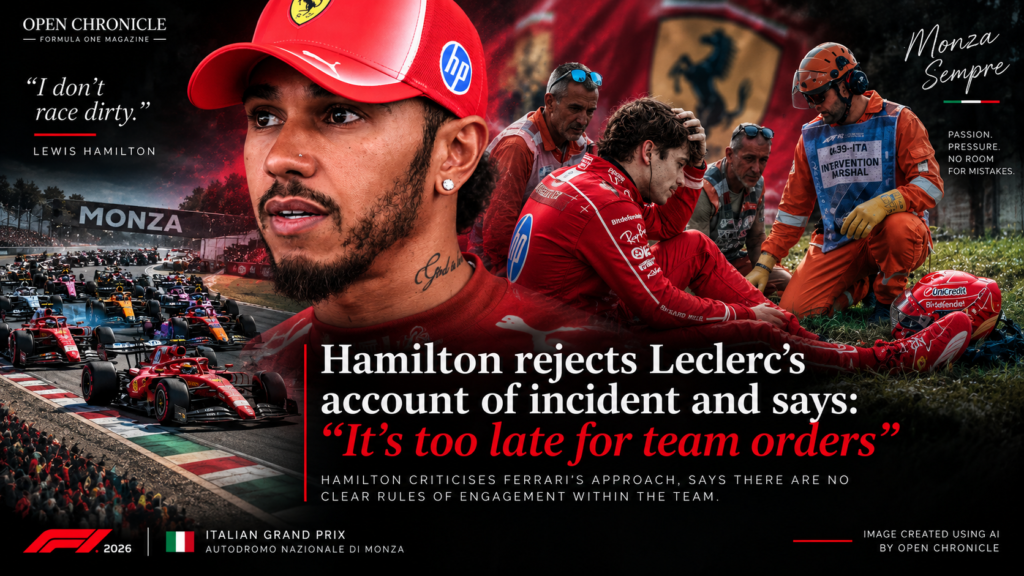
Lewis Hamilton has rejected Charles Leclerc’s suggestion that both Ferrari drivers shared responsibility for their opening lap confrontation at Monza. After recovering to sixth while Leclerc crashed out moments later, Hamilton also delivered a wider warning to the Scuderia, arguing that the absence of clearly defined rules of engagement and delayed strategic decisions are costing Ferrari at a critical stage of the 2026 season.
By Open Chronicle Formula One Magazine
Ferrari arrived at Monza expecting to fight at the front in front of the tifosi.
Instead, its Italian Grand Prix has left the team facing uncomfortable questions about how its two drivers are being managed.
Lewis Hamilton has openly disagreed with Charles Leclerc’s interpretation of their opening lap confrontation and questioned Ferrari’s internal procedures, saying it is now too late for the team to begin considering championship based priority between its drivers.
The comments come after a disastrous opening sequence for Ferrari at its home Grand Prix.
Hamilton and Leclerc started together on the second row, but their battle during the opening lap resulted in Hamilton running through the gravel and falling to tenth.
Leclerc’s race ended shortly afterwards in a violent accident at the Parabolica.
Hamilton recovered to finish sixth.
What happened between the two Ferrari drivers before that accident has now become another issue for the team to resolve.
Leclerc: “We Went Too Far”
Leclerc’s initial assessment presented the first lap incident as the consequence of two teammates pushing their battle beyond a sensible limit.
His conclusion was that both drivers had contributed.
“We went too far,” Leclerc said.
Hamilton sees it differently.
When presented with his teammate’s description, the seven time World Champion disputed the use of “we”.
“I was ahead at Turn 2. At the apex, I was ahead. So there was no ‘we’.”
It was a concise response, but an important one.
Hamilton does not believe responsibility should be shared equally.
“I Don’t Race Dirty”
Asked further about the confrontation, Hamilton defended his own approach to racing.
“Look, I don’t race dirty. I’ve always raced clean and fair and I’ve always left space. So I don’t think they need to be worried about me.”
Hamilton’s argument extends beyond the specific positioning of the cars at Monza.
He believes his behaviour since joining Ferrari has demonstrated an effort to protect the interests of the team.
“I came into the team and tried to respect other people’s space, and definitely not put the team at risk. I maintain that position and that’s all I can say from my side.”
He then directed questions about Ferrari’s handling of the other side of the situation towards team principal Fred Vasseur.
“You’ll have to speak to Fred about the other side.”
For Ferrari, that makes the issue more significant than an ordinary disagreement between teammates.
Hamilton is effectively asking the team to define how it expects its drivers to race each other.
Ferrari Lost a Major Opportunity at Monza
The timing could hardly be worse.
Ferrari had entered its home Grand Prix with a genuine opportunity to produce a major result.
Pierre Gasly started from pole and George Russell was second, but Leclerc and Hamilton occupied the entire second row.
Championship leader Kimi Antonelli, meanwhile, started only 19th following a power unit related penalty.
For Ferrari, the possibilities were obvious.
Both cars were positioned to challenge for a podium and potentially victory.
For Hamilton, Monza also represented a chance to recover significant ground in the Drivers’ Championship.
Instead, the Ferrari drivers compromised each other almost immediately.
Hamilton fell to tenth.
Leclerc was out of the race shortly afterwards.
And Antonelli, despite starting 19th, ultimately won.
The championship opportunity had not merely disappeared.
It had reversed.
“It’s Too Late”
That context explains why Hamilton’s comments about team orders are particularly important.
Asked whether Ferrari should have prioritised him over Leclerc because of his stronger championship position, and whether such an arrangement might have prevented the opening lap confrontation, Hamilton suggested that the moment for establishing that policy had already passed.
“It’s too late for that, for those decisions to be made. Many, many weeks have already gone by.”
Hamilton’s conclusion was pragmatic.
“All I can do is keep showing up and try to do my job.”
The implication is difficult to ignore.
Hamilton does not appear to be explicitly demanding that Leclerc be ordered to support his championship campaign now.
Instead, he is questioning why Ferrari did not establish its position earlier.
That distinction matters.
A championship strategy created after points have already been lost cannot recover those points.
The Championship Makes the Issue More Urgent
Monza has made Ferrari’s situation considerably more difficult.
Antonelli now leads the championship with 267 points.
George Russell is second on 201.
Hamilton sits third with 191, leaving him 76 points behind Antonelli.
Leclerc remains on 155 after failing to score at Monza.
There are ten Grands Prix remaining.
Hamilton is therefore still a championship contender, but his position increasingly requires Ferrari to maximise every available opportunity.
That is why operational mistakes and internal battles become more costly.
A sixth place when Antonelli wins means another substantial points loss.
A retirement for the other Ferrari means no opportunity to take points away from the championship leader.
Ferrari can no longer afford weekends in which its own cars become part of the problem.
Hamilton Points Towards Vasseur
Hamilton’s criticism extended beyond the first lap incident.
Speaking about points Ferrari has lost through operational problems, he placed responsibility for organisational direction at the highest level of the Formula One team.
“Ultimately, that comes from the top. The decisions filter down through the levels, so it starts with Fred.”
That is a significant statement from Ferrari’s highest profile driver.
Hamilton was not simply discussing a mistimed pit stop or isolated strategic mistake.
He was questioning processes.
And he believes those processes need to change.
“We have to change things because this isn’t helping us move forward.”
Hamilton nevertheless indicated that Ferrari is receptive to reviewing its procedures.
He expects those discussions to take place internally over the coming weeks, particularly after the next race.
The objective, he explained, is to determine how Ferrari can change its procedures so that the same situations do not continue recurring.
The Mercedes Comparison
Perhaps the most revealing part of Hamilton’s criticism came when he compared Ferrari’s current approach with the system he experienced at Mercedes.
His central point was not that Mercedes teammates never fought.
They did.
Hamilton’s rivalry with Nico Rosberg became one of the most intense teammate battles of the modern Formula One era.
But Mercedes had a framework.
“I think it all comes down to the rules of engagement. When I was at Mercedes, we had rules of engagement written down.”
For Hamilton, that clarity matters.
Drivers know what is permitted.
They know what is expected.
And they understand where the limits lie before they arrive side by side at the first braking zone.
“We never had major problems. There was maybe one or two moments with me and Nico, but for the most part it worked well, especially with Valtteri.”
Hamilton was referring to Valtteri Bottas, with whom he shared Mercedes from 2017 through 2021.
The comparison creates an uncomfortable question for Ferrari.
If the Scuderia does not have equivalent rules clearly established between Hamilton and Leclerc, why not?
Rules of Engagement Are Not the Same as Team Orders
There is an important distinction between the two issues Hamilton raised.
Team orders determine whether one driver should be strategically prioritised over another.
Rules of engagement determine how teammates are permitted to race each other.
Ferrari may decide that Hamilton and Leclerc remain free to compete on equal terms.
That does not prevent the team from establishing boundaries governing how that competition should happen.
Hamilton’s Mercedes comparison suggests that this second element is what he believes Ferrari is missing.
The issue is therefore larger than deciding whether Leclerc should move aside for Hamilton.
It concerns the operating structure under which both drivers compete.
Leclerc’s Accident Compounds Ferrari’s Pain
The teammate dispute would already have made Monza uncomfortable for Ferrari.
Leclerc’s subsequent retirement made it considerably worse.
After the opening lap confrontation, Leclerc was attacked by Oscar Piastri approaching the Parabolica.
There was no contact.
Leclerc lost the rear of the Ferrari and crashed heavily into the tyre barrier.
The accident triggered a Safety Car and then a red flag because repairs were required.
Leclerc emerged from the car, but Ferrari had lost one half of its home Grand Prix challenge within the opening laps.
Hamilton then faced a recovery race from tenth.
He eventually climbed back to sixth, salvaging eight championship points.
But Ferrari had begun the afternoon with both cars on the second row.
Sixth place and a retirement represented a substantial underperformance from that starting position.
Ferrari Has a Leadership Question to Answer
Hamilton’s comments place Fred Vasseur and Ferrari management at the centre of the discussion.
The Scuderia now needs to determine several things.
Should Hamilton receive championship priority?
Should Leclerc remain completely free to race him?
What are the limits when the two Ferraris meet on track?
What happens if their individual interests conflict with the team’s?
And, most importantly, are those rules understood by both drivers before the next situation occurs?
These are not questions Ferrari can afford to answer during a race.
They need to be answered before one.
A Championship Cannot Be Won Through Internal Ambiguity
The mathematics now adds urgency.
Antonelli leads Hamilton by 76 points.
Russell sits between them.
Norris is also becoming increasingly competitive with McLaren.
Ferrari therefore faces opposition from multiple directions.
The Scuderia needs speed, reliability, strategic execution and consistent points from both cars.
Internal uncertainty adds another variable Ferrari does not need.
Hamilton’s criticism therefore goes beyond frustration over a first lap incident.
It is a warning about how championship campaigns are managed.
Monza Leaves Ferrari With More Than a Lost Race
The Italian Grand Prix will be remembered primarily for Antonelli’s extraordinary victory from 19th and the end of Italy’s 60 year wait for a home winner at Monza.
For Ferrari, the memories will be considerably less comfortable.
Its drivers started third and fourth.
They fought on the opening lap.
Hamilton went through the gravel.
Leclerc crashed out shortly afterwards.
Hamilton recovered to sixth.
And the championship leader, who started almost at the back, won the race.
Now the disagreement has continued beyond the chequered flag.
Leclerc believes both Ferrari drivers pushed their battle too far.
Hamilton rejects that interpretation.
More importantly, Hamilton believes Ferrari should already have established the framework necessary to prevent uncertainty between its drivers.
With ten races remaining, there is still time for Ferrari to improve its championship position.
There is far less time to decide how the team intends to operate.
Hamilton’s message from Monza was therefore about much more than Turn 1.
Ferrari needs rules.
And according to Hamilton, some of the decisions that might have changed its championship are already too late.