
Cars & Technology
By Open Chronicle Sports
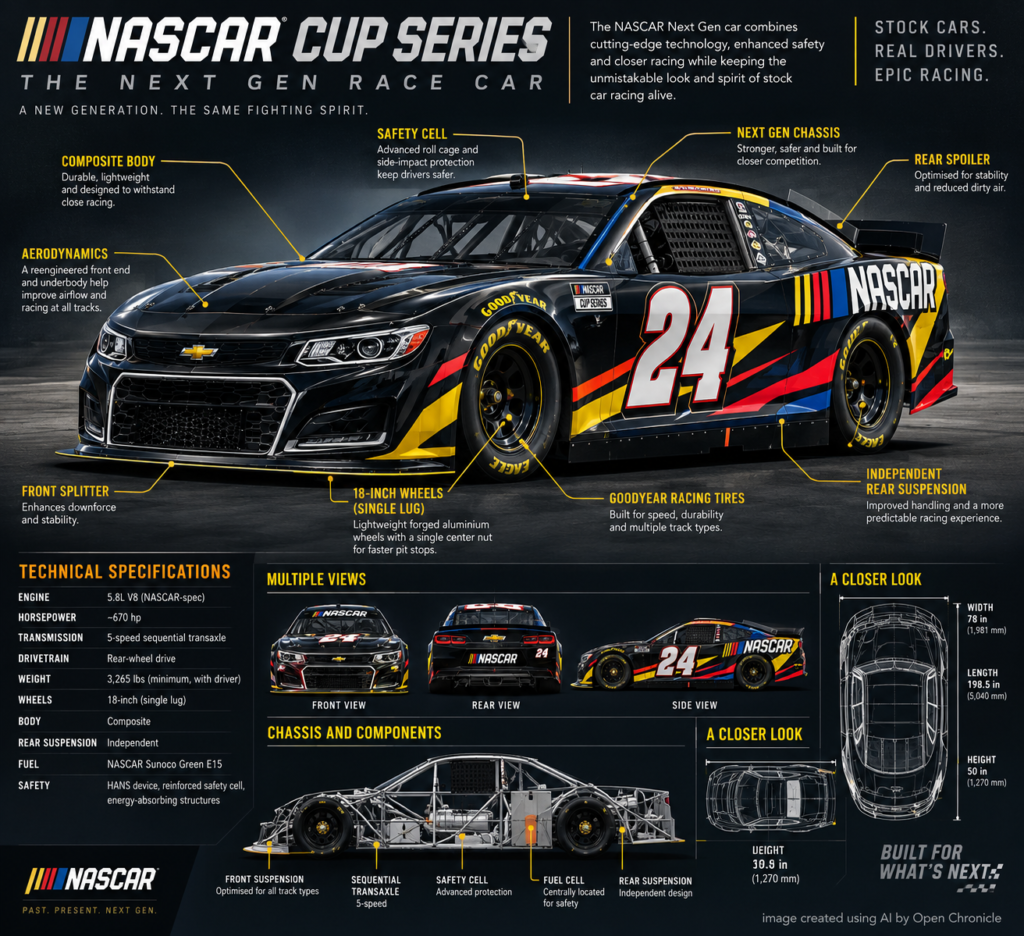
Look at a modern NASCAR Cup car and the first impression is simple: it looks like a brutally powerful racing version of an American road car.
Look beneath the bodywork and a much more interesting machine appears.
The NASCAR Next Gen car is not designed around one engineering objective. It is the product of several competing ideas: speed, safety, close racing, manufacturer identity, durability, cost control and driver influence. NASCAR wanted a car technologically closer to the modern automobile without allowing technology to erase the character of stock-car racing.
That tension explains almost everything visible in our infographic.
The splitter, composite body, safety cell, large wheels, independent suspension, transaxle and rear spoiler are not isolated technical features. Together, they represent NASCAR’s answer to a much larger question:
What should a stock car be in the 21st century?
The answer begins with a paradox.
It Is No Longer a Stock Car — Yet It Must Look Like One
The earliest NASCAR machines were genuinely rooted in production automobiles. Modern Cup cars are purpose-built racing machines.
NASCAR therefore faced an identity problem when developing Next Gen.
The mechanical connection with the showroom had weakened over decades, yet Chevrolet, Ford and Toyota still needed spectators to recognize something of their production vehicles in the cars racing on Sunday.
When NASCAR developed Next Gen, it deliberately moved toward a lower, wider, more coupe-like shape and gave manufacturers greater freedom to reproduce styling cues from their road-going cars. Underneath those recognizable shapes, however, NASCAR started almost from scratch.
That is the first principle behind the car illustrated above:
visual identity outside, racing architecture underneath.
Start With the Driver
The most important component of the car is not the engine.
It is the space surrounding the driver.
At the center of a Next Gen machine sits a steel-tube chassis and safety structure. NASCAR approached its design with crash performance as a fundamental engineering requirement rather than something added after performance development.
The front and rear structures incorporate energy-management concepts, while bolt-on front and rear clips surround the central section. Energy-absorbing materials and redesigned bumper structures were developed to dissipate impact forces before they reach the occupant compartment.
This changes how we should look at the car.
The body gives it identity.
The engine gives it speed.
But the survival cell gives the entire machine its architecture.
Everything else has to fit around it.
And NASCAR’s safety philosophy accepts another important reality: the design is never truly finished.
After rear-impact injuries during the inaugural 2022 Next Gen season, NASCAR modified the center and rear chassis structures for 2023 to encourage controlled deformation and improve energy absorption. Computer modelling, physical testing and real-world crash data were all part of that process.
A NASCAR crash therefore becomes more than an accident.
It becomes engineering information.
The Body: Designed to Take a Beating
The infographic identifies one of Next Gen’s most consequential changes:
Composite Body
Traditional NASCAR bodywork relied heavily on sheet metal.
Next Gen uses durable composite panels.
There is an important philosophical reason for that choice. NASCAR is a contact sport conducted with automobiles.
Cars touch.
Drivers lean on one another.
Fenders meet walls.
At short tracks, particularly, physical racing is part of NASCAR’s competitive DNA.
The composite panels were designed to tolerate more contact without the kind of permanent deformation that could dramatically compromise aerodynamic performance. NASCAR explicitly hoped this durability would allow drivers to continue the aggressive “bump and bang” style associated with stock-car racing.
In other words, this is advanced material technology being used not to make NASCAR more delicate, but to allow NASCAR to remain NASCAR.
Symmetry: Taking Aerodynamics Away From the Engineers
One of the most interesting design decisions is something a casual observer might never notice.
The Next Gen body is symmetrical.
Previous generations of Cup cars could exploit body offset and skew to generate aerodynamic sideforce. Engineers became extraordinarily good at manipulating airflow to make cars faster through corners.
But there was a consequence.
The driver’s ability could become increasingly intertwined with an aerodynamic engineering contest.
Next Gen deliberately reduced some of that freedom.
By eliminating much of the asymmetry, NASCAR wanted teams to depend more heavily on mechanical grip, chassis setup — and the person behind the steering wheel.
That reveals another fundamental Next Gen principle:
Technology should make the racing better, not replace the driver.
The Front Splitter: Controlling the Air
Follow the infographic down toward the asphalt and the aerodynamic philosophy becomes visible.
At the nose sits the front splitter.
Its job is not decorative. It helps manage airflow around and underneath the car while contributing to front-end aerodynamic load.
At NASCAR speeds, air becomes part of the suspension system in everything but name.
More aerodynamic load can increase grip.
But excessive dependence on aerodynamic load creates another problem: a car following another car receives disturbed airflow.
That is NASCAR’s famous battle with dirty air.
Next Gen therefore attacked airflow not only above the car, but beneath it.
The Underbody Revolution
One of the greatest departures from traditional NASCAR engineering is difficult to see unless the car is lifted into the air.
The Next Gen machine has a largely sealed underbody feeding airflow toward a rear diffuser.
Historically, the underside of a NASCAR stock car was comparatively aerodynamically crude.
Next Gen changed that philosophy.
Air passing beneath the car became deliberately managed, with NASCAR designing the underwing and diffuser partly to improve behavior in traffic and reduce the disruptive wake experienced by a following car.
This is an important distinction.
Aerodynamics are not simply about making one car faster.
For NASCAR, they also have to help make 40 cars race better together.
That is a very different engineering problem.
The Rear Spoiler: Stability Versus Wake
At the opposite end sits one of NASCAR’s most recognizable components:
The rear spoiler.
Its dimensions can change with the competition package because NASCAR uses it as one of the tools for controlling aerodynamic behavior.
More spoiler can generate greater rear stability and downforce but also affects drag and the aerodynamic wake.
Less spoiler places different demands on the driver and chassis.
There is therefore no universally “perfect” NASCAR aerodynamic configuration.
The optimum depends on what NASCAR wants the car to do at a particular type of circuit.
Daytona is not Martinsville.
Martinsville is not Watkins Glen.
And Watkins Glen is not Charlotte.
The Cup car must function across all of them.
Why the Wheels Became Bigger
The infographic draws attention to the 18-inch forged-aluminum wheels.
For generations, the familiar NASCAR wheel was a 15-inch steel unit secured by five lug nuts.
Next Gen moved to 18-inch aluminum wheels with a single center-locking fastener.
Why?
Partly because the larger wheel has greater relevance to contemporary performance road cars. But it also allows larger brakes and works with a wider tire and reduced sidewall.
NASCAR moved from 10-inch-wide tires to 12-inch tires, increasing the contact patch and allowing greater emphasis on mechanical grip.
Even this decision illustrates the broader philosophy:
reduce dependence on aerodynamic tricks and give the car more physical grip through its tires.
The Single Lug: NASCAR Reinvents a Ritual
The wheel produced one of the most controversial visual changes.
Five lug nuts disappeared.
One remained.
For decades, the rapid-fire sound of a pneumatic wrench hitting five NASCAR lug nuts was part of pit-road theatre.
But an 18-inch aluminum racing wheel operating under enormous loads required a different engineering solution. NASCAR adopted a large center-locking nut.
The decision illustrates the conflict present throughout Next Gen.
Tradition said five.
Engineering said one.
Engineering won.
But the essential NASCAR pit stop survived: tire changers, carriers and jackmen still attack the car under extraordinary time pressure.
The ritual changed.
The competition did not.
Independent Rear Suspension Changes the Car’s DNA
Now move beneath the body.
Here we find one of the largest mechanical breaks with NASCAR tradition.
Independent rear suspension.
For generations, the solid rear axle was part of the stock car’s mechanical identity.
Next Gen abandoned it.
Each rear wheel can now move more independently, giving teams different ways to manage wheel geometry and mechanical grip.
The change also removed the traditional track bar from the setup vocabulary and introduced more contemporary suspension architecture.
Four years into the Next Gen era, NASCAR itself has noted how substantially the platform changed the driving characteristics compared with previous Cup machinery.
The car may look evolutionary from the grandstands.
Mechanically, it was revolutionary.
The Transaxle: Moving the Gearbox
Next Gen also abandoned another familiar piece of NASCAR architecture.
The traditional four-speed H-pattern transmission gave way to a five-speed sequential transaxle.
Instead of keeping the transmission at the front and a separate differential at the rear, the transaxle integrates transmission and rear gearing into one rear-mounted assembly.
There are several benefits.
Packaging improves.
Weight distribution changes.
Shifting becomes sequential — forward and backward rather than navigating a traditional H-pattern.
And perhaps most importantly, the architecture gives NASCAR greater flexibility for whatever comes after the current V8 era.
NASCAR’s original Next Gen technical brief explicitly described the transaxle as having been designed with an eye toward the potential incorporation of electrification.
That doesn’t mean the V8 disappears tomorrow.
It means NASCAR designed the car so tomorrow remains possible.
The V8: The Tradition NASCAR Refused to Abandon
And then there is the engine.
Amid all this technological change sits something deeply traditional.
A naturally aspirated 358-cubic-inch V8 remains at the heart of the Cup car.
That is not accidental.
The sound, throttle response and character of the American V8 remain fundamental to the identity of NASCAR.
But even here the philosophy is evolving.
For 2026, NASCAR increased the target output to 750 horsepower at road courses and ovals shorter than 1.5 miles, up from the previous 670-horsepower baseline at those venues. The objective was to place greater emphasis on throttle control, tire management and passing opportunities.
That change is particularly revealing.
More power is not simply about higher speed.
It can make the car harder to drive.
And sometimes making a racing car harder to drive makes the racing better.
Brakes: Because a NASCAR Car Must Also Turn Right
The modern schedule imposes demands that early stock cars never faced.
Road courses require repeated heavy braking.
Short tracks punish brakes relentlessly.
The Next Gen architecture therefore incorporates substantially larger braking hardware, including 15-inch front rotors and 14-inch rear rotors in NASCAR’s technical specification.
The 18-inch wheel helped make that possible.
This is another example of systems engineering.
Change the wheel and you can change the brake.
Change the brake and you change what the driver can do.
Change what the driver can do and you potentially change the racing.
No component exists alone.
A NASCAR Car Is a Collection of Compromises
This is perhaps the most important lesson from the infographic.
A racing engineer could design a car specifically for Daytona.
It would be extraordinarily fast there.
But NASCAR doesn’t need a Daytona car.
It needs a car that can compete at Daytona, Bristol, Martinsville, Talladega, road courses, intermediate ovals and everywhere else on the Cup calendar.
It needs to draft at nearly 200 mph.
It needs to survive door-to-door contact.
It needs to negotiate tight road-course corners.
It needs to tolerate curb strikes.
It needs to remain stable in traffic.
It needs to permit recognizable Chevrolet, Ford and Toyota body styling.
It needs to protect a driver during a violent impact.
And NASCAR wants teams to race those cars closely enough that the engineering never overwhelms the spectacle.
That means virtually every design decision is a compromise.
Standardization Without Identical Performance
There is another philosophical revolution hidden beneath the car.
Next Gen uses many standardized or single-source components.
Historically, Cup teams fabricated enormous portions of their cars themselves. The largest organizations could deploy extraordinary engineering and manufacturing resources in search of tiny advantages.
Next Gen shifted that equation.
The concept is not that every team should perform identically.
It is that teams should begin with a more common technological foundation.
Competition then moves toward setup, simulation, strategy, execution, driver feedback and understanding how to extract performance from the same fundamental architecture.
The engineering contest remains.
Its boundaries have changed.
Designed to Be Repaired
Even the chassis architecture tells us something about NASCAR’s thinking.
The front and rear clips bolt to the central structure.
Why?
Because NASCAR cars crash.
Designing a racing car while pretending it will never hit anything would make little sense in stock-car competition.
Replaceable sections allow damaged areas to be serviced without necessarily discarding the entire central chassis.
It is a very NASCAR form of engineering:
build it to be fast — but also build it knowing somebody is eventually going to hit the wall.
The Car as a Laboratory
A modern NASCAR machine also produces something its ancestors could never provide:
data.
Sensors, cameras and incident-recording systems allow engineers to examine what happens to the vehicle with extraordinary precision.
That has consequences for competition, but it is particularly important for safety.
NASCAR can analyze an impact, model structural changes, test those changes and then compare subsequent real-world data.
The racing car becomes part of its own development program.
Today’s crash can influence tomorrow’s chassis.
Reading the Infographic From Front to Back
Look again at the car in the illustration and its design begins to tell a coherent story.
Front splitter: manage airflow and front aerodynamic performance.
Composite body: maintain manufacturer identity while tolerating NASCAR-style contact.
Safety cell: protect the driver at the center of the entire architecture.
18-inch wheels and wider tires: generate mechanical grip and accommodate modern braking hardware.
Sequential transaxle: modernize the drivetrain and create greater future flexibility.
Independent rear suspension: give engineers more sophisticated control over mechanical behavior.
Flat underbody and diffuser: manage air underneath the car and address traffic performance.
Rear spoiler: balance stability, drag and racing characteristics.
None is there merely because it looks modern.
Each answers a particular problem.
Together, they reveal the philosophy of the machine.
The Real Philosophy: Controlled Freedom
The Next Gen car is sometimes described primarily as a standardized race car.
That misses the more interesting idea.
Its philosophy is better understood as controlled freedom.
NASCAR defines the architecture.
Manufacturers give it identity.
Engineers search within the permitted setup space.
Crew chiefs adapt it to radically different racetracks.
Mechanics prepare it.
Strategists determine how to use it.
And then the driver has to make it work at speed while surrounded by dozens of other cars trying to occupy the same piece of asphalt.
Technology establishes the boundaries.
Competition happens inside them.
Built for What’s Next
The phrase at the bottom of our infographic — “Built for What’s Next” — captures the most important aspect of the Next Gen concept.
The car was not designed simply to solve the problems of Generation 6.
It created an architecture NASCAR could continue developing.
That matters because NASCAR sits between two worlds.
Its cultural foundations are deeply traditional: V8 engines, American manufacturers, oval racing, mechanical aggression and drivers willing to run inches apart at enormous speed.
Its future requires modern engineering: advanced crash analysis, contemporary suspension, sophisticated aerodynamics, data systems and potentially new powertrain technologies.
The genius — and the difficulty — lies in keeping both.
A NASCAR Cup car therefore cannot simply be the fastest machine engineers know how to build.
It must be something much more specific.
It has to be fast enough to thrill, difficult enough to reward talent, strong enough to race door-to-door, safe enough to protect its driver and recognizable enough that, when it thunders toward the grandstands, nobody needs to be told what kind of racing car it is.
That is the philosophy behind the modern NASCAR machine.
And that is why every line, component and compromise matters.
Technical Snapshot
| Component | Next Gen philosophy |
|---|---|
| Engine | Naturally aspirated 358 cu in V8; tradition combined with evolving power packages |
| Transmission | Five-speed sequential transaxle |
| Drive | Rear-wheel drive |
| Chassis | Steel-tube structure with replaceable front/rear clips |
| Body | Symmetrical composite construction with manufacturer-specific styling |
| Suspension | Independent front and rear |
| Steering | Rack-and-pinion |
| Wheels | 18 × 12-inch forged aluminum, single center lug |
| Aerodynamics | Splitter, flat carbon undertray and rear diffuser |
| Fuel | Approx. 20-gallon cell using Sunoco Green E15 |
| Core philosophy | Safety + close competition + manufacturer identity + driver influence + future adaptability |
NASCAR’s official technical specification lists the Next Gen at approximately 3,300 pounds, with a 110-inch wheelbase, 193.4-inch overall length and 78.6-inch width.