
By Open Chronicle History Desk
On 8 September 1504, the citizens of Florence encountered a work that would become one of the defining images of the Renaissance.
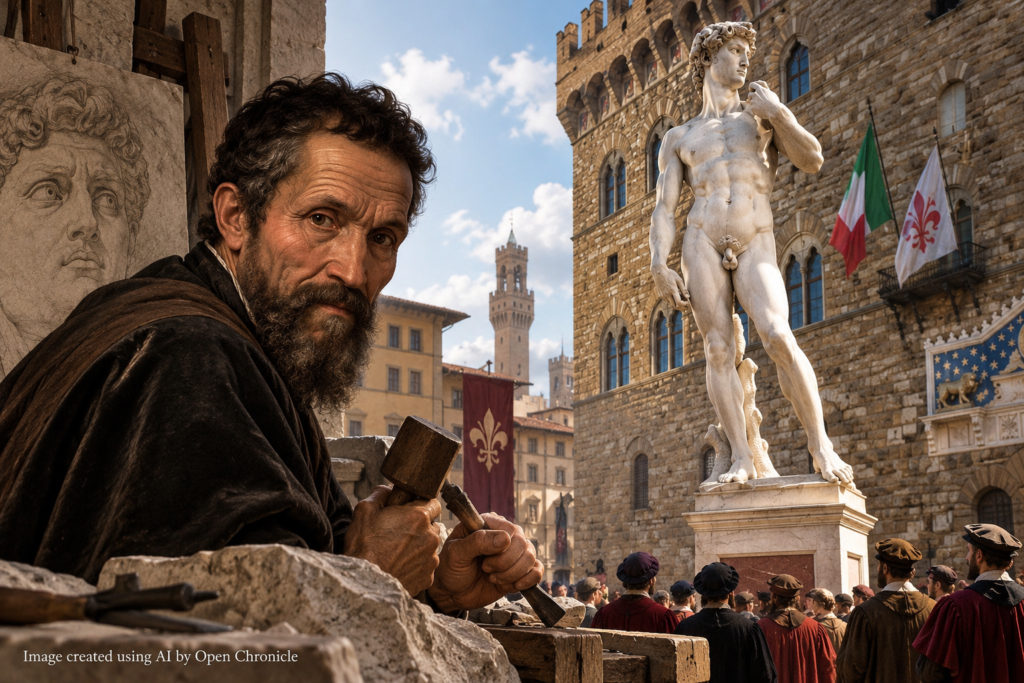
Michelangelo Buonarroti’s monumental marble David was formally unveiled outside the Palazzo della Signoria, the political heart of the Florentine Republic.
More than five metres tall, carved from a single enormous block of marble that earlier sculptors had struggled to use, the statue represented the biblical David before his confrontation with Goliath.
But to Renaissance Florence, Michelangelo’s figure meant considerably more.
David became a symbol of the republic itself: a relatively small political community surrounded by larger and more powerful rivals, determined to defend its independence.
The sculpture was simultaneously a biblical hero, an artistic revolution and a political statement carved in marble.
Michelangelo was only in his twenties when he created it.
More than five centuries later, David remains among the most celebrated works of Western art.
A Giant Block of Marble
The story of David began decades before Michelangelo touched the stone.
Florence Cathedral had long planned a series of monumental statues intended to decorate the cathedral complex. During the fifteenth century, an enormous block of Carrara marble was acquired for a sculpture of David.
The block presented serious problems.
It was unusually tall and relatively narrow, limiting what a sculptor could achieve.
Agostino di Duccio began working on it in 1464 but abandoned the project. Antonio Rossellino was later associated with another attempt, but the marble remained unfinished.
For years the huge block stood neglected.
Florentines reportedly came to refer to it as the Giant.
By 1501, cathedral officials wanted to rescue the expensive marble.
A new sculptor was required.
Michelangelo accepted the challenge.
Michelangelo Returns to Florence
Born in 1475, Michelangelo had already established an extraordinary reputation.
His Pietà, completed in Rome around the turn of the century, demonstrated a command of marble remarkable for such a young artist.
When Michelangelo returned to Florence, he was approximately 26 years old.
On 16 August 1501, the authorities commissioned him to create the David.
Work began shortly afterwards.
The challenge was formidable.
Michelangelo could not simply select an ideal piece of stone. He inherited marble that had already been partially worked and whose dimensions constrained the composition.
Instead of seeing those limitations as fatal, he designed the figure around them.
For more than two years, Michelangelo worked intensely on the sculpture.
David Before Goliath
Artists had represented David many times before.
The biblical story was familiar.
David, a young shepherd, confronts the Philistine warrior Goliath. Refusing heavy armour, he defeats the giant using a sling before killing him with Goliath’s own sword.
Earlier Renaissance representations frequently showed David after the victory.
Donatello’s famous bronze David, for example, stands over Goliath’s severed head.
Michelangelo chose a radically different moment.
There is no defeated giant.
No severed head.
No triumphant celebration.
Michelangelo’s David has not yet fought.
He is waiting.
The Moment Before Battle
That decision transformed the psychological character of the sculpture.
David’s body appears controlled, but tension runs through it.
His head turns.
His gaze focuses on an unseen opponent.
One hand holds the sling almost inconspicuously.
His posture uses the classical principle known as contrapposto, with the body’s weight resting predominantly on one leg.
The stance creates both relaxation and latent movement.
This is not simply an idealised male body.
Michelangelo captured the moment when thought is becoming action.
David knows that Goliath is there.
The battle has not yet begun.
A Renaissance Body
The statue also demonstrated the Renaissance revival of classical antiquity.
Italian artists and intellectuals had increasingly studied surviving Greek and Roman sculpture, architecture, literature and philosophy.
The human body returned to the centre of artistic investigation.
Michelangelo possessed an exceptional understanding of anatomy.
Muscles, tendons and skeletal structures are rendered with extraordinary attention.
Yet David is not anatomically naturalistic in every respect.
The head and hands are unusually large relative to the body.
Some of these proportions may have been influenced by the statue’s originally intended elevated position, where visual distortion would have altered how viewers perceived it.
Whatever the explanation, the oversized right hand contributes to David’s extraordinary expressive power.
Where Should the Giant Stand?
By early 1504, Florentine authorities faced an unexpected problem.
Michelangelo had produced something too important for its originally intended location.
The statue had been conceived for Florence Cathedral.
But placing it high above the ground would make it difficult to appreciate.
A committee of prominent Florentine artists and citizens was assembled to discuss where David should stand.
The gathering included some of the greatest names of Renaissance art.
Among those consulted were Leonardo da Vinci, Sandro Botticelli, Filippino Lippi, Piero di Cosimo and other leading figures of Florentine artistic life.
The debate itself reveals how quickly Michelangelo’s sculpture had come to be regarded as exceptional.
Eventually, a politically charged location was selected.
David would stand beside the entrance to the Palazzo della Signoria, today known as the Palazzo Vecchio.


Moving David
There was another problem.
The enormous marble figure weighed several tons.
Moving it through the narrow streets of Renaissance Florence was a major engineering operation.
A specially constructed wooden framework was used to transport the sculpture from Michelangelo’s workshop near the cathedral towards the Piazza della Signoria.
The journey covered only a relatively short distance.
It nevertheless took several days.
Workers carefully moved the statue through the city while protecting the marble from damage.
By June 1504, David had reached its new position.
Final adjustments continued before its formal unveiling in September.
September 8, 1504
When David was unveiled on 8 September 1504, its setting transformed its meaning.
The Palazzo della Signoria was not simply another beautiful building.
It was the seat of Florence’s government.
The statue therefore stood directly within the political landscape of the republic.
David’s invisible Goliath could now be interpreted metaphorically.
Florence itself had powerful enemies.
The city had experienced internal political upheaval, the expulsion of the Medici and repeated threats to its independence.
The biblical shepherd who defeated a giant through courage and intelligence provided an ideal republican symbol.
David seemed to be guarding Florence.
Florence Without the Medici
Understanding the statue’s political meaning requires understanding Florence in 1504.
The Medici family had dominated much of Florentine politics during the fifteenth century.
But in 1494, following the French invasion of Italy, Piero de’ Medici was expelled from the city.
Florence re-established republican government.
The following years were turbulent.
The Dominican preacher Girolamo Savonarola became enormously influential before being overthrown and executed in 1498.
The republic that emerged afterwards remained politically fragile.
Florence was wealthy and culturally extraordinary, but it existed within a dangerous Italian political environment.
France, the Papacy, Venice, Milan, Spain and other powers competed for influence.
In that setting, David carried obvious political resonance.
The Republic’s Guardian
David was an underdog who defeated a vastly stronger opponent.
Florence liked to imagine itself in similar terms.
The statue’s placement outside the seat of government transformed a religious subject into civic propaganda.
Its gaze was oriented towards a direction associated with potential threats to the republic.
Michelangelo had created something that could communicate several ideas simultaneously.
Biblical faith.
Classical beauty.
Human courage.
Republican liberty.
Florentine identity.
This ability to operate on several levels helps explain the sculpture’s extraordinary historical importance.
Michelangelo and Leonardo
The period also brought Michelangelo into the same city as another towering figure of Renaissance culture: Leonardo da Vinci.
Their relationship was competitive rather than harmonious.
Leonardo was more than twenty years older and already internationally famous.
Michelangelo was younger, fiercely ambitious and increasingly celebrated.
Florence briefly contained two artists whose names would become almost synonymous with the Renaissance.
The Florentine government even commissioned them to produce enormous battle scenes for the same hall in the Palazzo Vecchio.
Leonardo worked on the Battle of Anghiari.
Michelangelo prepared the Battle of Cascina.
Neither mural survived as originally intended.
Their preparatory designs nevertheless became legendary among contemporary artists.
A New Kind of Artist
Michelangelo’s career also reflected a changing conception of what an artist could be.
Medieval craftsmen often worked within guild systems and collective workshops.
By the Renaissance, exceptional painters, sculptors and architects increasingly acquired individual fame.
Michelangelo pushed this development much further.
His artistic identity became inseparable from ideas of genius, personal vision and extraordinary creative ability.
David contributed enormously to that reputation.
The abandoned marble block had become evidence that Michelangelo could accomplish what others could not.
He was no longer merely a talented young sculptor.
He was becoming a phenomenon.
From David to the Sistine Chapel
Only a few years later, Michelangelo would undertake another project that transformed Western art.
Pope Julius II summoned him to Rome.
Michelangelo initially became involved in the enormous and difficult project for the pope’s tomb.
Then came the Sistine Chapel ceiling.
Between 1508 and 1512, Michelangelo painted one of history’s most ambitious artistic cycles.
Scenes from Genesis, monumental prophets and hundreds of human figures transformed the chapel ceiling.
Decades later, he returned to paint The Last Judgment.
He also became one of the most important architects of Renaissance Rome and played a major role in the design of St Peter’s Basilica.
But David remained one of the works that established his reputation.
The Statue Survives
Standing outdoors for centuries inevitably endangered the marble.
The statue experienced weathering and episodes of physical damage.
In 1527, during political disturbances in Florence, objects thrown from the Palazzo Vecchio struck the sculpture and damaged its left arm.
Fragments were later recovered and repaired.
By the nineteenth century, concern about environmental deterioration had increased.
The decision was eventually made to move the original indoors.
In 1873, Michelangelo’s David was transferred to the Galleria dell’Accademia in Florence.
A replica was later installed in the Piazza della Signoria where the original had stood.
Today, visitors to Florence can therefore encounter David in two different historical contexts: Michelangelo’s original inside the Accademia and a replica occupying its famous civic position outside the Palazzo Vecchio.
More Than Perfect Marble
The enormous fame of David can sometimes obscure what made it revolutionary.
Its significance does not rest simply on technical perfection.
Michelangelo turned an ancient biblical narrative into a study of human psychology.
The sculpture captures anticipation rather than victory.
David’s strength has not yet been demonstrated.
His future remains uncertain.
That uncertainty gives the statue its tension.
He stands at the boundary between contemplation and action.
It is precisely the moment when courage matters most.
The Renaissance Ideal
David has consequently become one of the great visual symbols of the Renaissance.
The movement was not merely a rediscovery of ancient Greek and Roman aesthetics.
Renaissance culture also explored the possibilities of human agency.
Individuals could study nature.
They could recover ancient knowledge.
They could create.
They could reason.
They could shape political communities.
They could achieve extraordinary things.
Michelangelo’s David embodies that confidence while avoiding simple triumphalism.
The giant has not yet fallen.
Human potential exists, but it must still confront danger.
Why September 8 Matters
On 8 September 1504, Florence unveiled more than a statue.
The city presented an image of itself.
Michelangelo had taken a damaged and difficult block of marble and transformed it into a monumental figure combining biblical narrative, classical form, anatomical study, psychological tension and republican politics.
The result became one of the defining achievements of Renaissance culture.
Its influence extended far beyond Florence.
Generations of artists studied Michelangelo’s treatment of the human body. Historians examined its political symbolism. Millions of visitors eventually travelled to Florence specifically to see it.
Five centuries later, the sculpture remains instantly recognisable.
Yet perhaps the most important thing about David is still the moment Michelangelo chose to depict.
David has not won.
Goliath remains somewhere beyond our view.
The young man simply stands ready.
On 8 September 1504, Renaissance Florence looked at that figure and saw courage in the face of overwhelming power.
The world has been looking at him ever since.