
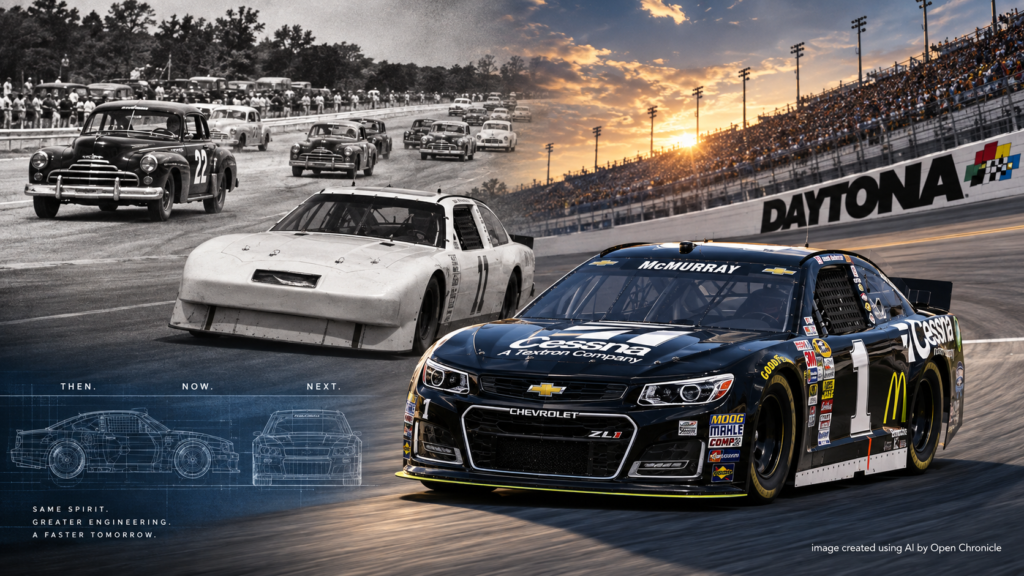
Cars & Technology
By Open Chronicle Sports
NASCAR CUP SERIES — The name has always said “stock car,” but the machines racing at Daytona, Darlington, Talladega and Bristol today are a very long way from the automobiles that early NASCAR competitors could drive from the street onto a racetrack.
That distance tells one of the most important stories in NASCAR history.
For more than seven decades, the Cup car has evolved through an extraordinary engineering journey — from modified production automobiles to purpose-built racing machines shaped by aerodynamics, crash science, data acquisition and increasingly sophisticated mechanical systems.
Yet NASCAR has repeatedly faced the same challenge: how far can the technology advance without losing the identity of the stock car?
The arrival of the Next Gen car in 2022 represented perhaps the most radical attempt yet to answer that question. And four seasons later, in 2026, NASCAR is still learning from it.
When Stock Cars Really Were Stock
The earliest NASCAR machines were remarkably close to the cars Americans could buy from dealerships.
When NASCAR’s Strictly Stock division — the ancestor of today’s Cup Series — emerged in 1949, the basic concept was contained in the name. Production automobiles formed the foundation of the competition.
As NASCAR itself describes its history, early race cars could effectively come off the street and onto the racetrack.
That connection created one of stock-car racing’s most powerful cultural ideas.
Win on Sunday, sell on Monday.
Ford, Chevrolet, Plymouth, Pontiac, Dodge, Mercury and Hudson could use NASCAR success to demonstrate the speed and durability of the automobiles they were trying to sell to American families.
But racing has a predictable effect on machinery.
Once engineers discover something that makes a car faster, competitors have to respond.
The evolutionary race had begun.
The Race Car Gradually Takes Over
As speeds increased and competition became more sophisticated, the cars became less like their showroom counterparts.
Roll cages grew more substantial. Suspensions became increasingly specialized. Engines were prepared specifically for competition. Chassis construction evolved. Bodies were manipulated in search of aerodynamic advantages.
Eventually, the production automobile became less the mechanical foundation of the NASCAR racer and more its visual inspiration.
That change was particularly significant once aerodynamics became a central battlefield.
At 190 or 200 mph, seemingly small differences in airflow can dramatically affect stability, drag, downforce and the ability of one car to follow another.
The stock car was becoming an aerodynamic machine.
The Invisible War: Aerodynamics
For decades, NASCAR engineers have fought a competition the spectator cannot directly see.
It happens in the air.
Teams discovered ways of shaping cars to manipulate airflow, generating advantages through the nose, roof, sides and rear bodywork.
Those developments produced enormously sophisticated race cars — but they also created a problem.
The more dependent cars became on aerodynamic performance, the more difficult it could become for a trailing car to operate in the disturbed air generated by the car ahead.
NASCAR fans know the phenomenon simply as dirty air.
A driver could have a faster car but lose front grip when approaching another machine, making passing increasingly difficult.
The battle between aerodynamic performance and close racing would become one of the defining engineering problems of modern NASCAR.
Safety Changes Everything
Speed wasn’t the only force driving NASCAR’s technological evolution.
So was tragedy.
The death of Dale Earnhardt in the 2001 Daytona 500 became a watershed moment for NASCAR safety.
The sport accelerated a transformation that affected virtually every part of the racing environment: the driver, the car and the racetrack.
NASCAR mandated head-and-neck restraints in 2001. Energy-absorbing SAFER barriers began replacing exposed concrete walls at tracks in 2002, and all NASCAR ovals had them by 2005. More advanced harness systems, cockpit protection and data-recording systems followed.
The NASCAR Research & Development Center became central to that process.
Cars could now be crash-tested and computer-modelled. Incident data recorders allowed engineers to study forces generated during accidents. High-speed cockpit cameras provided another layer of information about how a driver’s body reacted during an impact.
Crash investigation was increasingly becoming a science.
And that science would directly influence the race car.
The Car of Tomorrow
One of NASCAR’s most significant responses was the fifth-generation Cup car, widely known as the Car of Tomorrow.
Introduced progressively before becoming the full-time platform in 2008, it represented a major philosophical shift.
Instead of allowing manufacturers and teams enormous freedom in body and chassis development, NASCAR moved toward a more standardized architecture.
Safety was central to the concept.
The driver’s position was moved farther from potential impact areas, the cockpit became larger, and the chassis incorporated greater protection.
Aerodynamically, the car was also very different.
A front splitter and initially a rear wing became prominent features.
NASCAR describes Generation 5 as the beginning of a new safety era, with a common body and chassis that also reduced teams’ need to build specialized cars for different tracks.
The reaction from competitors and fans was mixed.
But technologically, NASCAR had crossed another boundary.
The Cup car was no longer evolving primarily through individual teams building their own interpretations of the stock-car formula.
Increasingly, NASCAR itself was engineering the platform.
Generation 6 Brings the Manufacturers Back
In 2013, NASCAR introduced the Generation 6 car.
Its mission was partly aesthetic.
Chevrolet, Ford and Toyota wanted their race cars to look more recognizably like the production models carrying the same badges.
Manufacturer-specific body panels returned more visual identity to the machines while maintaining the underlying race-car architecture. NASCAR described the objective as putting more “stock” back into stock-car racing.
The Gen-6 era produced some spectacular racing.
But engineers continued searching for aerodynamic performance, teams continued spending enormous resources developing tiny advantages, and the problem of following another car through turbulent air never disappeared.
Eventually NASCAR concluded that incremental development was no longer enough.
It needed a new car.
Not another evolution.
A clean sheet.
Next Gen
The result was the most ambitious technical project in modern NASCAR history.
The Next Gen car made its competition debut in 2022.
From a distance, it was unmistakably a NASCAR Cup car.
Underneath, almost everything had changed.
The traditional four-speed H-pattern gearbox disappeared. In its place came a five-speed sequential transaxle.
A solid rear axle gave way to independent rear suspension.
Traditional 15-inch steel wheels became 18-inch forged aluminum wheels secured by a single center-locking lug.
Rack-and-pinion steering arrived.
Larger brakes arrived.
A composite body replaced traditional sheet-metal construction.
Underneath the car, a flat floor and rear diffuser radically changed how NASCAR managed airflow.
For NASCAR, it was revolutionary.
Why the Next Gen Car Is So Different
Perhaps the biggest philosophical change was underneath the bodywork.
Historically, NASCAR teams designed and fabricated enormous portions of their race cars themselves.
That expertise became part of their competitive identity.
Next Gen moved toward standardized components supplied to the entire field.
The intention was to reduce the engineering arms race, control costs and create a more level technical foundation.
Teams would still tune and set up their cars.
But they would increasingly compete using the same fundamental pieces.
That shifted part of NASCAR’s engineering competition away from who could manufacture the cleverest car toward who could best understand and optimize the same car.
A Body Designed for Racing — and Contact
The composite Next Gen body represented another fundamental change.
Unlike traditional sheet metal, the material can tolerate considerable contact without deforming in the same way.
That matters enormously in NASCAR.
Stock-car racing has always involved bumping, rubbing and cars running inches apart.
NASCAR’s Next Gen development emphasized that the composite panels could withstand more of that punishment without immediately destroying the aerodynamic performance of the vehicle.
The body also became symmetrical.
Previous generations could use offset and skew to generate aerodynamic sideforce.
Next Gen was designed to reduce that effect and return more emphasis to mechanical grip, setup and driver control.
The Floor Becomes an Aerodynamic Device
One of the least visible Next Gen innovations may also be one of its most important.
The underside of the car became a carefully managed aerodynamic surface.
A flat underbody directs air toward a rear diffuser, which manages how airflow exits underneath the car.
The objective was partly to reduce dependence on the upper body for downforce and improve how the car behaves in traffic.
NASCAR explicitly designed the underwing and diffuser with reducing disruptive dirty air in mind.
That brought NASCAR closer to aerodynamic concepts familiar elsewhere in modern motorsport — while adapting them to a 3,000-plus-pound stock car capable of racing inches from another machine.
The Single-Lug Revolution
Few Next Gen changes were more immediately visible on pit road.
For generations, a NASCAR tire changer attacked five lug nuts.
Next Gen reduced that to one.
The new 18-inch aluminum wheel required a center-locking system capable of securing the wheel at racing speeds.
That fundamentally altered pit-stop technique.
The choreography remained recognizably NASCAR — jackman, tire carriers and changers moving around the car under enormous pressure — but decades of five-lug muscle memory suddenly had to be rewritten.
Even pit road had entered the Next Gen era.
Safety Is Never Finished
Next Gen was designed with safety as a fundamental requirement.
Among its original features were stronger structures, improved front and rear bumpers, energy-absorbing foam and modular front and rear chassis clips intended to manage impacts while also making damaged sections easier to replace.
But its introduction also demonstrated something fundamental about racing safety:
No race car is ever finished.
During the inaugural 2022 season, several rear impacts raised concerns about how crash energy was reaching drivers. Kurt Busch and Alex Bowman suffered concussions after crashes that season.
NASCAR responded.
For 2023, redesigned center and rear chassis sections incorporated structural changes intended to create more effective crush zones and absorb additional energy before it reached the cockpit. Further front-impact modifications followed.
That process has continued.
In June 2026, Christopher Bell’s crash at Michigan produced the largest recorded change in velocity of any impact during the Next Gen era and, according to NASCAR safety officials, the hardest recorded NASCAR impact in at least a decade. The incident provided another major dataset for engineers studying how the car protects its driver.
Modern NASCAR safety is therefore not a destination.
It is a feedback loop:
Crash. Measure. Analyze. Simulate. Test. Improve.
The Race Car as a Data Machine
The modern Cup car doesn’t merely race.
It produces information.
Sensors, incident recorders, onboard cameras and sophisticated data systems allow NASCAR and teams to understand the car at a level that would have been unimaginable to the mechanics who raced on Daytona Beach.
That information can influence performance.
But critically, it also influences safety.
When a major accident occurs, engineers can examine the forces involved rather than relying only on what the car looks like afterward or what the driver remembers experiencing.
The modern stock car has effectively become its own laboratory.
Has NASCAR Lost the “Stock” in Stock Car?
It is the unavoidable question.
A Next Gen Chevrolet, Ford or Toyota is obviously not a showroom automobile fitted with a roll cage.
It is a highly specialized racing machine.
Yet NASCAR has attempted to reconnect the race cars visually and technologically with contemporary road vehicles.
The Next Gen design gives manufacturers greater freedom to reproduce styling characteristics from production models. Its larger wheels, independent rear suspension, rack-and-pinion steering and transaxle architecture also reflect technologies more recognizable in modern performance cars than some of the traditional NASCAR hardware they replaced.
The connection has changed.
In 1949, “stock” largely described what the car was.
Today, it increasingly describes what the race car represents.
The Next Revolution
The most interesting element of Next Gen may ultimately be what it makes possible.
Its architecture was conceived not only for the present but also with future technology in mind. NASCAR’s original technical material specifically noted that the transaxle layout was developed with the potential incorporation of electrification in mind.
That does not mean the traditional NASCAR V8 is disappearing tomorrow.
It means the platform has been designed so the sport has options.
And that may be essential.
Automotive technology is changing rapidly. Manufacturers are developing hybrid systems, electric vehicles, advanced software and increasingly sophisticated powertrains.
NASCAR has always existed partly as a reflection of American automotive culture.
If that culture changes, NASCAR will eventually have to decide which elements to follow — and which traditions to protect.
From Detroit Iron to Engineering Laboratory
Place a 1949 Strictly Stock machine beside a 2026 Next Gen Cup car and they almost appear to belong to different sports.
One was fundamentally a production automobile adapted to survive racing.
The other is a purpose-built competition machine with a composite body, sequential transaxle, independent rear suspension, sophisticated aerodynamics, advanced crash structures and extensive data collection.
Yet the objective remains remarkably familiar.
Build a car.
Make it fast.
Make it survive.
And beat everyone else to the checkered flag.
That tension between tradition and technology has driven NASCAR for more than 75 years.
The stock car has never stopped evolving.
And if NASCAR’s history tells us anything, Next Gen will not be the final generation.
Cars & Technology — Quick Evolution
| Era | Defining development |
|---|---|
| 1949 | Production-based Strictly Stock cars |
| 1950s–60s | Purpose-built racing modifications accelerate |
| 1970s–90s | Chassis and aerodynamic development become increasingly specialized |
| 2001 onward | Major expansion of NASCAR’s systematic safety program |
| 2007–12 | Generation 5 / Car of Tomorrow emphasizes safety and standardization |
| 2013–21 | Generation 6 restores stronger manufacturer identity |
| 2022–present | Next Gen introduces composite bodies, transaxle, independent rear suspension, 18-inch single-lug wheels and underbody aerodynamics |