
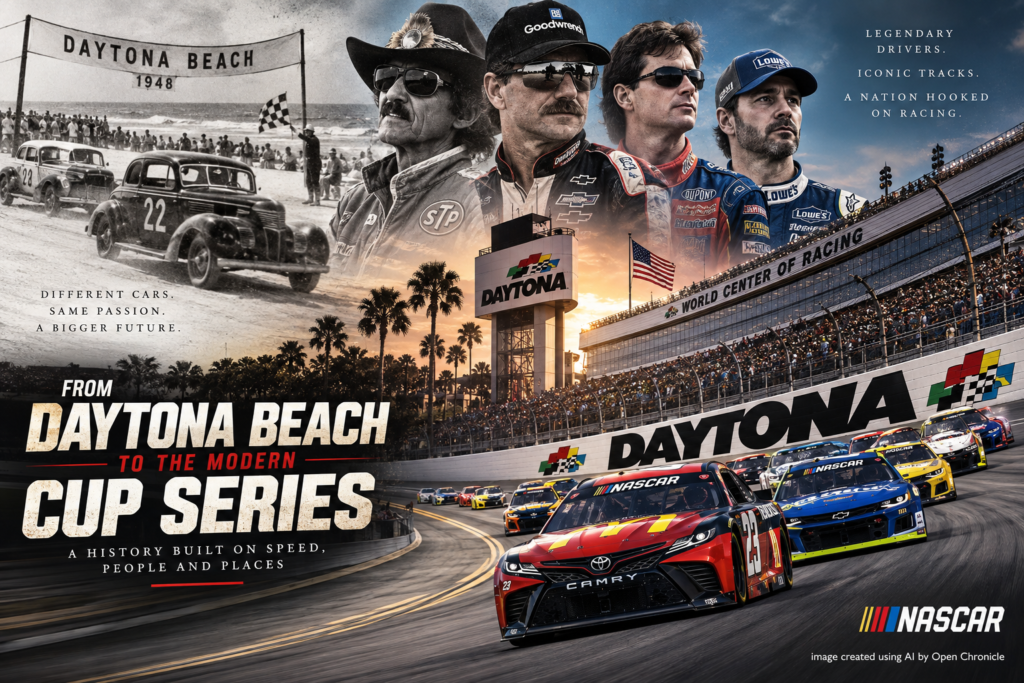
By Open Chronicle Sports
NASCAR History & Legends
DAYTONA BEACH, Fla. — Before the billion-dollar speedways, before the television audiences, before Daytona became synonymous with February and before names such as Petty, Earnhardt and Johnson became part of American sporting folklore, there was sand.
There were ordinary-looking automobiles.
Racers were willing to drive them harder than anyone thought sensible.
And there was a stretch of Florida coastline where an idea began to take shape.
NASCAR did not emerge fully formed as the national motorsport institution familiar today. It grew from the loosely organized world of American stock-car competition into a championship whose identity would eventually be built around speed, personalities, manufacturers, family dynasties and racetracks that became destinations in their own right.
The journey from the sands of Daytona Beach to the modern NASCAR Cup Series is, in many ways, the story of American motorsport itself.
It begins with a man named Bill France.
Before NASCAR, There Was Stock-Car Racing
Stock-car racing existed before NASCAR.
What it lacked was order.
During the 1930s and 1940s, races were staged throughout the American South under different promoters, different rules and often different interpretations of what constituted a legitimate stock car.
Competitors could race one weekend without knowing whether the purse promised by a promoter would actually be paid.
There was enthusiasm.
There was talent.
There was certainly speed.
What the sport didn’t yet possess was a unified structure.
Bill France Sr., a mechanic, racer and promoter who had become involved with events on Daytona Beach, believed stock-car racing could become something much larger.
But first it needed organization.
On December 14, 1947, France gathered approximately three dozen figures from the racing world at Daytona Beach’s Streamline Hotel to discuss creating a unified sanctioning organization.
The meetings produced the National Association for Stock Car Auto Racing.
NASCAR had been conceived.
Daytona Beach: Where the Story Started
Modern NASCAR fans know Daytona through the immense banking of Daytona International Speedway.
The original Daytona looked very different.
Racing took place partly on the beach itself and partly on nearby paved roads, creating one of the most distinctive circuits in American motorsport.
On February 15, 1948, NASCAR held its first sanctioned race on the Daytona Beach-Road Course.
Red Byron won in a Ford.
But the direct ancestor of today’s Cup Series arrived the following year.
On June 19, 1949, 33 cars assembled at the three-quarter-mile dirt Charlotte Fairgrounds Speedway for NASCAR’s first Strictly Stock race.
Approximately 13,000 spectators came to watch.
Jim Roper was eventually credited with the victory.
And NASCAR had its premier championship.
Red Byron became its first champion.
The 1949 schedule contained just eight races.
Few people watching those cars circle dirt tracks could have imagined what the championship would become.
When “Stock” Really Meant Stock
The name Strictly Stock was remarkably literal.
Early NASCAR cars were fundamentally production automobiles. Drivers competed in machinery that retained a close relationship with the vehicles Americans could purchase from dealerships.
That connection became fundamental to NASCAR’s appeal.
Ford.
Chevrolet.
Plymouth.
Pontiac.
Dodge.
Mercury.
Hudson.
The badge on the grille mattered.
Fans weren’t merely supporting drivers. They could support the manufacturers represented in their own driveways.
The old expression “Win on Sunday, sell on Monday” captured an era when Detroit understood that victories on America’s racetracks could translate into prestige in America’s showrooms.
Manufacturer rivalry became part of NASCAR’s DNA.
It remains there today.
Darlington Proved NASCAR Could Think Bigger
Then came Darlington.
Harold Brasington had attended the Indianapolis 500 and returned to South Carolina convinced that stock-car racing deserved a major paved speedway of its own.
The result was Darlington Raceway.
Its unusual egg-shaped configuration would become one of NASCAR’s most demanding challenges, while the Southern 500 grew into one of the sport’s defining races.
Darlington represented something important.
NASCAR was no longer simply adapting existing fairgrounds, beaches and dirt tracks.
Stock-car racing was beginning to build monuments of its own.
And the biggest was coming.
Bill France Builds Daytona
The beach course had history.
Bill France wanted a future.
Daytona International Speedway opened in 1959 as an audacious 2.5-mile high-banked superspeedway designed to take American stock-car racing into a new era.
Its first Daytona 500 immediately produced a finish worthy of the ambition.
Lee Petty and Johnny Beauchamp crossed the line so closely that officials required extensive photographic evidence before determining the winner.
The decision took 61 hours.
Lee Petty had won the first Daytona 500.
The race would grow into NASCAR’s most prestigious event.
The Great American Race.
Unlike many championships, NASCAR would eventually place its biggest event at the beginning of the season.
Win Daytona and a driver could become part of the sport’s history before February was over.
The Tracks Became Characters
NASCAR’s expansion created something unusual.
The racetracks themselves developed personalities.
Daytona became the cathedral of speed.
Darlington became The Track Too Tough to Tame.
Martinsville, with its tight half-mile layout, represented NASCAR’s short-track roots.
Bristol turned stock-car racing into something resembling controlled combat inside a stadium.
And then came Talladega.
At 2.66 miles with enormous banking and extraordinary speeds, Talladega Superspeedway pushed the concept of NASCAR superspeedway racing even further.
In 1970, Buddy Baker became the first driver to exceed 200 mph on a closed course while testing there.
NASCAR now had venues unlike anything else in American sport.
Drivers didn’t simply race one another.
They raced the places.
Then Came The King
Every major sport eventually finds the athlete who becomes larger than the competition itself.
For NASCAR, that man was Richard Petty.
The cowboy hat.
The sunglasses.
The No. 43.
Petty became NASCAR’s first transcendent superstar.
And his statistics remain staggering.
200 Cup victories.
123 poles.
Seven championships.
Seven Daytona 500 victories.
27 wins in a single season.
Petty’s 200 victories remain the all-time Cup Series record.
But the numbers tell only part of the story.
Petty helped transform NASCAR drivers from racers into recognizable American sports personalities.
Fans didn’t merely watch the No. 43.
They followed The King.
The 1979 Daytona 500 Changed Everything
February 18, 1979 deserves its own place in American sports history.
CBS broadcast the Daytona 500 live from start to finish — the first 500-mile NASCAR race shown nationally in its entirety.
Then almost everything NASCAR could have wanted happened.
A major snowstorm kept millions of Americans indoors across parts of the country.
Richard Petty won.
And behind him, Donnie Allison and Cale Yarborough crashed while fighting for the lead on the final lap.
The confrontation continued after the wreck, with Yarborough and the Allison brothers becoming involved in an infamous fight.
Millions watched.
NASCAR had produced spectacle, personality, conflict and drama in a single national broadcast. The race became one of the defining moments in the sport’s growth.
NASCAR was no longer merely a Southern racing series.
America was watching.
Earnhardt Changed the Hero
Petty represented one kind of NASCAR superstar.
Dale Earnhardt represented another.
Aggressive, uncompromising and intimidating, Earnhardt became known simply as The Intimidator.
His black No. 3 Chevrolet became one of the most recognizable racing cars ever built.
Earnhardt won his first championship in 1980.
Six more followed.
By 1994, he had joined Petty as a seven-time champion.
But there remained one glaring omission.
Daytona.
Earnhardt repeatedly came close to winning the Daytona 500 without finishing the job.
Then, in 1998, after two decades of trying, he finally won.
As Earnhardt drove toward Victory Lane, crew members from rival teams lined pit road to congratulate him.
It became one of NASCAR’s defining images.
NASCAR Goes National
By the 1990s, the transformation accelerated.
NASCAR moved beyond its traditional Southeastern base.
New races appeared in major markets.
Tracks were built or expanded.
Television exposure increased dramatically.
Corporate sponsorship poured into the sport.
Jeff Gordon became the face of a new generation.
Young, polished and extraordinarily fast, Gordon demonstrated that NASCAR’s future didn’t have to look exactly like its past.
His rivalry with Earnhardt came to symbolize NASCAR’s transition.
Old school versus new school.
The Intimidator versus the Rainbow Warrior.
But both were NASCAR.
And that was increasingly the point.
The Manufacturer Wars Never Went Away
While drivers became celebrities, another battle continued beneath them.
Detroit remained deeply invested.
Chevrolet and Ford fought across generations, while Dodge returned to Cup competition in 2001. Toyota’s arrival in NASCAR’s premier division in 2007 represented another watershed — a foreign manufacturer entering a championship so closely tied to American automotive culture.
The rivalry evolved from showroom sedans to purpose-built racing machines.
But manufacturer identity remained central.
Fans still argued Ford versus Chevrolet.
Teams still developed alliances around manufacturers.
Engine programs became increasingly sophisticated.
And winning the manufacturers’ championship retained real meaning.
NASCAR’s cars had moved far from their Strictly Stock ancestors.
The tribal loyalty survived.
The Day NASCAR Changed Forever
NASCAR’s rise came with tragedy.
On February 18, 2001, Dale Earnhardt was killed in a crash on the final lap of the Daytona 500.
He was 49.
The loss shook NASCAR to its foundations.
But it also accelerated a safety revolution.
Head-and-neck restraint systems became mandatory.
Track barriers evolved.
Seat construction improved.
Crash analysis became more sophisticated.
NASCAR established its Research and Development Center in Concord, North Carolina, in 2003.
The sport could never eliminate danger.
But after Earnhardt, NASCAR approached it differently.
Safety became an engineering mission.
Johnson Joins the Seven-Time Club
The next great dynasty belonged to Jimmie Johnson and Hendrick Motorsports.
Johnson won five consecutive championships from 2006 through 2010 — an achievement unprecedented in NASCAR’s premier division.
He later won titles in 2013 and 2016.
Seven championships.
Petty.
Earnhardt.
Johnson.
Three drivers separated by different eras, different cars and different versions of NASCAR.
One extraordinary number connects them.
From Winston Cup to NASCAR Cup Series
Even the championship’s name tells the story of NASCAR’s evolution.
The premier division began as Strictly Stock.
It became Grand National.
For decades, sponsorship made Winston Cup one of the most recognizable names in American motorsport.
Nextel took over title sponsorship in 2004, later followed by Sprint and Monster Energy.
In 2020, NASCAR moved away from a single title sponsor and established the simpler identity that survives today:
NASCAR Cup Series.
The names changed.
The championship remained.
The Cars Became Racing Machines
Perhaps nothing illustrates NASCAR’s transformation better than the cars.
NASCAR itself describes the journey as one from vehicles that could effectively be driven from the street to the racetrack to highly specialized technological machines.
Roll cages became sophisticated survival structures.
Aerodynamics became crucial.
Telemetry and simulation transformed preparation.
Pit crews evolved into specialized athletic units.
Engineering departments grew.
And in 2022, NASCAR introduced the Next Gen car.
Independent rear suspension.
Sequential transmission.
18-inch center-lock wheels.
Composite bodies.
More standardized components.
The machine was still unmistakably a stock car.
But beneath the bodywork was technology the pioneers of 1949 could scarcely have imagined.
NASCAR Rediscovers Its Roots — While Looking Outward
Modern NASCAR has also become more willing to experiment.
Dirt returned to the Cup schedule at Bristol.
Road-course racing expanded.
The Cup Series raced through downtown Chicago on a street circuit.
North Wilkesboro returned.
Bowman Gray Stadium brought the Cup world back into intimate contact with old-school short-track NASCAR.
And NASCAR went international.
In 2025, the Cup Series raced for points in Mexico City — its first points-paying event outside the United States in half a century.
These moves might appear to represent NASCAR moving away from tradition.
In another sense, they represent the opposite.
Early NASCAR raced almost anywhere.
Beaches.
Dirt tracks.
Fairgrounds.
Road courses.
Short ovals.
The modern championship is rediscovering some of that unpredictability.
The Races That Became American Traditions
Through all the change, certain events became anchors.
The Daytona 500 is NASCAR’s defining race.
The Southern 500 connects the modern sport directly to its early expansion.
The Coca-Cola 600 tests endurance through 600 miles at Charlotte.
The Brickyard 400 brought NASCAR to Indianapolis Motor Speedway.
Talladega remains an event where almost anything can happen.
Bristol under the lights remains one of the sport’s most visceral spectacles.
Martinsville still awards its winner a grandfather clock.
These aren’t simply rounds of a championship.
They are NASCAR traditions.
And the Families Remained
Perhaps more than most major professional sports, NASCAR has always been built around families.
The Pettys.
The Allisons.
The Earnhardts.
The Waltrips.
The Labontes.
The Burtons.
The Elliotts.
The Blaneys.
Generations have moved through garages where fathers, sons, brothers and grandchildren sometimes competed against one another.
The same applies to ownership.
Petty Enterprises.
Wood Brothers Racing.
Hendrick Motorsports.
Richard Childress Racing.
Joe Gibbs Racing.
Team Penske.
Roush.
NASCAR history isn’t only preserved in museums.
Much of it has been passed down through garage stalls.
From Sand to Superspeedways
Stand on Daytona Beach today and it can be difficult to imagine stock cars racing down the shoreline.
Drive a few miles inland and Daytona International Speedway rises above the Florida landscape.
That distance tells NASCAR’s story.
The sport went from beach racing to 200-mph superspeedways.
From production automobiles to Next Gen machines.
From regional promoters to national television.
From Strictly Stock to the NASCAR Cup Series.
From Red Byron to Richard Petty.
From Earnhardt to Gordon.
From Johnson to the stars of the modern championship.
Yet the fundamental attraction has survived every transformation.
A driver.
A car.
A rival.
A racetrack.
And the possibility that on any given Sunday, something unforgettable might happen.
NASCAR has spent more than three-quarters of a century modernizing almost everything around that idea.
It has never needed to replace the idea itself.
NASCAR History — Milestones
| Year | Moment |
|---|---|
| 1947 | Bill France Sr. gathers racing figures at Daytona’s Streamline Hotel and NASCAR is conceived |
| 1948 | NASCAR holds its first sanctioned race on the Daytona Beach-Road Course |
| 1949 | First Strictly Stock race; Red Byron becomes the inaugural premier-series champion |
| 1950 | Darlington hosts the first Southern 500 |
| 1959 | Daytona International Speedway opens and Lee Petty wins the inaugural Daytona 500 |
| 1969 | Talladega Superspeedway opens |
| 1979 | Daytona 500 receives landmark flag-to-flag national television coverage |
| 1984 | Richard Petty scores his 200th and final Cup victory at Daytona |
| 1994 | Dale Earnhardt joins Petty as a seven-time champion |
| 1998 | Earnhardt finally wins the Daytona 500 |
| 2001 | Earnhardt’s death leads NASCAR into a new era of safety development |
| 2004 | NASCAR introduces the Chase championship concept |
| 2010 | NASCAR Hall of Fame inducts its inaugural class |
| 2016 | Jimmie Johnson becomes the third seven-time Cup champion |
| 2022 | Next Gen car begins Cup Series competition |
| 2025 | Cup Series stages a points-paying race in Mexico City |
NASCAR’s official historical record traces that evolution from the December 1947 Daytona meetings through Strictly Stock and the construction of Daytona International Speedway to today’s technologically advanced Cup Series.