
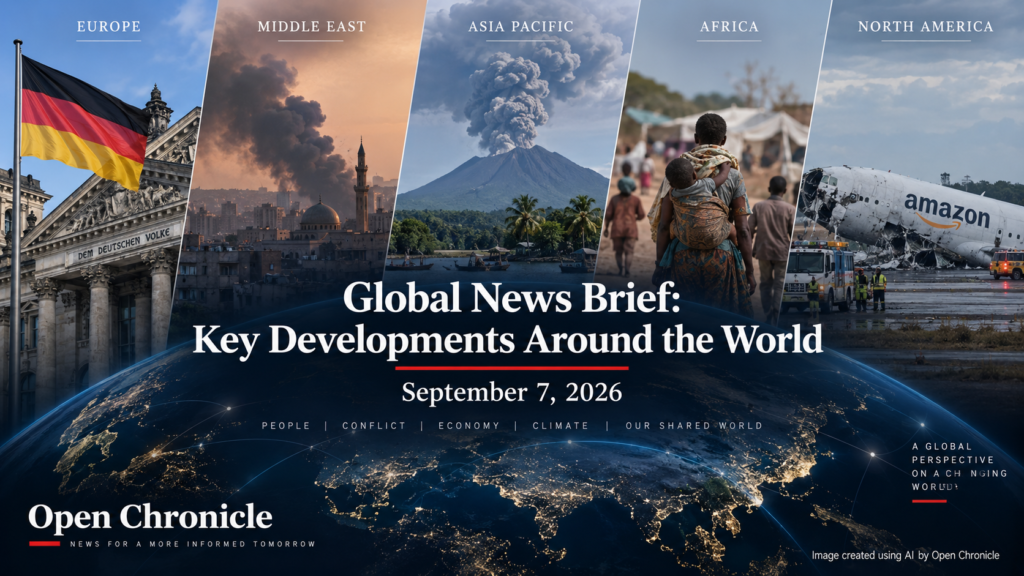
By Open Chronicle News Desk
Political upheaval in Germany, growing tensions around the Strait of Hormuz, renewed diplomatic efforts over Ukraine and a series of humanitarian and security crises are shaping the international agenda on September 7.
In Europe, the historic electoral breakthrough of the Alternative for Germany is reverberating well beyond Saxony Anhalt, while Russia and the West remain locked in confrontation over Ukraine and European security. In the Middle East, the war involving the United States and Iran is placing increasing pressure on Gulf states and global shipping. Across Asia, deadly disasters, geopolitical competition and security concerns are dominating headlines.
Here are the key developments by world region.
Europe
AfD victory in Saxony Anhalt sends shockwaves through Germany and Europe
Germany is confronting the political consequences of a historic victory by the far right Alternative for Germany in the eastern state of Saxony Anhalt.
The AfD emerged comfortably ahead of Chancellor Friedrich Merz’s Christian Democratic Union, marking one of the most significant electoral breakthroughs in the party’s history. Ulrich Siegmund, the AfD’s leading candidate in the state, celebrated the result as evidence of a fundamental shift in German politics.
Despite its commanding performance, the party appears to have fallen short of the parliamentary majority required to govern alone. The result therefore places renewed pressure on Germany’s established parties and their longstanding refusal to cooperate with the AfD.
European politicians have reacted with concern. Poland has warned that the AfD’s growing influence could affect Polish interests, while French officials have cautioned against the normalization of far right political ideas.
The result also creates a serious political challenge for Merz. A poor CDU performance in a state the party governed for more than two decades is likely to intensify questions about his leadership and the direction of Germany’s governing conservatives.
Germany takes Israel arms case to international court
Germany has asked the International Court of Justice to dismiss a case concerning Berlin’s military support for Israel.
The dispute comes as international scrutiny of arms transfers to Israel continues. UN human rights chief Volker Türk has urged governments to reconsider weapons transfers where there is a risk that international law could be violated.
The issue places Germany in a particularly sensitive position given its historic relationship with Israel and its simultaneous commitment to international humanitarian law.
Serbia faces criticism over glorification of Ratko Mladić
Serbia is facing renewed criticism after events in Belgrade honoring Ratko Mladić, the former Bosnian Serb military commander convicted of war crimes, crimes against humanity and genocide.
The controversy has generated warnings from European officials concerned about the continued glorification of figures associated with the Balkan wars of the 1990s.
Russia warns over U.S. missiles in Norway
Moscow has warned that the deployment of American missile systems in Norway could seriously damage strategic dialogue between Russia and the United States.
The Kremlin portrayed the deployment as a direct security concern, adding another source of tension to relations between Russia and NATO at a time when the war in Ukraine remains unresolved.
U.S. envoys pursue Ukraine peace diplomacy
American envoys Jared Kushner and Steve Witkoff have continued Washington’s attempt to revive negotiations over the war in Ukraine.
Their diplomatic mission follows discussions in Moscow and meetings with Ukrainian officials as the Trump administration explores whether a framework for renewed negotiations can be established.
The Kremlin has described recent contacts with Washington as a small step toward peace and has not ruled out eventual trilateral discussions involving Russia, Ukraine and the United States.
Europe battles heat, fires and a collapsing wine harvest
Extreme weather is again affecting parts of Europe.
The World Meteorological Organization has warned that heatwaves and wildfires are damaging air quality across parts of the continent. France is meanwhile heading toward what could be its weakest wine harvest in roughly three decades following severe heat and drought.
The agricultural losses provide another indication of the growing economic consequences associated with increasingly extreme weather conditions.
Middle East
Iran prepares exclusion zone near Strait of Hormuz
Iran says it plans to establish a prohibited or exclusion zone near the Strait of Hormuz, raising concerns over freedom of navigation through one of the world’s most strategically important waterways.
Tehran maintains that responsibility for resolving the confrontation lies with Washington and says the United States must change its approach before meaningful progress can occur.
The announcement comes amid continuing military confrontation between Iranian and American forces and heightened concern about the security of commercial shipping.
The Strait of Hormuz remains vital to international energy markets, meaning any prolonged disruption could have consequences far beyond the Gulf.
Qatar warns Gulf stability can no longer be guaranteed
Qatar has issued one of the clearest regional warnings yet about the consequences of the U.S. Iran conflict.
Officials in Doha say the war has demonstrated that Gulf security can no longer be taken for granted, even for states maintaining close strategic relationships with Washington.
The comments highlight growing anxiety among Gulf governments that an extended confrontation could destabilize regional trade, energy infrastructure and security arrangements.
IAEA warns over loss of visibility into Iran’s nuclear program
International Atomic Energy Agency Director General Rafael Grossi has warned about the agency’s ability to monitor Iran’s nuclear activities.
The lack of effective oversight is becoming increasingly significant as military tensions grow and Washington considers how to prevent Tehran from advancing sensitive nuclear capabilities.
Without reliable inspections, the international community faces greater uncertainty about Iran’s nuclear inventory, enrichment infrastructure and possible reconstruction of damaged facilities.
Gaza and West Bank tensions continue
Violence continues across the Palestinian territories.
Palestinians have been injured during Israeli operations in the occupied West Bank, while further casualties have been reported in Gaza.
UN officials have also raised concerns that reconstruction and rubble clearing could potentially destroy evidence relevant to future investigations into alleged violations of international law.
At the diplomatic level, efforts to advance a Gaza political roadmap remain constrained by disagreements over security, Hamas disarmament and Israel’s future policy toward the territory.
Yemen fighting intensifies
Fighting in Yemen continues as forces opposed to the Houthis seek to consolidate positions along the country’s western coast.
The renewed clashes underline how Yemen remains another potential source of regional escalation while the broader Middle East is already under severe pressure from the confrontation involving Iran.
Asia Pacific
Nepal mourns victims of catastrophic floods
Nepal is observing a national day of mourning following devastating flash floods that have caused mass casualties.
The disaster has become one of the most serious humanitarian emergencies currently unfolding in Asia, with rescue teams continuing to search affected areas and authorities working to identify victims.
The scale of destruction has placed enormous pressure on emergency services and infrastructure.
Deadly building collapse in New Delhi
At least six people have been reported killed following the collapse of a building in New Delhi.
Rescue teams have been searching through debris for survivors as authorities investigate the cause of the collapse.
The disaster again raises concerns about construction standards and urban safety in rapidly expanding Indian cities.
Indonesia deals with Anak Krakatau eruption
Indonesia continues to experience aviation disruption following renewed volcanic activity at Anak Krakatau.
Airport closures have been extended as ash clouds interfere with flight operations, affecting domestic and international travel.
Indonesia sits along the Pacific Ring of Fire and experiences frequent volcanic and seismic activity, but major eruptions can still cause substantial disruption across one of Southeast Asia’s busiest aviation markets.
North Korea adds another naval destroyer
North Korea has added a second new destroyer to its expanding naval forces while the United States, South Korea and Japan conduct joint military exercises.
The development reflects Pyongyang’s broader effort to modernize its armed forces and strengthen its ability to operate beyond its traditional coastal defense role.
The timing is particularly significant as Washington, Seoul and Tokyo deepen military cooperation in response to North Korea’s expanding missile and nuclear capabilities.
China accused of supplying drone production materials to Russia
Reports that China secretly supplied large quantities of materials associated with drone production to Russia are likely to renew Western scrutiny of Beijing’s relationship with Moscow.
China has sought to portray itself as neutral regarding the Ukraine war, while Western governments have repeatedly accused Chinese companies of providing components and technologies that can support Russia’s defense industrial base.
Beijing has rejected accusations that it is directly supporting Russia’s war effort.
Japan seeks renewed engagement with Washington
Japanese Prime Minister Sanae Takaichi is reportedly seeking talks with President Donald Trump ahead of a planned meeting with Chinese President Xi Jinping.
Tokyo faces an increasingly complicated strategic environment as it attempts to preserve its alliance with Washington while managing economic and security relations with Beijing.
Africa
More than 11,000 people remain missing in Sudan
The International Committee of the Red Cross says it has records relating to more than 11,000 people reported missing in Sudan.
The figure illustrates the enormous human cost of the country’s prolonged conflict.
Millions have been displaced since fighting erupted, while famine, collapsing health services and continued violence have created one of the world’s gravest humanitarian emergencies.
Tunisia faces pressure over political pluralism
The European Union has called on Tunisia to preserve political pluralism amid continuing concerns about the country’s democratic trajectory.
Relations between Tunis and European governments remain complicated by migration cooperation, economic assistance and concerns about political freedoms.
Kenya warns foreign nationals over visa rules
Kenyan authorities have warned foreigners against using visas improperly to engage in commercial activities.
The move comes as the government increases scrutiny of immigration and employment rules affecting foreign nationals operating inside the country.
North America
Five killed in Miami cargo aircraft crash
Five people have reportedly died after a cargo aircraft overshot a runway in Miami.
Video footage and eyewitness accounts are being examined as investigators attempt to determine what caused the aircraft’s late touchdown and subsequent crash.
The investigation is expected to focus on the aircraft’s approach, runway conditions, mechanical systems and crew actions before impact.
U.S. midterm battle begins to take shape
American political attention is increasingly turning toward the midterm elections, with control of the Senate expected to depend on a relatively small number of competitive states.
Democrats are attempting to regain congressional ground while Republicans face questions about President Donald Trump’s popularity among parts of their electoral coalition.
The campaigns are likely to become an increasingly important factor in Washington’s domestic politics over the coming months.
UN raises concerns over deaths in U.S. migrant custody
The United Nations has called for accountability following reports that 23 people have died in U.S. migrant custody during 2026.
The issue is likely to intensify scrutiny of detention conditions and immigration enforcement as migration remains one of the most politically divisive issues in the United States.
Global Affairs
UN rights chief warns of potential existential risks from advanced AI
UN human rights chief Volker Türk has warned that increasingly advanced artificial intelligence could eventually pose profound risks to humanity if development proceeds without sufficient safeguards.
The comments add to the growing international debate over how governments should regulate powerful AI systems while avoiding a fragmented global regulatory environment.
AI governance is increasingly moving from a technology policy question into the fields of national security, economics and international diplomacy.
Russia’s uranium position remains strategically important
Russia could strengthen its already significant role in the international uranium market in the coming years despite Western attempts to reduce dependence on Russian energy supplies.
The issue demonstrates the difficulty Western governments face in separating critical energy supply chains from Russia, particularly in sectors where alternative production capacity cannot be created quickly.
A world shaped by overlapping crises
The events of September 7 illustrate how several major geopolitical trends are increasingly converging.
The AfD’s breakthrough in Germany represents another test for Europe’s traditional political establishment. The continuing U.S. Iran confrontation threatens the security architecture of the Gulf and one of the world’s most important energy corridors. The Ukraine war remains unresolved despite renewed diplomacy, while Russia’s confrontation with NATO continues to generate new strategic tensions.
At the same time, humanitarian disasters in Nepal and Sudan, extreme weather in Europe and security developments across Asia demonstrate that the international agenda extends far beyond the world’s major wars.
For governments attempting to navigate this environment, the challenge is increasingly not managing a single crisis, but several overlapping crises at once.