
By Open Chronicle News Desk
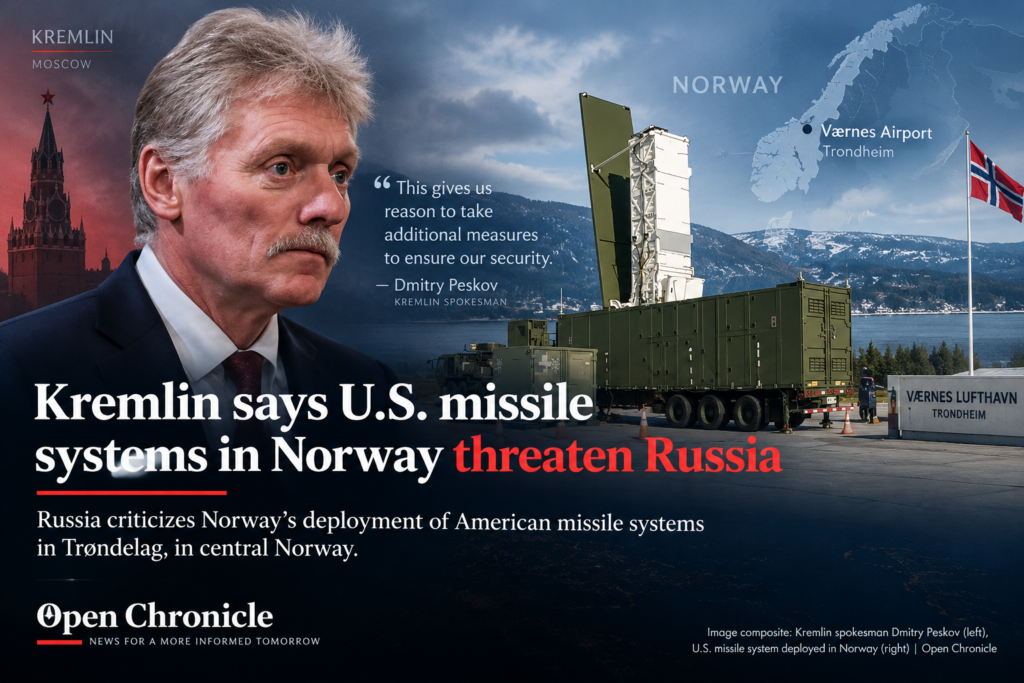
Russia has warned that the deployment of American missile systems in central Norway represents a security threat, with the Kremlin saying Moscow is considering additional measures in response.
Kremlin spokesman Dmitry Peskov said the deployment associated with military exercises in Norway could not be viewed by Moscow as anything other than a potential threat to Russian security.
The warning adds another source of friction between Russia and NATO as military activity across Europe’s northern flank assumes growing strategic importance.
Missile system deployed near Trondheim
According to the information reported by Norwegian newspaper Aftenposten, the American missile system arrived at Værnes Airport, near Trondheim in the Trøndelag region, in connection with a military exercise around the beginning of September.
The system is reportedly capable of employing Tomahawk cruise missiles, weapons with sufficient range, depending on the variant and launch position, to potentially threaten targets deep inside Russian territory.
For Moscow, the presence of a long range American strike capability in Norway changes the strategic significance of military infrastructure relatively close to Russia’s northwestern regions.
Peskov said Russian authorities were already assessing the implications.
“This gives us reason to take additional measures to ensure our security. Our Defense Ministry, as well as other relevant services, are dealing with it.”
The Kremlin did not specify what those measures might involve.
Norway’s strategic importance is growing
Norway occupies a particularly sensitive position within NATO’s northern defenses. The country shares a land border with Russia in the Arctic and sits close to strategically important Russian military installations on the Kola Peninsula.
That region hosts a significant part of Russia’s Northern Fleet and elements of Moscow’s nuclear deterrent.
The expansion of NATO military activity in northern Europe has therefore been closely monitored by Russia, particularly following Finland and Sweden’s accession to the alliance.
Norway has long maintained close military cooperation with the United States while simultaneously attempting to manage the risks associated with sharing a border with Russia.
The arrival of an American missile system capable of long range strikes is consequently likely to receive significantly more attention in Moscow than the deployment of conventional forces for a temporary exercise.
Tomahawk capability raises Russian concerns
The Tomahawk is one of the United States’ principal long range cruise missiles and has been used extensively in military operations since the Gulf War.
Modern variants can strike targets at considerable distances with high precision, making land based launch systems potentially important elements of NATO’s conventional deterrence.
From Russia’s perspective, the concern is not necessarily whether Tomahawk missiles are currently deployed with the system in Norway, but whether the infrastructure provides the United States with the ability to rapidly introduce such weapons during a crisis.
That distinction has increasingly become central to disputes between Moscow and NATO over missile deployments.
Russia has repeatedly argued that Western long range strike capabilities positioned closer to its territory reduce warning times and increase the risk of escalation during a confrontation.
NATO governments, meanwhile, have generally presented the strengthening of their northern defenses as a response to Russia’s military posture and the broader deterioration of European security since Moscow’s full scale invasion of Ukraine in 2022.
Northern Europe becomes increasingly militarized
The dispute illustrates the growing strategic importance of northern Europe.
Norway, Sweden and Finland now form a largely continuous NATO military space stretching from the North Atlantic to Russia’s northwestern frontier. This has significantly changed the alliance’s ability to coordinate air, naval and land operations across Scandinavia.
At the same time, Russia retains formidable military capabilities in the Arctic and around the Kola Peninsula.
Any expansion of long range Western missile capabilities in the region is therefore likely to generate countermeasures from Moscow, potentially including changes to air defenses, missile deployments, electronic warfare capabilities or military readiness.
Peskov’s statement suggests that Russia’s Defense Ministry is already examining possible responses.
Another pressure point between Russia and NATO
The Norwegian deployment comes at a moment when relations between Russia and the West remain deeply strained by the war in Ukraine and the broader military buildup along NATO’s eastern and northern flanks.
Even deployments associated with exercises can carry wider strategic implications when the systems involved have the potential to deliver long range weapons.
For Moscow, the central concern is the possibility that NATO infrastructure increasingly capable of supporting precision strikes is moving closer to strategically important Russian territory.
For Norway and its allies, strengthening military capabilities forms part of a broader effort to reinforce deterrence and ensure NATO can operate effectively in the increasingly contested Arctic and Nordic regions.
The result is another emerging pressure point in European security, one where geography, missile technology and rapidly changing military deployments are increasingly intertwined.