
By Open Chronicle History Desk
On the afternoon of September 7, 1940, Londoners looked towards the sky and witnessed the approach of one of the largest German air formations yet assembled over Britain.
Hundreds of aircraft crossed southern England.
Bombers flew towards the capital accompanied by fighter escorts. Their target was no longer primarily the airfields and installations of the Royal Air Force.
It was London.
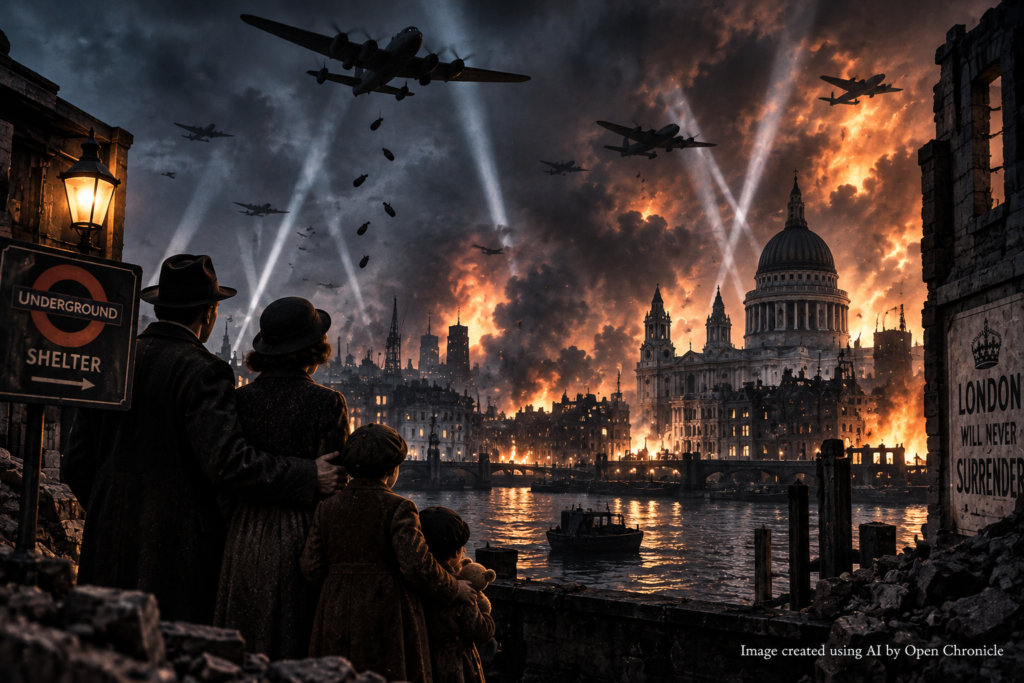
Shortly after 5 p.m., bombs began falling across the city’s East End and the docklands along the River Thames.
Warehouses burned.
Homes were destroyed.
Factories were hit.
Docks erupted in flames.
As darkness descended, another wave of German bombers arrived.
The night sky turned red.
The attack of September 7, 1940 marked the beginning of what became known as the Blitz, the sustained German bombing campaign against London and other British cities during the Second World War.
London would be bombed for 57 consecutive nights.
The campaign would eventually spread destruction across Coventry, Liverpool, Birmingham, Bristol, Plymouth, Southampton, Belfast and numerous other towns and cities.
Thousands of civilians would die.
Entire neighbourhoods would be transformed.
Yet Britain would not surrender.
And Germany’s decision to concentrate increasingly on cities rather than RAF infrastructure would become one of the most debated strategic decisions of the Battle of Britain.
Britain Stands Alone
To understand September 7, it is necessary to return to the extraordinary events of the previous months.
In May 1940, German forces launched their offensive into Western Europe.
The Netherlands fell.
Belgium fell.
British forces were driven towards Dunkirk.
France, which possessed one of Europe’s largest armies, collapsed with astonishing speed.
Paris was occupied.
On June 22, 1940, France signed an armistice with Germany.
Adolf Hitler now dominated much of continental Western Europe.
Britain remained at war.
Hitler Looks Across the Channel
Britain’s refusal to negotiate presented Germany with a strategic problem.
An invasion of the British Isles would require control of the English Channel.
The Royal Navy remained immensely powerful.
Germany therefore needed to weaken or destroy the Royal Air Force before an invasion could realistically proceed.
Plans were developed for Operation Sea Lion, the proposed German invasion of Britain.
Before German soldiers could cross the Channel, however, the Luftwaffe had to win the battle in the air.
Thus began the Battle of Britain.
The Battle of Britain
During the summer of 1940, German aircraft attacked shipping, coastal installations, radar stations and RAF airfields.
The Luftwaffe possessed formidable strength.
German pilots had accumulated extensive combat experience over Poland, Norway, France and the Low Countries.
Aircraft such as the Messerschmitt Bf 109 represented some of the world’s most advanced fighters.
Britain answered with aircraft including the Hawker Hurricane and Supermarine Spitfire.
But Britain’s defence depended on much more than individual aircraft.
It depended on a sophisticated integrated air defence system.
Britain’s Invisible Advantage
Under Air Chief Marshal Hugh Dowding, RAF Fighter Command had developed a network combining radar, ground observers, communications centres and fighter control stations.
The Chain Home radar system could detect incoming German formations before they reached British territory.
Information flowed through command centres.
Controllers could then direct fighter squadrons towards approaching enemy aircraft.
This allowed Britain to use limited fighter resources efficiently.
German intelligence never fully appreciated how effective this system had become.
Destroying individual airfields was not enough.
Britain’s entire air defence network had to be broken.
The Pressure on Fighter Command
By late August and early September, the situation had become extremely serious.
German attacks increasingly targeted RAF fighter stations in southern England.
Airfields were damaged.
Ground crews worked continuously.
Pilots flew repeated missions.
Experienced fighter pilots were being killed or wounded faster than they could easily be replaced.
Britain was not necessarily on the verge of immediate defeat, as some later popular accounts suggested, but Fighter Command was under substantial pressure.
Germany had found targets capable of damaging Britain’s defensive system.
Then Luftwaffe strategy changed.
Bombs Fall on Cities
Civilian areas had already been hit during the air campaign, sometimes through navigational error and sometimes as part of attacks on military and industrial targets.
On the night of August 24 to 25, German bombs fell on parts of London.
Britain responded by sending RAF bombers against Berlin.
The material damage was limited.
The political effect was much greater.
Hermann Göring had boasted that enemy bombers would not reach the German capital.
Now Berlin had been bombed.
Hitler was furious.
Hitler Threatens Britain’s Cities
On September 4, Hitler addressed a crowd at Berlin’s Sportpalast.
He threatened massive retaliation against British cities.
The Luftwaffe was already reconsidering its strategy.
German commanders hoped that attacking London could achieve several objectives simultaneously.
The capital was a major port and industrial centre.
Bombing it could damage British economic infrastructure.
It might also force RAF fighters into large battles where the Luftwaffe could destroy them.
And perhaps sustained attacks against Britain’s largest city would break civilian morale.
The new strategy was about to be tested.
September 7, 1940
Saturday afternoon began relatively normally in London.
Then radar stations detected enormous German formations approaching.
The Luftwaffe had assembled a major striking force.
Roughly 350 bombers, supported by several hundred fighters, participated in the afternoon assault.
The formations crossed the English coast and moved towards London.
Observers on the ground could see the aircraft filling the sky.
The primary target area lay around the London docks and East End.
At approximately 5 p.m., the attack began.
The East End
London’s East End contained some of the city’s most important industrial and maritime infrastructure.
The docks along the Thames handled enormous quantities of cargo essential to Britain’s economy and war effort.
Warehouses stored food, timber, fuel and other materials.
Factories surrounded the docklands.
Railways and roads connected the port with the rest of the country.
But hundreds of thousands of civilians also lived nearby.
Working class neighbourhoods stood close to strategically important targets.
Bombing the docks inevitably meant bombing homes.
The Thames Becomes a Target
German bombers followed the Thames towards their objectives.
The river provided an obvious navigational feature visible from the air.
Bombs struck the Royal Docks, Surrey Docks, West India Docks and surrounding industrial districts.
Warehouses caught fire.
Oil and timber burned.
Smoke rose thousands of feet above London.
Fire created additional navigational markers for the bombers that followed.
The first attack was devastating.
But it was only the beginning.
Night Falls
As the daylight raid ended, London prepared for another attack.
German night bombers arrived.
The fires created by the afternoon raid illuminated parts of the city.
Anti aircraft guns opened fire.
Searchlights swept across the sky.
Air raid sirens sounded.
Londoners moved towards shelters.
Explosions continued through the night.
The capital experienced something fundamentally different from previous raids.
This was not a short attack.
It was sustained aerial bombardment on a metropolitan scale.
London’s Burning Skyline
Fire became one of the defining features of the Blitz.
Incendiary bombs could ignite buildings across wide areas.
Firefighters faced an almost impossible task.
They had to combat multiple fires while bombs were still falling.
Water mains could be damaged.
Roads became blocked by debris.
Buildings collapsed.
Communications were disrupted.
The docks were particularly vulnerable because warehouses contained highly combustible materials.
From miles away, the glow above London could be seen against the night sky.
Civilians Under Bombardment
For ordinary Londoners, the experience was terrifying.
People sheltered beneath staircases, in basements, in public shelters and increasingly in Underground stations.
Families listened to the explosions overhead.
Children slept beside strangers.
Dust entered shelters when nearby buildings were struck.
People emerged after raids uncertain whether their homes would still exist.
The Blitz transformed warfare into an intensely civilian experience.
The front line had reached residential streets.
The Casualties of September 7
The first great raid killed hundreds of people and injured many more.
The East End suffered particularly heavily.
Homes disappeared beneath rubble.
Families were separated.
Emergency services worked throughout the night.
Hospitals received casualties.
Rescue teams searched collapsed buildings for survivors.
Yet the Luftwaffe returned the following night.
And the night after that.
And the night after that.
London was entering a new phase of the war.
Fifty Seven Consecutive Nights
From September 7 until November 2, 1940, London was bombed every night.
The intensity varied, but the psychological effect was enormous.
Air raid sirens became part of daily life.
People learned to recognise the sound of approaching aircraft.
Blackout regulations transformed streets after sunset.
Windows were covered to prevent light helping enemy bombers navigate.
Families kept emergency supplies ready.
Many children had already been evacuated from the city.
Others remained.
London adapted to life under aerial siege.
The Underground
One of the most enduring images of the Blitz is that of civilians sleeping on platforms of the London Underground.
The government had initially been reluctant to encourage the use of Underground stations as shelters.
Officials feared disruption to transportation and other problems.
But Londoners increasingly entered the stations during raids.
Authorities eventually adapted.
Bunks were installed in some locations.
Sanitation and medical arrangements improved.
Thousands of people spent nights beneath London while bombs exploded above.
The Underground became both transport network and refuge.
Anderson Shelters
Many families used Anderson shelters.
These small corrugated steel structures were installed partly underground in gardens and covered with earth.
Millions had been distributed before and during the war.
Other people used communal shelters.
Later, indoor Morrison shelters provided another form of protection.
No shelter offered absolute safety.
A direct hit could still be fatal.
But civil defence measures saved many lives.
Britain had prepared for bombing because government planners had feared aerial attack for years.
The ARP
Air Raid Precautions personnel became essential to urban survival.
Wardens enforced blackout regulations.
They guided civilians towards shelters.
They reported bomb damage.
They helped organise emergency responses.
Firefighters fought enormous blazes.
Ambulance crews entered bombed neighbourhoods.
Police maintained order.
Rescue workers dug through rubble.
Volunteers served in canteens and rest centres.
The defence of Britain was no longer simply the responsibility of soldiers and pilots.
Millions of civilians had become part of the war effort.
“Keep Calm” Was More Complicated
Later memory often portrays Londoners responding to bombing with almost effortless stoicism.
The reality was more human.
People were frightened.
Some panicked.
Some suffered psychological trauma.
Some became exhausted.
There was anger, grief and frustration.
Bombing also exposed social inequalities.
Poorer communities often lived closer to industrial targets and sometimes had access to less effective private shelter.
Yet predictions of widespread social collapse proved wrong.
Civil administration continued.
Factories continued producing.
Transport continued operating.
Most people continued working.
The Luftwaffe could destroy buildings.
Breaking an entire society proved much harder.
Buckingham Palace Is Bombed
The bombing did not spare symbols of the British establishment.
Buckingham Palace was struck several times during the Blitz.
King George VI and Queen Elizabeth remained in London for much of the bombing campaign.
Their presence became symbolically important.
The royal family visited damaged areas and met civilians.
The monarchy’s wartime visibility helped strengthen its connection with the population.
But no individual symbol became more closely associated with British resistance than Prime Minister Winston Churchill.
Churchill and the Blitz
Churchill had become prime minister in May 1940, during the collapse of France.
His speeches had already framed Britain’s struggle in dramatic historical terms.
After bombing raids, Churchill visited devastated neighbourhoods.
Crowds sometimes greeted him enthusiastically.
His rhetoric emphasised endurance and resistance.
Britain, he insisted, would continue fighting.
But Churchill’s public confidence existed alongside serious strategic concerns.
Nobody knew whether the Luftwaffe could eventually destroy enough infrastructure to force Britain into a catastrophic position.
The battle remained dangerous.
The Luftwaffe’s Strategic Gamble
The decision to focus heavily on London remains one of the most discussed aspects of the Battle of Britain.
Attacking the capital did not mean German attacks on RAF targets stopped entirely.
Nor was the decision simply an emotional act of revenge by Hitler.
London contained genuine military, industrial and transportation targets.
German planners also hoped Fighter Command would be forced to defend the capital in large engagements.
But the shift had an important consequence.
Pressure on some RAF sector stations and airfields decreased.
Fighter Command gained valuable breathing space.
Damaged facilities could be repaired.
Pilots could continue operating from the broader defensive network.
Germany had changed the character of the battle without destroying the RAF.
September 15
Eight days after the Blitz began, Germany launched another enormous daylight attack against London.
The RAF intercepted the formations.
Large air battles developed over southern England.
British claims of German losses were initially exaggerated, as frequently happened in wartime reporting, but the Luftwaffe suffered significant losses and failed to achieve air superiority.
September 15 later became commemorated as Battle of Britain Day.
The hoped for destruction of Fighter Command had not occurred.
Operation Sea Lion became increasingly unrealistic.
Hitler Postpones the Invasion
On September 17, Hitler postponed Operation Sea Lion.
Germany had not achieved the air superiority required for an invasion.
The postponement did not end the bombing campaign.
Instead, attacks increasingly shifted towards nighttime operations.
The Luftwaffe could reduce fighter losses by operating in darkness.
But nighttime bombing was far less accurate.
Entire urban areas became vulnerable.
The Blitz continued.
Coventry
London was not the only target.
On the night of November 14 to 15, 1940, the Luftwaffe launched a devastating raid against Coventry.
The city was an important industrial centre.
Hundreds of German bombers attacked.
Factories were damaged.
Large areas of the historic city centre were destroyed.
Coventry Cathedral burned.
Hundreds of people were killed.
The destruction became one of the most famous symbols of the Blitz outside London.
Liverpool and the Atlantic Lifeline
Liverpool was another crucial target.
Its port was essential to Britain’s Atlantic supply system.
Food, fuel, weapons and raw materials arrived through western ports after crossing an ocean threatened by German U boats.
German bombers therefore attacked Liverpool and the surrounding Merseyside region repeatedly.
The city suffered particularly severe raids during 1941.
Destroying Britain’s ports could potentially achieve what bombing morale alone could not.
It could weaken the country’s ability to continue fighting.
Birmingham, Bristol and the Industrial War
Birmingham’s factories made it strategically important.
Bristol combined port facilities with major industrial production.
Southampton contained docks and aircraft manufacturing.
Plymouth was an important naval centre.
Cities across Britain experienced repeated attacks.
The Blitz was therefore not simply a campaign against London.
It became a national experience of urban bombardment.
Industrial workers increasingly lived and worked on a front line without trenches.
Belfast
The bombing eventually reached Northern Ireland.
In April and May 1941, Belfast suffered devastating German attacks.
The city contained important shipbuilding and industrial facilities.
Civil defence preparations were inadequate compared with some British cities.
The raids caused heavy casualties and extensive destruction.
The Belfast Blitz demonstrated the geographical reach of German air power.
Few major British industrial centres could assume they were safe.
The Second Great Fire of London
One of the most dramatic raids occurred on the night of December 29, 1940.
German aircraft dropped large numbers of incendiary bombs over the City of London.
Fires spread through the historic centre.
The raid became known as the Second Great Fire of London, recalling the Great Fire of 1666.
Churches and commercial buildings burned.
Firefighters struggled to contain the flames.
A famous photograph showed St Paul’s Cathedral surrounded by smoke.
The cathedral survived.
Its dome became one of the enduring visual symbols of British resilience.
Bombing and Propaganda
Both sides used bombing for propaganda.
German broadcasts portrayed Britain as increasingly vulnerable and isolated.
British media emphasised civilian courage and national unity.
Images of firefighters, bomb damaged streets and people continuing ordinary life became powerful instruments.
The phrase Blitz spirit later emerged as shorthand for this narrative of collective resilience.
The reality was more complex.
But propaganda mattered because morale itself had become a strategic battlefield.
Could Bombing Break a Nation?
Before the war, military theorists had made terrifying predictions about strategic bombing.
Some believed that fleets of bombers could destroy cities so rapidly that civilian populations would panic and governments would collapse.
The Blitz tested those theories.
Bombing killed civilians and caused enormous destruction.
But the British state did not collapse.
Industrial production continued.
Political resistance remained strong.
This did not mean bombing was ineffective.
It meant that the relationship between physical destruction and political surrender was much more complicated than prewar theorists had assumed.
That lesson would not prevent the Allies from later conducting far larger bombing campaigns against Germany and Japan.
The Moral Transformation of Air War
The Blitz also contributed to the escalation of strategic bombing.
During the early months of the war, governments had sometimes attempted to distinguish carefully between military targets and civilian areas.
As the conflict intensified, those boundaries eroded.
Britain expanded its bombing campaign against Germany.
The RAF would eventually conduct enormous area bombing operations against German cities.
Hamburg, Cologne, Dresden and many others would suffer destruction on a scale greater than most British cities experienced during the Blitz.
The air war became increasingly total.
Civilians on both sides paid an enormous price.
May 1941
The major phase of the Blitz ended in May 1941.
Germany was preparing for an even larger military operation.
Hitler intended to invade the Soviet Union.
Luftwaffe resources were shifted eastwards for Operation Barbarossa.
London experienced one particularly severe raid on the night of May 10 to 11.
Then the sustained bombing campaign diminished dramatically.
Britain had survived.
Germany had failed to force the country out of the war.
The Human Cost
The cost had been terrible.
Across Britain, roughly 43,000 civilians were killed during the Blitz, with many more seriously injured.
London suffered the largest share of casualties.
Homes were destroyed on an enormous scale.
Families lost everything.
Historic buildings disappeared.
Industrial facilities and ports were damaged.
The psychological effects continued long after the bombing stopped.
The statistics describe the scale.
They cannot fully describe what it meant to hear an air raid siren and wonder whether your street would still exist the following morning.
Children of the Blitz
Children experienced the war in particularly disruptive ways.
Large evacuation programmes moved young people away from cities considered vulnerable to bombing.
Some were sent to rural Britain.
Others travelled overseas.
Families were separated for months or years.
Not every evacuation experience was positive.
Some children experienced loneliness, mistreatment or severe homesickness.
Others formed lasting relationships with host families.
The Blitz therefore reshaped childhood for an entire generation.
Britain Had Won the Immediate Battle
The Luftwaffe failed in its most important strategic objective.
The RAF survived.
Germany did not obtain air superiority.
Operation Sea Lion was never launched.
Britain remained a base from which the war against Germany could continue.
This had consequences Hitler could not fully foresee in September 1940.
American supplies increasingly flowed into Britain.
British bombers continued operating against occupied Europe and Germany.
Later, American forces arrived in enormous numbers.
And in 1944, Britain became the principal launching ground for the Allied invasion of Normandy.
The island Germany had failed to defeat in 1940 eventually became the platform from which Western Europe was liberated.
The Battle of Britain and the Blitz
The two terms are often used interchangeably.
They should not be.
The Battle of Britain was primarily the struggle for control of the air over Britain during 1940, particularly between the RAF and Luftwaffe.
The Blitz refers principally to the sustained German bombing campaign against British cities from September 1940 into May 1941.
The periods overlap.
September 7 belongs to both stories.
German bombers attacked London while fighter battles continued overhead.
But the strategic emphasis had changed.
The civilian population was now at the centre of the conflict.
Was September 7 Hitler’s Great Mistake?
Popular histories sometimes describe the decision to bomb London as the moment Hitler lost the Battle of Britain.
The reality deserves more caution.
German strategy did not change instantly or completely.
RAF installations continued to be attacked.
London itself contained major military and industrial targets.
The Luftwaffe also hoped to draw British fighters into combat.
Nevertheless, the shift unquestionably relieved some of the intense pressure being placed on Fighter Command’s infrastructure.
Germany had failed to understand the resilience of Britain’s integrated air defence system.
It also underestimated the difficulty of destroying a modern industrial society through bombing alone.
The consequences were strategically significant.
Memory of the Blitz
The Blitz occupies a powerful place in British historical memory.
Images recur again and again.
Searchlights crossing the night sky.
Children sleeping in Underground stations.
Firefighters standing among burning buildings.
St Paul’s Cathedral surrounded by smoke.
Families examining the ruins of their homes.
Churchill walking through bomb damaged streets.
These images helped create a national narrative of resistance.
Like all national memories, it simplifies a more complicated reality.
But it reflects something genuine.
Britain endured months of sustained bombing and continued fighting.
A Different Kind of Battlefield
The Blitz demonstrated that industrial warfare had erased many traditional distinctions between battlefield and home front.
A factory worker in London could be exposed to enemy attack while producing weapons.
A firefighter could face lethal danger without being a soldier.
A child could become a casualty hundreds of kilometres from the nearest ground battle.
Technology had expanded the geography of war.
Aircraft could carry destruction directly into the centre of cities.
This transformation would define warfare throughout the twentieth century.
Why September 7 Matters
September 7, 1940 matters because it marked the moment when Britain’s struggle against Nazi Germany entered a new and terrifying phase.
The Luftwaffe attempted to use air power to damage British industry, disrupt transportation, weaken military capacity and undermine civilian morale.
Instead, the campaign revealed the limitations of bombing as an instrument for forcing political surrender.
Britain suffered enormously.
But Britain remained in the war.
The RAF remained operational.
The invasion was postponed.
London continued functioning.
The strategic objective was not achieved.
September 7, 1940
As darkness fell over London that Saturday evening, nobody knew how long the bombing would continue.
Nobody knew whether German troops would soon cross the Channel.
Nobody knew whether Britain could withstand months of attacks.
The people sheltering beneath the city could hear explosions above them.
Firefighters were fighting blazes along the Thames.
Rescue workers were searching destroyed houses.
Pilots were returning to damaged airfields.
The skyline burned.
And the Luftwaffe would return the following night.
Then again.
And again.
For 57 consecutive nights, London would experience bombing.
The Blitz would kill thousands, destroy homes and transform civilian life.
But it would not produce the surrender Hitler sought.
Britain remained at war.
Four years later, Allied armies would cross the Channel in the opposite direction.
That is the historical significance of September 7, 1940.
The day London entered one of the darkest chapters in its history also began one of the most enduring stories of civilian survival during the Second World War.