
By Open Chronicle News Desk
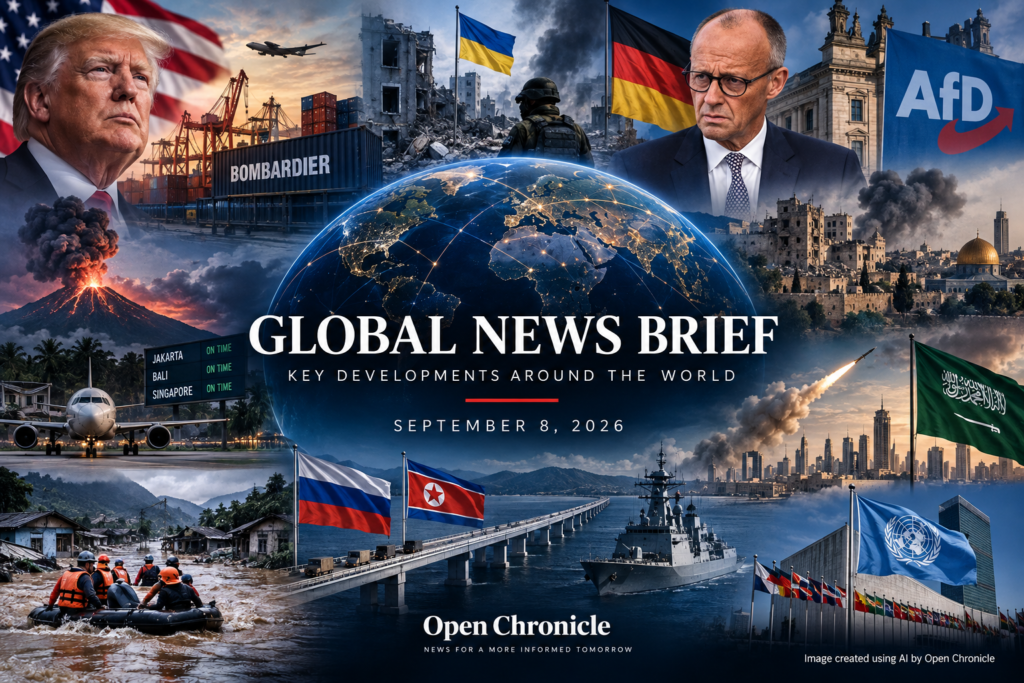
The international agenda on September 8 is being shaped by renewed fighting in Ukraine, growing instability across the Middle East, diplomatic friction between Russia and European governments, trade tensions in North America and a series of major developments across Asia.
Russian attacks on Kyiv resumed shortly after a visit by senior US envoys aimed at advancing peace efforts, while Britain announced a new air defence package for Ukraine. In the Middle East, Houthi attacks on Saudi Arabia have opened another dangerous front in an already volatile regional security environment. Elsewhere, Indonesia is restoring air travel after volcanic ash disrupted airports, and the opening of the first road bridge between Russia and North Korea provides another sign of deepening ties between Moscow and Pyongyang.
Europe
Russia resumes strikes on Kyiv after US diplomatic mission
Russia launched a new wave of drone and missile attacks against Kyiv following a temporary pause associated with the visit of US envoys Steve Witkoff and Jared Kushner.
Reports from Ukraine said at least two people were killed in the renewed attacks. Ukrainian officials portrayed the timing as evidence that Moscow remains prepared to use military pressure even while diplomatic efforts continue.
The visit had nevertheless produced indications of possible movement toward negotiations. Ukrainian President Volodymyr Zelenskyy said the US delegation had helped unblock contacts with Russia and that he expected to meet President Donald Trump later in September.
The contrast between renewed diplomacy and continuing attacks illustrates the fragile state of efforts to bring the war closer to negotiations.
Britain announces new Patriot package for Ukraine
The United Kingdom has announced a £100 million package to strengthen Ukraine’s air defences ahead of winter, including Patriot missiles.
The assistance comes as Ukraine prepares for another period in which Russian forces could intensify attacks against energy infrastructure and urban centres.
Ukraine can also now use European Union loan funding to purchase US Patriot interceptors, potentially expanding Kyiv’s ability to replenish its increasingly important air defence stocks.
Hungary expels Russian diplomats, Moscow threatens retaliation
Hungary has expelled ten Russian diplomats over what Budapest described as unacceptable activities and alleged violations of diplomatic rules.
Moscow responded by promising a harsh retaliatory response.
The confrontation is particularly significant because Hungary has maintained a more accommodating relationship with Russia than most European Union governments throughout the Ukraine war. A serious diplomatic dispute between Budapest and Moscow could therefore represent a notable shift in their relationship.
Finland completes 200 kilometre fence along Russian border
Finland has completed approximately 200 kilometres of fencing along its border with Russia, another physical manifestation of the transformation of Europe’s northern security environment.
The project forms part of broader measures adopted since Russia’s invasion of Ukraine and Finland’s subsequent entry into NATO.
Elsewhere on NATO’s northern flank, Sweden is moving to acquire US HIMARS rocket systems while considering domestic production of associated ammunition.
Millions in Renoir works stolen from French museum
Several paintings attributed to Pierre Auguste Renoir have been stolen from a museum in southern France in a high value art theft.
Reports put the value of the stolen works at roughly €9 million to €10 million. Some accounts said the thieves initially attempted to take four paintings but abandoned part of the haul while escaping.
French authorities have opened an investigation into the robbery.
Middle East
Houthi attacks open dangerous new front against Saudi Arabia
Saudi Arabia says Houthi attacks have struck several cities and energy facilities in the south of the kingdom, causing fires and injuring more than 70 people.
Saudi officials described the attacks as a dangerous escalation. Egypt also condemned the strikes, while the Houthis confirmed operations against Saudi territory and indicated that attacks could continue.
The development is particularly significant because it threatens to widen regional instability at a time when the Gulf is already under severe pressure from the US Iran conflict.
Shipping patterns are also being affected, with traffic reportedly slowing through the Strait of Hormuz while activity increases through Bab al Mandab.
Britain widens pressure on Iran
The United Kingdom has unveiled tougher sanctions and trade restrictions against Iran, including expanded powers targeting vessels connected with prohibited activity.
Iran, meanwhile, continues to warn that further US strikes could trigger attacks against American energy interests in the Gulf.
Oil markets remain sensitive to the confrontation. Prices reached a six week high amid renewed concerns surrounding Hormuz, although the disruption has so far failed to push crude above the psychologically important $100 level.
Arab League rejects displacement of Palestinians
Arab foreign ministers have called for immediate protection for Palestinians and rejected attempts to forcibly displace the population of Gaza.
The diplomatic intervention comes as uncertainty continues over Gaza’s reconstruction and the political framework that could follow the conflict.
The UN Security Council is meanwhile preparing to decide the future of UNIFIL, the United Nations peacekeeping mission in Lebanon, as its 2026 mandate approaches its conclusion.
Questions intensify over reported pre October 7 warning
Israeli political debate has intensified following reports that Prime Minister Benjamin Netanyahu received a warning from the United Arab Emirates shortly before the October 7 attack.
Political opponents have seized on the claims, with former prime minister Naftali Bennett among those accusing Netanyahu of ignoring warnings.
The reports could deepen the long running political controversy in Israel over responsibility for the security failures surrounding the attack.
North America
Trump threatens Bombardier with exclusion from US market
President Donald Trump has threatened Canadian aircraft manufacturer Bombardier with losing access to the American market unless it expands manufacturing in the United States.
The warning adds another dimension to worsening trade relations between Washington and Ottawa.
Canada has meanwhile introduced retaliatory tariffs worth around $20 billion as broader trade negotiations with the United States remain stalled.
The dispute could become increasingly important for North America’s highly integrated aerospace and manufacturing industries.
Iceland summons US envoy over Trump map
Iceland has summoned the US representative following the publication of a map by Trump depicting the Nordic island under the American flag.
The episode has triggered a diplomatic protest in Reykjavik and comes amid renewed controversy surrounding Trump’s territorial rhetoric.
In the United States, political leaders in New Mexico have separately rejected Trump’s suggestion that the state could be renamed “New America.”
Aircraft carrying American family disappears
Authorities are searching for an aircraft carrying a family of four that disappeared while travelling from the Bahamas toward Florida.
The search was continuing as of the latest reports.
Asia Pacific
Indonesia reopens airports after Anak Krakatau eruption
Flights are gradually returning to normal in Indonesia after volcanic ash from Anak Krakatau forced airport closures for two days.
Several airports, including facilities serving Jakarta, reopened after authorities determined that the ash disruption had eased.
The shutdown affected large numbers of passengers, with reports indicating that hundreds of thousands of travellers faced disruption.
Russia and North Korea open first road bridge
Russia and North Korea have opened their first road connection across their shared border, providing another tangible sign of rapidly deepening relations between Moscow and Pyongyang.
The bridge is expected to facilitate trade and transportation between the two countries.
Its strategic importance extends beyond commerce. North Korea has become an increasingly important Russian partner during the Ukraine war, and improved transport infrastructure could make exchanges of goods and other material considerably easier.
Nepal flood disaster continues to worsen
The scale of the disaster along the Nepal China border continues to grow, with reports placing the death toll at around 1,400 and thousands of people still missing.
Rescue operations are concentrating on areas where workers are believed to be trapped inside tunnels, while damaged roads and bridges are complicating access to affected communities.
The catastrophe is also renewing concern about the growing danger of glacial floods across the Himalayas.
China and Japan enter new trade dispute
China has imposed provisional anti dumping measures on imports of Japanese dichlorosilane, a chemical used in semiconductor manufacturing.
Japan has protested the restrictions.
The dispute comes as competition over advanced technology and semiconductor supply chains remains one of the most sensitive elements of economic relations in East Asia.
Africa
Security concerns grow over Islamic State activity in Mozambique
Attention is again turning to northern Mozambique amid reports examining the expansion of Islamic State linked militants into Niassa province.
The spread of militant activity beyond traditional areas of insurgent operations could complicate efforts by Mozambique and regional partners to contain the conflict.
DR Congo creates critical minerals database
The Democratic Republic of Congo has launched a national database intended to map the country’s critical mineral resources.
The initiative comes as international competition intensifies for minerals essential to batteries, electric vehicles, defence systems and advanced technologies.
With the DRC already central to global cobalt production, better mapping of its mineral resources could strengthen the country’s strategic importance in global supply chains.
Latin America and the Caribbean
Bolivia military base disaster worsens
The death toll from explosions at a Bolivian military installation has risen to nine, according to the latest reports, while seven people remain missing.
The disaster has prompted investigations into the handling and storage of explosive material at military facilities.
Rubio begins Latin America tour
US Secretary of State Marco Rubio has begun a diplomatic tour of Latin America as Washington seeks to reinforce its influence across the region.
The trip comes amid intensifying strategic competition involving China and growing US concern over security, migration, trade and infrastructure investment across the Western Hemisphere.
Ecuador’s criminal groups increasingly target education
Organised criminal groups in Ecuador are increasingly targeting schools and the wider education sector, according to reports highlighting the expanding social consequences of the country’s security crisis.
The trend illustrates how organised crime is extending beyond traditional trafficking networks and affecting everyday institutions and communities.
The global picture
September 8 presents an international landscape in which several crises are becoming increasingly interconnected.
The Ukraine war remains simultaneously military and diplomatic, with negotiations continuing even as missiles again strike Kyiv. The Middle East faces another potentially destabilising development as Houthi attacks extend into Saudi territory while the confrontation involving Iran continues to threaten energy markets and Gulf security.
At the same time, Russia’s closer relationship with North Korea, European military reinforcement along NATO’s eastern and northern borders, and widening sanctions against Iran demonstrate how regional conflicts are reshaping alliances far beyond their immediate theatres.
Economic confrontation is also becoming increasingly visible. Washington’s pressure on Bombardier and Canada’s retaliatory tariffs show that strategic competition is no longer confined to traditional geopolitical rivals.
From volcanic disruption in Indonesia and catastrophic flooding in Nepal to instability in Mozambique and Ecuador, the day’s developments underline a broader reality: governments are increasingly confronting security, climate, economic and geopolitical pressures at the same time.