
By Open Chronicle News Desk
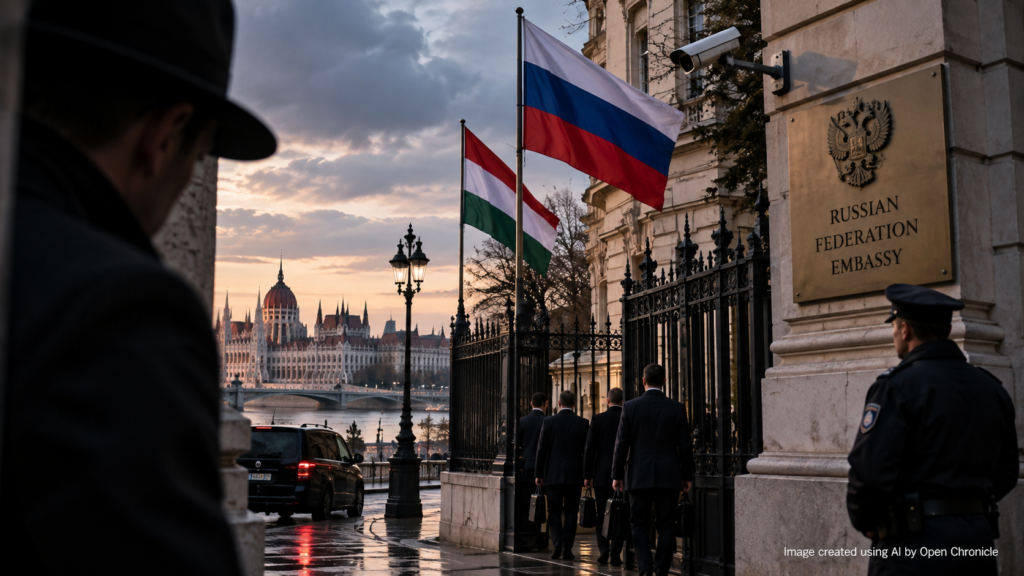
Hungary has ordered the expulsion of 10 Russian diplomats over activities that Budapest says violated the rules governing diplomatic missions, marking a sharp deterioration in relations between Moscow and a European government that has traditionally maintained comparatively close ties with Russia.
Hungarian Foreign Minister Anita Orban announced the decision, saying authorities had formally notified the Russian Embassy and that the diplomats would be required to leave Hungarian territory.
The Hungarian government suspects the officials of conducting activities incompatible with their diplomatic status, with espionage allegations surrounding the case.
Orban said the expulsions were necessary to protect Hungary’s national security and sovereignty, while stressing that Budapest was not breaking diplomatic relations with Moscow.
Hungary, she said, intends to maintain dialogue with Russia on the basis of “mutual respect and compliance with rules.”
Budapest invokes Vienna Convention
According to the Hungarian government, the 10 Russian diplomats engaged in activities prohibited for diplomatic personnel under the Vienna Convention.
Budapest has not publicly disclosed detailed evidence concerning the alleged activities, meaning the precise nature of the suspected intelligence operations remains unclear.
The decision is nevertheless significant because Hungary has frequently pursued a more pragmatic relationship with Moscow than many of its European Union partners, particularly since Russia’s full scale invasion of Ukraine.
The government’s insistence that diplomatic dialogue will continue appears intended to distinguish the expulsions from a broader rupture in Hungarian Russian relations.
Moscow promises retaliation
Russia reacted angrily.
Foreign Ministry spokesperson Maria Zakharova dismissed Hungary’s action as an expression of “Russophobia” and warned that Moscow’s response would be “harsh and painful.”
She did not specify what retaliatory measures Russia intends to take.
A reciprocal expulsion of Hungarian diplomatic personnel would be one possible response, although Moscow had not announced specific measures at the time of the Hungarian decision.
The Russian Embassy in Hungary had also not publicly responded to the allegations.
Its recent communications have instead focused heavily on the war in Ukraine, including criticism of Ukrainian military operations and messaging reflecting the Kremlin’s description of the Ukrainian government as the “Kyiv regime.”
Questions surrounding Russia’s diplomatic presence
The expulsions revive earlier questions surrounding the scale of Russia’s diplomatic presence in Hungary.
In 2022, a Hungarian investigative journalist reported that staffing at the Russian Embassy had increased substantially during the opening months of the war in Ukraine.
According to that investigation, the number of personnel rose from 46 to 62.
The increase attracted attention because the reported staffing level in Budapest exceeded that of Russian diplomatic missions in several considerably larger or strategically important European capitals.
At the time, the reasons for the increase were not publicly established.
European security services have increasingly warned that diplomatic missions can provide intelligence agencies with personnel, infrastructure and diplomatic protections useful for espionage operations. Russia has consistently rejected many European accusations of intelligence and sabotage activities as politically motivated.
Diplomatic confrontation spreads across Europe
The Hungarian decision comes amid a broader deterioration in diplomatic relations between Russia and European governments.
Germany recently took action against Russian diplomatic and cultural institutions following an investigation into an attempted attack involving explosive laden drones at Leipzig Halle Airport.
German authorities linked Russia to the incident, which involved drones threatening an Antonov cargo aircraft carrying military assistance for Ukraine.
Berlin subsequently closed Russia’s consulate general in Bonn and the Russian House cultural centre in Berlin.
Moscow retaliated by closing Germany’s consulate general in Saint Petersburg and a branch of the Goethe Institut.
Russia has denied Western accusations that it is conducting a coordinated campaign of sabotage across Europe.
Reports of another suspected sabotage attempt emerged in early September, involving an alleged bombing plot targeting an energy facility near Cologne.
Europe confronts growing hybrid security concerns
The developments come as European governments increasingly focus on what officials describe as Russian hybrid operations.
These concerns extend beyond traditional espionage and include suspected sabotage, cyberattacks, disinformation campaigns, interference with critical infrastructure and covert influence operations.
Since the invasion of Ukraine, European governments have expelled large numbers of Russian diplomats suspected of intelligence activities.
The expulsions have reduced Russia’s official diplomatic presence across much of Europe, while Moscow has frequently responded with reciprocal measures against European embassies.
Hungary had remained somewhat removed from the most severe diplomatic confrontations because of its continuing political and economic relationship with Russia.
The expulsion of 10 diplomats therefore carries significance beyond the immediate espionage allegations.
A test for Hungary’s relationship with Russia
Budapest has attempted for years to maintain a difficult balance between its obligations as a member of NATO and the European Union and its continuing relationship with Moscow.
Hungary has maintained energy and economic links with Russia and has frequently differed with other EU governments over sanctions, Ukraine and the future of European relations with the Kremlin.
The latest confrontation does not necessarily signal the end of that approach. Orban’s emphasis on continued dialogue suggests Budapest wants to contain the dispute.
Much will now depend on Moscow’s response.
If Russia follows through on its promise of a “harsh and painful” reaction, the espionage dispute could develop into one of the most serious diplomatic confrontations between Hungary and Russia since the beginning of the Ukraine war.
For Europe more broadly, the case adds to growing concern that the confrontation with Moscow is increasingly being fought not only on the battlefield in Ukraine, but through intelligence operations, diplomatic pressure and alleged acts of sabotage across the continent.