
By Open Chronicle News Desk
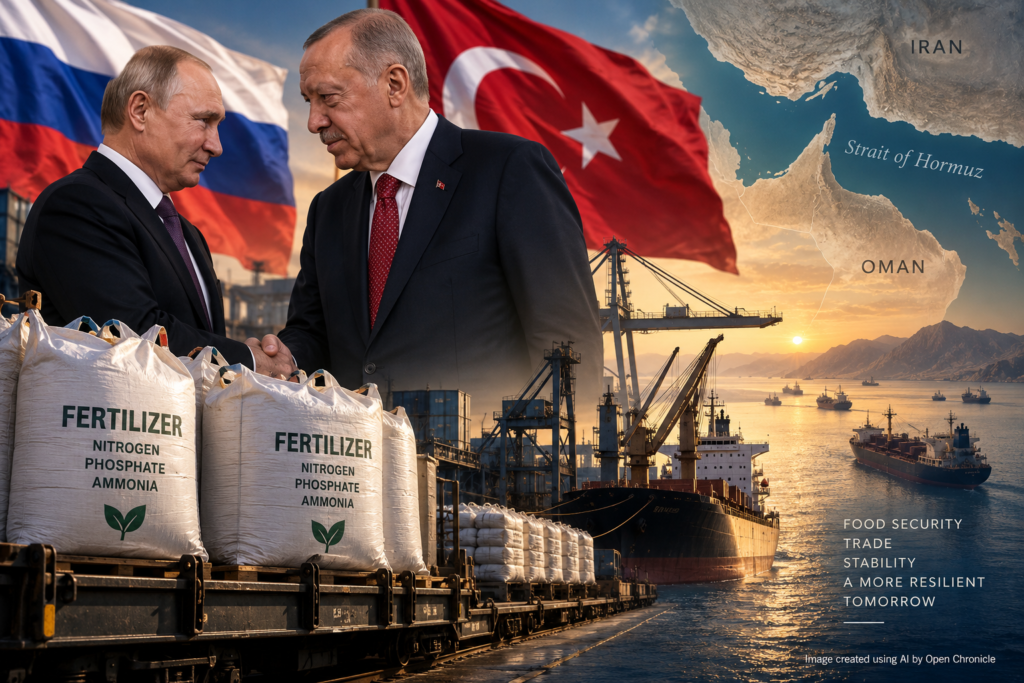
Russia and Turkey are moving to deepen their agricultural trade relationship as instability around the Strait of Hormuz threatens fertilizer supplies from major Gulf producers, potentially giving Ankara preferential access to Russian exports at a time of growing pressure on global supply chains.
Turkish officials are expected to sign a memorandum of understanding with Russia aimed at increasing fertilizer imports and easing some of Moscow’s existing export restrictions, according to reporting by Al Monitor citing Turkish government sources and Bloomberg.
The agreement comes as disruption around the Strait of Hormuz raises concerns about the availability of fertilizer and ammonia produced in the Gulf, highlighting how the widening regional conflict is beginning to affect sectors far beyond oil and natural gas.
Ankara turns to Moscow as Gulf supplies come under pressure
Turkish Deputy Agriculture Minister Ahmet Bagci is expected to sign the memorandum in Moscow with Russian Deputy Agriculture Minister Maxim Borovoy Markovich.
Under the proposed arrangement, Russia would ease restrictions affecting exports of nitrogen and phosphate fertilizers as well as ammonia destined for Turkey. The measure would effectively provide Ankara with preferential access to Russian supplies even while Moscow maintains broader restrictions on fertilizer exports.
For Turkey, the agreement offers an alternative source of strategically important agricultural inputs as uncertainty surrounding maritime traffic through Hormuz increases the risk of supply interruptions from Gulf producers.
Fertilizer availability is particularly important for agricultural economies because shortages or sharp increases in prices can raise production costs for farmers and eventually contribute to higher food prices.
Hormuz crisis spreads beyond energy markets
The Strait of Hormuz is normally associated primarily with global oil and liquefied natural gas flows. The current disruption, however, demonstrates the wider economic importance of the waterway.
Gulf countries are also major producers and exporters of fertilizers and petrochemicals. Any prolonged disruption to shipping therefore has the potential to affect agricultural supply chains across Europe, Asia and other major food producing regions.
For Ankara, securing alternative supplies before shortages become more severe could reduce its exposure to further disruption.
The arrangement with Moscow also illustrates how countries are adapting their trade relationships as the conflict involving Iran reshapes shipping patterns and commodity markets across the Middle East.
Fertilizer becomes another strategic commodity
Russia is already one of the world’s major fertilizer producers, giving Moscow significant influence over international agricultural supply chains.
Fertilizers have become increasingly strategic since Russia’s full scale invasion of Ukraine in 2022 disrupted energy, grain and agricultural markets. Nitrogen fertilizer production in particular is closely connected to natural gas availability and prices.
The proposed Turkish Russian agreement demonstrates how that importance could increase further if supplies from the Gulf become more difficult or expensive to obtain.
For Russia, providing Turkey with privileged access also offers economic and diplomatic advantages. Ankara has maintained extensive commercial relations with Moscow despite the wider deterioration in relations between Russia and NATO countries.
Turkey has simultaneously maintained ties with Ukraine and positioned itself as an important diplomatic and commercial intermediary between Russia, Europe and the Middle East.
Moscow and Ankara deepen pragmatic economic ties
The fertilizer agreement fits into a broader relationship in which Russia and Turkey frequently cooperate economically despite disagreements on several geopolitical issues.
Energy has long been central to those ties, while trade, tourism, agriculture and infrastructure have also created significant economic links between the two countries.
The latest arrangement suggests that agricultural security could become another increasingly important component of that relationship.
For President Recep Tayyip Erdoğan’s government, securing fertilizer supplies would help protect Turkey’s agricultural sector from some of the consequences of a prolonged Gulf crisis.
For Moscow, the agreement strengthens Russia’s position as a reliable commodity supplier while creating another important market for its agricultural exports.
A wider warning for global food markets
The immediate agreement concerns Turkey, but the underlying issue has broader international implications.
If instability around Hormuz persists, countries dependent on Gulf fertilizer supplies may increasingly search for alternative producers. That could increase demand for Russian fertilizer and place additional pressure on international prices.
The consequences could eventually reach consumers. Fertilizer is one of the most important costs facing farmers, and sustained increases in fertilizer prices can translate into higher costs for grain, vegetables and other agricultural products.
The developing situation therefore represents another example of how conflict around one of the world’s most important maritime corridors can spread through the global economy.
What began primarily as a security and energy crisis around the Persian Gulf is increasingly affecting shipping, industrial commodities and agricultural supply chains.
Turkey’s move to secure preferential access to Russian fertilizer shows that governments are already preparing for the possibility that disruption around the Strait of Hormuz could persist, potentially reshaping international commodity flows well beyond the Middle East.