
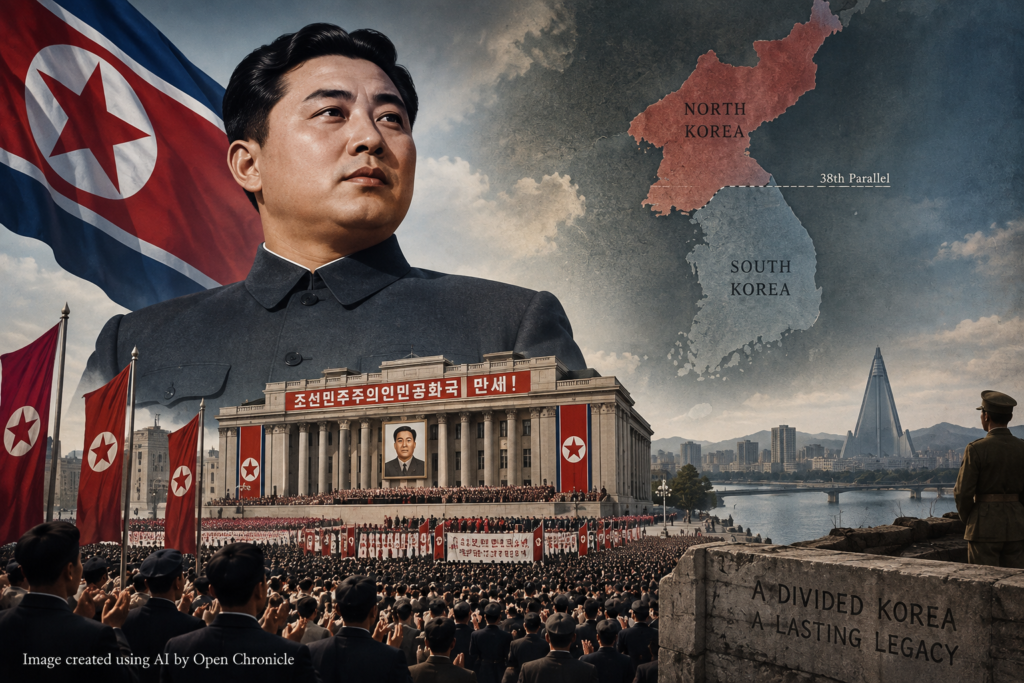
By Open Chronicle History Desk
On September 9, 1948, the Democratic People’s Republic of Korea, better known as North Korea, was formally established in Pyongyang, with Kim Il Sung as its first premier.
The proclamation came less than a month after the establishment of the rival Republic of Korea in Seoul.
Three years after liberation from Japanese colonial rule, Korea had not emerged as the unified independent nation many Koreans had hoped for in 1945. Instead, the peninsula had become divided between two governments, each claiming legitimacy over Korea as a whole and each supported by one of the emerging superpowers of the Cold War.
What had originally been conceived as a temporary occupation arrangement hardened into one of the most consequential geopolitical divisions of the twentieth century.
Less than two years later, the rivalry exploded into the Korean War.
More than seven decades later, the peninsula remains divided.
Korea Before the Division
For centuries, Korea possessed a distinct political and cultural identity.
That independence was progressively threatened during the late nineteenth and early twentieth centuries as imperial Japan expanded its influence across East Asia.
Following Japan’s victory over Russia in the Russo-Japanese War, Japanese domination intensified.
In 1910, Japan formally annexed Korea.
The Korean Peninsula would remain under Japanese colonial rule for the next 35 years.
Japanese authorities attempted to integrate Korea into the empire politically, economically and culturally.
Land and industrial development transformed parts of the peninsula, but colonial rule was accompanied by political repression and efforts to weaken Korean national identity.
Korean resistance never disappeared.
The March First Movement
One of the most important demonstrations of Korean nationalism occurred in 1919.
On March 1, activists proclaimed Korean independence.
Mass demonstrations spread across the peninsula.
Japanese authorities violently suppressed the movement, but the protests demonstrated that Korean nationalism remained powerful despite colonial rule.
Independence organisations continued operating both inside and outside Korea.
Some nationalists looked towards liberal democratic models.
Others embraced socialism or communism.
Still others organised armed resistance.
These ideological divisions would become enormously important after Japan’s defeat.
World War II Changes Everything
During the Second World War, Japan mobilised Korea as part of its imperial war effort.
Koreans were conscripted into military and industrial service, while many women were forced into the Japanese military’s system of sexual slavery commonly associated with the term “comfort women.”
Meanwhile, the Allied powers increasingly discussed what should happen to territories controlled by Japan after the war.
There was broad agreement that Korea should eventually become independent.
But there was much less agreement about exactly how that transition should occur.
That uncertainty became critical in August 1945.
Japan Collapses
The final weeks of the Pacific War unfolded with extraordinary speed.
The United States dropped atomic bombs on Hiroshima and Nagasaki.
The Soviet Union entered the war against Japan and launched a massive offensive in Manchuria.
Japanese resistance collapsed.
Emperor Hirohito announced Japan’s acceptance of Allied surrender terms on August 15.
For Koreans, Japanese defeat promised liberation after 35 years of colonial rule.
But liberation came alongside foreign occupation.
The 38th Parallel
American officials faced an immediate practical problem.
Soviet troops were advancing rapidly through northeastern Asia and into Korea.
Washington wanted to establish an American occupation zone before Soviet forces could occupy the entire peninsula.
Two American officers were tasked with proposing a dividing line.
They selected the 38th parallel.
The Soviet Union accepted the arrangement.
Soviet forces would receive the Japanese surrender north of the line.
American forces would do the same in the south.
The division was not originally intended to create two permanent Korean countries.
It was an administrative solution to the surrender of Japanese forces.
But temporary lines have a way of becoming political borders.
Soviet Forces Enter the North
Soviet troops entered northern Korea in August 1945.
American forces arrived in southern Korea the following month.
The peninsula was effectively divided into two occupation zones.
At first, there remained hopes that some form of unified Korean government could emerge.
But relations between the Soviet Union and United States were deteriorating rapidly.
The wartime alliance against Nazi Germany and Imperial Japan was giving way to strategic rivalry.
Eastern Europe was becoming divided.
Germany was being occupied.
Arguments were developing over political systems, elections and security.
Korea became another arena in the emerging Cold War.
Who Was Kim Il Sung?
Among the Korean communists who emerged in the Soviet occupation zone was Kim Il Sung.
Born Kim Song Ju in 1912, he had participated in anti-Japanese guerrilla activities and spent part of his career operating in Manchuria.
During the Second World War, he served with a Soviet military unit.
When he returned to Korea after Japan’s defeat, he possessed useful credentials.
He was Korean.
He had fought against Japanese rule.
He was a committed communist.
And, crucially, he had Soviet support.
The Soviet occupation authorities helped elevate Kim within the developing political system in northern Korea. He eventually emerged as the dominant figure of the new regime.
He was only 36 years old when the DPRK was established.
A New Political Order in the North
Between 1945 and 1948, northern Korea underwent profound political and social transformation.
Communist authorities consolidated control.
Japanese property and assets associated with collaborators were confiscated.
Land reform redistributed agricultural property.
Major industries were nationalised.
Political opponents faced increasing pressure.
Many Koreans who opposed the developing communist system fled south.
At the same time, the new authorities sought to portray themselves as the legitimate heirs of the Korean independence struggle.
The political institutions being created in Pyongyang increasingly resembled those of the Soviet bloc.
A Different Korea Emerges in the South
Developments south of the 38th parallel followed a different trajectory.
American military authorities administered the southern occupation zone.
The political environment was highly unstable.
Korean conservatives, nationalists, socialists, communists and other movements competed for influence.
Washington increasingly backed anti-communist political forces.
One of the most prominent figures was Syngman Rhee, a veteran Korean nationalist who had spent many years abroad.
As Cold War tensions increased, hopes for a negotiated national government diminished.
The United Nations Becomes Involved
Attempts by Washington and Moscow to agree on a unified Korean political settlement failed.
The Korean question eventually moved to the newly created United Nations.
The United States supported elections intended to establish a representative Korean government.
But Soviet authorities refused to permit UN-supervised elections in the northern zone.
Elections therefore proceeded only in areas accessible to the UN commission — primarily southern Korea.
The result accelerated the political division of the peninsula.
The Republic of Korea
On August 15, 1948, the Republic of Korea was formally established in Seoul.
Syngman Rhee became its first president.
The new South Korean government was strongly anti-communist and aligned with the United States.
But its creation immediately raised a fundamental question.
Was it merely the government of southern Korea?
Or was it the legitimate government of the entire Korean Peninsula?
The authorities in Seoul claimed a wider national legitimacy.
Pyongyang was about to do the same.
September 9, 1948
Less than four weeks later, on September 9, the Democratic People’s Republic of Korea was proclaimed.
Pyongyang became its capital.
Kim Il Sung became premier.
The new state claimed to represent Korea as a whole, not simply the territory north of the 38th parallel.
Two Korean governments now existed.
Both regarded the division as illegitimate.
Both claimed national sovereignty.
Both wanted reunification.
But they proposed radically different political futures.
One was aligned with the United States.
The other with the Soviet Union.
The temporary occupation boundary of 1945 had become a frontier between competing states.
The Cold War Comes to Korea
The creation of North and South Korea cannot be understood separately from the emerging Cold War.
By 1948, relations between the United States and Soviet Union had deteriorated dramatically.
Europe was already being divided into rival political blocs.
The Berlin Blockade began in June 1948.
Communist governments dominated much of Eastern Europe.
The United States had introduced the Truman Doctrine and Marshall Plan.
Strategic competition between Moscow and Washington was becoming global.
Korea became one of the places where that competition intersected with a genuine internal political struggle.
The division was therefore both international and Korean.
Two States, One Nation
The creation of two governments did not immediately produce acceptance of permanent partition.
Quite the opposite.
Political leaders on both sides regarded Korea as one country.
The question was which government would rule it.
Border incidents became increasingly frequent.
Political violence continued.
Both governments strengthened their armed forces.
The Soviet Union provided substantial support to the North Korean regime.
The United States supported South Korea.
The conditions for war were developing.
Soviet Withdrawal
After helping establish the North Korean state, Soviet forces began withdrawing.
American forces also reduced their military presence in South Korea.
By 1949, most Soviet and American occupation troops had left the peninsula.
On paper, Korea was now controlled by Koreans again.
In reality, the peninsula had inherited a dangerous political structure from the occupation.
Two hostile governments faced one another across the 38th parallel.
Each possessed armed forces.
Each claimed the other side’s territory.
And each had connections to a powerful international patron.
Kim Wants Reunification by Force
Kim Il Sung increasingly argued that Korea could be reunified militarily.
He sought Soviet approval for an invasion of the South.
Joseph Stalin initially hesitated.
The Soviet leader did not want to provoke a direct military confrontation with the United States.
But the strategic environment changed.
The Soviet Union successfully tested an atomic bomb in 1949.
Communist forces under Mao Zedong won the Chinese Civil War.
The People’s Republic of China was proclaimed in October 1949.
American forces had largely withdrawn from South Korea.
Kim repeatedly pressed Moscow for permission to act.
Eventually, Stalin agreed, after also considering the possibility of Chinese support.
June 25, 1950
Before dawn on June 25, 1950, North Korean forces crossed the 38th parallel.
The Korean War had begun.
North Korean troops advanced rapidly.
Seoul fell within days.
South Korean and American forces were pushed towards a defensive perimeter around Busan in the southeast.
For a time, it appeared possible that North Korea might conquer almost the entire peninsula.
Then the war changed.
The United Nations Intervenes
The United States decided that the invasion could not be allowed to succeed.
President Harry Truman committed American forces.
The United Nations Security Council authorised military assistance to South Korea.
A multinational UN force, overwhelmingly American but including troops from numerous countries, entered the conflict.
In September 1950, General Douglas MacArthur launched the dramatic amphibious landing at Inchon.
The operation transformed the battlefield.
UN forces recaptured Seoul and drove North Korean troops northwards.
Soon they crossed the 38th parallel.
The objective was no longer merely to defend South Korea.
The possibility emerged of reunifying Korea under Seoul.
China Enters the War
That advance brought UN forces close to China’s border.
The People’s Republic of China warned against further movement north.
When those warnings failed to halt the offensive, Chinese forces entered the conflict in enormous numbers.
UN forces were driven south.
Seoul changed hands again.
The war became a brutal struggle involving North Korea, South Korea, China, the United States and other UN forces, with the Soviet Union providing important support to the communist side.
The Korean conflict had become one of the most dangerous confrontations of the early Cold War.
A Devastated Peninsula
The human cost was enormous.
Military personnel and civilians died in vast numbers.
Cities were destroyed.
Families were separated.
Refugees moved across the peninsula.
Bombing devastated infrastructure.
Atrocities were committed in the context of political repression and warfare.
By 1951, the front stabilised roughly around the region where the war had begun.
For another two years, soldiers fought and died while diplomats negotiated.
The Armistice
On July 27, 1953, an armistice was signed.
The fighting largely stopped.
But there was no peace treaty.
A Demilitarized Zone, or DMZ, was established between the two sides.
It became one of the most heavily fortified borders in the world.
The Korean Peninsula remained divided.
The war that had been intended by Pyongyang to reunify Korea instead reinforced the division created after 1945.
That division survives today.
Kim Il Sung Consolidates Power
After the war, Kim Il Sung strengthened his control over North Korea.
Political rivals were eliminated or marginalised.
The state developed an increasingly powerful personality cult around its leader.
Kim became more than a political figure.
Official propaganda transformed him into the central symbol of the state and its revolutionary history.
Over time, North Korea developed its own ideological framework associated with Juche, commonly translated as self-reliance.
In practice, the country remained dependent at different times on Soviet and Chinese economic and military assistance.
But the ideology helped distinguish the North Korean system from its larger communist neighbours.
A Family Dynasty
One of the most unusual features of the North Korean political system was what happened after Kim Il Sung’s death in 1994.
Power passed to his son, Kim Jong Il.
After Kim Jong Il’s death in 2011, leadership passed to his son, Kim Jong Un.
A state founded under communist revolutionary principles had effectively developed a hereditary political succession across three generations.
The Kim family remained at the centre of North Korean political identity.
Few political systems created during the early Cold War survived in such recognisable form into the twenty-first century.
North and South Take Different Paths
The contrast between the two Koreas became increasingly dramatic.
North Korea initially possessed significant industrial advantages, and in the early postwar decades its economy could compare favourably with the South in some respects.
But the trajectories eventually diverged.
South Korea underwent rapid industrialisation.
Despite decades of authoritarian government, it eventually transitioned towards democracy.
Companies from South Korea became major participants in the global economy.
Seoul developed into one of the world’s major metropolitan and technological centres.
North Korea followed a different path.
Its economy stagnated.
Political isolation deepened.
Military spending remained extremely high.
The collapse of the Soviet Union removed a crucial economic partner.
During the 1990s, North Korea experienced catastrophic famine.
Nuclear North Korea
The division created in 1948 eventually acquired a nuclear dimension.
North Korea developed an extensive nuclear weapons programme.
In 2006, it conducted its first nuclear test.
Subsequent tests and missile programmes demonstrated increasingly sophisticated capabilities.
The country’s development of ballistic missiles capable of potentially carrying nuclear warheads transformed the Korean Peninsula into one of the world’s most serious security flashpoints.
What began as a postwar occupation dispute had evolved into a confrontation involving nuclear deterrence.
The DMZ
Few places illustrate the legacy of 1948 more dramatically than the Korean Demilitarized Zone.
The DMZ stretches across the peninsula near the old 38th parallel.
Barbed wire, minefields, guard posts and military forces separate the two Koreas.
Families divided during the Korean War have sometimes spent decades without contact.
The border represents something extraordinary in modern history.
Germany was divided during the Cold War and eventually reunited.
Vietnam was divided and eventually reunited through war.
Korea remained divided.
Could Korea Have Remained United?
Historians continue to debate whether partition was inevitable.
In 1945, the 38th parallel was intended as an occupation boundary rather than a permanent international frontier.
But several forces pushed the peninsula towards division.
American-Soviet rivalry intensified.
Korean politics were deeply polarised.
Communist and anti-communist movements competed violently.
Both emerging governments sought exclusive legitimacy.
Neither superpower wanted the other side to dominate the entire peninsula.
The Cold War turned a temporary administrative line into a political reality.
Once two separate governments were established in 1948, reunification became vastly more difficult.
Why September 9 Matters
September 9, 1948, was not merely the birthday of another country.
It represented the institutionalisation of Korea’s division.
Three years earlier, Koreans had celebrated liberation from Japanese colonial rule.
Many expected independence and national reunification to follow.
Instead, the peninsula became one of the first great geopolitical fault lines of the Cold War.
The creation of the DPRK completed the emergence of two competing Korean states.
That rivalry led directly towards war.
The Korean War then internationalised the division, drawing in the United States, China, the Soviet Union and the United Nations.
Millions suffered.
And the war ended without reunification.
September 9, 1948
More than seventy years later, the consequences remain visible.
Two states occupy the Korean Peninsula.
They share a language, centuries of history and a broader cultural inheritance.
Yet their political systems could scarcely be more different.
One developed into a prosperous democracy deeply integrated into the global economy.
The other became one of the world’s most isolated authoritarian states and eventually developed nuclear weapons.
Between them lies a militarised frontier created from a division that was once supposed to be temporary.
That is what gives September 9, 1948 its extraordinary historical importance.
The establishment of North Korea was not simply the creation of a new government in Pyongyang.
It marked the moment when the division of Korea became embedded in competing state institutions.
The line drawn across a map in the final days of the Second World War had become something much harder to erase.
A border.
A Cold War front.
And, ultimately, one of the longest unresolved divisions in modern history.