
By Open Chronicle with agencies
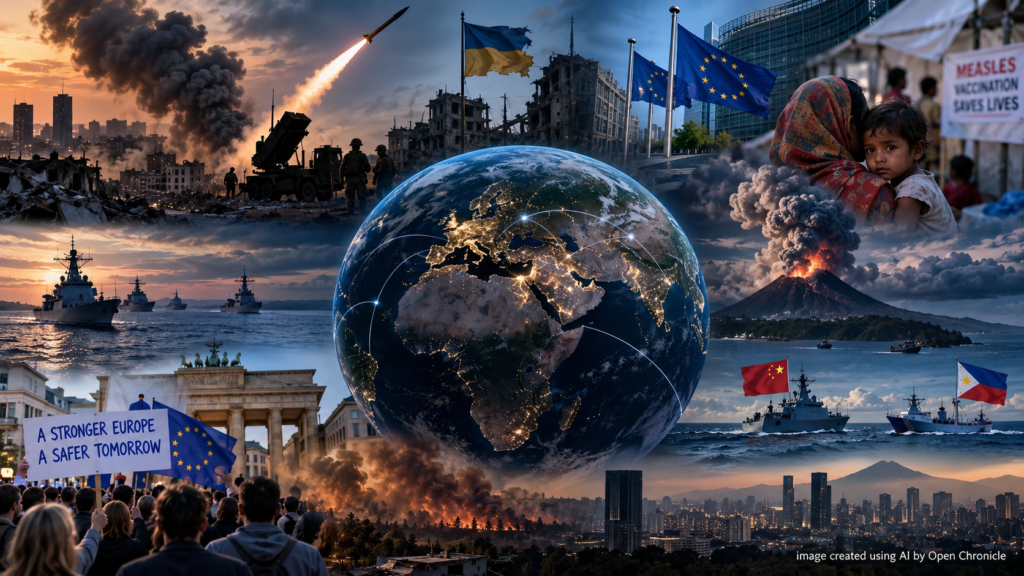
A widening Middle East confrontation, political upheaval in Europe, renewed Russian attacks on Ukraine, a devastating health emergency in Bangladesh and escalating tensions in the South China Sea are among the developments shaping the international agenda.
The Middle East remains the principal geopolitical flashpoint, with attacks on shipping, fighting in Yemen and growing concern that additional regional powers could become directly involved. In Europe, Serbia is heading for an early election while Germany confronts the political consequences of the AfD’s dramatic rise. Across Asia, humanitarian disasters and strategic rivalries are unfolding simultaneously.
Middle East
Pakistan weighs intervention as Yemen conflict threatens wider regional war
Pakistan is reportedly considering military action against Yemen’s Houthis if Saudi Arabia requests assistance under the emerging security arrangement sometimes described as the Mecca Pact. The prospect would represent a significant test of Islamabad’s relationship with Riyadh and could further internationalise the conflict surrounding Yemen.
The reports come as Houthi attacks against Saudi Arabia and fighting across several Yemeni provinces raise fears of another major escalation. Nearly 1,400 families were reported displaced in western Yemen in a single day, while the United Nations has warned that attacks on Saudi territory risk widening the confrontation.
US and Iran trade accusations as confrontation spreads to shipping
The military confrontation involving Iran and the United States is increasingly affecting maritime traffic across the Gulf. Reports described attacks on tankers and other commercial vessels, while oil prices climbed above $100 a barrel amid concerns about regional energy supplies.
Iran said it had targeted American vessels and oil tankers in response to US operations against Iranian shipping. US Central Command rejected Iranian Revolutionary Guard claims that American Navy warships had been successfully struck, saying Iranian attack attempts had failed.
Jordan has also been drawn deeper into the crisis. Authorities said the country’s air defences intercepted 18 of 20 missiles launched from Iran, with no casualties reported. Saudi Arabia and Kuwait condemned the attacks.
Deadly explosion hits weapons depot in Syria
At least 14 people were killed and 11 injured when an explosion struck a weapons storage facility near Sarmada in Syria’s northwestern Idlib region, according to reports citing Syrian state television.
The incident occurred as Syria continues to navigate a fragile security environment. Separately, the International Atomic Energy Agency said outstanding questions surrounding Syria’s past undeclared nuclear activities had been resolved, effectively bringing a long running investigation to a close.
Pressure grows over Israeli settlements
Britain has announced restrictions on trade with Israeli settlements in the occupied West Bank, part of a wider international effort involving several European governments and Canada. Israel responded by ordering the closure of the British consulate in East Jerusalem and restricting entry for several British political figures.
The dispute has become another significant diplomatic confrontation over settlement expansion and the future of a two state solution.
Europe
Serbia dissolves parliament and heads for snap election
Serbian President Aleksandar Vučić has dissolved parliament and called an early election for October 25 following an extended period of political protests.
The election will represent a major test for Vučić after nearly two years of demonstrations and mounting public anger over corruption and governance. Serbia is simultaneously facing renewed tensions with European institutions over its domestic politics and relationship with Russia.
Merz attacks AfD over “remigration” policy
Germany’s political confrontation following the AfD’s recent electoral breakthrough intensified as Chancellor Friedrich Merz accused the far right party of advocating policies that would amount to “ethnic cleansing.”
His remarks focused on the AfD’s concept of “remigration,” which critics say could involve the mass removal of migrants and potentially German citizens with immigrant backgrounds.
The dispute comes as the AfD’s electoral gains continue to reshape German politics and increase pressure on the country’s traditional parties.
Norway says farewell to King Harald V
Norway held the funeral of King Harald V in Oslo, drawing members of European royal families, political leaders and large crowds of mourners.
The ceremony marked the end of an era for the Norwegian monarchy and became one of the country’s most significant state occasions in decades.
EU targets short term rentals amid housing crisis
The European Union is moving toward tighter controls on Airbnb style short term rentals as cities across the continent struggle with housing shortages and rising rents.
The proposed approach would give cities greater authority to regulate short term accommodation in areas where tourism is putting severe pressure on the long term housing market.
Russia and Ukraine
Russian strikes hit Ukraine and Moldova border region
Russia launched another series of strikes against Ukraine, including attacks close to the Moldovan border. Reports said at least two people were killed and several others injured near a border crossing.
President Volodymyr Zelenskyy criticised what he described as an insufficient international response to continuing Russian attacks and called for stronger pressure on Moscow.
Ukraine, meanwhile, continued extending the reach of its own strike campaign. Ukrainian drones reportedly targeted a major Russian gas producing region thousands of kilometres from Ukrainian territory, while other attacks were reported against the Russian naval base and oil infrastructure at Novorossiysk.
Diplomatic efforts remain uncertain. Moscow has expressed hope that US mediated negotiations could resume, while the Kremlin denied reports that a formal roadmap for a settlement already exists.
Asia Pacific
Bangladesh battles devastating measles outbreak
Bangladesh is struggling with what reports describe as one of the most severe measles outbreaks in its history.
Nearly 1,000 suspected measles deaths have been reported, with some accounts placing the toll above that level. Vaccine shortages and gaps in immunisation campaigns are being examined as possible factors behind the scale of the crisis.
China and Philippines clash again over South China Sea
The diplomatic confrontation between Beijing and Manila intensified after Philippine Defence Secretary Gilberto Teodoro publicly challenged China over its claims and behaviour in the South China Sea.
China responded sharply, accusing the Philippines of misrepresenting Beijing’s position. The confrontation illustrates how territorial disputes in the region continue to test relations between China, the Philippines and Manila’s security partners.
Search expands after Anak Krakatau eruption
Indonesian authorities are searching for eight people reported missing at sea near Anak Krakatau following volcanic activity in the area.
Journalists were reported to be among those missing, including a cameraman working for Anadolu. Search operations expanded as authorities attempted to locate the missing vessel.
Indonesia is simultaneously confronting severe wildfire conditions, with smoke forcing additional school closures and emissions from the fires reportedly reaching exceptionally high levels.
Nepal flood disaster deepens
The humanitarian consequences of catastrophic flooding in Nepal continue to worsen. Reports put the death toll at more than 1,300, while thousands remain missing.
Rescue operations continue as authorities assess enormous infrastructure and economic damage, particularly along Nepal’s northern border region and trade routes with China.
Americas
United States considers Middle East military posture
US officials are reportedly holding discussions about whether Washington should reduce parts of its military footprint in the Middle East after recent Iranian attacks highlighted the vulnerability of large American bases.
Any significant restructuring could have consequences for decades of US defence strategy in the Gulf, particularly as the confrontation with Iran becomes increasingly focused on missiles, drones and maritime warfare.
Washington and Bogotá seek to rebuild cooperation
The United States and Colombia have agreed to restore and strengthen bilateral cooperation as Washington attempts to reset relations with Bogotá.
The development could have implications for security cooperation, counter narcotics operations and wider US engagement in Latin America.
Africa
Thousands displaced as Sudan crisis continues
More than 4,500 people have reportedly been displaced in North Darfur and Blue Nile amid deteriorating security conditions in Sudan.
The humanitarian situation is being compounded by reductions in international assistance. Health facilities are reportedly being forced to close as funding shortages affect medical services for communities already devastated by conflict.
Ebola spreads to another health zone in DR Congo
The World Health Organization has reported that Ebola has spread into another health zone in the Democratic Republic of Congo, adding to concerns about containment of the outbreak.
The development places additional pressure on health authorities attempting to prevent wider transmission.
Technology and Artificial Intelligence
AI safety warning renews debate over existential risk
Warnings about the potential long term dangers of advanced artificial intelligence have returned to the international technology debate after an Anthropic safety researcher reportedly estimated a greater than 10 percent probability that sufficiently advanced AI could ultimately cause human extinction.
Such estimates remain highly speculative and disputed within the AI research community, but the comments underline the growing debate surrounding alignment, regulation and the development of increasingly autonomous systems.
At the same time, tensions between Washington and Beijing are spreading into artificial intelligence. US agencies have accused China based AI companies of improperly copying American models, allegations rejected by Beijing.
A world facing overlapping crises
September 8 closes with several crises increasingly intersecting rather than developing in isolation. Conflict in the Middle East is influencing energy markets and military calculations far beyond the region. Russia and Ukraine continue exchanging increasingly long range strikes. Europe is facing political realignment and housing pressures, while Asia is simultaneously confronting major public health emergencies, natural disasters and strategic competition.
Perhaps the most consequential immediate risk remains the Middle East. The possibility that Pakistan, Saudi Arabia and other regional powers could become more directly involved in the Yemen confrontation, alongside escalating US and Iranian operations in the Gulf, raises the danger that several previously separate conflicts could begin merging into a much broader regional crisis.