
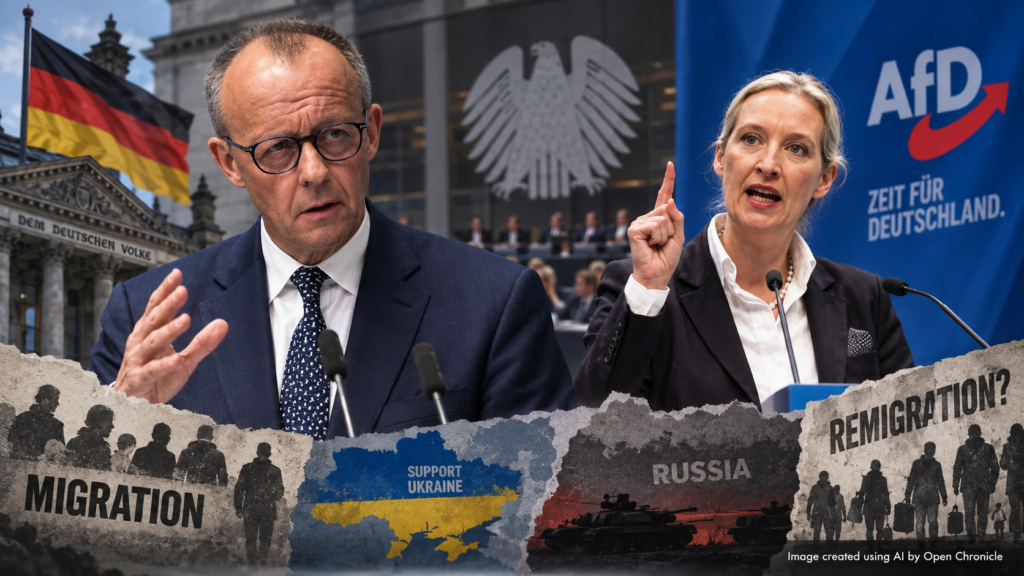
By Open Chronicle with agencies
German Chancellor Friedrich Merz has launched one of his strongest attacks yet on the Alternative for Germany, accusing the party of promoting migration policies that could amount to “ethnic cleansing” and of consistently siding with Russia against Germany’s security interests.
Speaking in parliament following the AfD’s historic election victory in Saxony Anhalt, Merz defended his government’s political direction despite the severe defeat suffered by his Christian Democratic Union and growing pressure over his own leadership.
The AfD rejected the chancellor’s accusations, saying Merz was deliberately misrepresenting its migration policy in an attempt to isolate and demonize the party.
Merz targets AfD’s ‘remigration’ policy
At the centre of the confrontation was the AfD’s use of the term “remigration,” which has become increasingly prominent in the party’s immigration platform.
Responding to an earlier speech by AfD co leader Alice Weidel, Merz said that implementing the policy as he understood it would have profound consequences.
“If what is being advocated here, namely ‘remigration’, were to become reality, it would be nothing other than a synonym for ethnic cleansing based on origin and skin colour,” Merz told parliament.
The AfD disputes that interpretation.
AfD lawmaker Bernd Baumann said the party uses “remigration” to describe the deportation, in accordance with German law, of foreigners who are legally required to leave the country.
He accused Merz of using inflammatory language to preserve the political “firewall” that prevents Germany’s established parties from cooperating with the AfD.
The AfD’s Saxony Anhalt election programme called for faster deportations of rejected asylum seekers and foreign criminals, incentives for some migrants to leave voluntarily, and separate classes for the children of refugees.
Merz warns of economic consequences
Merz also sought to shift the debate toward the economic implications of dramatically reducing Germany’s foreign workforce.
The chancellor argued that large scale removals would deepen existing labour shortages and severely affect sectors that depend heavily on migrant workers.
“Not a single nursing home will function. Not a single hospital in Germany will remain operational, and not a single restaurant will be able to stay in business,” Merz said.
Germany has faced persistent shortages of skilled workers as its population ages, making immigration an increasingly important component of the country’s labour market.
Migration, however, has also become one of Germany’s most divisive political issues and a major source of support for the AfD, particularly in parts of the former East Germany.
Russia and Ukraine become another dividing line
Merz also attacked the AfD over its position toward Moscow and its calls for Germany to end support for Ukraine.
He accused the party of being “steadfastly on Russia’s side” and linked the argument to recent German accusations of Russian involvement in hostile activity inside the country.
Merz referred to an alleged planned drone attack at a German airport last month that German authorities have attributed to Moscow. Russia has denied involvement.
The dispute reflects a wider political divide. The AfD has repeatedly called for a change in Germany’s Russia policy, an end to military assistance for Ukraine and the restoration of closer economic relations with Moscow.
Merz has instead insisted that Germany must continue supporting Kyiv and strengthen its defences against what his government considers a growing Russian security threat.
AfD victory transforms Saxony Anhalt politics
The confrontation came just days after the AfD emerged as the strongest party in Saxony Anhalt, inflicting a major defeat on Merz’s CDU.
Despite winning the largest share of the vote, the AfD failed to secure an absolute majority in the state legislature.
Merz seized on that point during his parliamentary attack.
“You failed to achieve your actual electoral goal of securing a majority of seats in Saxony Anhalt,” he said, adding that 56 percent of voters had chosen other parties.
The result nevertheless represents a significant breakthrough for the AfD and has intensified debate over whether Germany’s traditional strategy of politically isolating the party can survive its growing electoral strength.
Mainstream parties continue to reject coalitions with the AfD under the longstanding “firewall” policy. The possibility of alternative parliamentary arrangements, however, has become increasingly important as coalition mathematics grows more complicated.
AfD rejects extremist comparisons
The AfD has been classified as right wing extremist by the relevant regional branch of Germany’s domestic intelligence service, a designation the party rejects.
Its leaders argue that accusations of extremism are being used by political opponents to discredit millions of Germans who support the party.
Critics, meanwhile, point to controversial statements by senior AfD figures and what they describe as attempts by elements within the party to relativize Germany’s Nazi past.
The AfD, founded in 2013 during the eurozone debt crisis as a eurosceptic movement, rejects comparisons with the Nazi Party.
Concern over the party’s rise has nevertheless intensified among minority communities and Holocaust remembrance organizations.
Eva Umlauf, an Auschwitz survivor and president of the International Auschwitz Committee, said she was “appalled” by the Saxony Anhalt result.
Germany faces a deeper political confrontation
Three days after the election, the future government of Saxony Anhalt remained uncertain.
The immediate question is who can assemble enough parliamentary support to govern the state. The larger question is what the result means for German politics nationally.
For Merz, the challenge is particularly serious. His party has suffered a historic defeat, his approval ratings have fallen sharply, and the AfD is attempting to portray itself as the principal alternative to Germany’s established political order.
Merz, however, has rejected suggestions that he should resign.
His parliamentary confrontation with the AfD suggests that rather than retreating after the Saxony Anhalt defeat, the chancellor intends to sharpen the political dividing lines over migration, Russia, Ukraine and the future direction of Germany.
The battle is therefore no longer simply about one eastern German state. It is increasingly becoming a contest over what kind of country Germany intends to be, and which political forces will define its next era.