
By Open Chronicle News Desk
A British man has been accused of preparing to sabotage drone manufacturing facilities in the United Kingdom after allegedly receiving instructions from another Briton fighting for Russia in Ukraine and believed to have links to Russian military intelligence.
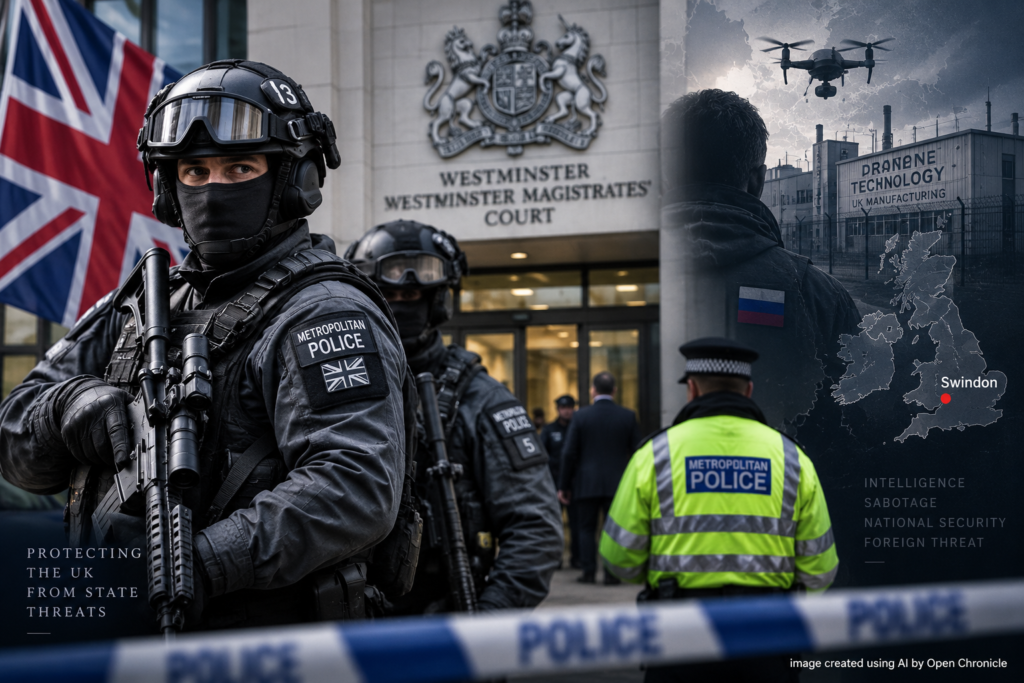
Joshua Cammidge, 31, is accused of researching potential targets around his hometown of Swindon, Wiltshire, conducting reconnaissance and supplying information to a representative of the GRU Volunteer Corps, an organization banned by the British government over its alleged connection to Russia’s GRU military intelligence service.
Prosecutors told Westminster Magistrates’ Court on Thursday that the alleged activity included identifying factories involved in drone production and investigating equipment that could potentially interfere with wireless communications.
Cammidge has not entered a plea. The allegations against him have not been proven.
Prosecutors allege contact with Briton fighting for Russia
At the centre of the case is Aiden Minnis, a British national who has fought alongside Russian forces against Ukraine and whom prosecutors believe is associated with the GRU Volunteer Corps.
Prosecutor Warren Stanier told the court that Cammidge initially communicated with Minnis through Facebook before their conversations moved to Telegram.
The pair allegedly exchanged frequent messages between August 28 and September 3.
“The essence of communications was locations within the UK of factories that manufactured drones and the sabotage of those factories,” Stanier told the court.
Prosecutors argue that Cammidge understood who he was communicating with and the potential significance of the assistance he was allegedly offering.
Drone factories allegedly identified
According to the prosecution, Cammidge supplied information that included screenshots identifying the locations of drone manufacturing facilities in Swindon.
He is also accused of carrying out reconnaissance related to potential targets and researching a Wi Fi jamming device.
The prosecution alleges that these activities went beyond casual communication and amounted to preparations intended to assist a foreign intelligence service.
Cammidge has consequently been charged under Britain’s National Security Act with engaging in conduct intended to materially assist a foreign intelligence service and with preparing an act of sabotage.
No sabotage attack is alleged to have actually taken place in the information presented at Thursday’s hearing.
Remanded in custody
Cammidge was not asked to enter a plea during his appearance at Westminster Magistrates’ Court.
He was remanded in custody and is due to appear at the Old Bailey on September 25.
The case is likely to attract significant attention because it combines several of the most prominent concerns currently confronting British security authorities: suspected Russian intelligence activity, domestic infrastructure protection and the growing strategic importance of drone manufacturing.
Swindon and the surrounding region contain companies involved in Britain’s rapidly expanding unmanned systems sector, which has become increasingly important as European countries increase defence production and support for Ukraine.
GRU Volunteer Corps banned in Britain
The British government banned the GRU Volunteer Corps in July under new powers designed to counter organizations accused of acting on behalf of hostile foreign states.
The group was prohibited alongside two organizations linked by British authorities to Iran.
Under the measures, supporting or assisting a proscribed organization, or receiving money from it, can constitute a criminal offence.
The British government’s official designation describes the GRU Volunteer Corps as being “directed and controlled by” Russia’s military intelligence service.
According to the listing, the organization supports Russian military and intelligence objectives by providing a structure through which the GRU can recruit, organize and deploy volunteer and proxy forces.
Russia has not been reported as responding to the specific allegations presented against Cammidge.
Britain confronts growing state threat concerns
The case comes as British security authorities devote increasing resources to suspected operations involving foreign intelligence services and their proxies.
The National Security Act has given investigators and prosecutors expanded powers to pursue individuals accused of assisting foreign states, conducting espionage or preparing sabotage inside Britain.
The allegations are particularly sensitive because drones have become central to modern warfare. Britain’s defence industry has expanded work on unmanned systems as the war in Ukraine demonstrates their importance for reconnaissance, surveillance, targeting and battlefield operations.
Any attempt by a foreign intelligence service to interfere with that industrial capacity would therefore have implications extending beyond the individual facilities allegedly identified.
For now, the prosecution’s case remains an allegation that will have to be tested through the British judicial system. Cammidge’s next scheduled appearance at the Old Bailey on September 25 will move the case into its next stage.