
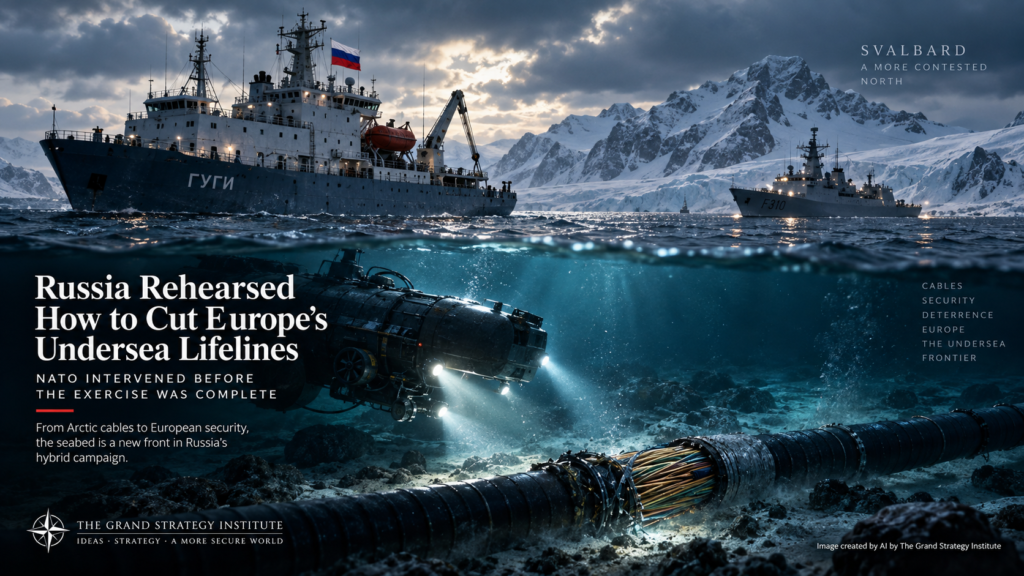
The Svalbard incident reveals how the seabed has become a central arena of Russia’s confrontation with Europe, where communications cables, satellite links and energy infrastructure can be threatened without crossing the traditional threshold of open war
By The Grand Strategy Institute Research Division
Grand Strategy Analysis | 10 September 2026
A future confrontation between Russia and NATO may not begin with tanks crossing a border.
It may begin beneath the sea.
This spring, Russian vessels operating near Norway’s Svalbard archipelago rehearsed an operation involving technology designed to disable critical undersea communications cables, according to Western officials cited by Reuters. The activity involved Russia’s Main Directorate of Deep-Sea Research, commonly known as GUGI, and specialised deep-sea submersibles. British, Norwegian and U.S. forces tracked the operation and confronted the Russian vessels, which ultimately withdrew without damaging the infrastructure.
The cables in question connect Svalbard to mainland Norway and support far more than ordinary civilian communications.
Norway officially describes the two fibre-optic links as critical infrastructure. They serve public authorities, businesses, Svalbard Airport and the Svalbard Satellite Station, or SvalSat.
NASA lists KSAT Svalbard as one of the commercial ground stations supporting its Near Space Network.
This makes the incident strategically important.
The reported Russian activity was not simply another suspicious ship movement.
If the Western account is accurate, Russian forces were practising how specialised undersea capabilities might be used against infrastructure carrying strategically valuable communications and satellite data.
No cable was cut.
No war began.
But a military capability was rehearsed close to infrastructure whose disruption could have consequences across civilian, commercial, scientific and defence networks.
That is precisely why the episode deserves attention.
Russia appears to be studying how Europe can be weakened without necessarily invading it.
The Battlefield Beneath Europe
Modern European societies depend on infrastructure that is simultaneously essential and remarkably difficult to defend.
Telecommunications cables cross seas for hundreds or thousands of kilometres.
Power interconnectors move electricity between national grids.
Pipelines carry energy.
Offshore installations support increasingly important economic activity.
The overwhelming majority of the physical infrastructure is civilian.
Much of it lies beyond constant visual surveillance.
Some components sit hundreds or thousands of metres beneath the surface.
This produces a strategic vulnerability fundamentally different from a conventional military target.
A military base can be surrounded by fences.
An airfield can be protected by air defence.
A government building can be guarded.
A cable stretching across the seabed cannot be protected continuously along its entire route in the same way.
That creates opportunity.
An adversary does not necessarily need to destroy Europe’s armies to disrupt European power.
It can target the systems that allow economies, governments and militaries to communicate.
Svalbard Is Not an Accidental Location
Geography makes the reported operation particularly significant.
Svalbard sits deep in the Arctic, roughly halfway between mainland Norway and the North Pole.
Although Norwegian sovereign territory, the archipelago occupies an unusual strategic position close to Russia’s northern military environment and the approaches to the Barents Sea.
The Arctic is increasingly important for Russian national security.
Russia’s Northern Fleet, including much of its strategic submarine capability, operates from the Kola Peninsula.
The region therefore connects several strategic domains:
nuclear deterrence,
submarine warfare,
maritime surveillance,
satellite communications,
Arctic access,
and control of the North Atlantic approaches.
The Svalbard cables consequently exist inside a much larger strategic geography.
Their significance is not simply that people on the islands need internet connectivity.
They link an Arctic territory containing internationally significant satellite infrastructure with mainland Norway.
That makes them part of the wider information architecture on which modern states depend.
SvalSat Raises the Stakes
SvalSat is particularly important because its northern location gives it frequent access to satellites in polar orbits.
Polar-orbiting spacecraft pass over high-latitude ground stations repeatedly as the Earth rotates beneath them.
This makes Svalbard exceptionally valuable for Earth observation, meteorology, climate research and other satellite missions.
NASA’s inclusion of KSAT Svalbard within the Near Space Network illustrates how the site connects Norwegian infrastructure with international space operations.
The strategic lesson is broader.
Modern military and civilian systems increasingly converge around shared infrastructure.
A fibre-optic cable can simultaneously transmit commercial communications, scientific data and information supporting government operations.
A satellite ground station may serve civilian missions while occupying obvious strategic relevance in a conflict dependent on space-based sensing and communications.
That makes distinctions between civilian and military infrastructure increasingly difficult during high-intensity competition.
GUGI Is Built for the Deep
The involvement of GUGI is one of the most important elements of the Reuters report.
Russia’s Main Directorate of Deep-Sea Research is associated with specialised undersea operations and highly capable platforms designed to operate at depths inaccessible to most conventional naval forces.
Britain had already publicly identified GUGI activity in northern waters earlier this year.
On 9 April, British Defence Secretary John Healey disclosed a Russian deployment involving an Akula-class submarine alongside two specialised GUGI submarines north of the United Kingdom. He said British forces, working with Norway and other allies, had responded to increased Russian activity in the Atlantic.
The United Kingdom also designated GUGI under its Russia sanctions regime in 2025.
The organisation is therefore not simply an oceanographic research institution in the conventional civilian sense.
Its importance lies in access to specialised platforms capable of operating on the seabed.
Those capabilities can have legitimate military functions.
They can inspect objects.
Recover equipment.
Deploy sensors.
Study seabed terrain.
Interact with underwater infrastructure.
But many of those same capabilities are inherently dual-use.
A system capable of reaching and manipulating a cable can potentially repair it, monitor it or damage it.
That ambiguity is itself strategically useful.
Rehearsal Matters Even When Nothing Is Destroyed
The absence of physical damage should not lead to the conclusion that nothing happened.
Militaries rehearse because rehearsal produces knowledge.
A simulated operation can reveal:
how quickly allied forces detect movement,
which surveillance systems respond,
how ships are tracked,
what communications NATO uses,
how close specialised platforms can approach infrastructure,
how governments react politically,
and at what point intervention occurs.
In other words, the Russian side may learn from failure.
So can NATO.
The Svalbard encounter therefore appears to have functioned as an intelligence contest as much as an undersea one.
Russia tested access.
NATO demonstrated detection.
Russia observed the response.
NATO observed Russian methods.
No infrastructure needed to be destroyed for both sides to acquire strategically valuable information.
NATO’s Intervention Was the Real Message
Norwegian Defence Minister Tore Sandvik said the allied response showed Russia that such activity would be detected and would have consequences, according to Reuters.
That is deterrence in its most practical form.
Deterrence does not begin when missiles are launched.
It begins when an adversary calculates that an operation is unlikely to succeed or likely to impose unacceptable costs.
By locating and confronting the vessels before the reported rehearsal could be completed, Britain, Norway and the United States demonstrated something crucial:
the seabed is no longer an unobserved operational sanctuary.
This is strategically important because one of the advantages of undersea sabotage is deniability.
A cable breaks.
An anchor may be responsible.
Fishing equipment may be responsible.
Technical failure may be responsible.
A state may be responsible.
If attribution takes months, political decision-making becomes difficult.
Persistent surveillance changes that equation.
The greater NATO’s ability to track suspicious vessels before an incident, the harder it becomes to hide intent behind ambiguity after an incident.
Europe Has Already Been Warned
The Svalbard episode does not occur in isolation.
European governments have spent years investigating damage to undersea infrastructure.
NATO launched Baltic Sentry in January 2025 following a series of incidents affecting power and telecommunications links in the Baltic Sea. The initiative increased the Alliance’s maritime presence and integrated frigates, maritime patrol aircraft, naval drones and national surveillance capabilities.
NATO Secretary General Mark Rutte said at the time that the Alliance had observed a broader campaign involving cyberattacks, sabotage and other destabilising activity. He also emphasised the enormous systemic importance of submarine communications infrastructure.
By 2026, NATO was accelerating the integration of autonomous systems and artificial intelligence into maritime surveillance. Eight Baltic and Nordic allies agreed in February to expand technology-enabled capabilities following tests involving dozens of air and maritime drones.
Europe is therefore gradually moving from a reactive model toward persistent monitoring.
Svalbard shows why.
Cables Are Attractive Targets Because the Damage Is Disproportionate
Undersea infrastructure offers an attacker a favourable relationship between operational effort and possible strategic effect.
A cable may be physically narrow.
Its function may be enormous.
Cutting one link does not necessarily disconnect a country because modern networks contain redundancy.
But coordinated attacks against several links could produce much more serious effects.
Traffic might have to be rerouted.
Latency could increase.
Networks could become congested.
Isolated regions might lose connectivity.
Government and commercial operations could be disrupted.
Repair vessels could take days or weeks to reach damaged areas.
If several incidents occurred simultaneously during a military crisis, the consequences could become substantially more serious.
The objective therefore does not need to be permanent destruction.
Temporary disruption at a carefully chosen moment can have military value.
The Real Weapon Is Timing
This is perhaps the most important point.
Destroying a cable during peacetime creates inconvenience, economic costs and political tension.
Destroying the same cable during a military crisis can have an entirely different effect.
Imagine a confrontation in the Arctic or Baltic occurring simultaneously with:
cyberattacks against European networks,
GPS interference,
sabotage against rail infrastructure,
disinformation campaigns,
drone incidents,
and cuts to multiple communications links.
Each individual event might appear manageable.
Together, they could produce confusion.
And confusion is strategically useful.
The purpose might not be to blind Europe completely.
It might be to slow decision-making during the first hours of a crisis.
To complicate military coordination.
To overload intelligence agencies.
To create uncertainty about attribution.
To generate public anxiety.
To force governments to spend time restoring infrastructure while military events develop elsewhere.
In modern warfare, temporary disruption can be strategically decisive if it occurs at the right moment.
Hybrid Warfare Moves Into the Maritime Domain
Much of the debate over Russian hybrid warfare has focused on cyber operations, election interference, sabotage and information operations.
The maritime domain expands that concept.
A civilian-looking vessel can conduct surveillance.
A research vessel can map infrastructure.
A merchant ship can behave anomalously near a cable.
A specialised submarine can approach the seabed invisibly.
A damaged cable can initially resemble an accident.
This gives maritime operations many characteristics associated with hybrid warfare.
The perpetrator may remain ambiguous.
The activity can occur below the threshold of armed conflict.
The strategic impact can nevertheless be substantial.
This is why undersea infrastructure has become such an attractive arena for grey-zone competition.
It sits precisely between peace and war.
Mapping Is Part of the Preparation
One element deserves particular attention.
Potential sabotage does not begin when someone cuts a cable.
It begins with intelligence preparation.
An adversary needs to understand:
where the infrastructure runs,
which links are most important,
where redundancy exists,
which cables carry strategically valuable traffic,
where repair capabilities are located,
how maritime forces patrol them,
and how quickly damage would be detected.
Reuters reported that Western authorities have observed growing numbers of vessels behaving suspiciously around sensitive European maritime infrastructure since 2023.
Slow movement, loitering or repeated passage over specific areas can have innocent explanations.
But they can also support mapping.
A modern sabotage campaign therefore begins long before the act itself.
Surveillance creates a catalogue of future options.
Russia Does Not Need to Cut Every Cable
It would be a mistake to imagine an adversary attempting to physically sever the entire European network.
That would be unnecessary.
Networks contain chokepoints.
Certain landing stations connect multiple cables.
Some remote territories depend on only a handful of physical links.
Other routes support strategic services whose disruption would have disproportionate consequences.
This transforms seabed warfare into a problem of systems analysis.
The relevant question is not:
How many cables does Europe possess?
It is:
Which combinations of failures would produce the greatest disruption?
That is precisely the type of problem intelligence services and military planners study.
Defenders must do the same.
Redundancy Is Europe’s First Defence
The strongest defence against undersea sabotage may ultimately be architectural rather than military.
No navy can guard every kilometre of cable.
Europe therefore needs networks capable of surviving damage.
That means additional routes.
Alternative landing sites.
Satellite backup.
Rapid rerouting.
Distributed data infrastructure.
Repair capacity.
Strategic reserves of replacement cable and components.
Shared situational awareness between governments and private operators.
NATO has already begun approaching the problem this way.
Its Critical Undersea Infrastructure Network brings governments and industry together, while its maritime centre in the United Kingdom coordinates protection efforts.
NATO has also examined technological approaches for rerouting communications through satellite systems if submarine connections are disrupted.
The principle is simple.
Infrastructure that can fail without causing systemic collapse is much harder to use as a weapon against society.
The Private Sector Is Part of the Front Line
There is another complication.
Much of Europe’s critical undersea infrastructure is not owned by NATO.
It belongs to governments, telecommunications companies, energy firms and specialised infrastructure operators.
Defence therefore requires cooperation across institutions that normally operate according to very different incentives.
A commercial company may focus on reliability and cost.
A military planner focuses on resilience under deliberate attack.
An intelligence service focuses on hostile intent.
A government focuses on political consequences.
Effective protection requires all four perspectives.
This is why critical infrastructure defence is becoming an alliance-wide strategic issue rather than simply a naval mission.
The battlefield belongs partly to private companies.
Article 5 and the Cable Problem
The political implications are potentially even more difficult than the technical ones.
What happens if Russia deliberately cuts a NATO member’s communications cable?
Would that constitute an armed attack?
Could it trigger Article 5?
The answer is not automatically yes or no.
NATO deliberately preserves flexibility in determining whether particular hostile actions meet the threshold for collective defence.
The circumstances would matter.
Scale would matter.
Attribution would matter.
Consequences would matter.
Intent would matter.
A single cable cut with limited impact might provoke a law-enforcement, economic or covert response.
A coordinated operation disabling multiple critical systems during a broader crisis could be interpreted very differently.
This uncertainty creates both deterrence and risk.
Russia cannot know precisely where NATO’s threshold lies.
But NATO cannot be certain that Russia will correctly estimate it.
This returns us to the problem identified in our previous GSI assessment of Russia and NATO:
the most dangerous confrontation may be the one Moscow believes is sufficiently limited not to trigger a collective response.
Svalbard fits directly into that strategic problem.
Sabotage Can Test NATO Without Seizing Territory
Traditional discussion of an Article 5 test tends to imagine a limited incursion into the Baltic states or another piece of NATO territory.
Undersea infrastructure presents another possibility.
An adversary could generate serious effects without occupying anything.
No border needs to move.
No flag needs to be raised.
No city needs to be captured.
Instead, the Alliance would face a different test:
Can it agree who was responsible?
Can it agree how serious the attack was?
Can it agree what response is proportionate?
Can it retaliate without escalating beyond what member governments are willing to accept?
Hybrid operations target these political questions.
The physical cable may therefore be only the immediate object.
NATO cohesion is the larger target.
Why the Arctic Matters More Every Year
The Arctic dimension deserves particular attention.
Climate change is making northern waters increasingly accessible.
Russia has invested heavily in Arctic military infrastructure.
The Northern Fleet remains central to Russian nuclear deterrence.
NATO expanded northward when Finland joined in 2023 and Sweden in 2024.
Norway’s strategic importance has consequently increased further.
Svalbard sits within this changing military geography.
It is therefore reasonable to expect increased surveillance and competition around northern infrastructure.
The region that once seemed peripheral to European security is becoming central to it.
The Incident Also Reveals NATO’s Adaptation
There is a more reassuring interpretation of the Svalbard episode.
The Russian vessels were reportedly detected.
They were tracked.
Multiple allies cooperated.
American, British and Norwegian capabilities contributed.
The activity was confronted.
The infrastructure remained intact.
This indicates that NATO is adapting.
The Alliance is integrating military surveillance, intelligence and new technologies in response to undersea threats.
NATO’s Baltic Sentry architecture already includes frigates, patrol aircraft and unmanned systems. Its broader maritime strategy increasingly treats undersea infrastructure protection as part of deterrence rather than an afterthought.
The challenge is scale.
Detection near one critical site does not mean every cable is protected.
But successful detection changes Russian calculations.
Deterrence by Denial May Matter More Than Retaliation
There are two broad ways to deter sabotage.
The first is punishment.
You threaten consequences after an attack.
Sanctions.
Seizure of vessels.
Cyber retaliation.
Diplomatic measures.
Potential military responses.
The second is denial.
You make the operation difficult to conduct successfully.
Persistent surveillance.
Tracking.
Redundant cables.
Hardening.
Rapid repair.
Unmanned underwater sensors.
Maritime patrols.
Intelligence sharing.
The Svalbard encounter demonstrates the value of denial.
If Russian forces cannot approach sensitive infrastructure without detection, the utility of covert sabotage falls.
This may ultimately be more stable than relying principally on punishment after infrastructure has already been destroyed.
But Protection Can Also Produce Escalation
There is a danger on the other side.
As NATO increasingly patrols sensitive maritime areas and confronts Russian vessels, the likelihood of direct encounters rises.
Ships can manoeuvre aggressively.
Submarines can be tracked.
Aircraft can operate overhead.
Unmanned systems can approach vessels.
Commanders can misread intentions.
An operation intended as surveillance can be interpreted as preparation for attack.
The undersea domain therefore creates its own escalation dynamics.
Protection must be credible without becoming reckless.
The more contested the seabed becomes, the more important communication and rules of engagement become.
Russia’s Denial Will Remain Part of the Strategy
Russia’s Defence Ministry did not respond to Reuters’ request for comment on the reported Svalbard operation, while the Kremlin has repeatedly rejected Western accusations that Moscow conducts sabotage against NATO countries.
That ambiguity matters.
Russia benefits strategically when evidence is insufficient to generate unanimous political attribution.
Western governments therefore face a difficult standard.
They need enough intelligence to detect threats while protecting sensitive collection methods.
They need to share enough evidence with allies to generate political consensus.
And they need to communicate enough publicly to maintain democratic legitimacy.
Attribution itself has become a strategic capability.
The Seabed Is Becoming the Grey Zone’s Most Important Geography
For much of modern military history, naval power meant control of the surface.
Later it meant control of the air above the sea and the submarines beneath it.
The digital age has added another layer.
The seabed itself has become infrastructure.
That changes maritime strategy.
The ocean floor is now crossed by the systems that allow global economies and governments to function.
The strategic competition beneath Europe therefore concerns not only submarines hunting submarines.
It concerns the cables, sensors, pipelines and data architecture connecting modern civilisation.
Control does not necessarily mean physical occupation.
It means knowing what is there.
Knowing who is approaching it.
And being capable of preventing an adversary from manipulating it.
GSI Strategic Assessment
The Grand Strategy Institute assesses that the reported Svalbard operation represents a significant development in the evolution of Russian pressure against European critical infrastructure.
The importance of the incident lies less in immediate damage, because no infrastructure was reportedly harmed, than in what the activity reveals about preparation for future contingencies.
Several conclusions follow.
First, undersea infrastructure is now firmly part of the Russia-NATO strategic competition.
NATO’s creation of specialised institutions, Baltic Sentry and autonomous maritime surveillance demonstrates that the Alliance already recognises this reality.
Second, GUGI gives Russia specialised capabilities particularly suited to operations in this environment.
The same deep-sea platforms capable of research and military seabed activity could potentially be used to interact with cables and other critical infrastructure.
Third, the Svalbard incident suggests that Russian planning may extend beyond general surveillance toward operational rehearsal.
According to the Western officials cited by Reuters, the vessels simulated deploying technology intended to disable cables. That is more significant than merely sailing near them.
Fourth, NATO demonstrated an increasingly important deterrence capability by detecting and confronting the activity before damage occurred.
Preventing sabotage may prove strategically superior to responding after infrastructure has been disabled.
Fifth, the target set is no longer exclusively military.
Civilian fibre-optic systems, satellite ground stations, pipelines and power interconnectors possess strategic value precisely because modern military and civilian systems depend upon them simultaneously.
Sixth, the principal Russian objective in a future crisis may not be permanent infrastructure destruction.
Temporary, coordinated disruption could be sufficient to complicate NATO decision-making at the moment when speed matters most.
Seventh, the Article 5 problem remains unresolved by design.
A limited and ambiguous attack against infrastructure could test political cohesion without resembling traditional territorial aggression.
Eighth, Europe cannot protect every kilometre of seabed physically.
Resilience, redundancy, surveillance and rapid repair therefore need to become central components of deterrence.
The larger lesson is that the boundary between preparation and attack is becoming increasingly difficult to identify.
Mapping a cable is not war.
Approaching it is not war.
Deploying a submersible is not necessarily war.
Simulating the placement of sabotage technology may still fall below the threshold of armed conflict.
But each action can prepare the conditions for war.
That is why the Svalbard incident matters.
The strategic contest may begin years before the first cable is actually cut.
Key Judgements
- Western officials say Russia rehearsed an operation near Svalbard involving technology designed to disable critical undersea cables. British, Norwegian and U.S. forces tracked and confronted the vessels, and no infrastructure was damaged.
- The reported involvement of GUGI substantially increases the strategic significance of the incident. Britain had already publicly disclosed GUGI submarine activity in northern Atlantic waters earlier in 2026.
- The Svalbard cables are critical Norwegian infrastructure. Norway confirms that two subsea fibre links connect the archipelago to the mainland and support SvalSat and other essential services.
- SvalSat has international strategic importance. NASA includes KSAT Svalbard among the commercial ground stations supporting its Near Space Network.
- The operation indicates that future Russian pressure against NATO may focus increasingly on systems enabling European connectivity rather than solely on conventional military targets.
- Undersea infrastructure is attractive because relatively limited physical actions can potentially create disproportionate systemic disruption.
- Russia does not need to permanently disable European communications networks to achieve military effects. Temporary disruption during a wider crisis could create operational and political advantages.
- Persistent surveillance is becoming central to NATO deterrence. Baltic Sentry and newer autonomous systems are designed precisely to increase detection of suspicious activity around critical infrastructure.
- Deterrence by denial may be more effective than relying only on retaliation. An operation that cannot be conducted covertly becomes less attractive.
- The seabed creates an acute attribution problem. Physical damage can initially resemble accident, technical failure or ordinary maritime activity.
- A deliberate cable attack could create a difficult Article 5 debate depending on its scale, attribution and consequences. This makes critical infrastructure an attractive arena for testing Alliance cohesion below conventional war.
- The Arctic is becoming increasingly central to the Russia-NATO competition because it combines strategic submarine activity, space infrastructure, maritime access and geographically exposed communications systems.
- NATO’s response around Svalbard demonstrates meaningful adaptation. The reported operation was identified and confronted before the cables were harmed.
- The most important strategic lesson is that infrastructure warfare begins before sabotage. Surveillance, mapping, rehearsal and testing the defender’s response are themselves components of operational preparation.
Conclusion
Europe’s most vulnerable frontier may not have a border fence.
It lies on the seabed.
The reported Russian operation near Svalbard illustrates how modern strategic competition is moving into spaces where the dividing line between peace and conflict is unusually difficult to define.
No Norwegian territory was invaded.
No missile was fired.
No cable was cut.
Yet specialised Russian military assets reportedly rehearsed an operation designed around infrastructure vital to communications and satellite services.
NATO forces responded before the exercise was completed.
That interaction contains a miniature version of the emerging European security environment.
Russia searches for vulnerabilities.
NATO searches for Russia.
Moscow attempts to preserve ambiguity.
The Alliance attempts to improve attribution.
Russia develops capabilities that can operate below the surface.
NATO invests in sensors, patrols and autonomous systems to expose them.
Neither side necessarily wants open war.
Both are preparing for circumstances in which the infrastructure supporting the other might become a battlefield.
This is the new strategic reality of Europe’s seas.
During the Cold War, NATO planners watched for Soviet submarines moving through the Greenland-Iceland-United Kingdom gap and prepared to defend Atlantic reinforcement routes.
In the twenty-first century, they must still watch the submarines.
But they must also watch what lies beneath them.
The cables carrying data.
The pipelines carrying energy.
The sensors monitoring the oceans.
The networks connecting satellites to the ground.
And the specialised vessels capable of reaching them.
The Svalbard incident did not disable European communications.
Its significance is that it demonstrated how someone might try.
Europe should therefore interpret the operation not as a failed act of sabotage, but as a warning about the infrastructure battlefield that could accompany the next major confrontation with Russia.
The first battle of such a conflict might not be visible from land.
It could take place silently, hundreds of metres beneath the sea.
The Grand Strategy Institute
Continue Exploring Strategic Analysis
Return to The Grand Strategy Institute for strategic assessments, long-form analysis and research examining geopolitics, military affairs, international security, emerging technologies and the changing international order.
← Back to The Grand Strategy Institute