
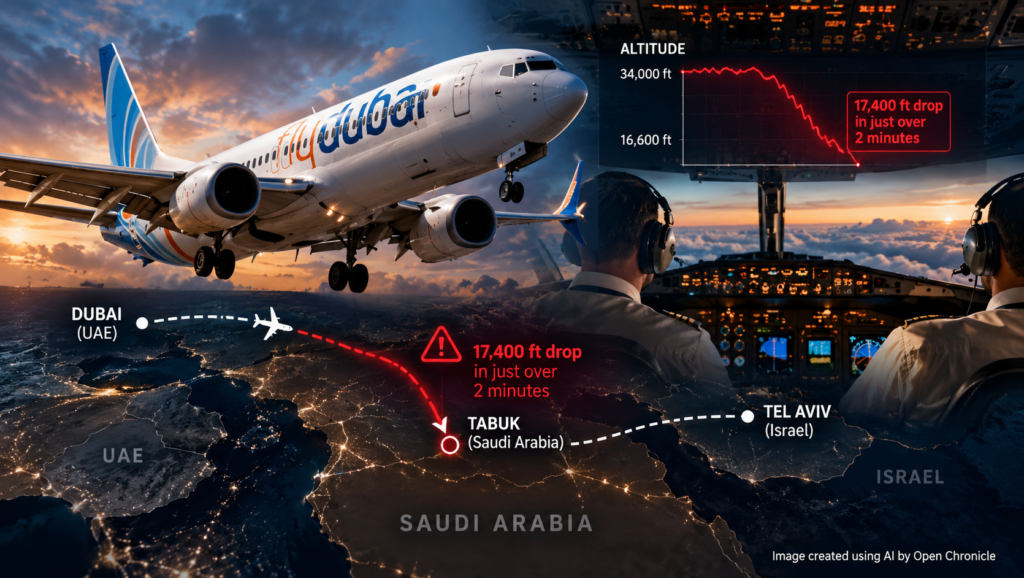
A Flydubai passenger aircraft travelling from Dubai to Tel Aviv made an emergency landing in Saudi Arabia on Wednesday after an apparent physical confrontation inside the cockpit. The incident initially raised fears of a possible hijacking, triggered emergency aviation codes and prompted Israel to scramble military aircraft, but officials later indicated that unlawful seizure of the plane had not occurred.
By Open Chronicle with agencies | September 30, 2026
TABUK, Saudi Arabia — A Flydubai passenger aircraft bound for Israel was forced to make an emergency landing in northwestern Saudi Arabia on Wednesday following what authorities and Israeli media described as a physical confrontation between the pilots.
The aircraft, carrying approximately 150 people from Dubai to Tel Aviv, diverted to Tabuk after transmitting emergency signals during the flight.
All passengers were reported safe following the landing.
The circumstances initially generated serious security concerns because the aircraft transmitted a code associated with possible unlawful interference or hijacking.
An Israeli official later said the emergency signals had been transmitted following an altercation between the pilots and that the incident was not a hijacking.
Emergency codes transmitted during flight
The aircraft was operating as Flydubai flight FZ1073 when the emergency developed.
According to flight information cited in the supplied reports, the aircraft initially transmitted squawk code 7700, the international transponder code used to indicate a general emergency.
The code was subsequently changed to 7500.
That second code carries much more serious security implications because it indicates unlawful interference with an aircraft, including a possible hijacking.
The signal immediately raised concerns about what was happening aboard the Israel bound flight.
The information that subsequently emerged, however, pointed toward an extraordinary confrontation inside the cockpit rather than an attempted seizure of the aircraft.
Reports of a physical confrontation between pilots
A regional official said there had been an altercation inside the cockpit that apparently involved the pilots.
The cause of the confrontation was not immediately clear.
Israeli media, citing security officials, also reported that the emergency resulted from a fight between the two pilots.
Passengers seated near the front of the aircraft reportedly heard shouting associated with the confrontation.
Some passengers were also quoted by Israeli media as saying that the pilot had been stabbed by the copilot. The supplied information does not include independent confirmation of that allegation, and the precise nature of any injuries inside the cockpit remained unclear.
Flydubai described the situation as an “incident” during the journey to Tel Aviv and confirmed that the aircraft diverted to Tabuk and landed safely.
Aircraft lost more than 17,000 feet
The flight also experienced a dramatic loss of altitude.
Flight tracking information cited in reports indicated that the aircraft descended approximately 17,400 feet in a little more than two minutes while flying over northwestern Saudi Arabia.
The plane reportedly fell from around 34,000 feet to approximately 16,600 feet.
Passengers described the aircraft descending steeply during the incident.
Earlier reports based on flight tracking information had described a fall of approximately four kilometres over a much shorter period, but the more detailed flight data cited later placed the altitude loss at approximately 17,400 feet over slightly more than two minutes.
The aircraft subsequently continued toward Tabuk and landed safely.
Emergency landing at Tabuk
Tabuk provided a strategically important diversion point because the airport serves both civilian and military operations in northwestern Saudi Arabia.
The aircraft landed there safely, with no reports of injuries among the passengers.
The diversion was particularly unusual because the flight had been travelling between the United Arab Emirates and Israel before making an unscheduled landing in Saudi Arabia.
The incident unfolded during a period of heightened regional security concerns, increasing the significance initially attached to the 7500 emergency code.
Israel scrambled warplanes
The possible hijacking signal prompted an immediate security response in Israel.
Israeli military aircraft were reportedly scrambled as authorities attempted to establish what was happening aboard the Flydubai flight.
The emergency also prompted senior Israeli officials to assess the situation amid fears that the aircraft could be facing a security threat.
Those concerns eased after information emerged indicating that the emergency had resulted from a cockpit confrontation rather than an attempted hijacking.
The episode illustrates how quickly aviation emergencies can acquire national security implications when an aircraft transmits a code specifically associated with unlawful interference.
Regional tensions heightened initial concerns
The flight emergency occurred against the backdrop of continuing conflict involving Iran and the United States.
Israel is a close American ally and had participated in earlier strikes against Iran in February, making any unexplained aviation incident involving an Israel bound passenger aircraft potentially significant.
The wider regional situation therefore contributed to the initial concern generated by the emergency signal.
Diplomatic contacts concerning the conflict have continued, with Iran seeking a ceasefire arrangement and a phased reopening of the Strait of Hormuz.
US and Iranian representatives have also communicated indirectly through mediators, although those contacts have not yet produced a confirmed breakthrough.
Against that environment, the possibility that an Israel bound civilian aircraft had been hijacked immediately attracted security attention.
Questions remain over what happened in the cockpit
Although the aircraft landed safely and initial fears of a hijacking were dispelled, significant questions remain.
It was not immediately clear what caused the reported confrontation between the pilots, how the dispute became physical or whether either pilot suffered serious injuries.
The circumstances surrounding the dramatic descent also remain important.
Investigators will need to determine whether the loss of altitude resulted directly from events inside the cockpit and establish precisely what happened before the emergency codes were transmitted.
The reported claim that one pilot stabbed the other also requires official confirmation.
All passengers reported safe
The most important immediate outcome was that the approximately 150 people aboard the aircraft reached the ground safely.
Flydubai, a Dubai based airline operating alongside the much larger Emirates aviation network, serves numerous regional and international destinations and is positioned as a lower cost carrier.
Wednesday’s extraordinary diversion turned what should have been a routine flight between Dubai and Tel Aviv into a major aviation and security incident.
What initially appeared through the aircraft’s emergency codes to be a possible hijacking ultimately emerged, according to officials cited in the supplied reports, as an apparent confrontation between the people responsible for flying the aircraft.
The safe landing in Tabuk ended the immediate danger, but the reported cockpit fight, the 7500 security signal and the aircraft’s sudden loss of more than 17,000 feet are likely to make the circumstances of flight FZ1073 the subject of intense scrutiny.