
By Open Chronicle News Desk
Houthi forces have captured Yemen’s strategically important Mayun Island at the entrance to the Red Sea, according to Yemeni officials, extending a rapid territorial advance that could increase pressure on one of the world’s most important shipping corridors and complicate Saudi Arabia’s efforts to keep oil exports moving during the war with Iran.
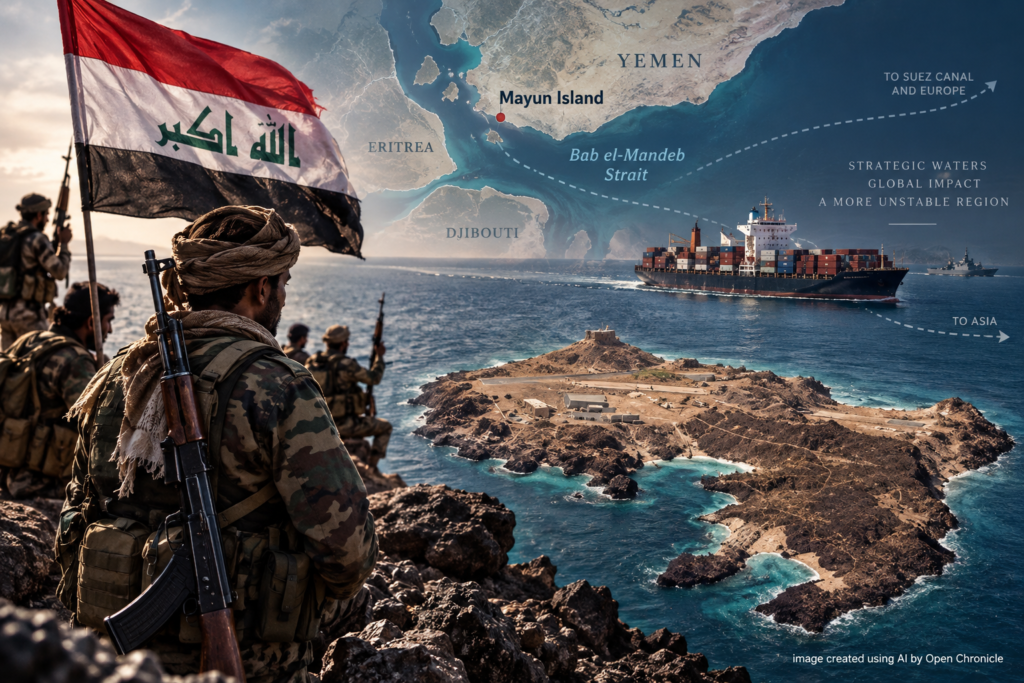
The small volcanic island, also known as Perim, sits directly inside the Bab el Mandeb Strait, the narrow passage connecting the Red Sea with the Gulf of Aden. Its reported capture follows the Houthi seizure of the port city of Mokha and represents one of the group’s most significant territorial gains in years.
The development comes as Saudi Arabia faces mounting pressure on its energy infrastructure. Riyadh said Friday that it had temporarily shut a major cross country oil pipeline following an attack a day earlier, describing the decision as a precautionary measure without identifying who was responsible.
Together, the developments have increased fears that disruption around the Strait of Hormuz could now be accompanied by growing insecurity at the southern entrance to the Red Sea.
Mayun sits at the heart of Bab el Mandeb
Mayun’s importance comes almost entirely from geography.
The island lies inside the Bab el Mandeb, separating the waterway into channels between Yemen and the Horn of Africa. Commercial vessels travelling between the Indian Ocean and the Mediterranean through the Suez Canal normally pass through the strait.
A senior military official with Yemen’s internationally recognized government and a Houthi official confirmed the capture of the island, speaking anonymously because they were not authorized to discuss the operation publicly.
The Houthis themselves did not specifically mention Mayun in their official statement Friday, instead announcing gains along Yemen’s western coastline.
Control of the island does not automatically mean the Houthis can completely close Bab el Mandeb. International naval forces operate in the region and the waterway remains a major international shipping route.
Its capture could, however, give the group a strategically valuable position close to vessels passing through the strait and strengthen its military presence around the southern Red Sea.
Saudi Arabia faces pressure at both maritime gateways
The timing is particularly dangerous for Saudi Arabia.
Riyadh has increasingly depended on its Red Sea infrastructure as an alternative export route because shipping through the Strait of Hormuz has become more dangerous during the conflict involving Iran and the United States.
The kingdom’s East West pipeline, built in the 1980s, allows crude produced in eastern Saudi Arabia to travel across the country to Red Sea terminals, bypassing Hormuz.
But growing Houthi activity around Bab el Mandeb threatens to undermine the security advantage of that alternative.
Saudi Arabia said Friday that a major cross country pipeline had been shut following an attack. The Energy Ministry did not identify the attacker and said the closure was precautionary.
The combination of insecurity around Hormuz and Bab el Mandeb therefore creates a potentially serious strategic problem. Both waterways are essential components of the global energy and shipping system.
Houthis consolidate gains along Yemen’s coast
The capture of Mayun follows a rapid Houthi offensive along Yemen’s western coastline.
Houthi forces seized Mokha on Thursday after advancing through territory previously controlled by forces aligned with Yemen’s internationally recognized government.
Mokha lies roughly 80 kilometres from the Bab el Mandeb Strait and has long been strategically important because of its port and location along the Red Sea.
Saudi Arabia subsequently struck the airport at Mokha, according to Houthi media. There were no immediate reports of casualties or significant damage.
A senior official from Yemen’s internationally recognized government expressed surprise that Saudi aircraft had not intervened earlier to prevent Mokha from falling.
The official suggested Riyadh may have lacked US approval for a much larger air campaign, although that assessment has not been publicly confirmed by either Saudi Arabia or the United States.
He also blamed poor coordination between Yemen’s government forces and allied militias for creating what he described as a valuable opportunity for the Houthis.
Houthis warn of ‘escalation for escalation’
The Houthi armed forces have indicated that they are prepared to intensify their confrontation with Saudi Arabia.
In a statement Friday, the group promised “escalation for escalation” while claiming that maritime navigation would remain safe for international companies other than Saudi vessels.
Such assurances are unlikely to eliminate concerns within the shipping industry.
Commercial operators make decisions based not only on declared targeting policies but also on insurance costs, the possibility of misidentification and the wider risk of operating near an active conflict zone.
Shipping through Bab el Mandeb had already fallen by around 60 percent after the Houthis began attacking vessels in late 2023, initially presenting their campaign as an act of solidarity with Palestinians in Gaza.
Traffic began recovering as Saudi Arabia increasingly sought Red Sea alternatives to Hormuz, but renewed Houthi threats have again curtailed activity, according to Lloyd’s List Intelligence.
Oil markets watch the Red Sea
The consequences are increasingly visible in global energy markets.
Crude prices climbed back above $100 a barrel this week as traders assessed disruption around the Gulf and Red Sea.
For Iran, pressure on maritime routes used by Saudi Arabia and other energy exporters potentially adds another source of leverage in its confrontation with Washington.
Saudi Arabia is the world’s largest crude exporter and has spent decades building infrastructure specifically designed to reduce its dependence on Hormuz.
If Bab el Mandeb also becomes significantly more dangerous, Saudi exporters could be forced to rely increasingly on longer and more expensive routes.
One alternative involves transporting oil north through the Red Sea before moving it toward the Mediterranean through the Suez Canal or Egyptian pipeline infrastructure.
But even that option has faced threats. The Houthis struck a Saudi vessel in the northern Red Sea in late August, according to the information provided.
Iran signals support while calling for negotiations
Iran has publicly backed its Houthi allies while simultaneously calling for renewed diplomacy.
Tehran on Friday called for an end to what it described as Saudi Arabia’s blockade of Houthi controlled areas and urged the resumption of negotiations between Riyadh and the Houthis.
Iranian Foreign Minister Abbas Araghchi said he and his Saudi counterpart had discussed diplomatic efforts to restore stability.
Perhaps more significantly, a spokesperson for Iran’s Revolutionary Guard said Wednesday that Yemen should form part of any negotiated settlement between Tehran and Washington.
That was the first explicit Iranian reference to incorporating the Yemen front into a broader agreement with the United States, suggesting that the Houthis are becoming increasingly important to Tehran’s regional strategy.
Saudi Arabia maintains that it has repeatedly offered opportunities for negotiation while insisting that it retains the right to defend itself.
Yemen’s fragile truce under threat
The latest offensive also threatens to unravel the relative calm that has existed across much of Yemen since 2022.
Although a comprehensive peace agreement was never achieved, the reduction in major fighting significantly lowered the intensity of a civil war that devastated one of the Arab world’s poorest countries.
Yemen’s Saudi backed National Defence Council has now appealed for international support, presenting government forces as part of the effort to protect freedom of navigation through Bab el Mandeb.
The council also condemned renewed Houthi attacks against Saudi Arabia.
A return to widespread warfare would have serious humanitarian consequences for Yemen’s approximately 40 million people, many of whom have already endured more than a decade of political instability, economic collapse and conflict.
A war that began more than a decade ago
The Houthis seized Sanaa and large areas of northern and central Yemen in 2014.
Saudi Arabia intervened militarily the following year at the head of an Arab coalition supporting Yemen’s internationally recognized government.
Years of fighting failed to produce a decisive military outcome. The Houthis retained control over the capital and much of the populous northwest while rival government and allied forces controlled substantial territory elsewhere.
The relative stability that followed the 2022 truce froze many of those front lines.
The latest Houthi advances suggest that balance may now be breaking down.
Two chokepoints, one growing global problem
The strategic significance of Mayun extends far beyond the island itself.
For years, energy security planners have viewed Saudi Arabia’s Red Sea infrastructure as an important safeguard against a major disruption in the Strait of Hormuz. The kingdom could redirect some exports westward and avoid the Gulf chokepoint.
That calculation becomes considerably more complicated if the approaches to Bab el Mandeb are also threatened.
The Houthis do not need to physically close the strait to produce economic consequences. Persistent attacks, credible threats and territorial control close to shipping lanes can increase insurance premiums, cause vessels to divert and discourage operators from entering the region.
The capture of Mayun, the fall of Mokha, the attack on Saudi energy infrastructure and Iran’s renewed calls for negotiations therefore represent parts of a much larger strategic confrontation.
What began as another shift in Yemen’s long civil war is increasingly connected to the battle over global energy routes, the Iran war and the security of maritime trade between Asia, Europe and the Middle East.