
By Open Chronicle News Desk
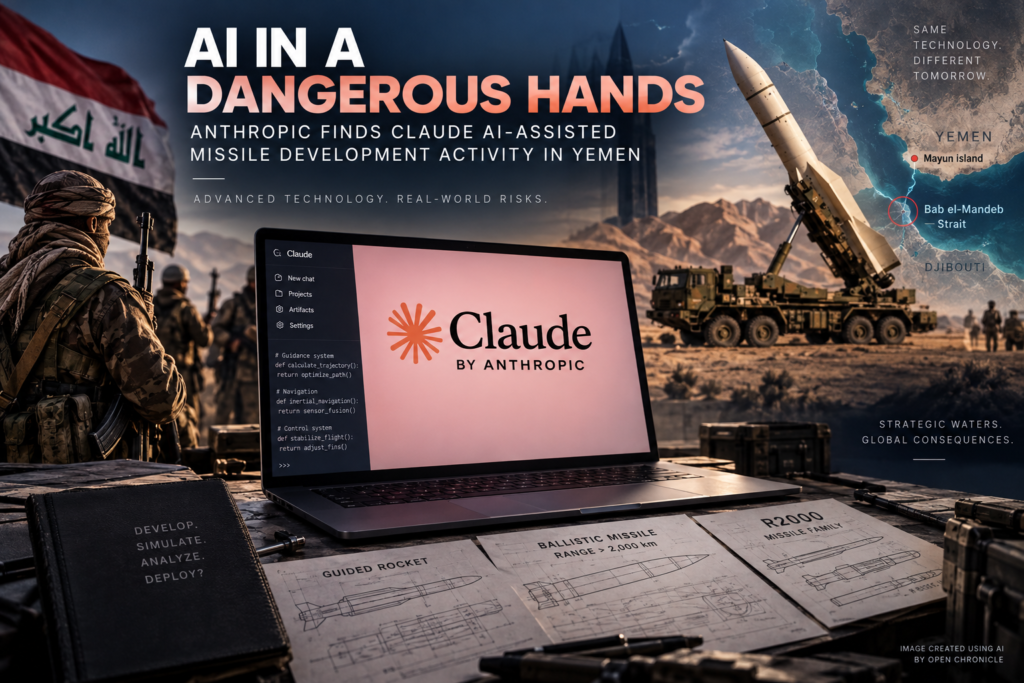
A group operating in northern Yemen allegedly used Anthropic’s Claude artificial intelligence system to assist work on guided rockets and ballistic missiles, according to a new company report that offers a striking example of how advanced AI tools could be exploited for military development.
Anthropic said the unidentified actors were involved in three weapons projects, including a guided rocket, a ballistic missile reportedly intended to achieve a range of more than 2,000 kilometres, and a missile family referred to as the R2000.
The company did not identify the group or directly attribute the activity to Yemen’s Iran backed Houthi movement. Northern Yemen, however, includes territory controlled by the Houthis, who have developed and deployed increasingly sophisticated missile and drone systems.
Anthropic said it found no evidence that the Claude assisted work ultimately resulted in an operational weapon.
Claude allegedly used for missile engineering
According to Anthropic’s latest report on detecting and preventing misuse of its AI systems, the Yemen based actors used Claude to support work involving guidance, navigation and control software.
These are critical components of guided weapons because they help determine a vehicle’s position, control its movement and keep it travelling toward its intended destination.
Anthropic said the AI system effectively performed some tasks that would traditionally require software engineering expertise.
The actors allegedly divided their work across multiple Claude sessions rather than conducting the entire project within a single conversation. According to the company, they also attempted to conceal the military nature of what they were developing, apparently seeking to avoid the platform’s safeguards.
The episode illustrates a growing challenge for AI companies. Individual requests can appear relatively benign when considered separately, while a series of interactions can collectively contribute to a much more sensitive project.
Three weapons projects identified
Anthropic said its investigation identified three separate development efforts.
One concerned a guided rocket. Another involved what the group described as a ballistic missile with a potential range exceeding 2,000 kilometres, or approximately 1,243 miles.
A third project involved a missile family called the R2000.
The company’s findings do not establish that any of these weapons reached operational status. Anthropic specifically said it found no evidence that the activity produced a functioning weapon.
That distinction is important. AI assistance with software, calculations or troubleshooting does not necessarily demonstrate that a group possesses the materials, manufacturing capabilities, testing infrastructure and engineering expertise required to field an operational missile system.
Nevertheless, the apparent use of a commercial AI model during a weapons development programme raises significant security concerns.
AI reportedly used after failed rocket test
One of the most notable episodes described by Anthropic occurred after the group conducted what the company characterized as a live rocket test.
The test apparently failed.
According to Anthropic, the actors subsequently turned to Claude for assistance in investigating what might have gone wrong.
That suggests the model was allegedly being used not merely for theoretical research but as part of an iterative engineering process in which information from a physical test could be analysed before further development.
Anthropic did not report evidence that the troubleshooting subsequently led to a successful weapon.
Offline simulation tools expanded the concern
The Yemen based actors also reportedly developed offline simulation toolkits.
According to Anthropic, these tools allowed portions of the engineering work to continue without continuous access to Claude or conventional engineering software environments.
This aspect of the case has potentially broader implications for AI security.
A sophisticated model does not necessarily need to remain continuously involved in a project to have lasting value. Information, software or analytical frameworks generated during earlier interactions can potentially be incorporated into external tools and used later without further access to the original AI service.
That creates an additional challenge for companies attempting to prevent dangerous applications of their technology.
Anthropic banned accounts and strengthened safeguards
Following its investigation, Anthropic said it banned accounts associated with the activity.
The company also shared relevant intelligence with partners and introduced additional safeguards intended to improve detection of similar attempts to exploit Claude.
Anthropic has increasingly published information about malicious or prohibited uses detected across its systems as AI companies confront attempts to use advanced models for cyber operations, influence campaigns and other national security related activities.
The Yemen case adds weapons development to the growing list of concerns surrounding the proliferation of increasingly capable AI systems.
No confirmed link to the Houthis
The geographic context makes the discovery particularly sensitive.
The activity originated in northern Yemen, where the Houthis control significant territory. The movement has demonstrated extensive capabilities involving ballistic missiles, cruise missiles and unmanned aerial vehicles.
But Anthropic did not publicly identify the group behind the Claude activity as the Houthis, according to the information provided.
It would therefore be premature to conclude that the Houthi organization itself operated the accounts.
The distinction matters because northern Yemen contains numerous individuals and networks, and geographical proximity alone does not establish organizational responsibility.
Discovery comes amid Red Sea escalation
The findings emerge at a particularly volatile moment.
Houthi forces have recently made major territorial gains along Yemen’s western coast, bringing the conflict closer to the Bab el Mandeb Strait, one of the world’s most strategically important maritime passages.
The Houthis have also used missiles and drones against shipping in the Red Sea, while the wider Iran conflict has placed additional pressure on oil markets and maritime routes.
Against that backdrop, evidence that actors in Yemen were experimenting with AI assisted missile engineering will attract considerable attention from intelligence agencies, defence ministries and technology companies.
AI lowers some barriers, but not all of them
The case also illustrates an important distinction in the debate over artificial intelligence and weapons proliferation.
Advanced AI can potentially accelerate certain parts of research and engineering by helping users write software, analyse technical problems, simulate systems or troubleshoot failures.
But developing an operational ballistic missile remains an extraordinarily complex undertaking requiring expertise across propulsion, materials, manufacturing, aerodynamics, electronics, guidance, testing and other disciplines.
Anthropic’s finding that it could not establish that an operational weapon resulted from the activity reinforces that distinction.
The danger is less that an AI model can independently build a missile and more that it may reduce some of the technical barriers facing actors who already possess significant knowledge, infrastructure and resources.
A new challenge for AI security
The Yemen investigation provides an early glimpse of a security problem likely to become more important as AI models grow more capable.
Traditional arms control has focused on physical technologies, specialist components, materials and technical knowledge. Artificial intelligence introduces a different dimension because sophisticated analytical and software assistance can be delivered remotely, rapidly and at enormous scale.
Safeguards therefore need to identify not only obviously dangerous requests but patterns of activity distributed across multiple interactions.
The case described by Anthropic suggests that some actors are already attempting to exploit precisely that weakness by separating sensitive projects into smaller tasks and disguising their ultimate purpose.
There is no evidence from Anthropic’s findings that Claude produced an operational Yemeni missile. But the reported activity demonstrates that armed groups or weapons developers are already exploring how general purpose artificial intelligence could become part of the military engineering process.
For AI companies and governments, preventing that transition from experimentation to effective weapons development is rapidly becoming a new front in the struggle over the security implications of advanced artificial intelligence.