
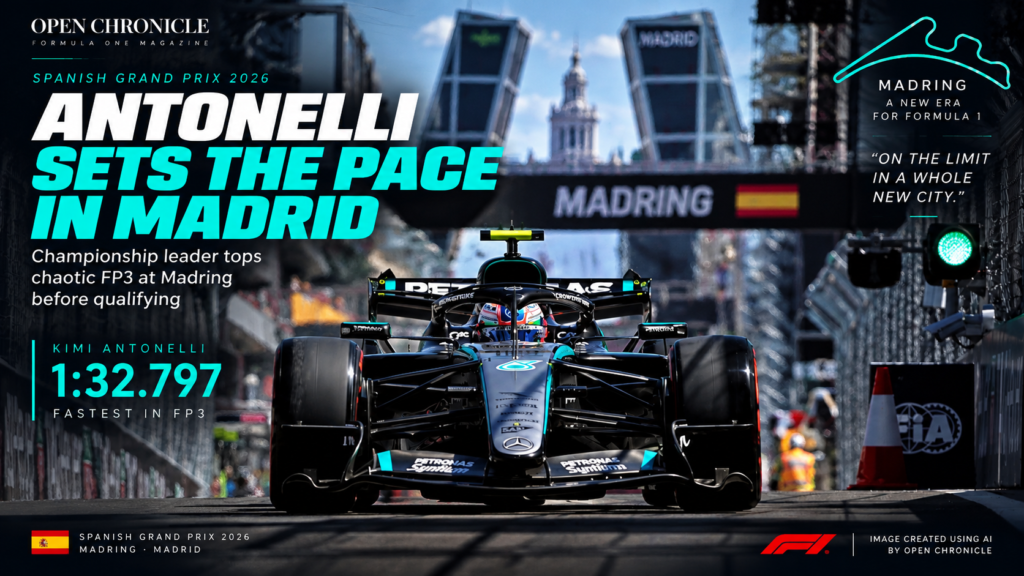
Kimi Antonelli strengthened his position as the early benchmark at Madring by setting a 1:32.797 in final practice for the 2026 Spanish Grand Prix. Charles Leclerc finished only 0.166 seconds behind, with Oscar Piastri and Lando Norris bringing McLaren into contention before qualifying. Lewis Hamilton and Oliver Bearman both crashed in a heavily disrupted session, while Gabriel Bortoleto put Audi inside the top ten.
By Open Chronicle Formula One Magazine
Kimi Antonelli will enter qualifying for the Spanish Grand Prix as the fastest driver from final practice after another commanding performance at Formula One’s newest circuit.
The Mercedes driver produced a 1:32.797 during a frantic conclusion to FP3 at Madring, beating Ferrari’s Charles Leclerc by 0.166 seconds and Oscar Piastri by 0.189 seconds.
Lando Norris recovered from the gearbox problem that effectively cost him FP2 to finish fourth, with Max Verstappen fifth and George Russell sixth.
But the final classification tells only part of the story.
Two red flags dramatically reduced meaningful running. Hamilton crashed at Turn 22 and caused a lengthy interruption while the TecPro barrier was repaired. Bearman then suffered another heavy accident in the closing moments, bringing the session to a premature end.
For teams attempting to make their final setup decisions before qualifying, FP3 became as much a test of adaptability as outright performance.
Antonelli arrives on Saturday as the reference
Mercedes had already established itself as the early benchmark at Madring.
Russell led FP1 with a 1:34.077.
Antonelli responded in FP2 with a 1:33.662.
The championship leader then went faster again on Saturday.
His 1:32.797 represented an improvement of 0.865 seconds over his Friday benchmark and made him the only driver to finish the session below 1:32.9.
More importantly, Antonelli has now topped two consecutive practice sessions heading into qualifying.
Yet Mercedes does not appear to have a comfortable advantage.
Leclerc is extremely close.
McLaren has moved forward.
Verstappen remains in contention.
The battle for the first Formula One pole position at Madring remains open.
Bortoleto is first onto the circuit
As is often the case in final practice, the opening minutes were quiet.
Teams were conserving tyres and waiting for track conditions to improve before beginning their most meaningful work.
Bortoleto eventually became the first driver to leave the pits.
The Brazilian established the opening benchmark with 1:35.777, before Audi teammate Nico Hülkenberg responded with a 1:35.721.
Both Audi drivers were initially using medium tyres, while several rivals subsequently appeared on softs. Lawson followed a different programme on the hard compound.
Bortoleto also attracted the attention of race control following an incident at Turn 1 concerning the required procedure through the escape area.
As more cars appeared, the times began falling quickly.
Lawson produced a 1:35.602, Fernando Alonso a 1:35.708 and Leclerc moved Ferrari to the front with 1:34.433.
Bearman then recorded a 1:34.769.
Antonelli was next to make a major step.
Antonelli and Leclerc trade the benchmark
Antonelli immediately demonstrated Mercedes’ potential with a 1:33.664.
Norris, needing mileage after his compromised Friday afternoon, moved into second with 1:34.099.
Leclerc then responded.
The Ferrari driver produced 1:33.332, reclaiming first position and again confirming that Ferrari’s Friday pace had not been an isolated result.
Hülkenberg was also producing an encouraging performance for Audi, remaining competitive against drivers using soft tyres while he continued his medium tyre programme.
Then FP3 changed completely.
Hamilton crashes at Turn 22
Hamilton lost control of the Ferrari at Turn 22 and hit the barrier.
The damage initially appeared manageable enough for the British driver to attempt to return to the pits, but his front wing was partially detached and rubbing against the front tyre.
Ferrari instructed him repeatedly to stop.
Hamilton initially believed he could make it back to the garage.
The team then warned him that he had a puncture.
“I know! I can see!”
Hamilton eventually stopped the car and climbed out.
His final practice session was over.
The consequences for the rest of the field, however, were only beginning.
TecPro repairs consume FP3
Hamilton’s accident damaged the TecPro barrier at Turn 22.
Marshals began recovering the Ferrari and rebuilding the protection, but the repair took considerably longer than initially anticipated.
Ten minutes passed.
Then 15.
Eventually the interruption approached 25 minutes.
With the delay beginning to affect the wider Saturday programme, the FIA paused the FP3 countdown while repairs continued.
For the teams, the interruption was particularly disruptive.
Final practice is normally the last opportunity to confirm setup changes before qualifying. At a completely new circuit such as Madring, that track time carries even greater value.
When the circuit was finally ready, the session had been transformed.
There would be approximately 13 minutes to decide everything.
A qualifying simulation begins
A long queue formed at the end of the pit lane before the green light.
When running resumed, almost everybody needed a representative lap.
Hamilton would not return.
Alexander Albon was also absent from the final phase after an earlier incident.
Leclerc immediately attacked.
The Ferrari driver became the first man of the weekend below the 1:33 barrier with a 1:32.963.
That was the first serious indication of the qualifying performance available at Madring.
Verstappen responded with 1:33.522.
Bortoleto improved significantly to 1:34.551, briefly climbing to seventh.
Piastri then recorded 1:33.288.
Antonelli answered with 1:33.260.
Russell had been buried near the bottom of the classification before completing his representative lap, but jumped to fourth with 1:33.499.
Norris then demonstrated that his lost FP2 had not removed McLaren from contention.
1:33.033.
He was suddenly close to Leclerc.
Antonelli breaks Leclerc’s benchmark
The final minutes became a succession of improvements.
Hülkenberg switched to soft tyres and immediately produced the fastest opening sector.
He completed the lap in 1:33.933, establishing Audi firmly inside the top ten.
Lawson also impressed with a 1:33.902.
But the decisive improvement came from Antonelli.
The Mercedes driver found another level and crossed the line in 1:32.797.
Leclerc had been displaced.
Piastri responded with 1:32.986, moving into third and leaving the top three separated by less than two tenths.
Verstappen improved to 1:33.172.
Four major teams now had representatives near the front.
Mercedes.
Ferrari.
McLaren.
Red Bull.
Qualifying suddenly looked extremely difficult to predict.
McLaren returns to the fight
McLaren’s Saturday recovery was one of the most significant developments of FP3.
Norris had failed to set a timed lap in FP2 after experiencing gearbox trouble. That left him with substantially less Friday data than most of his rivals.
His fourth place in FP3 therefore matters.
Norris’ 1:33.033 left him only 0.236 seconds behind Antonelli.
Piastri went even faster.
His 1:32.986 was just 0.189 seconds away from the Mercedes.
After a difficult Friday, McLaren appears to have brought both cars back into the conversation for qualifying.
Bortoleto finally breaks into the top ten
Bortoleto also made progress.
After finishing 11th in FP1 and 13th in FP2, the Audi driver entered the final minutes needing another improvement.
He had fallen to 14th as rivals completed their soft tyre runs.
Then came his final attempt.
1:34.288.
It moved Bortoleto into tenth.
The margins were extraordinarily small.
Hamilton’s pre accident time was 1:34.284.
Bortoleto therefore missed ninth by only 0.004 seconds.
Franco Colapinto, meanwhile, finished 11th on 1:34.346, only 0.058 seconds behind Bortoleto.
That illustrates just how difficult the midfield qualifying battle could become.
One minor error may separate progression from elimination.
Hülkenberg shows Audi’s Q3 potential
Audi had another reason for encouragement.
Hülkenberg finished eighth with 1:33.933, 0.355 seconds faster than Bortoleto.
Part of that difference reflected the timing of their respective tyre programmes, but Hülkenberg’s final soft tyre lap demonstrated genuine speed.
Both Audis therefore ended FP3 inside the top ten.
For a team that entered Saturday searching for the final tenths necessary to become a consistent Q3 contender, that represents a meaningful step.
Whether Audi can reproduce it when qualifying begins will be one of the key midfield questions.
Bearman crashes and ends the session
There was one final interruption.
Bearman suffered a heavy accident as FP3 approached its conclusion.
Race control immediately produced another red flag and dispatched the Medical Car.
Bearman quickly reported over the radio that he was okay, but the Haas had sustained substantial damage, particularly along its left side.
There was not enough time for another restart.
FP3 was over.
For Haas, attention immediately shifted from performance to repair work.
With qualifying approaching, the team faced a race against time to rebuild Bearman’s car.
Four teams emerge in the pole position battle
Antonelli finished first.
But perhaps the most important information was immediately behind him.
Leclerc was 0.166 seconds away.
Piastri was 0.189 behind.
Norris was 0.236 back.
Verstappen completed the top five at 0.375 seconds from the benchmark.
Mercedes, Ferrari, McLaren and Red Bull therefore all placed a car inside the first five positions.
Russell’s sixth place means Mercedes itself cannot assume Antonelli’s advantage will automatically translate into a front row lockout.
Qualifying should provide the first definitive competitive test of the Madring weekend.
Spanish Grand Prix 2026, FP3 Classification
| Pos. | Driver | Team | Time |
|---|---|---|---|
| 1 | Kimi Antonelli | Mercedes | 1:32.797 |
| 2 | Charles Leclerc | Ferrari | 1:32.963 |
| 3 | Oscar Piastri | McLaren | 1:32.986 |
| 4 | Lando Norris | McLaren | 1:33.033 |
| 5 | Max Verstappen | Red Bull Racing | 1:33.172 |
| 6 | George Russell | Mercedes | 1:33.499 |
| 7 | Liam Lawson | Red Bull Racing | 1:33.902 |
| 8 | Nico Hülkenberg | Audi | 1:33.933 |
| 9 | Lewis Hamilton | Ferrari | 1:34.284 |
| 10 | Gabriel Bortoleto | Audi | 1:34.288 |
| 11 | Franco Colapinto | Alpine | 1:34.346 |
| 12 | Esteban Ocon | Haas | 1:34.430 |
| 13 | Oliver Bearman | Haas | 1:34.481 |
| 14 | Arvid Lindblad | Racing Bulls | 1:34.505 |
| 15 | Yuki Tsunoda | Racing Bulls | 1:34.565 |
| 16 | Pierre Gasly | Alpine | 1:34.971 |
| 17 | Fernando Alonso | Aston Martin | 1:35.020 |
| 18 | Carlos Sainz | Williams | 1:35.464 |
| 19 | Lance Stroll | Aston Martin | 1:35.570 |
| 20 | Sergio Pérez | Cadillac | 1:36.441 |
| 21 | Valtteri Bottas | Cadillac | 1:36.670 |
| 22 | Alexander Albon | Williams | No time |
The first Madring pole is now the prize
Friday established Mercedes as the early reference.
Saturday has strengthened that conclusion, but it has also revealed just how vulnerable that position could be.
Antonelli has now led FP2 and FP3. Leclerc has remained consistently close. McLaren has recovered. Verstappen is still present.
And the characteristics of Madring may make qualifying particularly important.
Early driver feedback has suggested that following another car can be difficult around parts of the circuit. If overtaking proves equally challenging during the Grand Prix, track position could carry greater strategic value than usual.
That puts even more emphasis on the next session.
For the first time, Formula One will fight for pole position at Madring.
And after three practice sessions, the championship leader is the man everyone has to beat.
Kimi Antonelli enters qualifying as Madrid’s fastest driver.