
By Open Chronicle with agencies
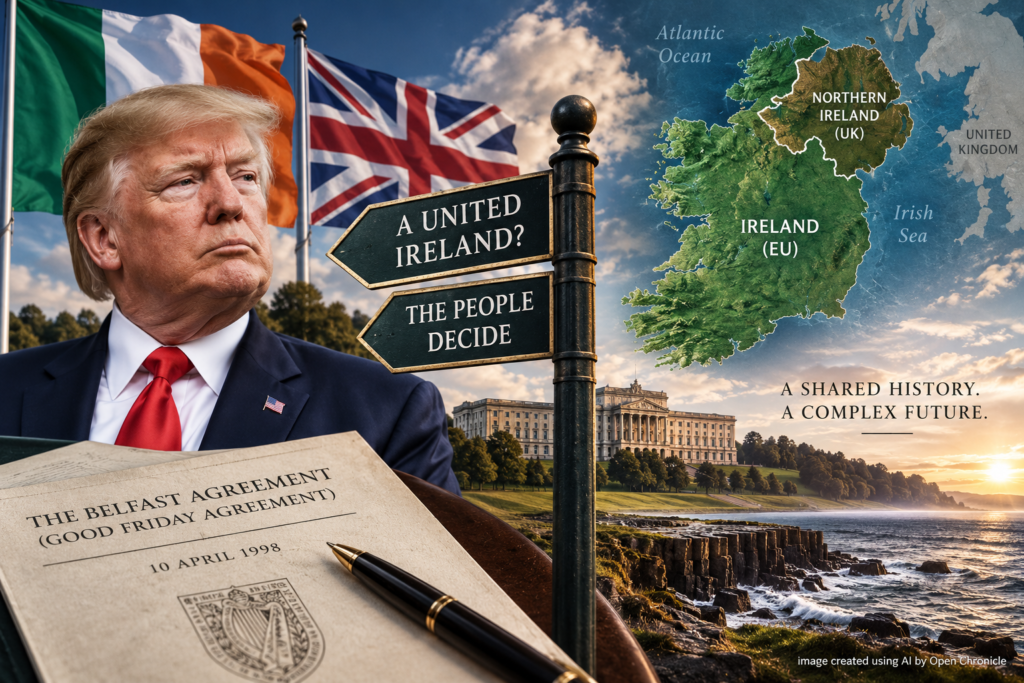
US President Donald Trump has triggered a sharp political reaction in Northern Ireland after saying he would “love to see” a united Ireland and suggesting that reunification was likely to happen eventually.
Trump made the remarks during his visit to Ireland while appearing alongside Taoiseach Micheál Martin. Asked about the constitutional future of the island, the US president openly expressed support for Irish unity.
“I’d love to see it unified,” Trump said, adding that he believed it would be a positive development.
He later returned to the subject during an appearance at the residence of the US ambassador to Ireland, acknowledging that his comments were likely to attract considerable attention.
Trump said he had been asked directly what he thought about the unification of Northern Ireland and the Republic of Ireland.
“I actually said it would be, I think, a very cool thing. To be honest with you, I think it would be cool,” he told guests.
The intervention immediately touched one of the most politically sensitive questions on the island of Ireland and prompted criticism from several unionist leaders.
DUP says Northern Ireland’s future is for its people to decide
Democratic Unionist Party leader Gavin Robinson rejected the suggestion that politicians outside Northern Ireland should determine its constitutional future.
“Northern Ireland’s constitutional future will be decided by the people of Northern Ireland, not by commentary in London, Dublin or Washington,” Robinson said.
He argued that Northern Ireland remains part of the United Kingdom because that reflects the democratic preference of its population and expressed confidence that voters would continue to support remaining within the UK.
The response is particularly significant because the DUP has maintained engagement with the Trump administration despite political disagreements elsewhere in Northern Ireland over US policy.
Northern Ireland’s constitutional status is governed by the principle of consent established under the 1998 Belfast, or Good Friday, Agreement.
Under the agreement, the British government can call a referendum on Irish unity if it appears likely that a majority in Northern Ireland would support constitutional change. Any reunification would also require approval from voters in the Republic of Ireland.
Unionist leaders reject outside intervention
Traditional Unionist Voice leader Jim Allister also criticised Trump’s intervention, accusing the US president of commenting on an issue that should be determined locally.
“Northern Ireland is not a pawn in Trump’s fall-out with the UK,” Allister said. “Our constitutional future does not depend on him or any other foreign dignitary.”
Ulster Unionist Party leader Jon Burrows adopted a more measured tone, saying Trump was entitled to express his opinion but stressing that the decision ultimately belonged to Northern Ireland’s population.
“The only people whose decision counts are the people of Northern Ireland,” he said.
Burrows pointed to the principle of consent contained in the Good Friday Agreement and argued that Northern Ireland remained safer and more prosperous within the United Kingdom.
Nationalists react very differently
Trump’s comments produced a markedly different response among some Irish nationalists.
Former SDLP leader and Foyle MP Colum Eastwood, a frequent critic of the US president, shared footage of Trump’s comments on social media with the brief remark: “Always liked him.”
That reaction prompted criticism from UUP MLA Robbie Butler, who accused some Trump opponents of suddenly welcoming the president’s views because they aligned with their position on Irish reunification.
The exchange illustrated the political divide surrounding the constitutional question, which remains one of the defining issues in Northern Irish politics.
Sinn Féin has increasingly called for preparations for a referendum on Irish unity, particularly following Brexit. The party has also boycotted the traditional St Patrick’s Day visit to Washington during the past two years because of disagreements with the Trump administration over its Middle East policy.
Good Friday Agreement remains the framework
Despite Trump’s intervention, the legal mechanism governing any potential reunification remains unchanged.
The Good Friday Agreement, reached in 1998 with significant US diplomatic involvement, helped bring an end to decades of conflict known as the Troubles.
Its central constitutional compromise established that Northern Ireland would remain within the United Kingdom unless a majority of its population voted otherwise.
If the British government concludes that a majority for reunification appears likely, the Northern Ireland secretary is required to call a border poll.
A corresponding vote would also be necessary in the Republic of Ireland before constitutional reunification could take place.
Trump’s remarks therefore carry no formal constitutional authority, but comments from a sitting US president inevitably carry political weight given Washington’s historic involvement in the Northern Ireland peace process.
A sensitive issue during Trump’s Ireland visit
The controversy adds an unexpected political dimension to Trump’s visit to Ireland, which has included meetings with senior Irish political figures as well as events connected to his golf resort at Doonbeg.
For unionists, his comments risk appearing to undermine the principle that Northern Ireland’s future should be determined exclusively through democratic consent.
For nationalists seeking a referendum, however, the intervention from the US president is likely to intensify discussion about whether the constitutional question is moving closer to the centre of international political debate.
More than a quarter of a century after the Good Friday Agreement, the question of Irish unity remains unresolved. Trump’s comments have not changed the legal path toward any potential reunification, but they have ensured that the issue has once again moved rapidly to the forefront of political debate on both sides of the Irish border.