
By Open Chronicle Explained
Electricity is so deeply embedded in everyday life that its arrival feels automatic.
Press a button and a computer starts.
Plug in a phone and its battery begins charging.
Turn on an oven and electrical energy becomes heat.
Across a city, millions of people can do these things simultaneously.
Yet electricity is not simply stored somewhere in enormous quantities waiting for someone to turn on a light.
In most power systems, generation and consumption must remain closely balanced every second.
That makes the electricity grid an extraordinary engineering system.
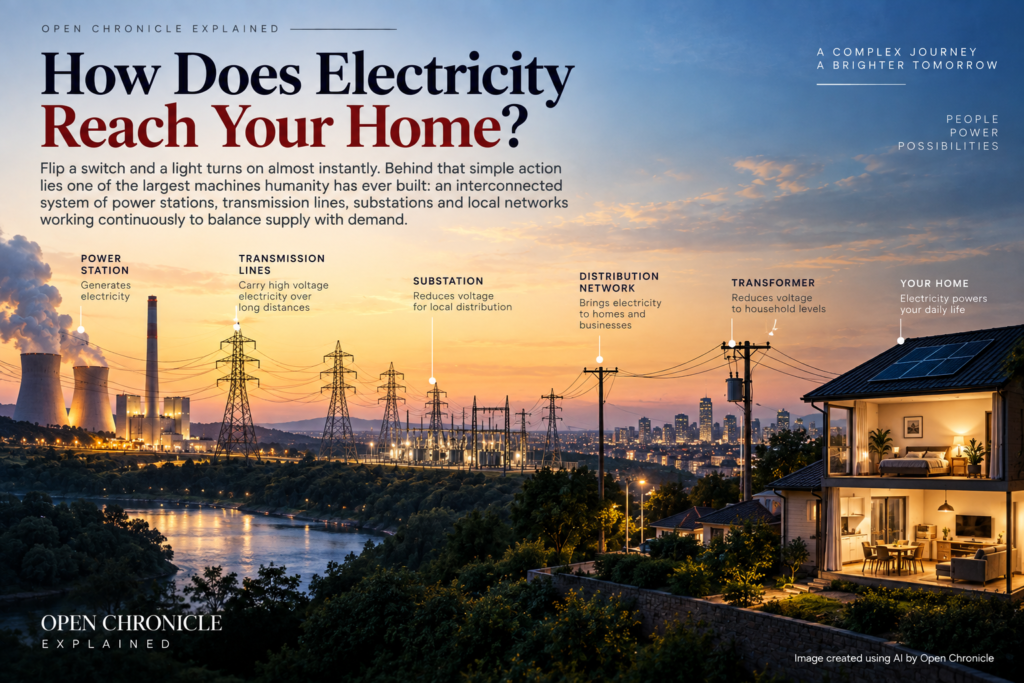
To understand how electricity reaches your home, we need to follow its journey from the place where it is generated to the socket in the wall.
Where does electricity begin?
Electricity can be generated in many different ways.
A natural gas power station can burn fuel to produce energy.
A nuclear reactor uses heat released by nuclear fission.
A hydroelectric plant uses moving water.
Wind turbines convert the movement of air into electrical energy.
Solar photovoltaic panels convert sunlight directly into electricity.
Coal, geothermal energy, biomass and other sources can also contribute depending on the country and its energy system.
Despite their differences, many large power stations ultimately perform a similar task.
They generate electrical power and inject it into the grid.
How does a power station generate electricity?
In many conventional power stations, electricity begins with a turbine and generator.
A source of energy produces movement.
Steam may turn a turbine in a nuclear, coal or some gas power plants.
Flowing water turns turbines at hydroelectric facilities.
Wind rotates turbine blades directly.
The turbine is connected to a generator.
Inside the generator, mechanical motion and magnetic fields are used to produce electrical current.
The energy has now become electricity.
But it may still be hundreds of kilometres from the people who will use it.
Why isn’t electricity sent directly from the power station to your house?
Because moving large amounts of electricity over long distances efficiently requires very high voltages.
Electrical transmission through wires produces losses, primarily as heat.
For a given amount of power, increasing voltage allows the current to be reduced.
Lower current means lower resistive losses in transmission lines.
So before electricity begins a long journey across the grid, transformers increase its voltage.
The electricity then enters the high voltage transmission network.
What is the transmission grid?
The transmission grid is the long distance highway of the electricity system.
Large pylons and high voltage lines carry enormous quantities of electrical power between generating regions, cities and major industrial areas.
Some transmission lines cross hundreds of kilometres.
Others connect neighbouring countries.
The network is interconnected because electricity demand and generation are constantly changing.
A city does not necessarily receive power from one particular power station.
Instead, many generators feed electricity into a common network, while millions of consumers draw energy from it.
Electricity flows through that network according to the physical characteristics and operating conditions of the grid.
Why are electricity pylons so large?
Partly because high voltage conductors need substantial separation from the ground, structures and each other.
Transmission lines can operate at hundreds of thousands of volts.
Large towers keep the conductors safely elevated while supporting them over long distances.
The familiar pylons crossing landscapes are therefore not simply oversized versions of local electricity poles.
They form part of the infrastructure designed to transport huge quantities of energy efficiently across large areas.
What happens when electricity reaches a city?
The voltage is reduced.
The enormous voltages useful for long distance transmission are not suitable for ordinary homes and businesses.
Electricity therefore passes through substations.
A substation is a crucial junction in the grid.
It can contain transformers, switches, protection equipment and control systems.
Transformers reduce the voltage from transmission levels to levels appropriate for regional or local distribution.
Electricity then enters the distribution network.
What is the difference between transmission and distribution?
Think of a road network.
Transmission lines are the motorways.
They move large quantities of electrical power over long distances.
Distribution networks are the smaller roads that bring electricity into communities, neighbourhoods and individual buildings.
After leaving major substations, electricity travels through progressively more local networks.
Its voltage is typically reduced in stages.
Eventually it reaches a neighbourhood transformer or another local transformation point.
There the voltage is adjusted again to the level required by local consumers.
What does the transformer near your home do?
Its job is fundamental.
Electricity travelling through the local distribution network may still be at a voltage too high for ordinary household use.
A distribution transformer reduces that voltage.
Depending on the country and electrical system, these transformers may be mounted on poles, installed inside cabinets or housed in small substations.
From there, low voltage cables carry electricity toward individual buildings.
At this point, the journey that may have begun hundreds of kilometres away is almost complete.
How does electricity enter your house?
A service connection links the local distribution network to the building.
Electricity passes through a meter that records consumption.
It then reaches the electrical panel.
The panel distributes power across different circuits inside the property.
Separate circuits may supply lighting, wall sockets, kitchen appliances and other equipment.
Circuit breakers and other protective devices help isolate faults or excessive electrical currents.
From the panel, wires embedded throughout the building finally carry electricity to switches, sockets and appliances.
When you turn on a lamp, you complete an electrical circuit that allows current to flow through it.
Is the electricity in my socket from one particular power station?
Usually, that is not a useful way to think about it.
Once multiple generators feed electricity into an interconnected alternating current grid, electricity becomes part of the common electrical system.
A household may be located geographically close to a particular power station, but the grid is constantly balancing generation and consumption across a much larger network.
Different power stations increase or reduce their output.
Renewable generation changes with weather conditions.
Power can flow between regions.
Imports and exports can occur between interconnected countries.
What reaches your home is therefore the result of the entire system operating together.
Why must supply and demand stay balanced?
This is one of the most important characteristics of an electricity grid.
At every moment, the amount of electricity being generated must closely match the amount being consumed, accounting for system losses and other grid conditions.
Demand changes constantly.
Millions of people wake up and begin using appliances.
Factories start production.
Offices open.
Electric vehicles begin charging.
Air conditioning demand rises during hot weather.
Lighting demand increases after sunset.
At the same time, generation changes.
Clouds can affect solar production.
Wind speeds change.
Power stations can fail unexpectedly.
Grid operators must continuously manage these variations.
What happens if too much or too little electricity is generated?
The grid’s frequency can begin to move away from its required operating level.
In much of Europe, for example, alternating current systems operate at a nominal frequency of 50 hertz.
Maintaining frequency close to its target is essential for grid stability.
If generation suddenly becomes insufficient relative to demand, frequency can fall.
If generation exceeds demand, frequency can rise.
Power systems therefore maintain reserves and use automatic controls to respond rapidly to imbalances.
Some generators can change output.
Battery systems can inject or absorb power.
Demand can sometimes be adjusted.
Interconnections can allow electricity to flow from other regions.
The objective is constant balance.
Who controls the grid?
Electricity systems typically involve several different organizations.
Power producers generate electricity.
Transmission system operators manage high voltage networks.
Distribution system operators manage regional and local networks.
Energy suppliers sell electricity to customers.
Regulators establish rules for markets, reliability and consumer protection.
The exact structure differs between countries.
But somewhere in the system, control centres are monitoring conditions continuously.
Operators watch generation, demand, transmission flows, frequency, equipment status and potential faults.
Modern electricity grids are therefore both physical and digital systems.
How does electricity know where to go?
It does not receive an address like a package moving through the postal system.
Electricity flows according to the laws of physics.
In an interconnected alternating current network, power flows through available paths depending on factors including electrical impedance, voltage conditions and the configuration of the grid.
Operators influence these flows by controlling generation, network configuration and other equipment.
This is one reason electricity grids are complex.
You cannot simply tell a particular electron to travel from one power station to one house.
The entire network operates as an interconnected electrical system.
What happens when a power line fails?
Protection systems detect many electrical faults and isolate affected equipment.
Circuit breakers can disconnect a damaged line before the fault destabilizes larger parts of the network.
If alternative transmission paths exist, electricity can be rerouted through other parts of the grid.
This redundancy is essential.
A well designed electricity system should be able to tolerate certain equipment failures without causing widespread outages.
But redundancy has limits.
If several important components fail, or if the system becomes severely unbalanced, failures can spread.
That is how local problems can sometimes develop into large blackouts.
What causes a blackout?
There is no single cause.
Extreme weather can damage transmission or distribution infrastructure.
Wildfires can threaten power lines.
Floods can affect substations.
Equipment can fail.
Power stations can unexpectedly disconnect.
Trees can fall onto local lines.
Cyber incidents can affect parts of increasingly digital energy infrastructure.
Human error can also contribute.
Large blackouts sometimes involve a sequence of failures rather than one isolated event.
The grid is designed with protection mechanisms intended to prevent a problem in one location from cascading across the network.
Can electricity be stored?
Yes, and storage is becoming increasingly important.
Historically, large electricity systems had limited ability to store power directly at grid scale.
Instead, operators adjusted generation to follow demand.
Pumped storage hydroelectricity has long provided one major form of large scale storage.
When electricity is abundant, water can be pumped to a higher reservoir.
When electricity is needed, the water is released through turbines to generate power.
Battery storage now provides another rapidly developing option.
Large battery installations can absorb electricity when supply is abundant and return it to the grid when required.
Storage can also respond extremely quickly to changes in grid conditions.
Why do renewables make grid management different?
Wind and solar generation depend on environmental conditions.
A gas turbine can generally be instructed to increase or decrease output within its operational limits.
A wind farm cannot command the wind to blow harder.
A solar farm cannot prevent night from arriving.
This does not make renewable electricity unmanageable, but it changes the challenge.
Grid operators can combine renewable sources across large geographic areas, use energy storage, strengthen transmission connections, manage flexible demand and retain other sources capable of responding when needed.
Weather forecasting has also become an important part of electricity system management.
The future grid will therefore depend increasingly on coordination between generation, storage, transmission and demand.
Why are international electricity connections important?
Because neighbouring electricity systems can support one another.
High capacity interconnectors allow electricity to move between countries or regions.
If one area has abundant generation while another has high demand, power can flow between them.
Interconnections can also help integrate renewable energy.
Strong winds in one country may produce surplus electricity that can be exported elsewhere.
Hydroelectric resources in another region may provide flexible generation when demand rises.
The larger and better connected the network, the more options operators can have for balancing the system.
But interconnection also means disturbances must be carefully managed so problems do not spread.
Is the electricity grid one giant machine?
In an important sense, yes.
A large synchronized AC grid connects enormous numbers of generators, transformers, transmission lines, substations and consumers.
All of them interact continuously.
A power station hundreds of kilometres away can influence conditions elsewhere in the network.
A major transmission failure can alter power flows across a wide region.
A sudden change in demand is reflected throughout the system.
This is why electricity grids are sometimes described as among the largest machines ever constructed.
They are not a single physical object.
They are millions of components operating together as one system.
Why is the grid becoming more important?
Because more parts of the economy are becoming electrified.
Electric vehicles increase electricity demand.
Heat pumps can replace fossil fuel heating.
Data centres require enormous quantities of reliable electricity.
Industry is exploring electrification as part of efforts to reduce emissions.
At the same time, wind and solar generation are expanding in many countries.
The electricity grid must therefore carry more power, connect new generating sources and manage increasingly complex flows.
Transmission infrastructure that once attracted little public attention is becoming a central part of energy policy.
The Bigger Picture
When you turn on a light, the final action is simple.
The system behind it is not.
Somewhere, electricity is being generated.
Transformers increase its voltage.
Transmission lines carry power across regions.
Substations redirect it and reduce its voltage.
Distribution networks bring it into your neighbourhood.
Another transformer prepares it for local use.
Cables carry it into your building.
Protection systems watch for faults.
Meters record consumption.
Control centres monitor the wider network.
And throughout all of this, generation and demand must remain balanced.
The remarkable thing is not simply that electricity can travel from a power station to your home.
It is that an enormous network can coordinate millions of producers and consumers continuously, while making the result feel as simple as pressing a switch.
That is how electricity reaches your home.
Understanding the systems behind the headlines.
Explore Open Chronicle Explained →