
By Open Chronicle Explained
Send a message from Lisbon to New York and it can arrive almost instantly.
Open a website hosted in the United States from Europe and the information appears on your screen within fractions of a second.
Make a video call across the Atlantic and voices, images and data travel between continents quickly enough for a conversation to feel almost natural.
It is easy to imagine all of this information travelling through satellites.
Most of it does not.
The physical backbone of the international internet lies beneath the oceans.
Across the Atlantic, Pacific, Indian Ocean and many smaller seas runs a vast network of submarine telecommunications cables carrying data between continents.
They are among the most important pieces of infrastructure in modern civilization.
And most people rarely see them.
What is a submarine internet cable?
A submarine communications cable is a physical cable laid across the seabed to transmit digital information between locations separated by water.
Modern systems use fibre optic technology.
Inside the cable are extremely thin strands of glass capable of carrying information as pulses of light.
Those pulses represent digital data.
Emails, financial transactions, streaming video, website requests, telephone calls, cloud computing traffic and countless other forms of communication can all travel through these fibres.
The principle is surprisingly simple.
Information is converted into optical signals.
Those signals travel through fibre optic cables.
At the destination, they are converted back into usable digital information.
What makes the system extraordinary is its scale.
A single modern submarine cable can carry enormous amounts of data simultaneously.
Why doesn’t the internet mainly use satellites?
Satellites are important, particularly for remote areas, maritime communications, aviation and locations without terrestrial infrastructure.
But for high capacity communications between major population centres, fibre optic cables have major advantages.
They can carry enormous quantities of data.
They generally offer lower latency than communications routed through distant satellites.
And once installed, they provide extremely efficient connections between major network hubs.
This is why the overwhelming majority of intercontinental digital traffic travels through submarine cables rather than satellites.
The internet may increasingly reach individual devices wirelessly, but its international backbone remains overwhelmingly physical.
What happens when you open a website across the Atlantic?
Imagine someone in Portugal opening a website whose data is stored on servers in the United States.
The request begins on a computer or smartphone.
It might first travel through Wi Fi or a mobile network.
From there, it enters the infrastructure of an internet service provider.
The request is then routed through terrestrial fibre networks toward major network exchange points.
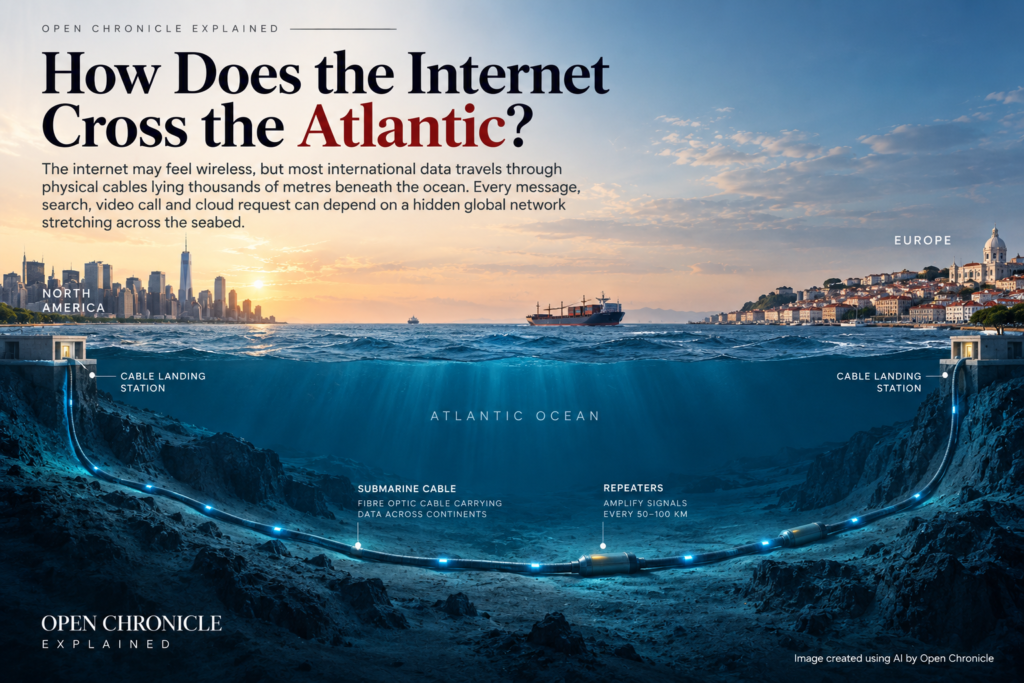
If the required data must cross the Atlantic, traffic can be directed toward a submarine cable landing station.
At the coast, terrestrial infrastructure connects with the submarine cable.
The data then begins its journey beneath the ocean.
Thousands of kilometres later, the cable reaches another landing station on the opposite side of the Atlantic.
The traffic enters another terrestrial network and continues toward the server hosting the requested information.
The response then travels back through the network.
All of this can happen in a fraction of a second.
How can light carry information?
Modern fibre optic communications rely on one of the most important technologies behind the digital age.
Optical fibre.
A fibre is an extremely thin strand of highly purified glass.
Light can travel through it while remaining confined inside the fibre.
Digital information is encoded into optical signals and transmitted along these strands.
Different techniques allow multiple streams of information to travel through the same fibre.
One important method uses different wavelengths of light simultaneously.
Instead of imagining a fibre as carrying a single beam, think of it as a highway where many lanes of optical traffic can operate at the same time.
This allows modern cables to achieve enormous transmission capacities.
Can light really travel across an entire ocean?
Not without help.
Even in high quality optical fibre, signals gradually weaken as they travel.
A transatlantic cable can stretch for thousands of kilometres.
To maintain the signal, submarine cable systems use repeaters positioned along the route.
These devices amplify the optical signals as they cross the ocean.
Electrical power for the repeaters is supplied through the cable system itself from landing stations.
The result is an extraordinary engineering chain.
A signal enters the ocean on one continent, is maintained by equipment distributed along the seabed, and eventually emerges thousands of kilometres away.
What does an undersea cable actually look like?
It depends on where the cable is located.
In the deep ocean, a submarine cable can be surprisingly thin, often roughly comparable in diameter to a garden hose.
The central optical fibres occupy only a small portion of the structure.
Around them are layers designed to provide protection, insulation and structural strength.
Closer to shore, cables often receive additional armour.
That is because coastal waters are more dangerous.
Fishing activity, anchors, currents and human activity create greater risks in shallow water than in much of the deep ocean.
Cable designers therefore adapt protection to the environment.
How are cables placed on the ocean floor?
Specialized cable laying ships install them.
Before installation begins, engineers survey the proposed route.
They study seabed geography, geological hazards, existing infrastructure, fishing areas and other potential risks.
The cable is then loaded onto a specialized vessel.
As the ship follows the planned route, cable is carefully paid out behind it and lowered toward the seabed.
In deep water, the cable generally rests on the ocean floor.
Closer to shore, it may be buried beneath the seabed for additional protection.
Special equipment can create a narrow trench, place the cable inside and allow sediment to cover it.
The objective is not to build a giant structure across the ocean.
It is to place a relatively narrow communications line along a carefully selected route.
Where do submarine cables come ashore?
They reach land at cable landing stations.
These facilities form the bridge between submarine infrastructure and terrestrial telecommunications networks.
A landing station contains equipment used to power, monitor and manage the cable system.
From there, fibre networks carry traffic inland toward internet exchanges, data centres and telecommunications networks.
This means the geography of the internet does not end at the coastline.
Landing stations themselves become strategically important infrastructure.
Locations connected to several submarine cables can become major nodes in global communications.
Is there only one cable between Europe and North America?
No.
One of the strengths of the global internet is redundancy.
Multiple submarine cable systems connect Europe and North America across different routes.
The same principle applies to many other heavily connected regions.
Traffic can therefore be rerouted when a cable experiences problems.
If one transatlantic system fails, the internet between Europe and North America does not simply disappear.
Network operators can redirect traffic through other cables.
But redundancy has limits.
If several important cables were disrupted simultaneously, remaining routes could experience congestion and reduced capacity.
This is why the number and diversity of cable routes matter.
Who owns these cables?
There is no single owner of the global submarine cable network.
Historically, many systems were developed by consortia of telecommunications companies.
That model still exists.
But the structure of the industry has changed as global technology companies have become some of the world’s largest consumers of international bandwidth.
Companies operating enormous cloud platforms, search engines, social networks and digital services have strong incentives to invest directly in submarine infrastructure.
As a result, some modern cable systems involve major technology companies alongside traditional telecommunications operators and specialist infrastructure firms.
The physical architecture of the internet increasingly reflects the enormous scale of cloud computing and global digital platforms.
What happens if a cable breaks?
It happens more often than many people realize.
Submarine cables can be damaged by anchors, fishing equipment, underwater landslides, earthquakes and other events.
In most cases, users never notice.
That is because network operators reroute traffic through alternative cables.
The damaged section can then be repaired.
Specialized repair vessels travel to the approximate location of the fault.
Engineers identify the damaged cable, recover it from the seabed, repair or replace the affected section and return it to the ocean.
Depending on location, weather and vessel availability, repairs can take time.
Are submarine cables vulnerable?
Yes, but vulnerability needs context.
The global cable system is simultaneously resilient and fragile.
It is resilient because there are many cables, many routes and sophisticated systems for rerouting traffic.
It is fragile because enormous volumes of communication depend on relatively small pieces of physical infrastructure.
Some regions have extensive redundancy.
Others depend on only a few connections.
Islands and geographically isolated countries can be particularly vulnerable if they rely on a small number of submarine cables.
Natural disasters can also damage multiple systems in the same region.
This is why route diversity is important.
Two cables do not provide much resilience if both pass through exactly the same vulnerable location.
Could someone deliberately cut an internet cable?
A submarine cable can physically be damaged, so deliberate sabotage is possible.
The strategic significance of undersea infrastructure has therefore attracted increasing attention from governments and security organizations.
But deliberately disrupting global communications on a large scale would be considerably more complicated than cutting a single cable.
Major routes often contain multiple systems.
Traffic can be rerouted.
Repair capabilities exist.
And determining exactly how much disruption would result from damaging a particular cable requires detailed knowledge of network architecture.
The larger concern is concentrated infrastructure.
Locations where multiple important cables converge can represent potential points of vulnerability.
Does the internet have chokepoints too?
Yes.
The concept is similar to maritime chokepoints such as the Strait of Hormuz.
The internet is designed as a distributed network, but physical geography still matters.
Cables must reach land somewhere.
Some coastlines host numerous landing stations.
Certain narrow seas and maritime corridors carry many cable systems.
Major internet exchanges and data centre regions also concentrate enormous volumes of digital traffic.
The network therefore contains locations whose importance is far greater than their physical size suggests.
Understanding these digital chokepoints is increasingly important for national security and economic resilience.
How fast does information cross the Atlantic?
Extremely fast, but not instantaneously.
Light has a finite speed.
It also travels more slowly through optical fibre than through a vacuum.
Network routes are not perfectly straight, and data must pass through networking equipment along the way.
These factors create latency.
For normal internet users, the delay between Europe and North America is often measured in tens of milliseconds.
That may seem insignificant.
For certain activities, however, milliseconds matter.
Financial trading, cloud computing, gaming and real time applications can all be sensitive to latency.
This is one reason cable operators seek efficient routes between major economic and digital centres.
Why are submarine cables so important to the economy?
Because modern economic activity depends on data.
Banks communicate internationally.
Companies access cloud services.
Financial markets exchange information.
Manufacturers coordinate global supply chains.
Governments communicate with overseas institutions.
Streaming services deliver enormous amounts of content.
Businesses process transactions across borders.
Individuals send messages, make video calls and access websites hosted in other countries.
All of these activities depend on telecommunications infrastructure.
Submarine cables are therefore not simply part of the internet.
They are part of the physical infrastructure of the global economy.
Why don’t we see them?
Because the most important infrastructure is often invisible until something goes wrong.
Roads, airports and bridges are obvious.
Submarine cables disappear into the ocean.
Once they reach deep water, they can remain on the seabed for years while carrying extraordinary quantities of information.
That invisibility contributes to one of the great misconceptions about the internet.
We often describe digital activity as existing in “the cloud”.
But the cloud is physical.
It consists of data centres, servers, routers, fibre networks, electricity systems and submarine cables.
Every digital service ultimately depends on hardware somewhere.
The Bigger Picture
The internet changed how humanity communicates, works, trades and shares information.
But the network often feels more abstract than it really is.
A photograph stored in the cloud still exists on physical hardware.
A website still runs on servers.
A wireless connection still eventually connects to wired infrastructure.
And communication between continents still depends overwhelmingly on physical cables.
Beneath the Atlantic Ocean lies a network carrying conversations, financial transactions, entertainment, scientific data, government communications and countless other pieces of information every second.
The digital world is therefore built on something surprisingly tangible.
Glass fibres.
Ships.
Landing stations.
Data centres.
Electricity.
And thousands of kilometres of cable resting silently on the ocean floor.
That is how the internet crosses the Atlantic.
Understanding the systems behind the headlines.
Explore Open Chronicle Explained →