
By Open Chronicle Explained
A radar detects something unusual.
Hundreds of kilometres away, an object is climbing rapidly through the atmosphere.
Computers begin analysing its speed and trajectory.
Sensors determine that it is not an aircraft.
It is a missile.
Almost immediately, another calculation begins.
Where is it going?
What could it hit?
How much time remains?
Which defensive system can reach it?
Should an interceptor be launched?
Within moments, a missile defence network may have to transform incomplete sensor information into a life or death decision.
An interceptor launches.
It accelerates toward the incoming threat.
Sensors continue updating the target’s position.
The two objects approach one another at extraordinary speed.
Then comes the hardest part.
The interceptor has to stop the missile before the missile reaches its target.
That is missile defence.
But behind that apparently simple sequence lies one of the most difficult engineering problems in modern warfare.
First, what is a missile?
A missile is a guided weapon designed to travel toward a target.
That definition includes weapons with very different characteristics.
Some fly through the atmosphere like aircraft.
Others climb high above the atmosphere before descending at enormous speed.
Some travel a few dozen kilometres.
Others can cross continents.
Some follow relatively predictable trajectories.
Others manoeuvre.
Understanding missile defence therefore begins with understanding that there is no single type of missile.
And there is no single type of missile defence.
What is a ballistic missile?
A ballistic missile is powered by rockets during the initial part of its flight.
After that acceleration phase, much of its trajectory is governed by gravity and momentum.
Longer range ballistic missiles can climb extremely high before descending toward their targets.
The trajectory resembles an enormous arc.
This produces several distinct phases of flight.
The boost phase occurs while the missile’s engines are firing.
The midcourse phase occurs after powered flight, when longer range systems may travel through space.
The terminal phase occurs when the warhead descends toward its target.
Different missile defence systems are designed to engage threats during different phases.
What is a cruise missile?
A cruise missile behaves differently.
Rather than following a high ballistic arc, it generally flies through the atmosphere using aerodynamic lift and sustained propulsion.
In some ways, it resembles a small unmanned aircraft.
Cruise missiles can fly at relatively low altitude.
Terrain and the curvature of the Earth can make them harder for distant ground based radars to detect.
They may also approach targets from unexpected directions.
Defending against cruise missiles therefore involves a different sensor and interceptor problem from defending against ballistic missiles.
What about hypersonic weapons?
The word hypersonic generally describes speeds above Mach 5, five times the speed of sound.
Ballistic missiles have reached hypersonic speeds for decades during portions of their flight.
The modern strategic discussion often focuses on systems such as hypersonic glide vehicles and certain manoeuvring missiles.
Their potential ability to change trajectory at high speed can complicate tracking and interception.
The problem is not simply speed.
It is speed combined with manoeuvrability and uncertain flight paths.
What is missile defence trying to do?
At the most basic level, missile defence attempts to prevent an incoming missile or its payload from reaching the intended target.
That can involve several layers.
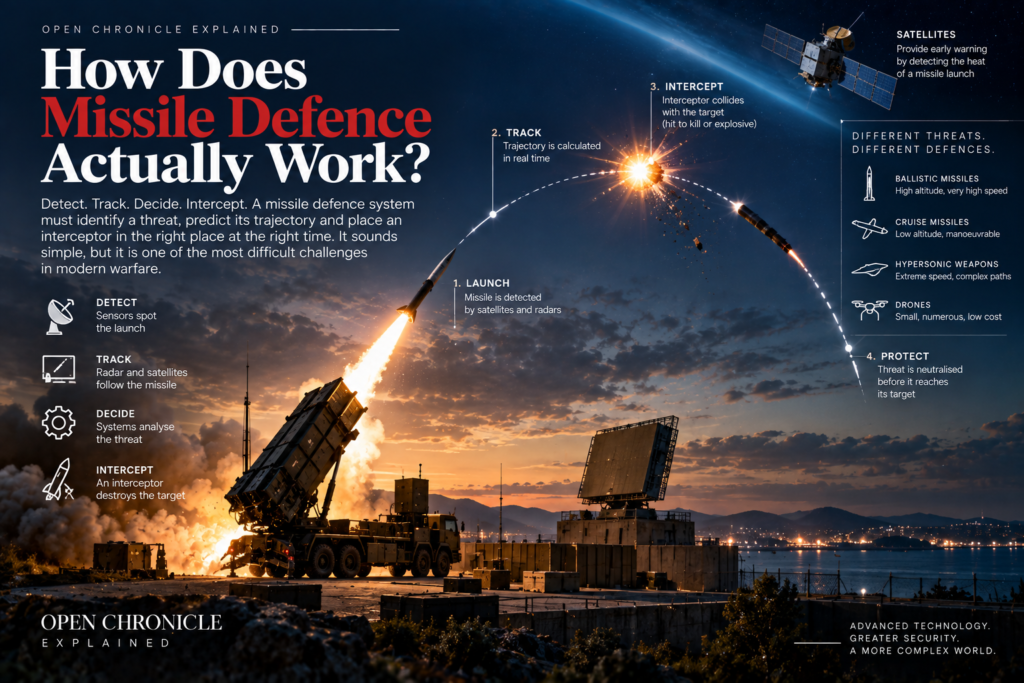
Detect the launch.
Track the missile.
Identify the threat.
Predict its trajectory.
Determine what it may be targeting.
Select an appropriate defensive system.
Launch an interceptor.
Guide the interceptor.
Destroy or disable the incoming threat.
Every step must happen quickly.
And errors early in the sequence can affect everything that follows.
How is a missile detected?
Sensors.
Radar is one of the most important.
A radar transmits radio waves.
Those waves reflect from objects.
The returned signal can provide information about distance, direction and movement.
Large military radars can detect objects at considerable ranges.
But radar is not the only method.
Satellites equipped with infrared sensors can detect the intense heat generated by missile launches.
Airborne sensors can contribute.
Ships can carry powerful radar systems.
Different sensors can share information.
Modern missile defence is therefore better understood as a network than as one launcher watching the sky.
Why are satellites useful?
A missile launch produces enormous heat.
Infrared sensors aboard satellites can detect that thermal signature from space.
This can provide early warning before ground based radars have a clear view of the missile.
For long range ballistic missile threats, every additional second matters.
Satellite detection can alert command networks that something has launched.
Other sensors can then begin searching for and tracking the object.
This is the first important lesson of missile defence:
the interceptor is only as useful as the information guiding it.
What happens after detection?
The system needs to establish a track.
One radar measurement tells you where an object was at one moment.
Repeated measurements reveal movement.
Computers estimate speed.
Direction.
Altitude.
Acceleration.
The system begins predicting the trajectory.
For a ballistic missile, physics can provide powerful clues about where the object may travel.
But uncertainty remains.
Sensors have measurement errors.
The missile may manoeuvre.
Objects may separate.
The defender has to keep updating the track.
How does the system know where the missile is going?
By continuously estimating its trajectory.
Suppose radar observes an object travelling rapidly through the atmosphere.
Its position changes over time.
Computers use those observations and models of motion to predict future positions.
This allows the defence network to estimate a possible impact area.
That matters because not every detected missile necessarily threatens the defended location.
An interceptor may be a scarce and expensive resource.
The system must decide whether engagement is necessary.
Who decides whether to fire?
That depends on the system, the threat and the rules established by the military operating it.
Some defensive functions can be highly automated because reaction times are extremely short.
Computers can detect, classify and prioritize targets.
Human operators may supervise and authorize engagement.
The balance between automation and human decision making varies.
But the underlying challenge is universal.
Wait too long and the opportunity to intercept may disappear.
Act too quickly and the system risks wasting interceptors or engaging the wrong object.
What is an interceptor?
An interceptor is a defensive missile designed to reach an incoming threat.
It must accelerate rapidly.
It must be guided toward the target.
Its sensors or the wider defence network must continue updating the engagement.
And then it must neutralize the threat.
Some interceptors use explosive warheads.
Others use direct collision.
The exact mechanism depends on the system and the target it was designed to defeat.
What does “hit to kill” mean?
Some missile defence systems attempt to destroy an incoming ballistic threat by physically colliding with it at extremely high speed.
This is known as hit to kill.
The interceptor does not necessarily require a conventional explosive warhead to destroy the target.
The kinetic energy of the collision can be enormous.
But this creates an extraordinary guidance problem.
Two relatively small objects may be approaching one another at several kilometres per second.
The interceptor must arrive at almost exactly the correct point in space at almost exactly the correct time.
A tiny error can mean a miss.
Why is missile interception often compared to hitting a bullet with a bullet?
Because both objects can be moving extremely quickly.
But the comparison is imperfect.
A modern missile defence system is not firing blindly at a tiny object.
It has radar.
Computers.
Data links.
Guidance systems.
Potentially satellites and multiple sensor networks.
The interceptor can receive updated information.
Some interceptors have their own seekers for the final phase.
The real achievement is not simply speed.
It is the integration of sensing, computing, communications and guidance.
What is an interceptor seeker?
During the final part of an engagement, an interceptor may use its own sensor to locate the target.
This is called a seeker.
Depending on the system, it might use radar or infrared sensing.
The wider network brings the interceptor into the correct region.
The onboard seeker then helps refine the final approach.
Small steering adjustments can be made.
This final phase is sometimes called terminal homing.
At this point, fractions of a second can matter.
Why can’t the interceptor simply chase the missile?
Because chasing from behind can be inefficient or impossible.
Interception is often a geometry problem.
The defensive system tries to predict where the target will be and send the interceptor toward an intercept point.
Imagine two cars approaching an intersection from different roads.
The objective is not to follow the other car’s path.
It is to arrive at the intersection at the same moment.
Missile defence uses a vastly more complex version of that principle.
The interceptor aims for the future position of the threat.
What is an engagement envelope?
Every missile defence system has limits.
Maximum and minimum ranges.
Altitude limits.
Reaction time requirements.
Sensor limitations.
Target types it is designed to engage.
Together, these constraints define an engagement envelope.
A defensive system cannot protect everything everywhere.
A missile approaching outside the system’s effective geometry may be impossible to engage.
This is why positioning missile defence batteries matters so much.
Geography is part of the weapon system.
Can one missile defence system stop every type of missile?
No.
Different threats require different defensive capabilities.
A system designed to intercept aircraft and cruise missiles may have limited ability against ballistic missiles.
A system optimized for short range ballistic missiles may not be capable of intercepting an intercontinental ballistic missile.
A strategic interceptor designed for very high altitude engagements would be inappropriate for many low flying threats.
This is why sophisticated air and missile defence networks are layered.
What is layered missile defence?
Layered defence means using different systems to create multiple opportunities to stop an incoming threat.
Long range sensors provide early warning.
Longer range interceptors may attempt an engagement first.
Medium range systems provide another layer.
Short range systems protect specific targets.
If one layer misses, another may still have an opportunity.
The objective is not to build an impenetrable shield.
It is to increase the probability that enough incoming threats can be stopped.
What is Patriot?
The Patriot system is a ground based air and missile defence system developed in the United States and operated by multiple countries.
Different versions and interceptors have different capabilities.
Patriot can be used against certain aircraft, cruise missiles and ballistic missile threats.
A Patriot battery is not simply a launcher.
It includes radar, command and control equipment, launchers, communications and interceptor missiles.
That illustrates an important principle.
The visible missile launcher is only one part of the system.
What is THAAD?
THAAD stands for Terminal High Altitude Area Defense.
It is designed primarily to intercept certain ballistic missile threats during the terminal portion of their flight.
THAAD uses hit to kill technology.
Its role differs from shorter range systems.
Used alongside other defences, it can contribute to a layered architecture.
A threat that survives one interception opportunity may encounter another defensive layer.
What is Aegis missile defence?
Aegis is a naval combat system used aboard warships, with ballistic missile defence capabilities incorporated through specialized sensors, software and interceptor missiles.
Ships equipped with appropriate Aegis capabilities can contribute to regional missile defence.
Their mobility provides an important advantage.
A ship can reposition.
That can change radar coverage and interception geometry.
Land based variants also exist in some locations.
What is Iron Dome?
Israel’s Iron Dome was developed primarily to defend against short range rockets and related threats.
It operates in a very different threat environment from strategic ballistic missile defence.
One of its notable characteristics is its ability to assess trajectories and prioritize threats expected to strike populated or protected areas.
Not every incoming rocket necessarily requires interception.
This helps conserve interceptors.
Again, the challenge is not merely launching a defensive missile.
It is deciding what actually needs to be intercepted.
What about Arrow?
Israel’s Arrow family is designed for ballistic missile defence at longer ranges and higher altitudes than systems such as Iron Dome.
Together with other systems, it contributes to a layered Israeli air and missile defence architecture.
This demonstrates how one country can use different systems for different threats.
Short range rockets.
Aircraft.
Cruise missiles.
Drones.
Ballistic missiles.
No single interceptor solves every problem.
Why are drones changing air defence?
Because they complicate the economics of interception.
A sophisticated interceptor can cost far more than a simple drone.
If an attacker launches large numbers of inexpensive unmanned aircraft, using premium missile interceptors against every target may become economically unsustainable.
Defenders therefore increasingly combine missiles with guns, electronic warfare and other counter drone technologies.
The challenge is no longer simply:
Can we destroy the incoming object?
It is also:
Can we afford to keep doing it?
Why are interceptor missiles so expensive?
They are sophisticated machines.
They require powerful propulsion.
Precision guidance.
Sensors.
Secure communications.
Specialized electronics.
Extreme reliability.
They may have to operate under enormous acceleration and temperature stresses.
Production quantities can also be relatively limited compared with ordinary industrial products.
But cost creates a strategic problem.
An attacker may deliberately use cheaper weapons to force the defender to consume expensive interceptors.
What is saturation?
Imagine a defence battery capable of engaging several threats simultaneously.
Now imagine dozens of missiles and drones arriving together.
Sensors must track them.
Computers must classify them.
Launchers must have enough interceptors.
Each engagement consumes time and ammunition.
At some point, the number of incoming threats can exceed the defensive system’s ability to respond.
This is called saturation.
It is one of the fundamental limitations of missile defence.
Even a highly capable system can be overwhelmed if enough threats arrive simultaneously.
Why not just build more interceptors?
Countries do.
But missiles require factories.
Specialized components.
Skilled labour.
Testing.
Storage.
Maintenance.
Money.
Production capacity cannot always be increased quickly.
And a country must decide how many interceptors to keep available for future attacks.
Firing everything at the first wave may leave nothing for the second.
Missile defence therefore involves inventory management as well as physics.
What is shoot look shoot?
A defender may sometimes use an engagement strategy in which one interceptor is launched, the result is assessed and another is fired if necessary.
This can conserve ammunition.
But it requires enough time to observe the first engagement before another opportunity disappears.
Against very fast or short range threats, there may not be enough time.
Another strategy may involve launching multiple interceptors against the same target to increase the probability of success.
That improves defensive odds.
It also consumes ammunition faster.
Does firing two interceptors guarantee a kill?
No.
Probabilities do not work that way.
If one interceptor has a certain probability of successfully destroying a target, launching another can improve the combined probability.
But the result depends on whether the engagements are independent and on many technical conditions.
Real missile defence performance cannot be reduced to a simple universal percentage.
Threat type, geometry, countermeasures, sensor quality, operator decisions and system condition all matter.
Why is the “success rate” of missile defence so difficult to measure?
Because real combat is not a laboratory.
An interceptor may launch at a target that was already going to miss a populated area.
Several interceptors may be fired against one missile.
Debris may make damage assessment difficult.
Military information may be classified.
Different sides may have incentives to exaggerate or minimize results.
And not every incoming object is identical.
A headline claiming a particular interception percentage can therefore hide enormous complexity.
What happens if the interceptor misses?
If another defensive layer exists and enough time remains, the network may attempt another engagement.
If not, the missile continues toward its target.
Civil defence then becomes important.
Warning systems.
Shelters.
Dispersal.
Hardened infrastructure.
Emergency response.
Missile defence is therefore only one component of protection against missile attack.
It reduces risk.
It does not eliminate it.
Can missiles use decoys?
Yes.
This is particularly relevant to some ballistic missile defence problems.
An attacker may attempt to make it difficult for sensors to determine which object is the real warhead.
Decoys and other countermeasures complicate discrimination.
The defender must answer:
Which object must I intercept?
Destroying a harmless decoy while the actual warhead continues toward its target would be a defensive failure.
Sensor quality and data analysis therefore become critical.
What is discrimination?
Discrimination is the process of distinguishing the real threat from other objects.
Those objects might include debris.
Rocket stages.
Decoys.
Other components.
For strategic ballistic missile defence, this can be extremely challenging, particularly during portions of flight outside the atmosphere.
The interceptor does not merely need to reach an object.
It needs to reach the correct object.
Why not destroy the missile immediately after launch?
This is called boost phase interception.
In theory, the boost phase offers advantages.
The missile is producing a strong heat signature.
It has not yet released possible decoys or multiple warheads.
Destroying it early could prevent the rest of the trajectory.
But there is a major problem.
Time and geography.
The boost phase is relatively short.
The defensive system must be close enough to detect, decide and engage almost immediately.
Against missiles launched deep inside hostile territory, that may be extremely difficult.
What happens during midcourse interception?
For longer range ballistic missiles, the midcourse phase can occur outside the atmosphere.
This provides more time for interception.
But it creates other challenges.
The defender may need to distinguish a warhead from other objects.
Distances can be enormous.
The interception geometry is demanding.
Strategic missile defence systems designed for midcourse engagements are therefore among the most technically ambitious defensive technologies ever developed.
What about terminal defence?
Terminal defence attempts to intercept the threat as it approaches the target.
The advantage is that sensors may have a clearer picture of what is actually incoming.
The disadvantage is time.
There may be only seconds or minutes left.
The defended area can also be smaller.
Terminal systems are therefore often designed to protect particular cities, military bases, infrastructure or forces.
Can missile defence protect an entire country?
That depends heavily on the country’s size, the threat and the systems involved.
Protecting a small region from short range rockets is one problem.
Protecting an entire continent from intercontinental ballistic missiles is another.
Coverage depends on radar placement.
Interceptor range.
Numbers of launchers.
Available ammunition.
Attack direction.
Terrain.
Sensor networks.
No missile defence system creates a perfect dome over a country.
The popular image of an invisible shield is misleading.
Why does geography matter so much?
Because radars have lines of sight.
Interceptors have ranges.
Missiles follow trajectories.
The curvature of the Earth matters.
Mountains can matter.
The location of ships can matter.
The position of launch sites matters.
The location of the defended target matters.
Two identical missile defence batteries positioned in different places may have very different effectiveness against the same threat.
Missile defence is geometry expressed through military technology.
Why is radar horizon important?
A ground based radar cannot see indefinitely across the Earth’s curved surface.
Low flying cruise missiles can remain below the radar horizon until they are relatively close.
That reduces warning time.
Elevated sensors help.
Airborne early warning aircraft can see farther.
Ships and distributed radars can expand coverage.
Networked sensors can share tracks.
Again, one radar is less powerful than a system of sensors working together.
Can fighter aircraft intercept cruise missiles?
Potentially, yes.
Fighter aircraft can contribute to cruise missile defence if they can detect, track and engage the threat.
Airborne radar and early warning systems can also help.
This creates another layer.
Missile defence is often discussed as though only missiles intercept missiles.
In reality, integrated air defence can involve aircraft, surface based missiles, guns, electronic warfare and sensors operating together.
Can electronic warfare stop a missile?
Sometimes electronic warfare can interfere with guidance, navigation or communications used by certain weapons.
But effectiveness depends on the missile.
Some weapons can operate autonomously.
Others use multiple navigation methods.
Ballistic missiles following inertial trajectories present a very different problem from drones depending heavily on satellite navigation.
Electronic warfare is therefore one defensive tool, not a universal solution.
What role does artificial intelligence play?
Modern defence systems increasingly use advanced algorithms to process large volumes of sensor data.
Computers can help classify objects.
Predict trajectories.
Prioritize threats.
Detect patterns.
Allocate defensive resources.
But high stakes military decisions raise important questions about human control and reliability.
The faster the threat, the greater the pressure for automation.
The more autonomous the system becomes, the more important verification, safeguards and rules of engagement become.
How much time does a defender have?
Sometimes very little.
A long range ballistic missile may provide more strategic warning time than a short range missile launched from nearby.
A cruise missile flying low may be detected relatively late.
A high speed ballistic threat can cover large distances rapidly.
This is why early warning matters so much.
Every second gained at detection creates more time for tracking, decision making and interception.
Missile defence is partly a competition for time.
Can missile defence stop nuclear weapons?
Some missile defence systems are designed to intercept ballistic missiles that could potentially carry nuclear warheads.
But the strategic problem is extraordinarily serious.
Even a high interception rate may be considered insufficient when a single successful penetration could cause catastrophic destruction.
An attacker might also launch multiple missiles, decoys or other countermeasures.
This is why nuclear strategy has historically relied heavily on deterrence rather than assuming missile defence can provide complete protection.
What is nuclear deterrence?
Nuclear deterrence attempts to prevent attack by convincing an adversary that the consequences would be unacceptable.
If a country knows that launching nuclear weapons would result in devastating retaliation, it may decide not to attack.
Missile defence operates differently.
It attempts to physically stop incoming weapons.
The two concepts can coexist.
But strategic missile defence can affect deterrence calculations because countries may worry that defensive systems could reduce the credibility of their retaliatory forces.
Missile defence therefore has geopolitical consequences beyond the battlefield.
Why can’t we build a perfect missile shield?
Physics.
Cost.
Numbers.
Geography.
Uncertainty.
Attackers adapt.
If defenders improve radar, attackers develop stealthier or lower flying weapons.
If defenders improve interceptors, attackers develop manoeuvring systems.
If defenders deploy more missiles, attackers can increase salvo size.
If interception becomes highly effective, decoys and other countermeasures become more valuable.
Military technology evolves competitively.
There is no final defensive system that permanently solves the problem.
Is 100 percent protection possible?
In realistic warfare, absolute protection is an extremely difficult standard.
Even highly capable systems can fail.
Equipment can malfunction.
Sensors can be deceived.
Interceptors can miss.
Attackers can overwhelm defences.
Weather and terrain can complicate detection.
Humans can make mistakes.
Missile defence should therefore be understood probabilistically.
Its objective is to reduce the number of threats reaching their targets and increase the attacker’s uncertainty and cost.
Why deploy missile defence if it cannot stop everything?
Because stopping some missiles can save lives and preserve critical infrastructure.
It can protect military forces.
It can reduce the effectiveness of an attack.
It can give political leaders additional options during a crisis.
It can complicate enemy planning.
An attacker may need to launch more weapons to achieve the same objective.
That increases cost and reduces certainty.
A defensive system does not need to be perfect to have strategic value.
What happens after an interception?
The danger does not necessarily disappear completely.
Fragments of the destroyed missile and interceptor can fall.
If the incoming weapon carried hazardous material, additional risks may exist.
Emergency services may need to respond.
Radar operators continue searching for additional threats.
Launchers may need reloading.
Commanders assess remaining ammunition.
The defence network prepares for the next attack.
One successful interception may be only one moment in a much larger engagement.
Why is reloading important?
Missile launchers carry finite numbers of interceptors.
Once those missiles are fired, the launcher must eventually be replenished.
That can require specialized vehicles and trained crews.
During a sustained attack, the rate at which defensive missiles are consumed becomes strategically important.
A battery with excellent interceptors but empty launchers is no longer an effective defence.
Logistics is therefore part of missile defence.
Why does industrial production matter?
Modern wars can consume missiles faster than factories replace them.
Interceptor production requires supply chains.
Rocket motors.
Electronics.
Seekers.
Propellants.
Specialized materials.
Testing facilities.
Manufacturing capacity.
A country may possess highly advanced technology but still face shortages if production cannot keep pace with expenditure.
Missile defence therefore connects battlefield performance with industrial capacity.
Is missile defence becoming more important?
Yes.
Ballistic missiles, cruise missiles and drones have become increasingly prominent in modern conflicts.
Precision weapons allow states and armed forces to threaten targets far behind front lines.
Air bases.
Ports.
Power stations.
Command centres.
Cities.
Critical infrastructure.
Defending those targets has therefore become a central military challenge.
At the same time, the growing use of inexpensive drones is forcing defenders to rethink the economics of traditional missile interception.
What might future missile defence look like?
More sensors.
More networking.
Greater automation.
Better integration between land, sea, air and space based systems.
Cheaper methods for defeating inexpensive threats.
Directed energy technologies may eventually play larger roles in some defensive missions.
Electronic warfare will remain important.
Satellite constellations may provide improved tracking.
But the central challenge will remain unchanged.
Find the threat early enough.
Understand what it is.
Predict where it is going.
And stop it before it arrives.
The Bigger Picture
Missile defence is often represented by its most dramatic moment.
An interceptor rises into the night sky.
A flash appears.
The incoming missile is destroyed.
But that explosion is only the final visible moment of a much larger system.
Long before the interceptor launches, a satellite may have detected heat from the enemy missile.
Radar establishes a track.
Computers calculate its trajectory.
Command systems determine what it threatens.
Operators decide whether to engage.
A launcher receives instructions.
An interceptor accelerates into the sky.
Sensors update its path.
An onboard seeker searches for the target.
Guidance systems make tiny corrections.
Two objects moving at extraordinary speed converge on the same point.
Everything must work together.
Detection.
Tracking.
Communications.
Computing.
Decision making.
Propulsion.
Guidance.
Interception.
And even then, success is never guaranteed.
That is the central truth about missile defence.
It is not an invisible shield that makes missiles harmless.
It is a race between sensors, computers and interceptors on one side, and speed, numbers, manoeuvre and deception on the other.
A race in which the defender may have only minutes to solve the problem.
Sometimes only seconds.
Open Chronicle Explained
Defence & Security
Understanding the technologies, systems and strategies that shape modern security.
Understanding the systems behind the headlines.
Explore Open Chronicle Explained →