
By Open Chronicle with agencies
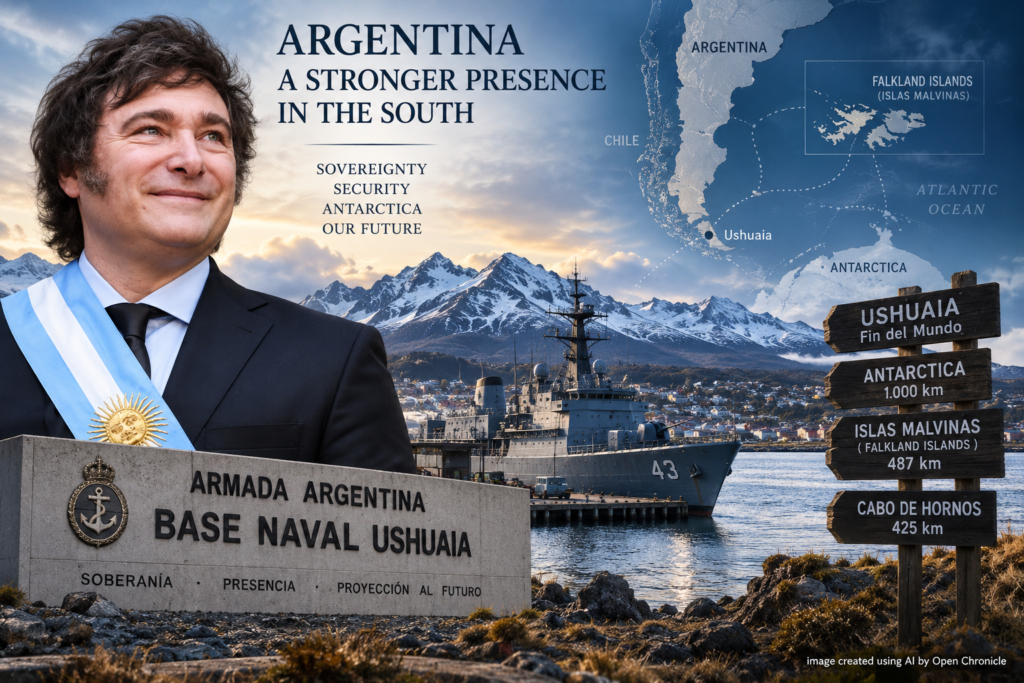
Argentina is reviving plans for a major naval base in Ushuaia, one of the world’s southernmost cities, as President Javier Milei seeks to strengthen the country’s presence in the South Atlantic and Antarctica while taking a tougher position over British oil exploration around the disputed Falkland Islands, known in Argentina as the Islas Malvinas.
The project, formally conceived as an Integrated Naval Base, sits beside the Beagle Channel in Tierra del Fuego. Its location gives it unusual strategic importance, close to maritime passages connecting the Atlantic and Pacific oceans and to the principal routes leading toward Antarctica.
For now, however, Milei’s geopolitical ambitions remain far ahead of construction.
The site near Ushuaia airport consists largely of foundations and a 2,500 square metre concrete slab on approximately 38 hectares. According to official information cited in reports, only 9.13 percent of the project has been completed.
Milei puts Ushuaia back on the strategic agenda
The naval project was originally launched under former president Alberto Fernández in 2022, but progress subsequently stalled.
Milei revived the initiative last week as his government also intensified its opposition to hydrocarbon development around the Falkland Islands. He pledged to toughen sanctions and penalties related to oil exploration in waters claimed by Argentina.
The announcement comes as Buenos Aires opposes the British backed Sea Lion oil development near the islands.
Argentina claims sovereignty over the Falklands, which have been under British administration since 1833. Britain and Argentina fought a war over the islands in 1982. The United Kingdom maintains that the islanders have the right to determine their own political status, while Argentina continues to regard the sovereignty dispute as unresolved.
The issue has gained additional attention following comments from US President Donald Trump declining to rule out reconsidering Washington’s traditional neutrality over the sovereignty dispute.
A gateway to Antarctica
Beyond the Falklands dispute, the Ushuaia base could become a central element of Argentina’s Antarctic strategy.
Daniel Guzmán, a veteran of the 1982 conflict and an international affairs analyst, said the principal objective would be to consolidate Argentina’s presence in Antarctica.
The facility could eventually support ships and aircraft operating in southern waters while also providing logistical services to other naval forces.
Ushuaia already occupies an important position in Antarctic logistics. Its proximity to the continent makes the wider Tierra del Fuego region strategically significant for scientific missions, maritime operations and access to southern sea routes.
That importance is likely to increase as governments devote greater attention to Antarctica and the surrounding oceans.
Support in Tierra del Fuego, but with conditions
Despite political differences with Milei, Tierra del Fuego Governor Gustavo Melella supports construction of the base as a means of expanding Argentina’s presence in the South Atlantic.
His support comes with an important condition.
Melella has argued that the project should remain under Argentine control and should not involve foreign countries.
That distinction has become politically sensitive because of speculation surrounding possible American involvement.
In 2024, Milei travelled to Ushuaia to meet Laura Richardson, then commander of US Southern Command. During the visit, Milei spoke about the project helping turn the two countries into a gateway to Antarctica.
His government subsequently clarified that the installation would not be a joint Argentine American base. Presidential officials have more recently described the project as entirely Argentine.
Washington keeps watching the far south
American interest in Tierra del Fuego has nevertheless remained visible.
In April 2025, then US Southern Command chief Alvin Holsey visited naval facilities in Ushuaia and received briefings concerning maritime route protection and Antarctic operations.
A delegation of 23 Americans, including seven members of Congress, also visited the province in January 2026.
Such visits reflect the broader strategic importance of the region rather than simply the proposed naval facility.
Ushuaia lies along the Beagle Channel and near important routes between the Atlantic and Pacific. The Falkland Islands and Punta Arenas in Chile occupy similarly important positions across the wider South Atlantic and southern South American maritime environment.
China adds another dimension
China’s growing economic presence has added another layer to the geopolitical competition surrounding Tierra del Fuego.
While Washington’s involvement has been most visible through military and political visits, Beijing has expanded its position largely through investment.
Chinese Ambassador to Argentina Wang Wei visited the site of a Chinese funded thermoelectric power plant near Ushuaia in March. The project reportedly represents an investment approaching $80 million.
Political scientist Luis Castelli, director of Tierra del Fuego consultancy Vox Pópuli, argues that the international attention surrounding Ushuaia reflects wider competition between major powers.
The United States is increasingly concerned about China’s expanding presence across Latin America, while Beijing continues developing commercial and infrastructure relationships throughout the region.
In Tierra del Fuego, those broader geopolitical trends intersect with Antarctic access, maritime routes, energy interests and Argentina’s own sovereignty concerns.
The South Atlantic returns to geopolitical prominence
The future of the Ushuaia base therefore extends well beyond the construction of another Argentine naval installation.
If completed as envisioned, it could strengthen Buenos Aires’ ability to operate in the South Atlantic, support Antarctic missions and maintain a greater presence around some of the world’s most strategically important southern maritime passages.
It would also emerge at a time when competition for influence in the far south is becoming increasingly visible.
For Milei, the project additionally connects several politically powerful themes: Argentina’s historic claim over the Malvinas, opposition to British oil development, relations with Washington and the country’s ambitions in Antarctica.
Yet the scale of that vision contrasts sharply with conditions on the ground.
Today, the future strategic base remains mostly an empty construction site overlooking the cold waters of the Beagle Channel. Whether it eventually becomes a major Argentine gateway to Antarctica will depend on Buenos Aires turning renewed geopolitical ambition into sustained investment and construction.