
By Open Chronicle with agencies
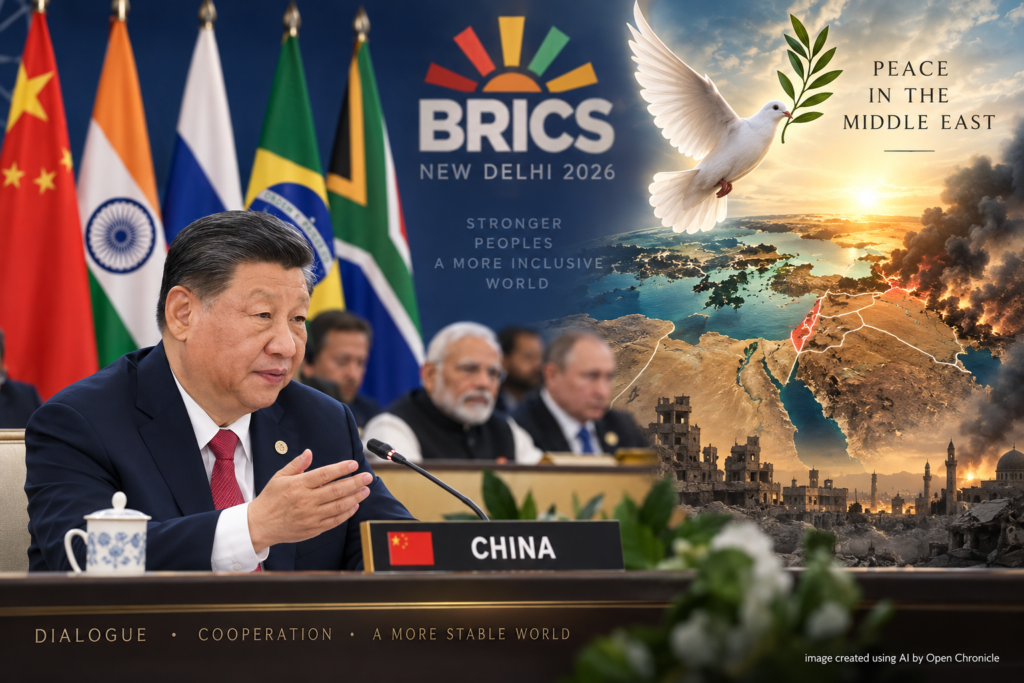
Chinese President Xi Jinping has called on BRICS countries to play a greater role in efforts to restore peace in the Middle East, warning that the continuing conflict is inflicting heavy losses across the region and damaging the wider international community.
Speaking at the BRICS Leaders’ Summit in New Delhi on Saturday, Xi said the rapidly changing security situation in the Middle East and Gulf required greater diplomatic engagement from emerging powers.
“The situation in the Middle East and the Gulf region continues to evolve, the war there has caused serious losses to people across the region and does not serve the common interests of the international community,” Xi said, according to China’s state run Xinhua News Agency.
His remarks come as the continuing war involving the United States and Iran has placed growing pressure on regional security, international shipping and global energy supplies.
China calls for stronger BRICS diplomatic role
Xi urged BRICS members to work collectively to promote stability, arguing that the grouping should assume greater responsibility in international affairs.
He called on BRICS countries to “firmly stand on the right side of history” and said Beijing was prepared to work with other members to play their “due role in achieving peace and tranquility in the Middle East and Gulf region.”
The comments reflect China’s broader effort to present itself and BRICS as important diplomatic actors in conflicts traditionally dominated by Western powers.
Xi also stressed the importance of respecting national sovereignty and opposing interference in the internal affairs of other states.
BRICS summit unfolds against backdrop of major wars
The New Delhi summit comes at a particularly tense moment for international diplomacy.
The conflict between the United States and Iran has continued for seven months, according to the information presented at the summit, while Russia’s war against Ukraine has lasted for more than four years.
The presence in New Delhi of the presidents of China, Russia and Iran gives the gathering additional geopolitical significance as BRICS seeks a larger voice in shaping the international order.
For Beijing, the current crises also reinforce its argument that emerging economies should have greater influence over global institutions and international decision making.
Xi rejects bloc confrontation
Xi used his address to criticize what he described as a “Cold War mentality and bloc confrontation.”
He called on BRICS countries to oppose violations of national sovereignty and interference in domestic affairs while encouraging greater cooperation among developing nations.
The Chinese president also rejected protectionism and urged the group to promote greater economic openness.
His message placed the Middle East conflict within a broader Chinese argument that the international system should become more representative of emerging economies and the Global South.
AI, cyberspace and global governance
Xi said BRICS should take a leading role in shaping governance in areas extending beyond traditional diplomacy.
He specifically highlighted artificial intelligence, cyberspace, outer space and the deep sea as fields in which international rules and institutions will increasingly matter.
The Chinese leader also called for BRICS members to uphold the authority of the United Nations and strengthen cooperation on artificial intelligence.
Xi described BRICS as the “world’s most influential platform for cooperation among emerging markets and developing countries,” while calling on members to increase the voice of the Global South.
BRICS seeks greater global influence
BRICS has expanded significantly from its original grouping of Brazil, Russia, India, China and South Africa, developing into a broader political and economic forum representing a substantial share of the global economy and population.
According to figures cited by BRICS, its members now account for approximately 49.5 percent of the world’s population, 40 percent of global GDP and 26 percent of international trade.
Those figures have strengthened arguments within the organization that BRICS should exercise greater influence over institutions created when Western economies represented a much larger proportion of global economic power.
India currently holds the rotating presidency of the organization. China is scheduled to assume the presidency next year.
The previous BRICS summit was held in Rio de Janeiro in 2025, while China is expected to host the next gathering.
New Delhi summit continues Sunday
BRICS leaders are scheduled to participate on Sunday in an open session titled “Resilience, Innovation, Cooperation and Sustainability: Shaping the Future for Inclusive Global Growth.”
The session is expected to broaden discussions beyond immediate geopolitical crises to economic development, technological cooperation and reform of international governance.
For Xi, however, the Middle East has already emerged as one of the central diplomatic issues of the summit.
His appeal for BRICS involvement signals Beijing’s ambition for the organization to become more than an economic forum, positioning it as a platform capable of influencing some of the world’s most difficult security and diplomatic crises.