
By Open Chronicle History Desk
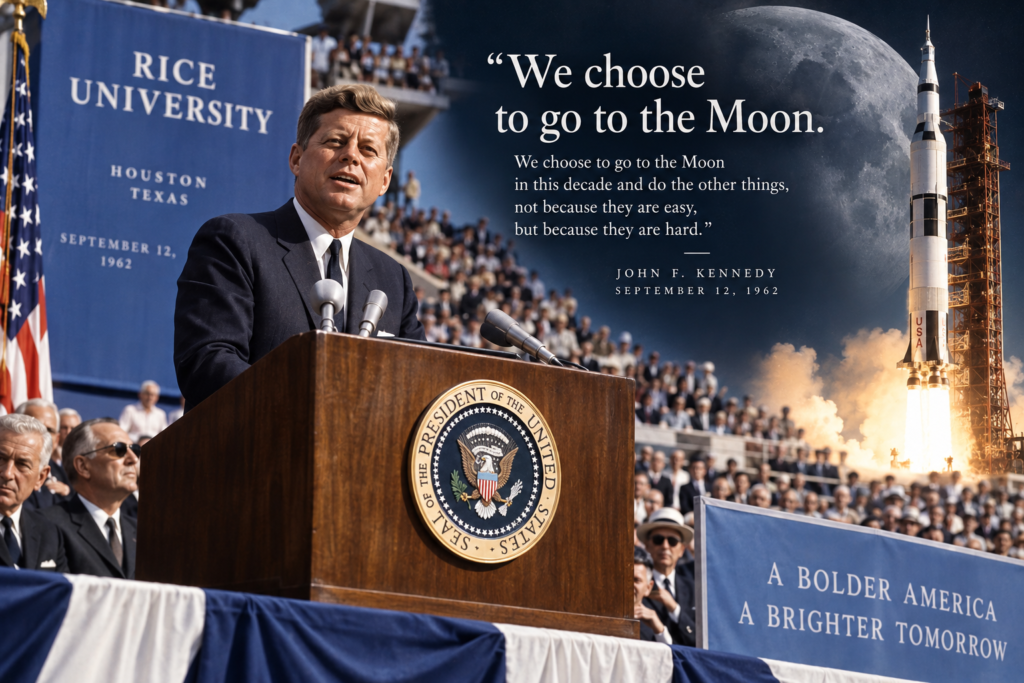
On September 12, 1962, President John F. Kennedy stood before a vast crowd at Rice University in Houston, Texas, and publicly committed the United States to one of the most audacious technological ambitions in human history.
America would go to the Moon.
The goal itself was not entirely new. Kennedy had already asked Congress in May 1961 to commit the nation to landing a man on the Moon and returning him safely to Earth before the end of the decade.
But the Rice University speech transformed that objective into something larger.
Kennedy presented the Moon not simply as a destination, but as a test of national ambition, technological capability and political determination.
Then came the words that would define the speech:
“We choose to go to the Moon.”
Kennedy argued that the United States would attempt the seemingly impossible not because it was easy, but precisely because it was difficult.
At the time, success was anything but certain.
The Soviet Union appeared to hold the advantage in the Space Race. Yuri Gagarin had already become the first human to orbit Earth. American human spaceflight experience remained extremely limited. No spacecraft capable of carrying astronauts to the Moon existed. The enormous Saturn V rocket had not yet flown. Engineers were still solving fundamental questions about how a lunar mission could work.
Seven years later, Neil Armstrong and Buzz Aldrin would walk on the Moon.
The journey from Kennedy’s speech to Apollo 11 became one of the most extraordinary scientific and engineering achievements of the twentieth century.
But it began in a world shaped as much by the Cold War as by the desire for exploration.
The Space Race Was a Cold War Battlefield
After the Second World War, the United States and Soviet Union emerged as rival superpowers.
Their competition was military, ideological, political, economic and technological.
Both possessed nuclear weapons.
Both developed increasingly powerful missiles.
Both sought allies around the world.
And both understood that scientific achievement could demonstrate the superiority of their political system.
Space became another battlefield in that competition.
There were no armies fighting one another in orbit.
But every rocket launch carried geopolitical meaning.
The same fundamental technologies capable of launching satellites into space could also contribute to the development of intercontinental ballistic missiles.
Space exploration therefore combined science, national prestige and strategic power.
Sputnik Changes the World
On October 4, 1957, the Soviet Union launched Sputnik 1, the world’s first artificial satellite.
It was a relatively simple spacecraft.
Yet its political effect was enormous.
Sputnik travelled around Earth while transmitting radio signals that could be detected internationally.
The Soviet Union had beaten the United States into orbit.
For Americans who had assumed their country possessed overwhelming technological superiority, the achievement was unsettling.
If Soviet rockets could place satellites above the Earth, what else could those rockets carry?
The Space Race suddenly became a national security issue.
America Responds
The United States accelerated its space programmes.
In 1958, the federal government created the National Aeronautics and Space Administration, better known as NASA.
The new agency inherited and consolidated important American aeronautical and space research efforts.
NASA’s early human spaceflight programme became Project Mercury.
Its objective was initially straightforward but enormously difficult.
Put an American astronaut into space.
Study whether humans could survive and function there.
And return them safely.
But the Soviet Union remained ahead.
Yuri Gagarin
On April 12, 1961, Soviet cosmonaut Yuri Gagarin climbed aboard the spacecraft Vostok 1.
He launched from the Baikonur Cosmodrome and completed an orbit around the Earth.
Gagarin had become the first human in space.
The Soviet achievement was historic.
It was also another geopolitical shock for the United States.
Less than four years after Sputnik, Moscow had again achieved one of space exploration’s defining milestones before Washington.
The United States had not yet sent a human into space.
Kennedy had been president for less than three months.
He needed a response.
Alan Shepard
America’s first human spaceflight came on May 5, 1961.
Astronaut Alan Shepard flew aboard Freedom 7.
The flight was successful.
But there was an important distinction.
Gagarin had orbited the Earth.
Shepard’s mission was a short suborbital flight.
America remained behind.
Kennedy began asking advisers what ambitious objective the United States could pursue where it might have a realistic chance of overtaking the Soviet Union.
The answer was extraordinary.
The Moon.
May 25, 1961
On May 25, Kennedy addressed a joint session of Congress.
He proposed that the United States commit itself to achieving, before the decade was over, the goal of landing a man on the Moon and returning him safely to Earth.
This was not simply a prediction.
It was a political commitment.
And it was astonishingly ambitious.
At that point, the total American human spaceflight experience amounted essentially to Alan Shepard’s flight of about fifteen minutes.
No American had yet orbited Earth.
Yet Kennedy was proposing sending astronauts approximately 384,000 kilometres from Earth, landing them on another world and bringing them home.
The technological gap between those achievements was enormous.
Why the Moon?
Kennedy’s decision was not motivated solely by scientific curiosity.
The Moon offered an unusual strategic advantage in the Space Race.
The Soviet Union had already achieved several important firsts.
First satellite.
First human in space.
A series of additional Soviet achievements appeared possible.
Trying simply to catch the Soviets milestone by milestone risked leaving the United States permanently behind.
A lunar landing was different.
It was so technically difficult that neither superpower was close to achieving it.
By choosing an objective far into the future, the United States could transform the competition.
Instead of trying to recover from previous defeats, America could redefine the finish line.
John Glenn Orbits the Earth
The American programme began making progress.
On February 20, 1962, astronaut John Glenn became the first American to orbit Earth.
His Friendship 7 spacecraft completed three orbits.
Glenn returned as a national hero.
The mission demonstrated that the United States was narrowing the gap.
But orbiting Earth remained vastly different from travelling to the Moon.
NASA would need new rockets.
New spacecraft.
New navigation systems.
New computers.
New spacesuits.
New communications networks.
And entirely new techniques for operating beyond Earth orbit.
Houston Becomes Central to Apollo
Kennedy’s choice of Rice University for his September speech was therefore highly appropriate.
Houston was becoming one of the centres of America’s human spaceflight programme.
NASA had selected the Houston area for what became the Manned Spacecraft Center, later renamed the Lyndon B. Johnson Space Center.
The facility would become the operational heart of American human spaceflight.
Mission Control would eventually direct Gemini and Apollo missions from Houston.
The phrase later heard during lunar missions, “Houston,” would become synonymous with humanity’s journey into space.
September 12, 1962
Kennedy arrived at Rice University Stadium on a hot Texas morning.
Tens of thousands of people gathered to hear him.
The speech was officially concerned with America’s space programme.
But Kennedy’s argument went much deeper.
He placed space exploration within a sweeping history of human progress.
Human civilisation, he suggested, had repeatedly advanced by accepting difficult challenges.
The exploration of space represented the next frontier.
Then he delivered the passage that entered history.
“We choose to go to the Moon.”
He repeated the idea.
America would go to the Moon during that decade and pursue other difficult objectives.
Not because they were easy.
Because they were hard.
“Because They Are Hard”
The phrase became the philosophical centre of Kennedy’s argument.
Difficulty itself was being transformed into justification.
The lunar programme would test America’s ability to organise scientific knowledge, industrial resources and human talent towards an extraordinary objective.
Kennedy argued that the challenge would serve to organise and measure the nation’s energies and skills.
It would be expensive.
It would be dangerous.
It might fail.
But that was precisely why achieving it would matter.
The Moon became a symbol of what technological civilisation might accomplish when confronted with an apparently impossible goal.
The Cost Was Enormous
Apollo required an extraordinary financial commitment.
NASA’s budget expanded dramatically during the 1960s.
At its peak, the agency received more than four percent of federal spending.
Hundreds of thousands of people across universities, government laboratories and private companies participated directly or indirectly in the lunar programme.
The project required enormous industrial coordination.
Rocket stages were built in different locations.
Spacecraft systems came from specialised contractors.
Tracking stations were positioned around the world.
Computers processed navigation data.
Engineers tested thousands of components.
Apollo became a national technological ecosystem.
The Saturn V
Nothing symbolised the scale of the programme more dramatically than the Saturn V rocket.
The launch vehicle stood approximately 111 metres tall.
Its first stage used five enormous F 1 engines.
At launch, the rocket generated millions of pounds of thrust.
Its purpose was to accelerate the Apollo spacecraft away from Earth and place it on a trajectory towards the Moon.
The Saturn programme was closely associated with Wernher von Braun and his team at NASA’s Marshall Space Flight Center.
Von Braun’s story also reflected one of the uncomfortable complexities of America’s space programme.
From the V 2 to the Moon
Von Braun had worked on Germany’s wartime rocket programme.
The V 2 became the world’s first operational long range guided ballistic missile and was used by Nazi Germany against cities including London and Antwerp.
Its production also relied on forced labour under horrific conditions.
After the war, the United States brought von Braun and other German specialists to America through Operation Paperclip.
Their expertise contributed significantly to American missile and space development.
The technological road towards the Moon therefore contained a darker historical inheritance from the Second World War.
Scientific achievement and moral complexity existed side by side.
How Do You Land on the Moon?
NASA faced a fundamental question.
What mission architecture should Apollo use?
Several approaches were considered.
One involved sending a very large spacecraft directly to the lunar surface.
Another involved assembling spacecraft in Earth orbit.
The approach eventually selected was called Lunar Orbit Rendezvous.
A command and service module would remain in lunar orbit while a smaller spacecraft, the Lunar Module, descended to the surface.
After completing the landing mission, the lunar module’s ascent stage would return to orbit and rendezvous with the command module.
The astronauts would then travel back to Earth.
The concept reduced the amount of mass that needed to land on and leave the Moon.
But it required something frighteningly precise.
Two spacecraft would have to meet and dock while orbiting another world.
Project Gemini
Before Apollo could attempt the Moon, NASA needed to learn how humans and spacecraft behaved during longer missions.
That was the purpose of Project Gemini.
Between 1965 and 1966, Gemini astronauts developed essential techniques.
Long duration spaceflight.
Spacewalks.
Orbital manoeuvring.
Rendezvous.
Docking.
Precision reentry.
Each achievement addressed a problem Apollo would face.
Gemini was less famous than Mercury or Apollo.
But without it, the lunar landing would have been extraordinarily difficult.
NASA was learning how to travel to the Moon one technique at a time.
Computers and the Moon
Apollo also pushed computing technology forward.
The Apollo Guidance Computer was extraordinarily limited by modern standards.
Yet it had to perform critical navigation and guidance functions reliably under extreme conditions.
The programme contributed to demand for miniaturised electronic components and integrated circuits.
Software engineering became increasingly important.
The spacecraft needed systems capable of responding to rapidly changing conditions while astronauts interacted with computers through compact interfaces.
The digital revolution was still young.
Apollo became one of its most demanding early applications.
Kennedy Would Never See Apollo 11
There was one tragedy that overshadowed the programme.
John F. Kennedy would not live to see the goal achieved.
On November 22, 1963, the president was assassinated in Dallas, Texas.
He was 46 years old.
The assassination shocked the world.
Kennedy’s successor, Lyndon B. Johnson, remained strongly committed to the space programme.
The lunar objective survived.
It also acquired additional symbolic significance.
Completing Apollo increasingly became associated with fulfilling Kennedy’s national challenge.
But the road to the Moon remained dangerous.
Apollo 1
On January 27, 1967, astronauts Virgil “Gus” Grissom, Edward White and Roger Chaffee were conducting a ground test inside an Apollo command module at Cape Kennedy.
A fire erupted inside the cabin.
The pure oxygen atmosphere allowed flames to spread rapidly.
The hatch design made immediate escape impossible.
All three astronauts died.
The disaster devastated NASA.
The programme stopped while investigators examined what had gone wrong.
Designs were changed.
Materials were reconsidered.
Procedures were revised.
The tragedy exposed the danger of allowing schedule pressure to coexist with unresolved engineering problems.
Apollo would continue.
But at terrible cost.
The Soviet Union Was Still Competing
The American story can sometimes make the Moon race appear inevitable.
It was not.
The Soviet Union continued developing its own lunar ambitions.
Soviet engineers pursued enormous launch vehicles and lunar spacecraft.
But the Soviet programme suffered from organisational rivalries, technical failures and the death of chief designer Sergei Korolev in 1966.
The massive Soviet N1 rocket failed during each of its launch attempts.
The USSR never sent cosmonauts to the lunar surface.
But American officials could not know that outcome in advance.
For much of the 1960s, uncertainty about Soviet capabilities helped maintain pressure on Apollo.
Apollo 7
In October 1968, Apollo 7 carried astronauts into Earth orbit.
It was the first crewed Apollo mission after the Apollo 1 disaster.
The spacecraft performed successfully.
NASA now faced a remarkable decision.
Intelligence suggested the Soviet Union might be preparing significant lunar activity.
The Lunar Module was not yet ready for a full mission.
NASA decided to send the next crew somewhere no humans had ever travelled.
Around the Moon.
Apollo 8
On December 21, 1968, Apollo 8 launched carrying Frank Borman, Jim Lovell and William Anders.
Three days later, they became the first humans to orbit the Moon.
They saw the lunar far side with their own eyes.
They also saw something equally extraordinary.
Earth rising above the lunar horizon.
Anders photographed the scene.
The image became known as Earthrise.
It showed a small, colourful Earth suspended above the barren lunar landscape.
The photograph became one of the most influential images in environmental and human history.
For the first time, millions could see their planet from the perspective of another world.
Apollo 9 and Apollo 10
NASA continued methodically.
Apollo 9 tested the Lunar Module in Earth orbit.
Apollo 10 travelled to the Moon and rehearsed almost the entire landing mission.
The Lunar Module descended to within roughly 15 kilometres of the lunar surface before returning to orbit.
Everything was now ready.
The next mission would attempt to land.
Kennedy’s deadline was approaching.
It was 1969.
Apollo 11
On July 16, 1969, a Saturn V lifted off from Kennedy Space Center.
Aboard were Neil Armstrong, Edwin “Buzz” Aldrin and Michael Collins.
Millions watched the launch.
The spacecraft travelled towards the Moon.
Once in lunar orbit, Armstrong and Aldrin entered the Lunar Module Eagle.
Collins remained aboard the Command Module Columbia.
On July 20, Eagle began its descent.
Problems quickly appeared.
Computer Alarms
During the descent, the Lunar Module’s computer generated alarms.
Mission Control had to determine rapidly whether the landing could continue.
The alarms indicated the computer was overloaded but still handling essential tasks.
The mission continued.
Then Armstrong noticed that the automatic guidance system was directing Eagle towards a dangerous landing area containing rocks and a crater.
He took more direct control.
Fuel was running low.
Mission Control began calling out the remaining seconds.
Then came the message:
The Eagle had landed.
Humanity Steps Onto Another World
Several hours later, Armstrong descended the ladder.
On July 20 in the United States and July 21 in Coordinated Universal Time, he placed his foot on the lunar surface.
Human beings had reached another celestial body.
Buzz Aldrin joined him.
The astronauts deployed scientific experiments, photographed the surface and collected lunar samples.
Above them, Michael Collins orbited alone.
Hundreds of millions of people around the world followed the mission through television and radio.
The objective Kennedy had described less than seven years earlier had become reality.
Kennedy’s Deadline Was Met
The significance of the timing was extraordinary.
Kennedy had challenged America to land a man on the Moon and return him safely to Earth before the decade was out.
Apollo 11 returned safely on July 24, 1969.
The deadline had been met with months to spare.
The United States had gone from Alan Shepard’s brief suborbital flight in May 1961 to walking on the Moon in July 1969.
Barely eight years separated those achievements.
Few technological programmes in history have advanced so dramatically in such a short period.
Apollo Continued
Apollo 11 was not the end.
Apollo 12 returned astronauts to the lunar surface later in 1969.
Apollo 13 nearly ended in disaster after an oxygen tank exploded en route to the Moon in 1970. The landing was abandoned, but extraordinary improvisation by astronauts and Mission Control brought the crew safely home.
Apollo 14 landed in 1971.
Apollo 15 introduced the Lunar Roving Vehicle.
Apollo 16 explored the lunar highlands.
And Apollo 17 became the final crewed lunar mission of the programme in December 1972.
Twelve people ultimately walked on the Moon.
No human has done so since 1972.
What Apollo Brought Back
The astronauts returned hundreds of kilograms of lunar rocks and soil.
Scientists studied the samples to investigate the Moon’s composition and geological history.
Experiments placed on the lunar surface transmitted data.
Laser reflectors allowed researchers to measure the Earth Moon distance with extraordinary precision.
Apollo contributed to a transformation in understanding lunar origins.
The missions were political achievements.
But they were also scientific expeditions.
The Moon became a place that could be directly investigated.
The Price of Apollo
The triumph carried enormous costs.
Financially, Apollo required billions of dollars at a time when the United States faced major social problems and the escalating Vietnam War.
Critics questioned why such resources should be spent reaching the Moon while poverty and inequality persisted on Earth.
The programme also carried human costs.
The Apollo 1 astronauts died.
Test pilots and others associated with America’s broader space programme also lost their lives.
Apollo was not an effortless march towards inevitable success.
It was a risky undertaking in which failure was always possible.
Was Apollo Really About Science?
Science was important.
Exploration was important.
Technological development was important.
But Cold War competition was fundamental.
Kennedy’s own discussions about space policy make clear that beating the Soviet Union mattered enormously.
A lunar landing offered a spectacular demonstration of American technological and organisational power.
When Apollo 11 succeeded, the geopolitical message was impossible to miss.
The United States had achieved the most dramatic milestone of the Space Race.
But Apollo quickly became something more universal than the political circumstances that created it.
“For All Mankind”
The plaque left on the Lunar Module’s descent stage described the astronauts as representatives of humanity.
Apollo 11 carried the American flag.
It was unquestionably an American national achievement.
Yet people across the world watched.
The images of astronauts walking beneath a black sky produced a profound sense that humanity itself had crossed a boundary.
For most of human existence, the Moon had been unreachable.
People had worshipped it.
Mapped its phases.
Used it to measure time.
Written poetry about it.
Observed it through telescopes.
Now human footprints existed on its surface.
The Earth Looks Different From the Moon
Perhaps one of Apollo’s most unexpected legacies concerned not the Moon but the Earth.
Photographs taken during lunar missions showed the planet as a small sphere surrounded by darkness.
There were no visible national borders.
No political divisions.
Just one planet.
Images such as Earthrise and later the famous Blue Marble photograph became icons of environmental awareness.
Space exploration had changed humanity’s perspective by allowing people to see their home from outside it.
The journey outward produced a new way of looking inward.
Technology and Apollo
Apollo’s technological legacy is sometimes exaggerated through claims that NASA invented every modern technology from microchips to household products.
The real story is more interesting.
NASA became a major customer and driver of advanced technologies.
The programme accelerated research in computing, electronics, materials, communications, manufacturing, systems engineering and reliability.
Perhaps Apollo’s greatest technological achievement was not any single invention.
It was learning how to coordinate enormous numbers of people, machines and institutions around a system in which countless components had to function together.
Apollo was engineering on a continental scale.
The Power of a Deadline
Kennedy’s deadline mattered.
“Someday” does not create the same organisational pressure as “before this decade is out.”
The date forced NASA to make decisions.
Budgets had to be allocated.
Facilities had to be built.
Contractors had to deliver hardware.
Astronauts had to train.
Mission architectures had to be selected.
Problems had to be solved.
The deadline was politically created.
But it became an engineering instrument.
Less than seven years separated the Rice speech from the first lunar landing.
The Speech Outlived the Space Race
The Cold War circumstances surrounding Kennedy’s address have faded.
The Soviet Union no longer exists.
The political world of 1962 has disappeared.
Yet the speech remains famous.
Why?
Partly because Kennedy expressed something larger than superpower rivalry.
He described difficult goals as worthy precisely because they force societies to test their capabilities.
That idea has survived the specific politics of the Space Race.
The phrase “because it is hard” has become shorthand for choosing ambitious objectives despite uncertainty.
The Moon After Apollo
After Apollo 17, humans stopped travelling to the Moon.
Robotic exploration continued.
The Soviet Union conducted successful robotic lunar missions.
Later spacecraft from the United States, China, India, Japan and other nations transformed knowledge of the Moon.
Evidence of water ice in permanently shadowed polar regions increased scientific and strategic interest.
The Moon once again became a major destination for space exploration.
But this time, the competition is more complicated than the binary rivalry Kennedy knew.
A New Lunar Era
NASA’s Artemis programme seeks to return astronauts to the Moon as part of a broader strategy for sustained lunar exploration.
China has developed an increasingly ambitious lunar programme.
India’s Chandrayaan missions have contributed major scientific achievements.
Private companies are becoming involved in lunar transportation and exploration.
The Moon is again becoming a geopolitical and scientific frontier.
Kennedy’s speech therefore feels unexpectedly contemporary.
Humanity is once more asking what it means to establish a long term presence beyond Earth.
Could America Have Reached the Moon Without Kennedy?
Probably eventually.
Rocket technology was advancing rapidly.
Both superpowers were pursuing increasingly ambitious space programmes.
But timing matters in history.
Kennedy transformed lunar exploration from a possible future objective into an urgent national commitment.
He created political momentum.
Congress provided enormous funding.
NASA gained institutional priority.
Industry mobilised.
Hundreds of thousands of people worked towards a specific deadline.
Without that political decision, the first human lunar landing might have happened very differently, or much later.
Kennedy’s Great Paradox
There is also a profound historical irony.
Kennedy became permanently associated with Apollo 11.
Yet he never saw most of the programme’s achievements.
He never saw Gemini rendezvous.
He never saw the Saturn V fly.
He never saw Apollo orbit the Moon.
He never saw Earthrise.
He never heard “Tranquility Base here. The Eagle has landed.”
He never saw Armstrong step onto the lunar surface.
When Kennedy died in 1963, the Moon remained an almost unimaginably difficult objective.
The programme he championed continued without him.
Why September 12 Matters
September 12, 1962 matters because it represents the moment when an extraordinary technological objective was translated into a compelling public vision.
Kennedy did not design the Saturn V.
He did not calculate lunar trajectories.
He did not build the Apollo Guidance Computer.
He did not fly the spacecraft.
Hundreds of thousands of engineers, scientists, technicians, factory workers, mathematicians, administrators, astronauts and contractors made Apollo possible.
But political leadership gave their work a national objective and a deadline.
The speech connected all of those future efforts to one simple idea.
Go to the Moon.
September 12, 1962
Imagine listening to Kennedy at Rice University without knowing what came next.
There was no guarantee America would succeed.
The Soviet Union had repeatedly reached major space milestones first.
American astronauts had only begun venturing into orbit.
The rocket required for the lunar mission did not yet exist in operational form.
The Lunar Module did not exist.
The techniques for lunar rendezvous had not been demonstrated.
The computers were primitive by modern standards.
And no human being had ever travelled farther than low Earth orbit.
Kennedy nevertheless stood before the crowd and said America would attempt it.
Seven years later, a Saturn V rose from Florida carrying three men towards another world.
Four days after launch, two of them descended towards the Sea of Tranquility.
A machine built on Earth touched the Moon.
A ladder unfolded.
A human being stepped down.
The distance between those two moments, between the speech in Houston and the footprints in lunar dust, is what gives September 12, 1962 its enduring place in history.
The speech was born from Cold War rivalry.
But the achievement it helped inspire transcended it.
For thousands of years, humans had looked at the Moon.
Kennedy challenged his country to do something different.
To go there.
And before the decade ended, they did.