
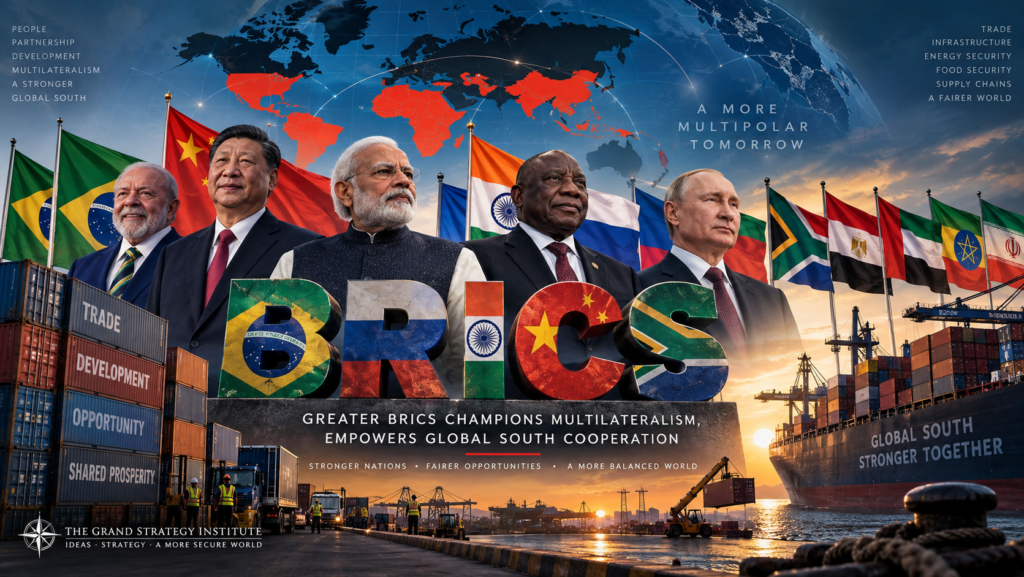
With 11 members, 10 partner countries and an expanding economic footprint, BRICS increasingly presents itself as a platform for a more multipolar international order. Its real test, however, is whether political diversity can be converted into practical cooperation on trade, finance, supply chains, energy and maritime security.
By The Grand Strategy Institute Research Division
Grand Strategy Analysis | 12 September 2026
The transformation of BRICS is becoming difficult to ignore.
What began as a loose political dialogue among Brazil, Russia, India and China has evolved into an 11-member grouping spanning Asia, Africa, the Middle East and Latin America. The expanded membership comprises Brazil, Russia, India, China, South Africa, Egypt, Ethiopia, Indonesia, Iran, Saudi Arabia, the United Arab Emirates, while ten additional states hold partner status. Official BRICS material describes the grouping explicitly as a political and diplomatic coordination forum for the Global South.
Its economic weight is substantial. Brazil’s central bank calculates that the 11 members account for roughly 49 percent of the world’s population, 39 percent of global GDP measured on its methodology and 23 percent of international trade.
Yet those figures alone do not make BRICS a coherent geopolitical bloc.
China and India are strategic competitors.
Iran and the United Arab Emirates have recently experienced severe political tensions associated with the Middle East war.
India cooperates strategically with the United States while Russia confronts NATO.
Saudi Arabia and the UAE remain deeply integrated with Western financial and security systems.
Brazil and South Africa generally resist attempts to transform BRICS into an explicitly anti-Western coalition.
The Greater BRICS is therefore something more complicated than an alliance.
It is becoming a laboratory for a different model of international organisation: cooperation among states that do not necessarily agree on the global order but increasingly agree that they want greater influence over how that order operates.
That distinction is fundamental.
The strategic future of BRICS will not be determined principally by whether it can challenge the West.
It will be determined by whether it can solve practical problems for the Global South.
And among the most important of those problems is economic resilience.
From BRIC to Greater BRICS
The original BRIC concept was not created by governments.
It originated as an economic category describing the potential rise of Brazil, Russia, India and China.
Political cooperation followed.
South Africa joined in 2011, turning BRIC into BRICS.
The next transformation was much larger.
Egypt, Ethiopia, Iran and the United Arab Emirates entered during the subsequent expansion, Indonesia joined later, and Saudi Arabia is now counted among the 11 members in official BRICS material.
A second institutional circle emerged through the creation of partner-country status at the Kazan Summit in 2024.
The ten partners are Belarus, Bolivia, Cuba, Kazakhstan, Malaysia, Nigeria, Thailand, Uganda, Uzbekistan and Vietnam.
This produces a network of 21 member and partner states.
But enlargement creates a paradox.
Every additional country increases BRICS’ geographical reach and political representation.
Every additional country can also make consensus more difficult.
The organisation is becoming simultaneously more powerful and more complicated.
BRICS Is Not a New Warsaw Pact
Understanding what BRICS is not is essential.
It is not NATO.
It is not the European Union.
It is not a military alliance.
It does not possess a supranational government.
It has no equivalent of the European Commission.
It does not operate under a mutual defence clause.
It does not even possess a permanent secretariat or its own budget in the conventional institutional sense. Decisions are reached through consensus.
That institutional looseness is frequently interpreted as weakness.
It can also be understood as part of BRICS’ attraction.
Many Global South states do not want to replace dependence on Washington with dependence on Beijing.
They want room for manoeuvre.
BRICS provides precisely that possibility.
A country can cooperate with China economically, purchase military equipment from Western suppliers, maintain relations with Russia, attract Gulf investment and participate in BRICS without surrendering formal sovereignty to the organisation.
This is multilateralism built around strategic autonomy rather than integration.
The Global South Does Not Want Another Cold War
This explains much of the attraction.
The international system is becoming more fragmented.
Competition between the United States and China increasingly affects technology, semiconductors, investment and supply chains.
The Russia-Ukraine War has transformed energy markets, sanctions policy and trade flows.
The Iran conflict has disrupted maritime security and intensified uncertainty surrounding the Strait of Hormuz.
Economic sanctions and tariffs are increasingly used as instruments of geopolitical competition.
For developing countries, these conflicts create an uncomfortable reality.
Many did not create the geopolitical confrontation.
Yet they pay part of its cost.
Energy prices rise.
Food prices can rise.
Shipping insurance increases.
Trade routes become less predictable.
Access to technology becomes politicised.
Financial transactions encounter sanctions restrictions.
And governments face growing pressure to align with competing geopolitical camps.
The desire for greater South-South cooperation therefore does not necessarily reflect ideological hostility toward the West.
It often reflects something more pragmatic:
developing countries want insurance against decisions made elsewhere.
Supply Chains Are Becoming Instruments of Power
The economic model that dominated much of the post-Cold War period assumed that efficiency would determine global production.
Companies would manufacture where costs were lowest.
Ships would follow the cheapest routes.
Capital would move toward the best returns.
Geopolitics has weakened that assumption.
Governments now speak about friend-shoring, de-risking, strategic autonomy, economic security and trusted supply chains.
Critical minerals have become strategic assets.
Semiconductor production has become a national-security issue.
Energy infrastructure has become part of geopolitical competition.
Shipping routes have become strategic vulnerabilities.
This creates a particular problem for developing countries.
They frequently possess less redundancy.
Smaller strategic reserves.
Less shipping capacity.
More limited financial resources.
Greater dependence on imported food, fuel or industrial inputs.
Stable global supply chains are therefore not merely a commercial convenience for the Global South.
They are part of national security.
India Provides an Important Case Study
India illustrates both the opportunities and vulnerabilities confronting emerging powers.
Its economy is large.
Its industrial capacity is expanding.
Its geopolitical importance is increasing.
Its navy is increasingly capable.
Yet India remains heavily dependent on global supply networks.
Energy provides one example.
Following Russia’s invasion of Ukraine, India refused to join Western sanctions against Russian oil.
New Delhi argued that access to affordable energy was necessary for its population and economy.
Russian crude subsequently became an important component of Indian imports.
The policy reflected a central feature of Indian grand strategy:
national interest would take precedence over demands for geopolitical alignment.
That approach generated benefits.
It also demonstrated how economic interdependence can create vulnerability.
Sanctions Changed the Cost of Strategic Autonomy
Washington subsequently used trade measures against India associated with its purchases of Russian energy.
This demonstrated a wider reality.
Sanctions are no longer relevant only to the country directly targeted.
They can reshape the behaviour of third countries.
A government may have no involvement in the conflict that produced the sanctions yet still face difficult choices because its banks, companies, shipping networks or energy imports intersect with the targeted economy.
This creates what might be described as secondary geopolitical exposure.
For the Global South, that exposure is becoming increasingly important.
Countries may discover that strategic autonomy carries economic costs when their policies diverge from those of major financial powers.
This helps explain why BRICS discussions about payment systems, local currencies and financial architecture attract increasing attention.
BRICS Is Looking at the Financial Plumbing
India is currently advocating greater interoperability between central bank digital currencies among BRICS members as part of efforts to make cross-border transactions faster and cheaper.
Reuters reported ahead of the New Delhi summit that the Indian proposal focuses on linking national digital-currency systems rather than creating a common BRICS currency or directly replacing the dollar as the world’s reserve currency. Serious technical and political obstacles remain.
That distinction matters.
The most realistic BRICS financial transformation may not involve launching a dramatic new currency.
It may involve something much less visible but potentially more useful:
making payments between member economies easier.
Reducing transaction costs.
Improving interoperability.
Expanding settlement options.
Developing financial infrastructure that provides alternatives when conventional channels become difficult to use.
This is less revolutionary than replacing the dollar.
It is also considerably more achievable.
De-Dollarisation Is Often Misunderstood
BRICS discussions are frequently framed as an attempt to destroy the dollar’s global role.
That oversimplifies the issue.
China, Russia, India, Brazil and the Gulf economies have very different monetary interests.
India has little strategic incentive to exchange dollar dependence for dependence on the Chinese renminbi.
Gulf economies maintain important relationships with dollar-based financial markets.
China wants greater international use of its currency but also operates capital controls.
Russia and Iran have much stronger incentives to develop alternatives because they face Western sanctions.
There is consequently no single BRICS monetary strategy.
The more plausible development is financial diversification.
The dollar can remain the dominant international currency while BRICS members simultaneously construct mechanisms allowing more trade to occur through alternative channels.
The two outcomes are not mutually exclusive.
China Brings Scale
China is indispensable to any discussion of Greater BRICS economic power.
Its manufacturing capacity, export networks, infrastructure companies, financial resources and enormous domestic market give Beijing capabilities no other BRICS member possesses.
Chinese trade fairs and commercial expos increasingly connect manufacturers with buyers throughout Africa, Asia, Latin America and the Middle East.
These events may appear less geopolitically significant than summits between presidents.
But commercial networks accumulate power.
A Nigerian distributor purchasing Chinese machinery, a Brazilian agricultural company entering the Chinese market or a Southeast Asian firm finding Chinese suppliers represents another connection within a growing South-South commercial architecture.
Over time, thousands of such relationships can matter more economically than summit communiqués.
China therefore provides BRICS with something essential:
economic gravity.
But that also creates one of the organisation’s central problems.
BRICS Cannot Become China Plus Ten
China’s economy is vastly larger than those of most BRICS members.
Its manufacturing dominance creates trade imbalances.
Its financial resources give Beijing substantial influence.
And its geopolitical ambitions sometimes conflict directly with those of other members.
India is the most obvious example.
China and India cooperate inside BRICS.
They also compete across the Indo-Pacific.
They have an unresolved border dispute.
Both seek influence across the Global South.
Both want greater roles in international institutions.
Neither wants the other to dominate Asia.
BRICS therefore faces a fundamental institutional test.
Can it use Chinese economic power without becoming an instrument of Chinese strategic power?
If the answer is no, its appeal to strategically autonomous states will eventually weaken.
India Offers a Different Model of Leadership
India’s opportunity lies precisely here.
New Delhi cannot compete with Beijing dollar for dollar or factory for factory.
But it can offer something different.
India presents itself as a bridge.
Between the West and the Global South.
Between BRICS and the Quad.
Between Russia and the United States.
Between continental Asia and the Indian Ocean.
Its diplomatic strategy emphasises strategic autonomy rather than bloc politics.
That makes India particularly well positioned to advocate practical cooperation that does not require ideological alignment.
Supply-chain resilience is one such area.
The Shipping Vulnerability
India’s maritime position illustrates the problem.
Despite possessing one of the world’s largest economies and populations, India controls a relatively small share of global commercial shipping capacity.
The data supplied for this analysis indicate that Indian-owned vessels represented only around 0.8 percent of global fleet value in 2026, while Indian shipping lines carried only a small fraction of India’s overseas cargo.
This matters because trade dependence and shipping dependence are not identical.
A country may possess enormous ports.
It may export hundreds of billions of dollars in goods.
It may import huge quantities of energy.
But if foreign companies carry most of that trade, the country does not completely control the logistics connecting its economy to the world.
During normal conditions, this may simply be economically efficient.
During crisis, it becomes strategic dependence.
The Strait of Hormuz Demonstrates the Problem
The Iran conflict has made this vulnerability visible.
The Strait of Hormuz is one of the world’s most important energy chokepoints.
When insecurity increases there, the consequences extend far beyond Iran, the Gulf monarchies or the United States.
Insurance premiums rise.
Shipping decisions change.
Energy markets react.
Import-dependent developing countries pay more.
India’s Prime Minister Narendra Modi emphasised the importance of freedom of navigation, maritime commerce and seafarer safety during discussions with Iranian President Masoud Pezeshkian on the eve of the BRICS summit.
That is not abstract diplomacy for India.
The Indian economy depends heavily on maritime trade.
The same applies to much of the Global South.
Maritime Security Is a Global Public Good
For decades, one of the less visible foundations of globalisation has been the security of major sea lanes.
The United States Navy has played an enormous role in maintaining that environment.
Developing economies benefited even when they contributed relatively little to the cost of providing it.
But the international system is changing.
American naval forces face simultaneous demands across Europe, the Middle East and the Indo-Pacific.
China’s naval power is expanding.
Regional conflicts threaten chokepoints.
Drone and missile technologies make attacks against commercial vessels easier.
The question for the Global South is therefore increasingly uncomfortable:
What happens when the security system protecting global commerce becomes overstretched?
That is precisely the type of problem Greater BRICS could address.
India Is Beginning to Build Maritime Capacity
India has already recognised the problem.
New Delhi is investing in shipbuilding and seeking to expand the domestic maritime industry.
It has also increasingly deployed naval forces to protect commercial traffic.
Operations such as Sankalp demonstrated India’s willingness to escort and protect shipping in strategically important waters.
India also participates in increasingly sophisticated naval exercises.
Through exercises such as MALABAR, it cooperates with the United States, Japan and Australia.
Through other frameworks, it works with Global South and Indian Ocean partners.
This creates another example of India’s multi-alignment.
India does not need to choose between maritime cooperation with Western powers and maritime cooperation with BRICS countries.
It can pursue both.
A Global South Supply Chain Compact
This suggests a practical area where Greater BRICS could evolve.
Instead of attempting to transform itself immediately into an alternative global order, BRICS could build specific mechanisms addressing vulnerabilities shared by developing economies.
A Global South Supply Chain Resilience Compact could include:
shared early-warning systems for shortages,
strategic mapping of critical supply chains,
coordination of emergency food and energy supplies,
information sharing on shipping disruption,
regional strategic stockpiles,
priority arrangements for essential medicines,
maritime risk monitoring,
port-to-port contingency agreements,
joint humanitarian logistics,
and rapid assistance during natural disasters or geopolitical crises.
Such arrangements would not require members to agree about Ukraine.
They would not require India and China to resolve their border dispute.
They would not require Iran and Gulf states to share a common regional strategy.
They would require only recognition of shared vulnerability.
That is a considerably more realistic foundation for cooperation.
Food Security Could Be an Early Test
Food provides an obvious example.
Many developing economies remain vulnerable to sudden changes in grain, fertiliser and energy prices.
The Russia-Ukraine War demonstrated how a conflict concentrated geographically in Europe could affect food prices thousands of kilometres away.
The Middle East conflict creates additional risks through energy and shipping.
A BRICS resilience mechanism could coordinate emergency supplies between agricultural exporters and vulnerable importers.
Brazil is an agricultural giant.
Russia is a major grain and fertiliser producer.
India possesses enormous agricultural capacity.
China maintains extensive strategic reserves.
Gulf states have sophisticated logistics systems.
African members provide access to regions where food insecurity can become particularly severe.
The complementary capabilities already exist.
The challenge is institutional coordination.
Energy Security Offers Another Opportunity
The expanded BRICS contains an extraordinary range of energy producers and consumers.
Russia, Saudi Arabia, Iran and the UAE are major hydrocarbon producers.
China and India are enormous consumers.
Brazil possesses significant oil production and major renewable-energy capabilities.
South Africa faces its own energy-transition challenges.
This creates potential for cooperation.
But it also demonstrates the diversity of national interests.
Producers benefit from higher prices.
Importers generally prefer lower prices.
Some members face sanctions.
Others maintain close relationships with Washington.
BRICS will therefore struggle to create a unified energy policy.
But it could improve emergency coordination, infrastructure investment, energy-finance mechanisms and information sharing.
Again, practical resilience may be more achievable than geopolitical unity.
The New Development Bank Matters
BRICS already possesses an institution capable of contributing to this agenda.
The New Development Bank was created to finance infrastructure and sustainable development.
Its strategic importance lies in demonstrating that BRICS cooperation can produce permanent institutions rather than merely annual declarations.
The next stage could involve directing greater attention toward infrastructure resilience.
Ports.
Railways.
Energy grids.
Digital networks.
Logistics corridors.
Warehousing.
Renewable power.
Water infrastructure.
All of these influence the ability of developing economies to absorb external shocks.
Development finance and strategic resilience are increasingly becoming the same conversation.
BRICS Wants Reform, Not Necessarily Destruction, of the Existing Order
This is another area where rhetoric frequently obscures reality.
BRICS finance ministers and central bank governors meeting ahead of the New Delhi summit called for reform of global development institutions, including the IMF and World Bank, seeking greater representation, transparency and accountability for emerging economies. They also criticised unilateral trade and financial measures and called for improved cross-border payment cooperation.
That agenda is important.
It is not equivalent to dismantling the international financial system.
Many BRICS members benefit substantially from existing institutions.
Their objective is often to acquire more influence within them while simultaneously creating alternatives.
This produces a dual strategy:
reform the existing order while building insurance against dependence on it.
That may prove to be Greater BRICS’ most durable strategic logic.
Multilateralism Is Becoming Competitive
The old assumption that multilateralism represented a single universal institutional system is weakening.
Different networks increasingly overlap.
A country can belong to BRICS.
Participate in the G20.
Cooperate with the World Bank.
Join regional development banks.
Conduct exercises with Western militaries.
Use Chinese infrastructure investment.
Trade in dollars.
Settle some transactions in local currencies.
And participate in Global South political forums.
This is not necessarily incoherence.
It is networked multipolarity.
States are building overlapping relationships to avoid excessive dependence on any single centre of power.
Greater BRICS fits naturally into that world.
But Internal Contradictions Are Serious
The greatest threat to BRICS may not come from Washington.
It may come from inside BRICS.
Expansion increases political diversity.
India and China compete.
Iran and Gulf members possess conflicting regional interests.
Russia wants stronger opposition to Western pressure.
India often resists explicitly anti-Western positioning.
Brazil generally emphasises institutional reform and development.
African members have their own economic priorities.
The current Iran conflict has made those differences particularly visible. Reuters notes that the war has complicated the attempt to produce unity ahead of the New Delhi summit, even as BRICS seeks a larger role in global affairs.
Consensus becomes harder as membership expands.
Greater representation therefore produces a governance dilemma:
How can BRICS become larger without becoming strategically emptier?
The Answer May Be Variable Geometry
BRICS may not need every member to participate equally in every initiative.
Smaller coalitions could develop inside the broader framework.
Maritime states could cooperate on shipping security.
Agricultural powers could develop food-security arrangements.
Central banks could work on payment interoperability.
Technology ministries could develop digital standards.
Development institutions could coordinate infrastructure finance.
Health authorities could build pharmaceutical supply reserves.
This approach would allow BRICS to operate through what might be called variable geometry.
The whole organisation provides political legitimacy.
Smaller groups provide implementation.
That model may be particularly suitable for a coalition containing 11 highly diverse major states.
The Global South Is Not a Bloc
The same caution applies to the phrase Global South.
There is no single Global South geopolitical position.
India and Pakistan have different interests.
Saudi Arabia and Iran have different interests.
Indonesia and China have different interests.
Brazil and Russia have different interests.
African economies differ enormously from one another.
The Global South is better understood as a broad political category describing countries that frequently seek greater agency within an international system historically shaped by Western industrial powers.
Its unity is therefore strongest around representation and autonomy, not necessarily policy.
BRICS succeeds when it recognises this.
It struggles when it pretends that diversity does not exist.
China and India Will Determine Whether Greater BRICS Works
Ultimately, much will depend upon the two Asian giants.
China provides the largest economic engine.
India provides a potentially crucial political balance.
If China attempts to dominate BRICS, India is likely to resist.
If India attempts to use BRICS principally to contain Chinese influence, Beijing will resist.
But if both accept that BRICS is useful precisely because neither controls it completely, the organisation could become much more important.
There is a strategic bargain available.
China gains a platform through which its economic power connects with the Global South.
India gains a platform through which developing countries can cooperate without accepting a Western or Chinese bloc structure.
Other members gain leverage by operating between them.
This would not produce an alliance.
It could produce something more characteristic of the twenty-first century:
a coalition of strategically autonomous powers managing interdependence.
GSI Strategic Assessment
The Grand Strategy Institute assesses that Greater BRICS is becoming an increasingly consequential component of the emerging multipolar international system, but its strategic importance should not be measured primarily through comparisons with NATO, the G7 or the Western alliance system.
Its potential lies elsewhere.
First, expansion has transformed BRICS from a small emerging-power dialogue into a geographically broad Global South network.
The organisation now contains 11 members and ten partner countries spanning several continents.
Second, its economic weight is already substantial.
Official Brazilian central-bank data place the 11 members at approximately 49 percent of global population and 39 percent of global GDP.
Third, BRICS remains institutionally loose.
Its consensus model and absence of a supranational authority reduce its capacity for rapid collective action but simultaneously make membership attractive to governments protective of strategic autonomy.
Fourth, the organisation should not be understood simply as an anti-Western alliance.
Members have fundamentally different relationships with the United States and Europe.
Fifth, economic fragmentation increases the value of BRICS.
Sanctions, tariffs, technological competition, energy disruption and maritime insecurity give developing countries stronger incentives to create alternative channels of cooperation.
Sixth, financial diversification is more plausible than rapid de-dollarisation.
Payment interoperability, local-currency settlement and potentially connected CBDC systems could reduce transaction friction without requiring a common currency. India’s current proposals illustrate this more pragmatic direction.
Seventh, China provides BRICS with enormous economic weight but also creates an internal balancing problem.
The organisation’s legitimacy would weaken if other members came to perceive it as primarily an instrument of Chinese power.
Eighth, India is particularly well positioned to prevent that outcome.
Its relationships with BRICS, the Quad, Russia, the United States and the wider Global South allow it to function as a bridge between geopolitical networks.
Ninth, supply-chain resilience offers one of the strongest opportunities for practical cooperation.
Food, energy, medicine, shipping, critical minerals and emergency logistics represent shared vulnerabilities that do not require ideological agreement.
Tenth, maritime resilience should become a major Global South priority.
The Iran conflict and instability around Hormuz demonstrate how rapidly distant geopolitical confrontation can impose economic costs on developing countries.
Eleventh, Greater BRICS will require flexible implementation mechanisms.
An organisation of 11 diverse members is unlikely to achieve deep consensus on every issue. Smaller coalitions operating within the broader BRICS framework may therefore become necessary.
Twelfth, BRICS’ ultimate significance will depend on delivery.
Declarations about multipolarity matter politically.
Reliable payment systems, development finance, emergency supply mechanisms and resilient trade corridors would matter strategically.
Key Judgements
- Greater BRICS now consists of 11 member countries and ten partner countries, giving it a much broader geographical and political footprint than the original BRIC grouping.
- BRICS represents a significant share of global economic and demographic power, but aggregate size should not be confused with political cohesion.
- The organisation is not a military or supranational alliance. Consensus and strategic autonomy remain fundamental to its operating model.
- The primary common interest among members is greater influence and autonomy within the international system rather than a shared ideology.
- Geopolitical fragmentation is increasing the strategic value of South-South economic cooperation.
- Supply-chain resilience could become one of BRICS’ most productive areas of cooperation, particularly in energy, food, medicine, shipping and critical materials.
- China’s economic scale is simultaneously BRICS’ greatest material strength and one of its most important political vulnerabilities.
- India can play a balancing role by promoting a model of Global South cooperation that does not require alignment with either China or the West.
- India’s shipping dependence demonstrates that large economies can remain structurally vulnerable to disruptions in global logistics.
- The Iran conflict has reinforced the importance of maritime chokepoints to Global South economic security.
- BRICS financial cooperation is more likely to advance through payment interoperability and diversification than through the rapid creation of a common currency.
- The New Development Bank gives BRICS an existing institutional foundation through which infrastructure resilience can be strengthened.
- BRICS’ calls for IMF and World Bank reform indicate that the grouping is pursuing influence within the existing system as well as alternatives outside it.
- Internal geopolitical disputes will continue to constrain collective action, particularly where the interests of China, India, Russia, Iran and Gulf members diverge.
- A variable-geometry model in which smaller groups pursue specific projects may offer the most realistic path toward deeper BRICS cooperation.
- BRICS’ long-term strategic importance will depend less on anti-Western rhetoric than on whether membership produces tangible economic resilience for developing countries.
Conclusion
Greater BRICS has reached a turning point.
Its first phase was about recognition.
Emerging powers wanted greater representation.
Its second phase was about expansion.
More states wanted access to the platform.
The third phase will have to be about delivery.
A group representing nearly half the world’s population cannot measure success merely by holding larger summits.
It must demonstrate that cooperation improves the strategic position of its members.
Can it make cross-border payments easier?
Can it finance infrastructure?
Can it protect supply chains?
Can it help vulnerable economies during energy shocks?
Can it coordinate emergency food supplies?
Can it strengthen maritime resilience?
Can it reduce the economic consequences of conflicts in which many Global South countries have no direct involvement?
If it can, BRICS will become more than a diplomatic forum.
It will become part of the infrastructure of multipolarity.
If it cannot, enlargement may produce an organisation that is impressive statistically but weak strategically.
This is why India’s role matters.
China possesses greater economic weight.
Russia possesses enormous military and energy resources.
The Gulf members possess capital and energy.
Brazil possesses agricultural, mineral and diplomatic weight.
But India occupies an unusual position connecting the Global South, Indo-Pacific, West, Russia and emerging multipolar institutions.
New Delhi therefore has an opportunity to define BRICS leadership differently.
Not through domination.
Through coordination.
Not by forcing countries to choose sides.
By giving them more options.
Not by replacing one hegemonic system with another.
By reducing the vulnerability created by dependence on any single system.
That may ultimately prove the most powerful idea behind Greater BRICS.
The Global South does not necessarily need another bloc. It needs greater capacity to act when the blocs created by others collide.
If Greater BRICS can provide that capacity, its expansion will represent more than a change in global diplomatic architecture.
It could become one of the institutional foundations of a genuinely multipolar international order.
WordPress Excerpt
Greater BRICS now connects 11 members and ten partner countries across the Global South. Its real strategic test is no longer expansion, but whether China, India and the wider coalition can turn enormous economic weight into practical cooperation on supply chains, trade, finance, energy and maritime resilience.
The Grand Strategy Institute
Continue Exploring Strategic Analysis
Return to The Grand Strategy Institute for strategic assessments, long-form analysis and research examining geopolitics, military affairs, international security, emerging technologies and the changing international order.
← Back to The Grand Strategy Institute