
By Open Chronicle with agencies
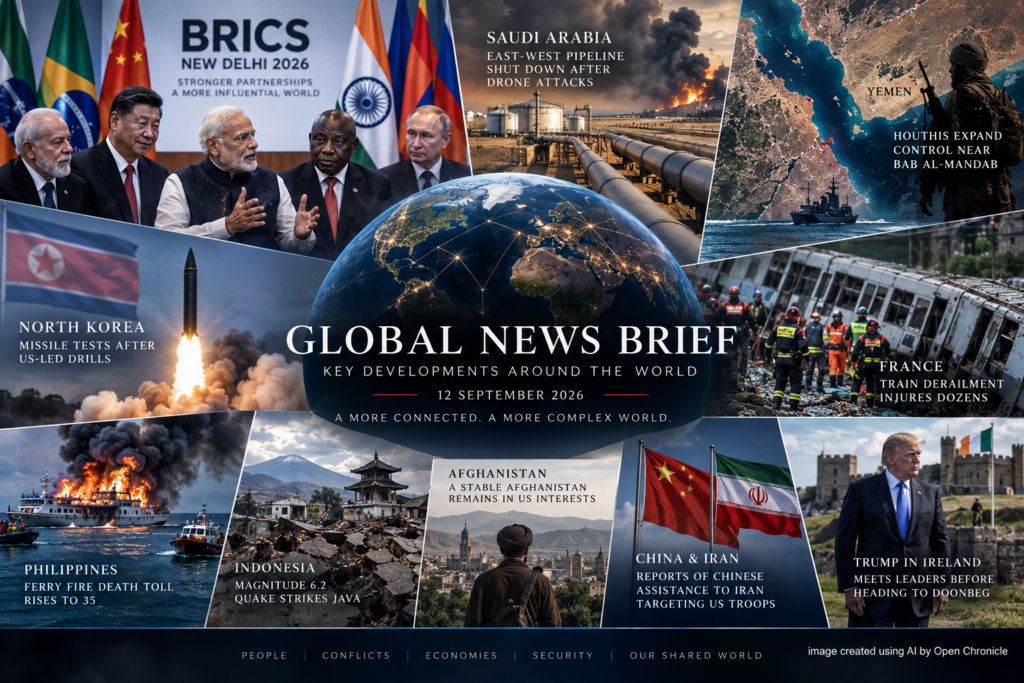
Global attention on Saturday is focused on a widening struggle over trade routes, energy security and geopolitical influence. BRICS leaders are gathering in New Delhi as the expanded bloc seeks a stronger international role, while escalating conflict around the Red Sea and Gulf is placing some of the world’s most important oil corridors under renewed pressure.
Elsewhere, North Korea has responded to multinational military exercises with missile launches, a deadly ferry disaster continues to unfold in the Philippines, and a powerful earthquake has struck Indonesia. In Europe, investigators are examining a train derailment in France that injured dozens of people.
Asia Pacific
BRICS leaders gather in New Delhi as bloc seeks greater global influence
Leaders from BRICS countries are gathering in the Indian capital for a summit taking place against an unusually turbulent international backdrop. The meeting is expected to focus on the bloc’s growing role in the global economy, reform of international financial institutions, trade and the consequences of ongoing conflicts.
Chinese President Xi Jinping has arrived in India for the summit, his first visit to the country in seven years, adding another diplomatic dimension to a gathering that could test the recent cautious improvement in relations between Beijing and New Delhi. Indian Prime Minister Narendra Modi has also been holding bilateral meetings with visiting leaders ahead of the main sessions.
The summit comes as BRICS attempts to translate its expansion into greater political and economic influence while navigating significant differences among its members over foreign policy, trade and relations with the United States.
North Korea launches missiles after US led military exercises
North Korea has fired missiles following joint exercises involving the United States, South Korea and Japan, describing the drills as provocative.
South Korean authorities reported several short range ballistic missile launches toward the sea, while Washington moved to reassure regional allies following the tests.
The episode represents another increase in military signalling on the Korean Peninsula and demonstrates how multinational exercises continue to trigger rapid responses from Pyongyang.
Philippines ferry disaster death toll rises to 35
The death toll from the catastrophic ferry fire in the Philippines has risen to at least 35 as search teams continue looking for missing passengers.
Bodies recovered from the vessel have begun arriving ashore for identification, while authorities continue the difficult search and recovery operation. Dozens of people were still reported missing as of Saturday morning.
The disaster has become one of the Philippines’ most serious recent maritime accidents and is likely to renew scrutiny of passenger ferry safety.
Magnitude 6.2 earthquake strikes Java
A magnitude 6.2 earthquake has struck Java, Indonesia, according to Germany’s GFZ geosciences research centre.
Initial reports confirmed the earthquake early Saturday, but the information supplied here does not establish the extent of casualties or structural damage.
Middle East
Saudi Arabia shuts strategic oil pipeline after drone attacks from Iraq
Saudi Arabia has temporarily shut its East West oil pipeline following drone attacks that Riyadh says originated in Iraq.
The pipeline provides Saudi Arabia with a strategically important alternative route for transporting crude from the country’s eastern oil producing regions toward the Red Sea. Its importance has increased dramatically as instability around the Strait of Hormuz threatens traditional Gulf export routes.
The attacks reportedly caused injuries and prompted discussions between Iraqi and Saudi officials. Baghdad has moved against military officials after confirming that drones targeting Saudi Arabia were launched from Iraqi territory.
The incident adds another layer of uncertainty to global energy markets at a moment when Saudi export infrastructure is facing pressure from several directions.
Houthis tighten their grip around Bab al Mandab
Yemen’s Houthi movement says it has expanded its control along Yemen’s Red Sea coastline and around the strategically critical Bab al Mandab area.
Recent Houthi advances have raised international concerns because the narrow waterway connects the Red Sea with the Gulf of Aden and ultimately the Indian Ocean. It forms a crucial part of the maritime route linking Asia with Europe through the Suez Canal.
Reports of Houthi gains have been accompanied by growing concern about the consequences for commercial shipping and global oil supplies.
Combined with disruption around the Strait of Hormuz and the attack on Saudi Arabia’s East West pipeline, the developments mean several of the Middle East’s principal energy routes are now simultaneously under pressure.
Iran seeks Hormuz talks with Gulf states in Oman
Iran says it intends to discuss the future of the Strait of Hormuz with Gulf states during talks in Oman on Monday.
Iranian President Masoud Pezeshkian has linked keeping the waterway open to an end to what Tehran describes as US aggression and blockade measures against Iran.
The planned talks could therefore become an important diplomatic test as regional governments attempt to prevent disruption to one of the world’s most strategically important oil transit corridors.
Israel Lebanon talks shift diplomatic venue
A planned round of talks involving Israel and Lebanon has been postponed in Rome, with attention shifting toward Washington.
Reports Saturday indicated that the Rome discussions had been postponed until October, while diplomatic activity surrounding the negotiations continues.
The talks come amid continuing tension along the Israeli Lebanese frontier and broader efforts to prevent another escalation involving Hezbollah and Israel.
Europe
French train derailment injures at least 44
At least 44 people have been injured after a train derailed in northern France.
French police are investigating whether sabotage may have been involved in the incident, according to subsequent reports on Saturday morning.
The investigation remains at an early stage, and the suspected cause should therefore not be treated as established.
Trump arrives in Ireland amid protests and political talks
US President Donald Trump has arrived in Ireland, where he is expected to meet Irish leaders before travelling to his golf resort at Doonbeg.
His visit is expected to include discussions covering trade and international affairs, while protests have also been organised against his presence.
The trip comes as Washington’s trade policies and approach to conflicts in the Middle East continue to shape relations with European governments.
Eurasia and Afghanistan
Debate continues over Afghanistan 25 years after 9/11
Twenty five years after the September 11 attacks, Afghanistan’s place in US security strategy remains unresolved.
A former US diplomat has argued that a stable Afghanistan remains in the American national interest, reflecting continuing concern over terrorism, regional instability and the ability of armed groups to operate from Afghan territory.
The anniversary has renewed debate over the consequences of the two decade Western intervention, the Taliban’s return to power in 2021 and the continued presence of extremist networks in Afghanistan.
China, Iran and the United States
Report raises questions over Chinese assistance to Iran
A report has alleged that China provided assistance that helped Iran target US troops, adding a potentially serious new dimension to tensions between Washington, Beijing and Tehran.
Separately, reporting has linked Chinese satellite imagery to an Iranian strike that killed three US soldiers. These remain reported allegations and should not be presented as established evidence of direct Chinese participation in Iranian military operations without further confirmation.
The issue could nevertheless become another source of friction between the United States and China at a time when Beijing is simultaneously using the BRICS summit to promote a larger diplomatic role for itself and the broader Global South.
A world of increasingly connected crises
The developments of September 12 demonstrate how apparently separate crises are becoming increasingly interconnected.
The BRICS summit is highlighting attempts to reshape international political and economic influence. At the same time, the conflict involving Iran is spreading pressure across the Gulf and Red Sea, threatening the Strait of Hormuz, Bab al Mandab and Saudi Arabia’s alternative oil infrastructure.
North Korea’s missile launches underline persistent security tensions in East Asia, while disasters in the Philippines, Indonesia and France are demanding immediate attention far from the world’s geopolitical flashpoints.
For governments and markets alike, the central concern is increasingly not a single crisis, but the possibility that several regional shocks could begin reinforcing one another.