
By Open Chronicle with agencies
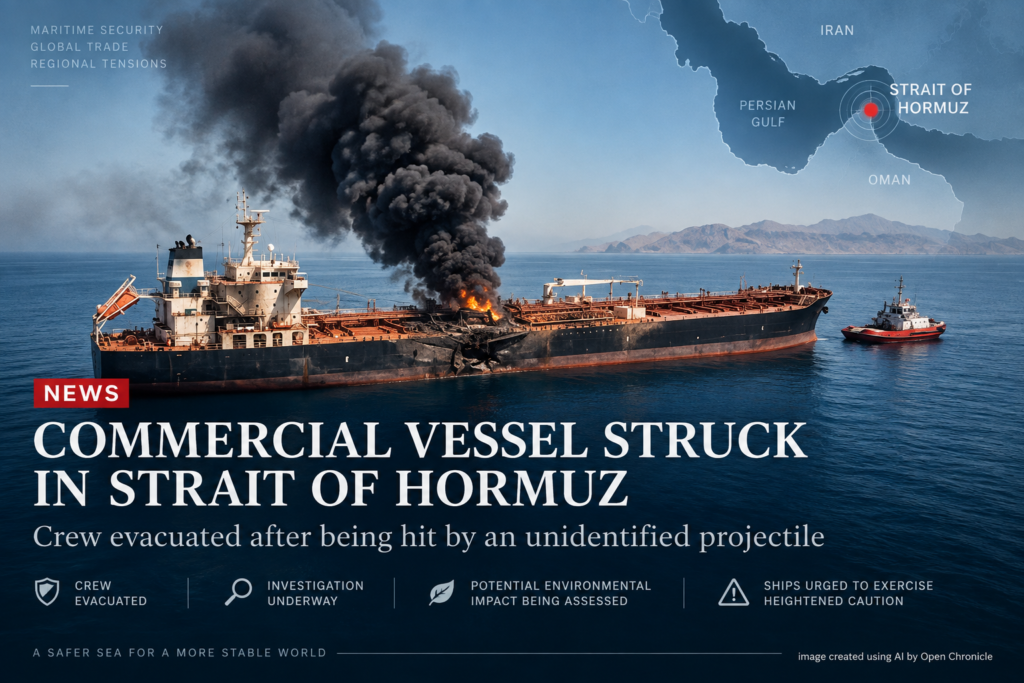
A commercial vessel was struck by an unidentified projectile while transiting the Strait of Hormuz early Sunday, sparking a fire and forcing authorities to evacuate the entire crew as security concerns intensify around one of the world’s most important maritime corridors.
The United Kingdom Maritime Trade Operations, or UKMTO, reported that the vessel suffered a direct impact while navigating the strategic waterway. The origin and type of projectile had not been established, and there was no immediate confirmation of who was responsible for the attack.
The strike caused a fire aboard the vessel, prompting an emergency response from local authorities.
All crew members were subsequently evacuated from the ship, according to the UKMTO report. Their medical condition was not immediately clear.
Emergency evacuation after fire breaks out
Local authorities responded after receiving distress calls from the vessel and began efforts to remove the crew from danger.
The evacuation was completed despite the fire aboard the ship, but authorities had yet to provide a full assessment of the damage caused by the impact and subsequent blaze.
Details about the vessel, including its name, flag, cargo and destination, were not immediately provided in the initial account.
The absence of those details, together with the unidentified nature of the projectile, leaves important questions surrounding the incident unanswered.
Authorities have not publicly attributed responsibility for the strike.
Investigation underway
A formal investigation has been launched to establish the circumstances surrounding the incident and determine what struck the vessel.
Investigators are expected to examine the nature of the damage as they attempt to identify the projectile and establish where it originated.
The potential environmental consequences are also being assessed. A serious fire or structural damage aboard a commercial vessel can pose pollution risks depending on the ship’s cargo and the quantity of fuel aboard.
No significant spill had been confirmed in the information available following the incident.
Until investigators establish the cause, the attack remains unattributed.
That distinction is particularly important given the heightened military tensions surrounding the Gulf, where incorrectly assigning responsibility for an attack could contribute to further escalation.
UKMTO warns ships to exercise extreme caution
Following the incident, UKMTO urged vessels operating around the Strait of Hormuz to maintain heightened vigilance.
Commercial ships and maritime operators were advised to report suspicious activity and unusual movements while passing through the area.
The warning reflects the growing risks confronting civilian shipping as regional tensions increasingly affect commercial maritime routes.
Shipping companies must now weigh security risks alongside normal navigational considerations when planning movements through the Gulf.
Hormuz remains a critical global chokepoint
The strategic significance of the Strait of Hormuz means that even an isolated attack can have international consequences.
The narrow waterway between Iran and Oman connects the Persian Gulf with the Gulf of Oman and Arabian Sea. It provides the principal maritime outlet for several of the world’s major oil and gas producing countries.
Large quantities of crude oil, petroleum products and liquefied natural gas move through the strait before reaching markets in Asia, Europe and elsewhere.
That concentration of energy traffic makes Hormuz one of the most consequential maritime chokepoints in the global economy.
Persistent attacks or even the perception that navigation is becoming significantly more dangerous can affect shipping insurance, freight costs, vessel movements and ultimately energy prices.
Commercial shipping increasingly exposed
The latest incident comes amid an increasingly unstable security environment across Middle Eastern shipping routes.
The Strait of Hormuz has become a particular focus of concern as military confrontation in the region spills into maritime areas.
At the same time, insecurity around the Red Sea and Bab el Mandeb has placed additional pressure on another vital shipping corridor.
The possibility of simultaneous disruption at both maritime gateways would have consequences extending far beyond the Middle East.
For shipping companies, the immediate concern is protecting crews while maintaining operations through waterways essential to international trade.
For governments, the challenge is preventing attacks on civilian shipping from triggering a broader military escalation.
Sunday’s incident leaves the most important question unanswered: who fired the projectile that struck the vessel?
Until investigators establish its origin, authorities face the delicate task of protecting commercial navigation through the Strait of Hormuz without drawing conclusions that the available evidence does not yet support.