
By Open Chronicle with agencies
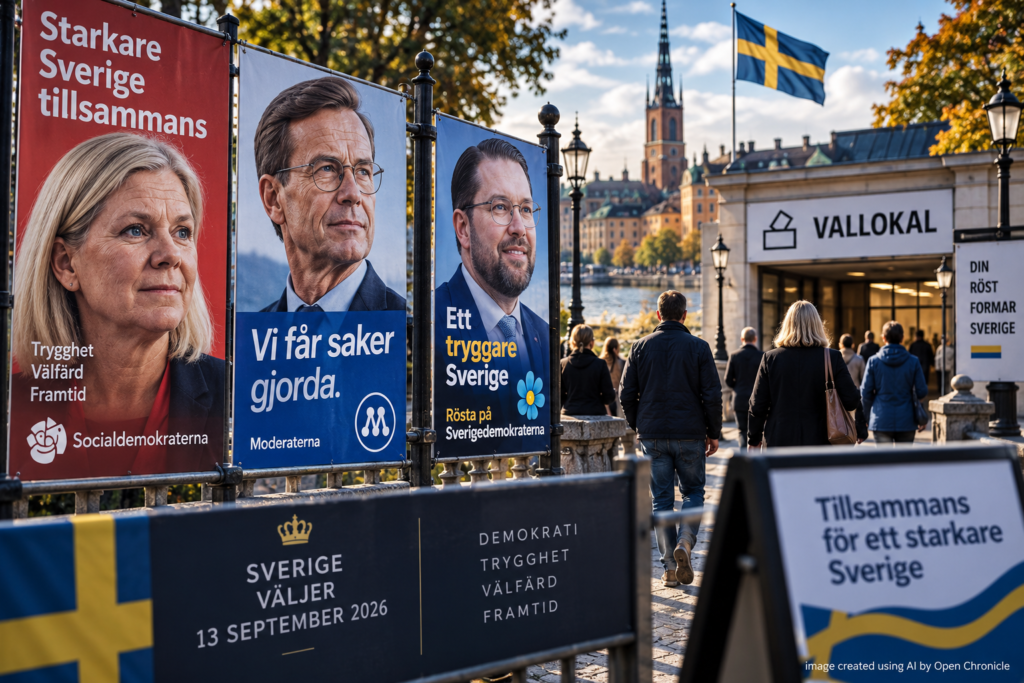
Swedes are voting Sunday in one of the country’s closest general elections in years, with the result potentially bringing the far right Sweden Democrats into government for the first time or returning the centre left to power under former prime minister Magdalena Andersson.
Polling stations opened at 8 a.m. across Sweden after a campaign dominated by the cost of living, immigration, public services and the country’s long struggle against organised crime.
For much of the campaign, Andersson’s opposition bloc appeared to hold a comfortable advantage over Prime Minister Ulf Kristersson’s governing alliance. That gap narrowed sharply during the final weeks, however, leaving the two sides effectively level as voters headed to the polls.
“We all knew it was going to be a very close election, I’ve said that all along,” Andersson told supporters at a final campaign rally in Stockholm.
The former prime minister framed the election as a fundamental choice over Sweden’s political direction, asking voters whether they wanted a government increasingly influenced by the Sweden Democrats or a centre left administration led by her Social Democrats.
Social Democrats seek return to power
Andersson, 59, became Sweden’s first female prime minister in 2021 and remained in office until 2022.
Her Social Democratic Party dominated Swedish politics for much of the 20th century and remains the country’s largest individual political party.
The Social Democrats have campaigned on strengthening Sweden’s welfare system while providing greater support to households struggling with higher living costs.
For Andersson, the election also represents an opportunity to move Sweden away from the tougher political direction adopted since Kristersson came to power four years ago.
The challenge is that the opposition bloc contains four parties with significant ideological differences. Even if they collectively secure a parliamentary majority, forming a stable government could require difficult negotiations.
Kristersson says Sweden has changed course
Kristersson is campaigning on the argument that his government has made progress on two of the country’s most politically sensitive issues: organised crime and immigration.
Sweden experienced years of shootings and bombings linked to criminal networks, turning gang violence into a central political issue in a country historically associated with high levels of social stability.
Violence has declined significantly in recent years, while asylum applications have fallen to record lows.
Kristersson says those developments give the government an opportunity to shift its attention toward household finances and everyday public concerns.
“We want to use our new and far better preconditions to improve the lives of ordinary people,” he told AFP, before borrowing Donald Trump’s political language and saying he wanted to “make Sweden great again.”
But Kristersson’s route to another term depends heavily on a political force that was once treated as an outsider by Sweden’s mainstream parties.
Sweden Democrats seek breakthrough
The Sweden Democrats have undergone one of the most dramatic political transformations in modern Swedish politics.
After entering parliament in 2010, the nationalist party steadily expanded its support and became crucial to Kristersson’s government following the 2022 election.
Kristersson formed a three party minority coalition but reached an agreement with the Sweden Democrats under which the party supported the government in parliament in exchange for substantial influence over policy, particularly immigration and crime.
This time, Sweden Democrats leader Jimmie Åkesson wants more.
After more than two decades leading the party, Åkesson is seeking formal participation in government for the first time.
Kristersson has indicated that the Sweden Democrats would receive important cabinet positions if the right wins. Åkesson has been widely discussed as a potential candidate for responsibility over migration policy.
Such an outcome would mark a significant change in Swedish politics, moving the Sweden Democrats from parliamentary support partner to direct participation in national government.
‘We’ve already won’
Åkesson projected confidence during his final rally in Stockholm’s Kungsträdgården Park on Saturday.
“We’ve already won!” he told supporters.
“Sweden is becoming safer, better, and more Swedish,” he said as supporters gathered around blue and yellow campaign material carrying the slogan “Make Sweden Sweden Again.”
The party’s appeal remains closely connected to immigration, national identity and crime.
Agneta Andersson, a 78 year old pensioner supporting the Sweden Democrats, told AFP that concerns about violence had influenced her vote.
“Like Jimmie, I want it to be like it was when I was young, in the old Sweden,” she said. “I can’t cope with all this violence in society.”
Other voters remained undecided even in the final hours before polling day.
Roman, a 22 year old student, said shortly before the election that he was still trying to decide which party deserved his support.
Eight million eligible to vote
Around eight million people are eligible to participate in the election out of Sweden’s population of approximately 10.6 million.
Turnout is traditionally high, regularly exceeding 80 percent.
Around half of eligible voters had already cast their ballots through Sweden’s advance voting system before polling stations opened Sunday morning.
Voting is scheduled to end at 8 p.m. local time, when the first exit polls are expected. More reliable preliminary results should emerge during the following hours.
Given the closeness of the contest, relatively small movements in support could determine which bloc emerges with enough seats to control the 349 member Riksdag.
Two very different paths after the election
Government formation could depend almost as much on the distribution of seats within the blocs as on which side finishes ahead.
A victory for Kristersson’s alliance could provide a comparatively clear path toward government, particularly because the parties have already cooperated during the previous parliamentary term.
The crucial difference would be the Sweden Democrats’ expected transition from influencing government policy to potentially exercising executive power themselves.
A centre left victory could prove more complicated. Although Andersson would be the obvious candidate for prime minister, the four opposition parties disagree on several economic and political questions.
Negotiations could therefore continue well beyond election night.
Whatever the final result, Sunday’s election represents an important moment for a country whose political identity has long been associated internationally with social democracy, liberal institutions and an extensive welfare state.
If the Sweden Democrats enter government, Sweden will cross a political threshold that would have appeared highly unlikely little more than a decade ago.
If Andersson succeeds in returning the Social Democrats to power, the result would instead represent a rejection of that shift and potentially move Sweden back toward a more traditional centre left model.
With the polls virtually tied, Sweden’s voters will make that choice.