
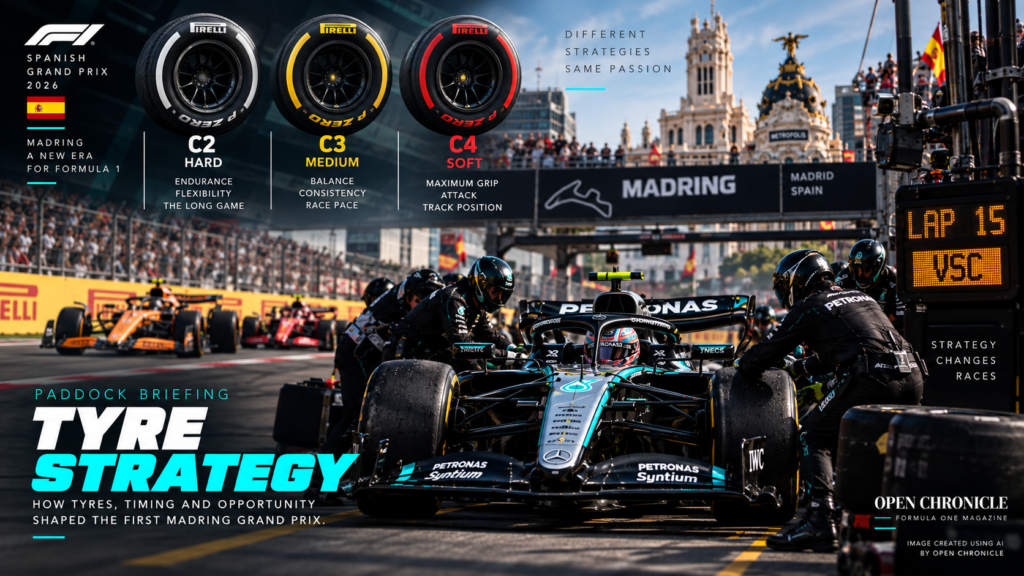
Pirelli arrived in Madrid expecting its C2, C3 and C4 compounds to create strategic variety and potentially favour a two stop race. What followed was even more complex. Lando Norris controlled the opening stint on the Medium, Max Verstappen attacked on the Soft, several rivals committed to the Hard, and Kimi Antonelli ultimately won after a perfectly timed Virtual Safety Car transformed the strategic order.
By Open Chronicle Formula One Magazine
Formula One’s first race at Madring began with one of the most intriguing strategic grids of the 2026 season.
There was no universally accepted starting tyre.
Lando Norris and Kimi Antonelli lined up at the front on Mediums. Max Verstappen and Lewis Hamilton chose the greater initial grip of the Soft. Charles Leclerc, George Russell, Oscar Piastri, Liam Lawson and Gabriel Bortoleto were among those committing to the Hard.
Three compounds.
Three different approaches.
And because nobody had previously raced a Formula One car at Madring, every strategy contained an element of uncertainty.
Teams had simulations, practice data and Pirelli projections. What they did not have was historical race information showing exactly how the tyres would behave over 57 competitive laps.
That uncertainty became one of the defining stories of the Spanish Grand Prix.
Pirelli Arrived Expecting a Serious Tyre Test
The challenge had been identified before the cars even reached Madrid.
Pirelli selected the C2 as the Hard, C3 as the Medium and C4 as the Soft for the inaugural Madring weekend. The choice was designed to provide enough separation between compounds to encourage strategic variation while offering protection against potentially high temperatures.
Pirelli’s simulations placed Madring among the five most demanding circuits of the season in terms of energy transmitted through the tyres. Lateral loads were expected to reach levels comparable with Barcelona and Silverstone.
One section was particularly significant.
La Monumental.
The approximately 550 metre banked section, featuring banking of up to 24 percent, was expected to generate exceptional vertical loads. Pirelli anticipated the highest vertical tyre load of the season through this part of the circuit.
Madrid therefore presented an unusual combination.
A new and initially low grip surface.
Significant lateral loading.
A heavily banked section.
High temperatures.
And no historical race data.
Tyre management was always going to matter.
The Three Compounds Offered Three Different Strategies
The fundamental strategic choices could be reduced to three philosophies.
| Compound | 2026 Specification | Main Strength | Main Risk | Strategic Purpose |
|---|---|---|---|---|
| Hard | C2 | Long tyre life | Warm up and initial pace | Extend the first stint and preserve flexibility |
| Medium | C3 | Pace and durability balance | Degradation over a longer stint | Conventional race strategy |
| Soft | C4 | Maximum initial grip | Greater thermal sensitivity | Attack at the start and gain track position |
The Medium represented the compromise.
The Soft represented aggression.
The Hard represented patience.
At many circuits, these choices would eventually converge as cars passed one another and pit stop cycles unfolded.
Madring made that considerably more complicated.
Friday Provides the First Warning
The first practice sessions immediately demonstrated how difficult predictions would be.
The new asphalt evolved rapidly as Formula One cars deposited rubber onto the racing line. At the same time, graining appeared and tyre management became one of the major technical subjects of Friday.
Max Verstappen was among those encountering graining on the Medium during FP1. Formula One’s analysis after Friday highlighted tyre behaviour as one of the important unknowns teams were trying to understand.
That mattered because graining can fundamentally alter strategic calculations.
A tyre that appears capable of completing a long stint according to conventional degradation models may lose significant performance if its surface begins tearing.
The teams therefore entered Saturday with more information than they had on Friday morning, but not necessarily with greater certainty.
Qualifying Makes Track Position Critical
Then another characteristic of Madring emerged.
Overtaking was going to be difficult.
Verstappen was particularly sceptical about passing opportunities before the race and suggested tyre degradation might become one of the few mechanisms capable of creating significant movement through the order.
That changed the value of every compound.
The fastest theoretical race strategy is not necessarily the fastest practical strategy if a driver exits the pits behind a slower car and cannot pass.
Track position became a strategic asset.
Norris therefore entered Sunday with an enormous advantage.
He had pole.
And he had the Medium tyre.
Medium: Norris Demonstrates the Ideal Opening Stint
Norris quickly demonstrated why the C3 was such an attractive race tyre.
Antonelli attacked immediately, but the Mercedes driver twice negotiated the chicane while fighting Norris and eventually had to concede position.
Verstappen exploited the situation and moved ahead of Antonelli.
But Norris escaped.
By approximately lap seven, his advantage had grown to 4.7 seconds.
This was important strategically.
The Medium was not forcing Norris to choose between tyre preservation and performance. He could produce enough pace to establish a useful advantage while retaining more theoretical durability than the Soft runners.
McLaren appeared to have the race exactly where it wanted it.
Norris had clean air.
He had tyre life.
He had track position.
He had a growing gap.
There was no obvious reason for McLaren to abandon the strategy.
Then came lap 15.
The Virtual Safety Car Changes Everything
Lance Stroll developed a brake problem.
Race control deployed the Virtual Safety Car.
For strategists, a VSC fundamentally changes the economics of a pit stop.
Under normal racing conditions, a car entering the pits continues travelling at pit lane speed while its rivals remain at full racing speed.
Under the VSC, the cars on track must respect reduced delta times.
The relative time lost by stopping is therefore considerably smaller.
Antonelli was in position to exploit it.
Norris was not.
The McLaren had just passed the pit entry.
Mercedes immediately called Antonelli in.
Red Bull reacted with Verstappen.
Russell also stopped.
Norris could only continue around the circuit.
A few seconds of geographical position had transformed the strategic race.
Why McLaren Could Not Simply React
This is one of the most important distinctions in understanding the Spanish Grand Prix.
McLaren did not necessarily make the wrong initial tyre decision.
Nor did Norris suddenly lose race pace.
The problem was timing.
When the VSC appeared, Norris was physically unable to make the same immediate strategic response as Antonelli.
He had already crossed the point at which he could enter the pit lane.
By the time he completed another lap and stopped, the strategic advantage offered by the neutralisation had changed.
His pit stop then compounded the problem.
Reuters reported that the McLaren stop lasted around seven seconds, further damaging Norris’ position.
He emerged fifth.
The driver who had been controlling the Grand Prix was suddenly chasing it.
Strategy Is Not the Same as Outcome
Norris’ race provides an excellent example of a principle that is frequently misunderstood in Formula One.
A bad result does not automatically mean a bad strategy.
Before the VSC, McLaren’s approach was working.
Norris had taken pole.
He retained the lead.
He created a gap.
His Medium tyres were performing.
Nothing in the opening phase suggested an urgent need to stop.
The VSC was an external event that occurred at precisely the wrong moment for Norris and precisely the right moment for Antonelli.
Antonelli later acknowledged that Norris had deserved the victory based on the way the race had developed.
Mercedes won because it had a competitive car, a viable tyre position and, critically, the opportunity to react immediately when the race changed.
That is different from saying Mercedes had simply selected a superior strategy before the start.
Soft: Verstappen Uses the C4 as an Attacking Weapon
Verstappen’s choice illustrated another strategic philosophy.
Red Bull started him on the Soft.
The objective was clear.
Initial grip.
Acceleration.
Track position.
Verstappen used that advantage effectively during the opening exchanges.
When Antonelli became involved in the fight with Norris, Verstappen was able to capitalise and move into second.
That was precisely the type of gain the Soft strategy was designed to create.
On a circuit where passing was expected to be difficult, gaining a position during the opening lap could be worth considerably more than extending the first stint by several additional laps.
The C4 therefore served as a tactical rather than purely endurance based weapon.
Hamilton’s Soft Strategy Is Never Fully Tested
Hamilton also started on the Soft, but Ferrari never received a complete answer about what that strategy might have produced.
His race became dominated by a brake problem.
Hamilton reported a long pedal as the problem worsened. He eventually ran straight and told Ferrari that he had lost braking performance.
The team instructed him to stop.
His retirement removed one of the most interesting Soft tyre comparisons from the race.
Verstappen consequently became the clearest example of what the aggressive opening compound could achieve.
Hard: The Alternative Race Begins
While the Medium and Soft runners fought at the front, another race was developing behind them.
Leclerc.
Russell.
Piastri.
Lawson.
Bortoleto.
Several drivers had started on the C2 Hard.
Their objective was different.
They were buying time.
The Hard allowed them to extend the first stint, wait for the race to develop and potentially take advantage of a later Safety Car or Virtual Safety Car.
This is where strategic optionality becomes important.
A driver who has not stopped retains more possible responses to future events.
But that flexibility has a price.
As the tyre ages, performance eventually declines.
The strategist must decide when the value of waiting becomes smaller than the lap time being lost.
Bortoleto Becomes the Ultimate Strategic Gamble
Nobody demonstrated that trade off more dramatically than Gabriel Bortoleto.
Audi left him on his original Hard tyres until lap 48 of 57.
The logic was understandable.
Every additional lap created another opportunity for a Safety Car or VSC.
If a neutralisation appeared, Bortoleto could stop at a reduced relative cost.
That could potentially transform his race.
His temporary position inside the top ten therefore contained strategic value.
But the neutralisation never came.
As the Hard tyres aged, the cost of waiting increased.
By the closing stages, Bortoleto was increasingly vulnerable to cars on fresher rubber.
Piastri closed rapidly.
Colapinto passed him.
Audi eventually abandoned the gamble and called Bortoleto in on lap 48.
The Brazilian ultimately finished 13th.
Was Audi Wrong?
Not necessarily.
This is where tyre strategy becomes more complicated than reading the final classification.
Audi was balancing two competing values.
Current lap time against future opportunity.
Stopping earlier would have provided Bortoleto with fresher tyres.
But it would also have removed the possibility of gaining dramatically from a late neutralisation.
Remaining out preserved that possibility while progressively sacrificing performance.
The gamble failed because the event Audi needed never occurred.
That does not automatically make the underlying logic irrational.
It simply demonstrates how Formula One strategy operates under uncertainty.
Leclerc Pushes the Hard Even Further
Leclerc also produced an extreme first stint.
Ferrari kept him out until approximately lap 49.
For a period, that placed Leclerc at the front of the classification as drivers on alternative strategies completed their stops.
But it was not the true net lead.
Unless a Safety Car or VSC intervened, Leclerc still had to make his mandatory compound change.
When Ferrari finally called him in, Antonelli inherited the effective lead.
The episode demonstrated both the strength and weakness of the Hard.
It could keep strategic possibilities alive for an extraordinary length of time.
It could not eliminate the eventual requirement to stop.
Russell Shows the Value of Flexibility
Russell’s race provides another perspective on the Hard strategy.
Starting on C2 gave Mercedes flexibility over the first stint, and the VSC then allowed the team to alter the race plan at reduced cost.
Russell later stopped again and returned to the fight before eventually climbing to fifth.
His result was less spectacular than Antonelli’s victory, but strategically significant.
Mercedes had placed its two cars on different starting approaches.
That created multiple possible responses to changing race conditions.
In a race containing substantial uncertainty, strategic diversification itself carried value.
Piastri’s Race Is Complicated by Damage
Piastri also started on the Hard but his strategic picture was compromised by contact with Russell.
The McLaren suffered front wing damage and fell backwards.
He eventually stopped on lap 43 and began recovering on fresher tyres, passing Lindblad as he worked back through the order.
Piastri ultimately finished eighth.
Again, the tyre strategy cannot be assessed independently of what happened to the car.
The theoretical performance of the Hard was only one variable.
Damage changed the equation.
Why Pirelli’s Two Stop Expectation Made Sense
Before the weekend, Pirelli had identified two stop racing as a plausible strategic direction.
The reasoning was sound.
Madrid was expected to place substantial energy through the tyres, temperatures could be high and the C4 Soft would be more thermally sensitive.
The C2, C3 and C4 allocation was intended to create enough performance differentiation to produce strategic choices.
But race strategy is never determined by tyre models alone.
Track position mattered enormously.
Overtaking proved difficult.
The VSC changed the relative cost of stopping.
Several teams therefore adapted away from what a simple pre race model might have predicted.
The inaugural Madring Grand Prix became less about finding one universally optimal strategy and more about maintaining enough flexibility to respond.
The Hidden Importance of Track Position
Madrid also demonstrated why tyre strategy cannot be analysed purely through degradation curves.
Imagine a fresher tyre that is 0.5 seconds per lap faster.
On an open circuit, that advantage may allow the driver to catch and pass a rival.
At Madring, the driver might catch the rival and remain trapped behind.
The theoretical tyre advantage then loses much of its strategic value.
This helps explain why teams were prepared to extend stints and protect track position.
A pit stop did not merely cost time.
It risked placing a car into traffic from which escaping could be difficult.
That made every stop more expensive strategically than its raw pit loss suggested.
What Each Compound Actually Delivered
By Sunday evening, the paddock had a much clearer understanding of Madring’s three tyres.
C2 Hard
The C2 offered enormous strategic range.
It allowed Leclerc and Bortoleto to extend deep into the race and gave teams the possibility of waiting for neutralisation.
Its weakness was clear as well.
Once the tyre aged sufficiently, the performance loss became difficult to defend.
C3 Medium
The Medium produced perhaps the best overall balance.
Norris demonstrated that it possessed enough performance to control the opening phase while still providing useful tyre life.
Antonelli also started on the C3 and ultimately won.
Its success made the Medium arguably the most versatile compound of the race.
C4 Soft
The Soft delivered immediate opportunity.
Verstappen used its initial grip to improve his race position.
But its greater thermal sensitivity made it a more aggressive strategic choice rather than the obvious foundation for a long opening stint.
The Strategy That Won Was Not Designed on Saturday Night
This may be the central lesson of Madring.
Antonelli’s winning strategy was not simply a perfect sequence calculated before the start.
The decisive part was created during the race.
Mercedes recognised the VSC opportunity.
Antonelli was in the correct part of the circuit.
The team reacted.
The driver executed the stop.
McLaren could not respond immediately.
That combination changed the Grand Prix.
Modern Formula One strategy is therefore not only about predicting the future.
It is about recognising when reality has invalidated the prediction.
Tyre Strategy Verdict
Madring delivered exactly the strategic uncertainty expected from a new Formula One circuit, but not necessarily in the form anticipated before the weekend.
The Soft provided Verstappen with an attacking weapon.
The Medium gave Norris the pace to control the opening race.
The Hard allowed Leclerc, Russell, Piastri, Lawson and Bortoleto to pursue longer and more flexible strategies.
Yet none of those compound choices alone decided the winner.
The decisive variable was timing.
Norris was controlling the Grand Prix when the VSC appeared.
Antonelli was positioned to stop.
Norris had already passed the pit entry.
Mercedes reacted immediately.
McLaren had to wait.
A difference measured in seconds of geographical position around a 5.4 kilometre circuit ultimately mattered more than the theoretical difference between the compounds.
That is what made the first Madring Grand Prix such a revealing strategic race.
Norris had the pace.
Verstappen had the aggressive opening strategy.
The Hard runners had flexibility.
Antonelli had the opportunity.
And when it arrived, Mercedes took it.