
By Open Chronicle Explained
A car approaches the kerb.
There is nobody behind the wheel.
In fact, there is no wheel.
There are no accelerator or brake pedals either.
Two passengers climb inside, select their destination and the vehicle pulls away into ordinary traffic.
That is the basic idea behind Tesla’s Cybercab, the purpose-built autonomous electric vehicle that began carrying paying passengers in limited areas of Austin, Texas, in September 2026.
The unusual interior immediately reveals what makes the Cybercab different from almost every conventional automobile.
It has two seats, a central touchscreen — and no traditional driving position.
But removing the steering wheel is the easy part.
The difficult question is:
What replaces the driver?
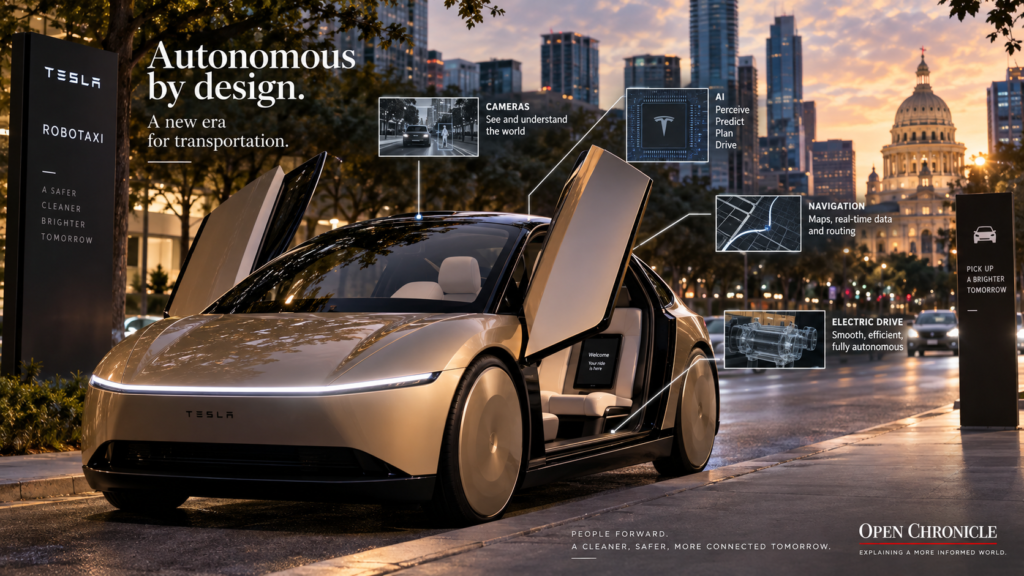
The answer involves cameras, artificial intelligence, neural-network processing, electric drive-by-wire systems, digital maps and routing, fleet software and a support infrastructure designed around a vehicle in which the humans inside are passengers rather than drivers.
Understanding the Cybercab therefore means understanding something larger than a new Tesla.
It provides a glimpse of what an automobile becomes when it is designed from the beginning around the assumption that a human being may never drive it.
What Is the Tesla Cybercab?
The Cybercab is a compact, fully electric, two-seat vehicle designed specifically for Tesla’s Robotaxi network.
Unlike a conventional Tesla Model 3 or Model Y, it is not fundamentally a normal passenger car with autonomous-driving technology added to it.
The Cybercab’s architecture assumes autonomous operation from the outset.
Tesla’s current production vehicle documentation describes an interior without a steering wheel, accelerator pedal or brake pedal.
Both front positions are therefore passenger seats.
The cabin contains a large central touchscreen through which occupants interact with the vehicle.
Passengers can use it to manage doors, seat position, climate settings, entertainment and support functions.
There is also a cabin camera, USB-C charging, window controls and a physical emergency stop button mounted between the overhead lights.
Behind the passenger compartment is a large luggage area. Tesla lists approximately 572 litres — 20.2 cubic feet — of rear cargo volume.
According to Tesla, it can accommodate combinations such as two standard checked suitcases plus two carry-ons.
But none of those features explains how the Cybercab drives itself.
For that we need to look outside.
Step One: Seeing the World
A human driver continuously collects information.
Where are the lane markings?
Is the traffic light red?
Is somebody crossing the road?
How fast is the car ahead travelling?
Is that object on the pavement about to move into the road?
A robotaxi must solve essentially the same problem.
Tesla’s approach is built heavily around machine vision.
Cameras positioned around the Cybercab observe its surroundings.
Instead of human eyes sending visual information to a biological brain, digital cameras send images to onboard computing systems.
The cameras provide different views around the vehicle, allowing the software to construct an understanding of the environment.
But a camera does not inherently know what it sees.
A stream of pixels is not the same thing as understanding a road.
That is where artificial intelligence enters the system.
Step Two: Turning Images Into an Understanding of the Road
Imagine a Cybercab camera sees a collection of coloured pixels ahead.
To a person, those pixels might obviously represent:
a pedestrian,
a parked van,
a bicycle,
a lane marking,
a traffic signal,
and an approaching intersection.
The vehicle’s neural networks must derive useful driving information from those visual inputs.
Tesla has spent years developing neural-network-based driving software using data collected from vehicles operating on real roads.
The objective is not merely to identify objects.
The system must build a useful representation of the driving environment.
It needs to understand where the road is.
Where other road users are.
Which areas are safe to occupy.
How objects are moving.
And, crucially, what they might do next.
A pedestrian standing beside a crossing presents a different problem from a stationary lamp post.
Both may occupy a similar part of an image.
Only one might suddenly walk into the vehicle’s path.
Autonomous driving therefore requires more than perception.
It requires prediction.
Step Three: Predicting What Happens Next
Driving is fundamentally an exercise in anticipating the future.
When a human driver sees a football roll into the road, the important information is not merely:
There is a ball.
It is:
A child might follow it.
Autonomous systems face similar problems constantly.
A Cybercab approaching an intersection must evaluate the movement of cars, pedestrians, cyclists and other objects.
Some movements are predictable.
Others are ambiguous.
The system must estimate possible trajectories.
Where will that vehicle be several seconds from now?
Will the pedestrian remain on the pavement?
Is the cyclist likely to enter the lane?
Is another driver about to turn despite failing to indicate?
This predictive layer is critical because a vehicle travelling through a city cannot simply react after something has happened.
At road speeds, waiting until danger becomes obvious may be too late.
Step Four: Planning a Path
Once the Cybercab has developed an understanding of its environment, another system must answer a different question:
What should the car do?
Suppose the vehicle approaches a slower car.
It might:
remain behind it,
slow down,
change lanes,
or prepare for an upcoming turn.
The planning system evaluates possible paths while considering road geometry, traffic rules, surrounding vehicles and the intended destination.
At a junction, the challenge becomes more complex.
The Cybercab must determine where it is permitted to travel, which traffic signals apply to it, whether it has right of way and whether another road user might conflict with its path.
The selected trajectory then becomes a sequence of commands for the vehicle.
Steer this much.
Accelerate this much.
Brake this much.
The passenger never performs those actions.
The computer does.
If There Is No Steering Wheel, How Does It Steer?
Removing the passenger-facing steering wheel does not eliminate steering.
The wheels still have to turn.
The difference is who sends the command.
In a traditional automobile, the driver’s hands rotate a steering wheel that ultimately changes the angle of the road wheels.
In an autonomous vehicle, electronic control systems can command steering directly.
The same principle applies to acceleration and braking.
The Cybercab’s computer determines the desired movement and the vehicle’s electronic systems execute it.
Conceptually, the chain looks like this:
Cameras → perception → prediction → planning → vehicle controls
And then the process begins again.
Not once per journey.
Continuously.
The system repeatedly observes the environment, updates its understanding and modifies the vehicle’s trajectory as conditions change.
Does the Cybercab Use LiDAR?
Tesla’s philosophy toward autonomous driving has long differed from several major competitors.
Companies such as Waymo have made extensive use of LiDAR, which sends laser pulses into the environment and measures their reflections to construct highly detailed three-dimensional information.
Tesla has instead placed much greater emphasis on cameras and neural-network-based vision.
The argument is partly philosophical.
Humans drive primarily using vision.
Tesla’s approach assumes that sufficiently capable cameras, computing and artificial intelligence can ultimately extract enough information from the visual environment to drive safely without depending on expensive LiDAR arrays.
That approach has potential advantages.
Cameras are comparatively inexpensive.
They can recognise colours and visual information such as traffic lights, signs and lane markings directly.
And a camera-centred system potentially makes autonomous hardware cheaper and easier to manufacture at enormous scale.
But it also creates one of the central debates surrounding Tesla’s strategy.
Critics argue that additional sensing modalities can provide valuable redundancy, particularly when visibility is difficult.
Tesla is effectively betting that advanced machine vision can solve enough of those problems through software and computation.
The Cybercab is perhaps the purest physical expression of that bet.
Where Does Artificial Intelligence Fit?
Artificial intelligence is not an optional feature layered on top of the Cybercab.
It is central to the concept.
Traditional vehicle software can be written using explicit rules:
If condition A occurs, perform action B.
Real streets are far too complicated for every situation to be programmed manually.
Consider a road partially blocked by construction workers while a cyclist approaches from behind and an oncoming vehicle crosses the centre line to avoid a parked truck.
There may be no neat rule describing exactly that combination of circumstances.
Machine-learning systems are intended to generalise from enormous amounts of driving data and learn representations that allow them to handle situations they have not encountered in precisely the same form before.
Tesla develops specialised AI computing hardware to process neural networks inside its vehicles.
The Cybercab therefore operates as both a vehicle and a mobile computing platform.
The electric motors move the car.
The AI determines how they should be used.
How Does the Cybercab Know Where It Is?
Perception answers:
What is around me?
Navigation must also answer:
Where am I, and where am I going?
A robotaxi combines positioning information, route planning and its real-time perception of the road.
The destination comes from Tesla’s Robotaxi app.
The navigation system determines a route.
But a route on a digital map cannot drive the vehicle by itself.
The Cybercab still needs to determine its precise position relative to lanes, intersections, kerbs and surrounding traffic.
That is why autonomous navigation is a fusion problem.
Global navigation tells the vehicle approximately where it needs to go.
Local perception tells it how to move safely through the physical world immediately around it.
What Happens When You Order One?
For the passenger, much of this complexity is hidden behind an experience resembling conventional ride-hailing.
A customer opens Tesla’s Robotaxi app.
They enter a destination inside the available service area.
The app displays an estimated fare and waiting time.
After the passenger confirms the journey, the network assigns a vehicle and sends it toward the pickup point.
Tesla uses the Cybercab’s exterior lighting to make identification easier.
At pickup, the rear lightbar illuminates red while the front lightbar displays a colour associated with the passenger’s ride.
The customer can also verify the vehicle’s licence plate through the app.
Once parked, its hazard lights flash.
The passenger approaches the vehicle and the nearest door can open automatically.
Why Does It Have Butterfly Doors?
Cybercab uses doors that swing outward and upward.
The design helps create a large opening into the two-seat cabin and contributes to the vehicle’s distinctive appearance.
They are electronically controlled.
From outside, passengers can use a button near the door area.
From inside, the touchscreen provides controls to open and close them.
The vehicle also monitors for obstructions during door operation.
But because electrically operated doors could become a problem if power is lost, Tesla includes a mechanical emergency release.
That detail illustrates an important principle in autonomous vehicle design:
Removing traditional controls does not remove the need for physical backups.
What Does the Passenger Control?
The Cybercab passenger does not control the direction or speed of normal driving.
But passengers are not completely powerless.
The central touchscreen provides controls for:
doors,
seat adjustment,
cabin temperature,
audio volume,
media,
and communication with Tesla support.
There are also conventional physical window switches beneath the touchscreen.
More importantly, passengers have several ways to request that the vehicle stop.
What If You Want the Cybercab to Stop?
Tesla provides a Pull Over command on the touchscreen.
A passenger can also request a stop through the Robotaxi mobile app.
And there is a physical STOP button between the cabin’s dome lights.
Activating one of these commands asks the Cybercab to find a safe place to pull over and ends the journey.
On a highway, this may not happen instantaneously because the vehicle must attempt to stop somewhere safe.
Tesla also provides an emergency mechanical door-release mechanism.
Fully pulling the interior door lever can trigger an emergency response in which the vehicle ends the trip and attempts to stop.
These systems matter because there is no human driver whom a passenger can simply tell:
“Stop the car.”
The vehicle itself must provide the equivalent function.
What Happens If Something Goes Wrong?
A driverless taxi still needs human support.
It simply moves that human involvement away from the driver’s seat.
Cybercab contains a two-way communication system allowing passengers to contact Tesla Robotaxi Support.
A support representative can communicate through the cabin’s microphone and speakers.
Tesla says support can also become involved following certain safety events.
This distinction is important.
A fully autonomous vehicle does not necessarily imply a completely human-free transportation system.
Fleet operations still involve maintenance, cleaning, customer support, incident management, charging, software monitoring and interaction with emergency services.
The driver disappears from the individual vehicle.
Humans remain elsewhere in the system.
Does It Secretly Have Manual Controls?
An intriguing detail emerged shortly after Cybercab entered public operation.
Some riders reported seeing an internal virtual joystick-style interface appear on the central display.
The interface reportedly contained controls capable of functions associated with manually manoeuvring the vehicle.
The passengers themselves were apparently unable to use those controls.
The most plausible purpose is operational rather than passenger driving — allowing authorised personnel to reposition or manipulate a Cybercab in controlled circumstances such as depots, production facilities or servicing environments.
Tesla has not publicly provided a complete technical explanation of the exposed interface.
Its existence nevertheless highlights a practical reality.
Even a vehicle designed never to have a conventional driver may occasionally need a mechanism through which trained personnel can command it.
Why Only Two Seats?
A conventional car is designed for many possible uses.
Family transport.
Commuting.
Long-distance travel.
Carrying passengers.
Personal ownership.
A dedicated robotaxi can be optimised for a narrower mission.
Many taxi and ride-hailing journeys involve only one or two passengers.
Tesla therefore designed Cybercab around two occupants rather than maintaining a conventional five-seat layout.
That reduces vehicle size and potentially reduces material use, mass and manufacturing cost.
At the same time, the rear cargo area remains substantial because passengers still need space for luggage, wheelchairs, strollers and other belongings.
The design reflects a fundamental change in thinking:
Cybercab is not primarily a car that can also be a taxi.
It is a machine designed specifically to sell transportation.
How Is It Powered?
Cybercab is a battery-electric vehicle.
Regulatory documentation reported in 2026 indicates a battery of roughly 50 kWh, a front-mounted electric motor rated around 219 horsepower, and an estimated driving range approaching 280 miles under EPA methodology, though final real-world fleet performance can vary with conditions and configuration.
Those figures are revealing.
A robotaxi does not necessarily need an enormous battery.
Large batteries add weight and cost.
For a fleet vehicle, Tesla can instead optimise the relationship between battery capacity, efficiency, charging and daily utilisation.
The economic objective is not to maximise a specification on a sales brochure.
It is to minimise the cost of moving passengers.
Why Is Cost So Important?
Autonomous driving receives most of the attention, but the Cybercab is ultimately an economic experiment.
A conventional taxi or ride-hailing journey contains a major cost:
the driver.
Remove that labour cost and, theoretically, transportation becomes much cheaper.
But only if other costs remain controlled.
The vehicle itself must be inexpensive.
Energy consumption must be low.
Maintenance must be limited.
Cleaning must be manageable.
Insurance must be viable.
The vehicle must spend a large percentage of its life carrying paying customers rather than sitting idle.
And the autonomous-driving system must be reliable enough to avoid expensive interventions.
This is why Tesla’s decisions about two seats, camera-based perception, electric propulsion and manufacturing simplicity are interconnected.
Cybercab is not merely trying to drive itself.
It is trying to make autonomous transportation economically scalable.
Is It the Same as Tesla Full Self-Driving?
No — and this distinction matters.
Tesla’s consumer vehicles offer Full Self-Driving (Supervised) in supported markets.
Despite the name, Tesla itself states that the currently enabled consumer system requires active driver supervision and does not make those vehicles autonomous.
Cybercab is designed for a fundamentally different operating model.
There is no steering wheel for a supervising passenger to grab.
There are no pedals for them to take over.
Within its authorised Robotaxi operation, the driving system must perform the dynamic driving task without expecting the passenger to become the fallback driver.
That places Cybercab conceptually in the world of highly automated, geofenced robotaxis, rather than conventional driver-assistance.
Is the Cybercab Level 5 Autonomous?
This requires careful terminology.
The SAE/NHTSA framework distinguishes between Level 4 and Level 5 automation.
At Level 4, the automated system performs the driving task without requiring a human driver, but only within conditions and areas where it is designed to operate.
At Level 5, the system could drive essentially everywhere a competent human could, across all road and environmental conditions.
Cybercab’s current commercial operation is geographically limited.
It should therefore not be interpreted simply as proof of universal Level 5 autonomy.
A vehicle can operate without a steering wheel inside a defined operational domain while still being unable or unauthorised to operate everywhere.
This distinction is one of the most commonly misunderstood aspects of autonomous vehicles.
No driver does not automatically mean Level 5.
Why Is the Cybercab Controversial?
Because Tesla has removed the very controls that traditionally provide the final safety fallback.
In a conventional car equipped with driver assistance, a human can take control.
In Cybercab, the passenger cannot.
That places enormous responsibility on the automated system.
It must recognise unusual objects.
Handle roadworks.
Interpret traffic signals.
React to emergency vehicles.
Deal with aggressive or unpredictable drivers.
Navigate poor visibility.
Respond to pedestrians behaving unexpectedly.
And recognise when conditions exceed its capabilities.
All without asking the person sitting inside to take the wheel.
There isn’t one.
What Are Regulators Investigating?
Cybercab’s design also collides with a regulatory system created largely around vehicles driven by humans.
US Federal Motor Vehicle Safety Standards historically contain requirements built around conventional controls and driver-oriented vehicle architecture.
On 4 September 2026, the US National Highway Traffic Safety Administration announced an Audit Query into Tesla’s certification that Cybercab complies with applicable federal safety standards following its commercial deployment in Austin.
The investigation does not by itself establish that the vehicle is unsafe or unlawful.
It means the regulator is examining Tesla’s self-certification and whether the unusual design satisfies applicable requirements.
At the same time, the US Department of Transportation has been working on changes to the regulatory framework for vehicles designed specifically for automated operation.
Cybercab is therefore arriving during a transitional period in which vehicle technology is evolving faster than many rules originally written for human-driven automobiles.
Why Is Cybercab Important?
Because most autonomous-driving development until now has involved adapting vehicles that still look fundamentally conventional.
Cybercab takes the next step.
It asks:
What would we build if we stopped assuming that a driver needed to exist?
The answer changes the cabin.
It changes the controls.
It changes the doors.
It changes the economics.
It changes the relationship between passenger and vehicle.
And eventually it could change the relationship between people and car ownership itself.
If autonomous taxis became inexpensive, reliable and ubiquitous, owning a vehicle that spends most of its life parked could become less attractive for some people.
Instead of buying a car, a person might simply summon transportation whenever necessary.
That possibility is much larger than Cybercab itself.
The Real Test
The technological achievement is not making a Cybercab complete one impressive journey.
It is making thousands — eventually millions — of ordinary journeys reliably.
Rain.
Night.
Construction zones.
Confusing intersections.
Emergency vehicles.
Pedestrians.
Cyclists.
Damaged road markings.
Temporary traffic signals.
Objects the software has rarely encountered.
The long tail of unusual situations is where autonomous driving becomes extraordinarily difficult.
And because Cybercab has no human driver, there is no conventional fallback when the software encounters something unexpected.
That is why the coming years will matter far more than demonstrations.
The central question is not whether a Cybercab can drive itself.
It clearly can under at least some operational conditions.
The question is how reliably it can do so across the enormous variety of situations that make up the real world.
What? How? Why?
What is Tesla Cybercab?
A purpose-built two-seat battery-electric robotaxi designed to transport passengers autonomously without a conventional steering wheel, accelerator pedal or brake pedal.
How does it drive?
Cameras observe the environment. Artificial-intelligence systems interpret those images, estimate the movement of surrounding road users and plan a safe trajectory. Electronic vehicle systems then translate those decisions into steering, acceleration and braking commands.
How does the passenger interact with it?
Through Tesla’s Robotaxi app and the vehicle’s central touchscreen. Passengers can manage doors, seats, climate and entertainment, contact support and request that the vehicle pull over.
What happens in an emergency?
Passengers can request a pull-over through the screen or app, press a physical STOP button, contact Robotaxi Support and, when necessary, use mechanical emergency door releases.
Why doesn’t it have a steering wheel?
Because Cybercab is designed around the assumption that the passenger is not the fallback driver. Within its operational domain, the automated-driving system is responsible for driving.
Why does it matter?
Because Cybercab represents more than automation added to an existing car. It is an attempt to redesign the automobile around autonomy itself — and to determine whether driverless transportation can become safe, inexpensive and scalable enough to operate as mass-market infrastructure.
The Cybercab therefore represents a deceptively simple idea.
Remove the driver.
But once the driver disappears, almost everything else about the car has to be reconsidered.
And that is what makes it one of the most important experiments in the future of transportation.
Related
Tesla Cybercab Begins Paid Rides Without Steering Wheel as Safety Debate Intensifies
Follow the latest deployment, regulatory scrutiny and safety debate surrounding Tesla’s new autonomous taxi.
Read the Open Chronicle report →
https://openchronicle.org/2026/09/13/tesla-cybercab-begins-paid-rides-without-steering-wheel-as-safety-debate-intensifies/
Open Chronicle Explained
What? How? Why?
Understand how the world works.
Understanding the systems behind the headlines.
Explore Open Chronicle Explained →