
By Open Chronicle with agencies
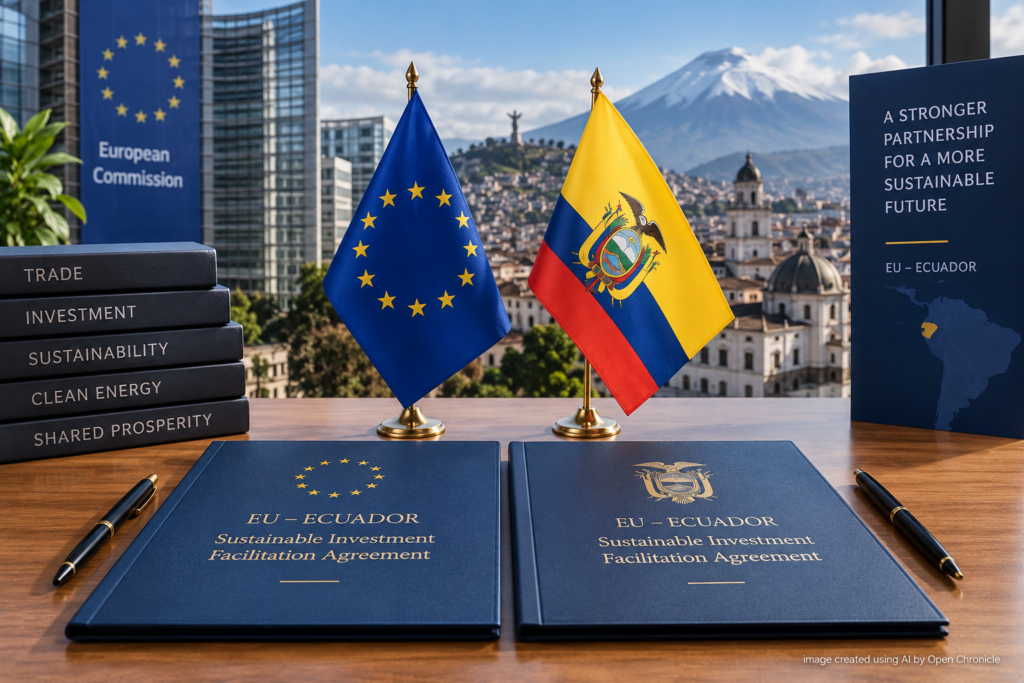
The European Commission has taken a major step toward strengthening economic ties with Ecuador, presenting a new Sustainable Investment Facilitation Agreement to the Council of the European Union for signature and conclusion.
The agreement, known as a SIFA, would be the European Union’s first of its kind negotiated with a Latin American country. It is designed to make investment in Ecuador easier and more predictable while encouraging European capital in areas including renewable energy, sustainable infrastructure and raw materials.
The Commission submitted its proposals to the Council on September 11, opening the next institutional stage before the agreement can be signed and eventually enter into force.
Reducing barriers to European investment
At the heart of the agreement is an effort to improve the environment faced by companies seeking to establish or expand operations in Ecuador.
The SIFA is intended to address practical obstacles such as bureaucratic procedures and regulatory uncertainty, which can discourage businesses from making long term investments.
Rather than focusing exclusively on particular industries, the framework is intended to facilitate investment across the Ecuadorian economy and benefit both European and local investors.
The Commission sees considerable potential in sectors where investment remains below what economic opportunities might support, particularly renewable energy.
By improving transparency and cooperation between authorities and investors, Brussels hopes the agreement can encourage more European companies to consider Ecuador as a destination for capital.
Renewable energy and raw materials take centre stage
The Ecuador agreement introduces an important development in the EU’s SIFA model.
For the first time, a Sustainable Investment Facilitation Agreement contains specific provisions intended to deepen cooperation and facilitate investment in sustainable energy and raw materials.
Both areas are strategically important for the European Union.
Europe is seeking to diversify energy supplies, accelerate the transition toward cleaner energy and develop more resilient access to the raw materials needed for modern industries and technologies.
For Ecuador, attracting additional investment could help develop domestic resources, infrastructure and renewable energy potential while expanding economic links with European markets.
The provisions therefore reflect a broader change in EU economic diplomacy, where investment policy is increasingly connected with energy security, sustainability and supply chain resilience.
Part of the EU’s Global Gateway strategy
The SIFA also complements the European Union’s Global Gateway strategy in Ecuador.
Global Gateway supports investment in sustainable infrastructure and development projects, including energy, water sanitation and waste management.
By combining investment facilitation with infrastructure cooperation, the EU is seeking to create conditions in which European investment can support Ecuador’s economic development while advancing environmental and sustainability objectives.
The approach is designed to go beyond traditional trade policy by connecting private investment, public policy and long term development priorities.
EU investment in Ecuador already reaches €9.1 billion
The European Union is already one of Ecuador’s leading trade and investment partners.
According to the Commission, the stock of EU foreign direct investment in Ecuador reached €9.1 billion in 2024.
European investment is spread across several important areas of the Ecuadorian economy, including construction, business services, transportation, storage, communications and manufacturing.
The new agreement is intended to build on that existing relationship rather than create one from scratch.
By reducing administrative obstacles and increasing regulatory predictability, Brussels hopes existing investors will find it easier to expand while new companies gain greater confidence in entering the Ecuadorian market.
Latin America gains importance in EU economic strategy
The decision to negotiate the first Latin American SIFA with Ecuador also reflects Europe’s wider effort to deepen partnerships beyond its traditional economic relationships.
Investment facilitation agreements form part of the objectives outlined in the EU’s Competitiveness Compass, which calls for new approaches to strengthening international partnerships and improving opportunities for European businesses.
The strategy has become increasingly important as geopolitical tensions, trade disputes and supply chain disruptions encourage governments to diversify economic relationships.
Latin America offers the EU significant opportunities in renewable energy, critical resources, infrastructure, agriculture and industrial cooperation.
Ecuador could now become an important test of how the SIFA model can be applied across the region.
What happens next
The agreement has not yet entered into force.
By presenting proposals for both the signature and conclusion of the SIFA, the European Commission is asking EU member states in the Council to approve the next stage of the process.
If the Council authorizes the signature, the agreement will subsequently be submitted to the European Parliament for its consent.
Following the required approvals, the agreement can enter into force.
That process means the September 11 announcement represents an important institutional milestone rather than the final implementation of the deal.
If completed, however, the EU Ecuador SIFA could establish a new framework for investment relations between Europe and Latin America.
For Ecuador, it offers the prospect of attracting additional European capital into sectors important to the country’s economic development. For the European Union, it provides another route toward diversifying investment opportunities, developing sustainable supply chains and strengthening its economic presence in Latin America.