
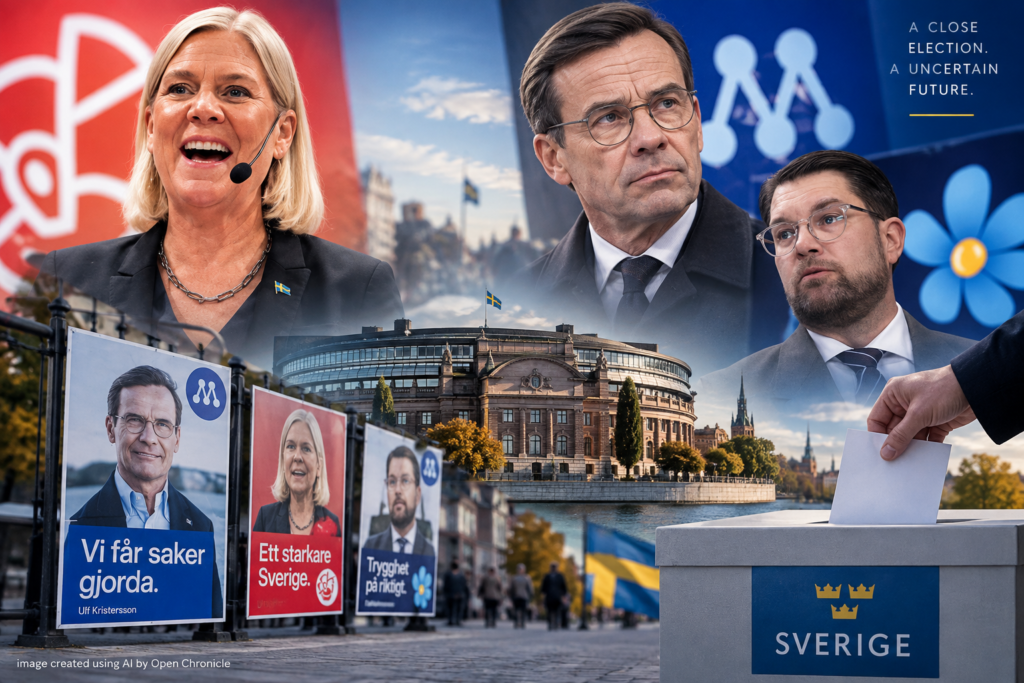
By Open Chronicle with agencies
Sweden entered a period of political uncertainty on Monday after an extraordinarily close general election left the centre left opposition holding a narrow parliamentary advantage, while the Sweden Democrats suffered their first decline in support since entering parliament 16 years ago.
With around 95 percent of votes counted, the four opposition parties led by Social Democrat Magdalena Andersson held a three seat advantage in Sweden’s 349 member parliament over the right wing alliance of outgoing Prime Minister Ulf Kristersson.
The result, however, was not yet definitive. Additional votes were expected to be counted by Wednesday, leaving open the possibility that the parliamentary balance could still change.
Whatever the final numbers, the election has produced a difficult political equation. Both Andersson and Kristersson have indicated that they will explore possible coalition arrangements, but either would need significant compromises from parties that entered the campaign with clear political red lines.
Andersson holds narrow advantage
The Social Democrats emerged from Sunday’s vote in the strongest position to attempt to form a government if the centre left advantage survives the remaining count.
Andersson, who served as prime minister between 2021 and 2022, would need to assemble support from the Greens, the Left Party and the Centre Party.
That is far from straightforward.
The Centre Party has said it will not support a government that includes the Left Party, while the Left has indicated that it will not support an administration unless it is formally included.
Those conflicting positions could make negotiations difficult even if the opposition ultimately controls a majority of seats.
Political analyst Mats Knutson of Swedish public broadcaster SVT described the emerging situation as a potential stalemate that could produce a prolonged government formation process and, in the most difficult scenario, another election.
“One or several parties may have to abandon their ‘red lines,’” Knutson said.
Kristersson searches for an alternative majority
Kristersson has not conceded the battle to remain prime minister.
The conservative leader said on election night that he would examine whether a workable government could still be constructed from what he described as the non socialist parliamentary majority.
One potential route would involve persuading the Centre Party to cooperate with the right.
The Centre Party was historically associated with Sweden’s centre right bloc before changing its political alignment in 2019. Bringing it back into cooperation with Kristersson could transform the parliamentary arithmetic.
There is a major obstacle, however.
The Centre Party remains strongly opposed to an alliance involving the Sweden Democrats, whose support has been central to Kristersson’s governing arrangement since 2022.
Annika Fredén, associate professor of political science at Lund University, said she considered a successful Kristersson approach to the Centre Party unlikely because of that fundamental disagreement.
The question is therefore whether the pressure to form a stable government will persuade parties on either side to reconsider positions they previously described as non negotiable.
Sweden could face weeks of negotiations
Sweden has experience with complicated coalition negotiations.
Following the 2022 election, it took 37 days to establish a government. The political deadlock after the 2018 election was considerably more severe, requiring 134 days before a new administration could take office.
Parliament could vote on a new prime minister from September 29 at the earliest, according to the information available following Sunday’s election.
The extremely narrow result means negotiations may not begin in earnest until the remaining votes have been counted and the final distribution of parliamentary seats is clear.
Despite the possibility of another election if negotiations collapse, political observers believe Sweden’s parties will make considerable efforts to avoid returning immediately to the polls.
Fredén pointed to what she described as Sweden’s political “culture of negotiation” and a strong reluctance among parties to trigger a snap election.
That culture could now face one of its most difficult tests in years.
Sweden Democrats suffer unexpected setback
One of the election’s biggest surprises was the performance of the Sweden Democrats.
The nationalist, anti immigration party received approximately 17.6 percent of the vote, down from more than 20 percent four years earlier.
The decline pushed the Sweden Democrats into third place behind the Social Democrats and Kristersson’s Moderate Party.
More significantly, it marked the first time the party has lost vote share in a national election since entering parliament in 2010.
The result interrupts an extraordinary political rise.
Once isolated on the margins of Swedish politics, the Sweden Democrats steadily increased their support and became the country’s second largest party in the 2022 election.
They subsequently agreed to support Kristersson’s minority government from outside the cabinet. That arrangement gave the party considerable influence over government policy, particularly on immigration and crime, without requiring it to assume direct ministerial responsibility.
Heading into Sunday’s election, Sweden Democrats leader Jimmie Åkesson had hoped to take the next step and enter government formally.
Instead, voters delivered the party its first significant electoral setback.
Has the far right lost ownership of immigration?
The Sweden Democrats’ decline does not necessarily mean Swedish voters have rejected tougher policies on immigration and crime.
It may indicate almost the opposite.
Several mainstream parties have adopted substantially more restrictive positions on migration in recent years, reducing the Sweden Democrats’ ability to distinguish themselves on the issue that powered much of their political ascent.
“Migration issues were strongest in 2015 and 2016 and now many parties are in favor of a restrictive policy,” Fredén said.
She argued that the Sweden Democrats had struggled to establish the same level of political strength on other issues.
Sweden’s experience therefore presents an interesting development in the wider European debate over populist and nationalist parties.
Policies once strongly associated with the political right have increasingly entered mainstream platforms. That can allow nationalist parties to influence national policy even when their own electoral support stops growing.
A polarized Sweden searches for a government
The election has exposed how closely divided Sweden has become.
Neither political camp has received a decisive mandate, and the narrow parliamentary balance means even small changes in the remaining count could have major consequences.
For Andersson, the challenge will be persuading ideologically divided parties to cooperate sufficiently to return the Social Democrats to government.
For Kristersson, remaining in office may require finding partners beyond the alliance that supported him during the previous parliamentary term.
For the Sweden Democrats, meanwhile, the result creates a different question. After 16 years of almost uninterrupted electoral growth, the party must determine whether its influence over Swedish politics has reached a ceiling or simply entered a new phase.
The final vote count will determine which bloc holds the numerical advantage.
It may take considerably longer to determine who can actually govern Sweden.