
By Open Chronicle with agencies
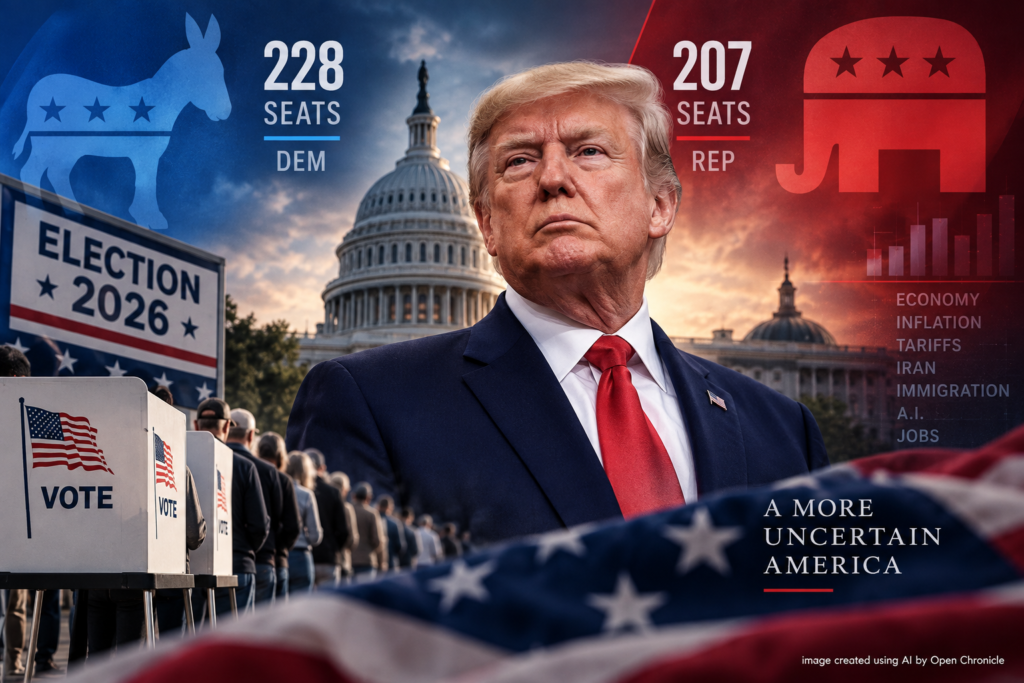
President Donald Trump is emerging as the central force shaping the 2026 congressional elections, motivating voters on both sides of America’s political divide as Democrats currently hold an advantage in the battle for control of the House of Representatives.
A CBS News and YouGov Battleground Tracker poll conducted from September 8 to 11 shows that the midterms are increasingly being viewed as a referendum on Trump, even though the president himself is not on the ballot.
Among likely voters, 45% say their congressional vote is primarily about opposing Trump, compared with 28% who say it is about supporting him. Another 27% say Trump is not a factor in their decision.
The effect is particularly pronounced among Democratic voters. Some 80% of likely Democratic voters say their congressional choice is about opposing Trump, while 61% of likely Republican voters say their vote is intended to support him.
If those attitudes persist through Election Day, Trump could become an even larger factor in the midterms than he was during the 2018 elections.
Democrats currently favored to control the House
The CBS News Battleground Tracker currently estimates that Democrats would win 228 seats, compared with 207 for Republicans.
A party needs 218 seats to control the 435 seat House.
The estimate, however, leaves considerable room for movement. CBS News places the Democratic range between 215 and 237 seats, while Republicans could finish between 198 and 220.
That means Democrats currently have the advantage, but Republican control remains a realistic possibility if several competitive races move toward the GOP before Election Day.
The political environment is being shaped by more than Trump. Inflation, the cost of living, tariffs, the conflict with Iran, immigration, artificial intelligence and concern over the rapid expansion of data centers are all influencing voters.
Inflation continues to hurt the party in power
Higher prices remain one of the most important forces shaping the electorate.
Among likely voters who say higher prices are causing financial difficulty or hardship, 62% plan to vote Democratic and 38% Republican.
Trump voters from 2024, however, remain overwhelmingly loyal to the GOP even when they are struggling with prices. Among that group, 92% say they intend to vote Republican, compared with only 7% who favor Democrats.
This illustrates one of the central dynamics of the election. Economic dissatisfaction may be helping Democrats overall, but it has not produced a large scale collapse in Trump’s political coalition.
Voters are also skeptical that either party will dramatically improve their personal finances.
Asked what would happen financially if Democrats controlled Congress, 36% said they would be better off, 36% worse off and 27% expected no change.
If Republicans win, 28% expect to be better off, while 46% believe they would be worse off and 26% expect no change.
The results suggest Democrats have a relative advantage on the issue, but neither party has persuaded a majority that congressional control would make voters financially better off.
Democratic vote driven heavily by opposition to Trump
The poll also exposes a potential weakness for Democrats despite their advantage.
Among likely voters supporting Democratic congressional candidates, 54% say their main motivation is stopping Donald Trump and Republican policies. Only 46% say they are voting primarily to help Democrats enact their own policies.
Republicans, meanwhile, remain strongly motivated by their perception of Democrats.
Among people who voted for Trump in 2024, 73% say Democratic control of Congress would threaten their culture and way of life. Only 7% believe it would protect their culture and way of life, while 20% say it would have no impact.
That sense of cultural threat could prove important in maintaining Republican turnout even among voters unhappy with prices or other aspects of the economy.
MAGA voters remain highly engaged
One of the major questions surrounding the midterms has been whether Trump’s most committed supporters would turn out when he was not personally running.
So far, the poll suggests that much of the MAGA electorate remains engaged.
Among Republican registered voters, 81% of MAGA Republicans say they will definitely vote, compared with 71% of non MAGA Republicans.
Asked specifically whether Trump’s absence from the ballot affected their interest in the election, 72% of MAGA Republicans said their interest remained the same. Sixteen percent said they were more interested and 12% less interested.
That is encouraging for Republican strategists who have worried about recreating Trump’s presidential election coalition in a midterm environment.
Tariffs, Iran and ICE divide the electorate
Trump’s policies themselves are also influencing congressional preferences.
Among likely voters, 56% say they prefer a congressional candidate who opposes Trump on tariffs, compared with 30% who prefer someone supporting him. Fourteen percent say the issue would not matter to their vote.
On the U.S. conflict with Iran, the result is similar. 56% prefer a candidate who opposes Trump’s position, while 32% prefer one who supports him and 12% say it does not matter.
The administration performs somewhat better on immigration enforcement. On ICE operations, 52% prefer a candidate opposed to Trump’s approach, while 40% prefer one who supports it. Eight percent say the issue does not matter.
The Iran conflict is also exposing divisions within the Republican coalition, particularly over energy costs.
Among MAGA Republicans, 67% say Americans should be willing to pay higher gasoline prices during the U.S. Iran conflict, while 33% disagree.
Among non MAGA Republicans, the result reverses sharply. Only 41% say Americans should accept higher gasoline prices, while 59% say they should not.
AI anxiety enters the midterm debate
Artificial intelligence has also become an economic and political concern.
A striking 64% of registered voters believe AI will decrease the number of jobs in the United States. Only 19% think it will increase employment, while 17% expect it to have no effect.
That level of concern suggests AI is moving beyond a technology policy debate and becoming a broader question about economic security.
The construction of data centers is producing another potential political fault line.
Among likely voters, 54% say they would prefer a congressional candidate who opposes building data centers, while just 15% prefer a candidate who supports their construction. Another 31% say the issue would not affect their vote.
The findings suggest that local opposition to energy intensive technology infrastructure could become a significant campaign issue in some congressional districts.
Democratic socialism presents another complication
Democrats also face difficulties when candidates are associated with democratic socialist organizations.
Among all likely voters, an endorsement by democratic socialists would make 42% less likely to support a candidate, compared with 26% who would become more likely to support that candidate. Another 32% say it would have no impact.
Even among Democrats, the effect is mixed. Fifty one percent say such an endorsement would make them more likely to vote for a candidate, while 8% say less likely and 41% say it would make no difference.
That suggests the label may energize part of the Democratic base while potentially creating problems among independents and other voters needed in competitive districts.
A midterm election increasingly centered on Trump
With control of Congress at stake, the emerging picture is one of an electorate driven as much by opposition as enthusiasm.
Democrats currently possess the stronger position in the House race and appear to benefit from dissatisfaction over prices, tariffs and the Iran conflict. Republicans, however, retain a highly loyal MAGA base and continue to hold most of the voters who backed Trump in 2024.
The decisive question may therefore be turnout.
Democrats must convert opposition to Trump into votes across competitive districts, while Republicans need to persuade Trump supporters that an election without the president’s name on the ballot is still important enough to command their participation.
With the CBS News model showing Democrats at 228 seats but Republicans still capable of reaching the 218 seats required for control, the battle for the House remains competitive.
What already appears clear is that the 2026 midterms will not be an election conducted in Donald Trump’s absence.
Politically, he is very much on the ballot.