
By Open Chronicle with agencies
A Russian drone strike on a passenger train near Ukraine’s border with Poland was intended to intimidate European countries and weaken their support for Kyiv, the European Union’s foreign policy chief Kaja Kallas said on Monday.
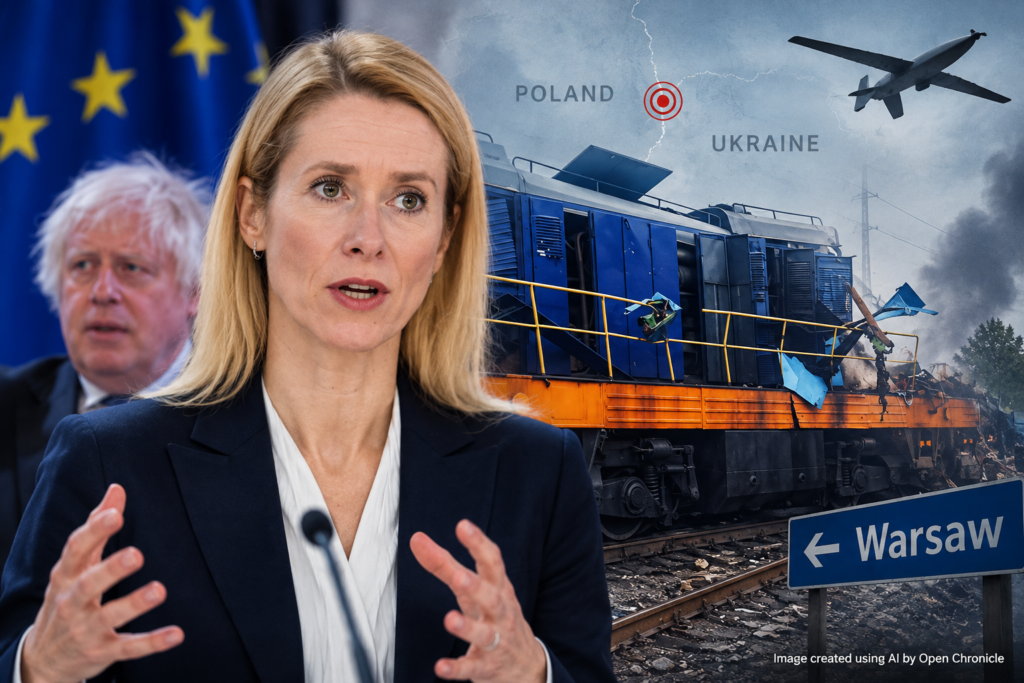
The attack struck the locomotive of a Warsaw bound passenger train in Ukraine’s western Volyn region on Sunday morning, around two kilometres from the Polish border. No injuries were reported, but the incident has raised particular concern because a train carrying several prominent Western security and political figures had travelled along the same railway shortly beforehand.
“This is clearly intended to frighten Western countries into ceasing their support for Ukraine, into refraining from going there to demonstrate their support,” Kallas told reporters after arriving in Finland for an Arctic summit.
French Foreign Minister Jean Noël Barrot offered a similar assessment, describing the strike as an attempt “to intimidate Europeans, discourage them and above all to divide them.”
Diplomatic train had recently passed through
Ukraine’s state railway operator confirmed that the drone struck the locomotive of the passenger service close to the frontier.
Although nobody was injured, Ukrainian railway officials said it was “quite likely” that the drone may also have been intended for a diplomatic train that had recently travelled along the same route.
According to the information released following the incident, passengers on that train included former British Prime Minister Boris Johnson, former CIA director David Petraeus and British National Security Adviser Jonathan Powell.
There has been no independently confirmed evidence establishing that the diplomatic train was specifically targeted, and Russia has not said that Western officials were the objective of the strike.
The timing and location of the attack, however, have intensified concern among European governments about the security of transport routes connecting Ukraine with NATO and European Union countries.
Moscow says railway infrastructure carried military cargo
Russia offered a different explanation for the attack.
The Russian Defence Ministry said its forces had targeted railway infrastructure in western Ukraine that was being used to transport military cargo arriving from Europe.
Moscow has repeatedly described Ukrainian railway and logistics infrastructure involved in transporting military supplies as legitimate military targets.
The latest incident is particularly sensitive because it occurred so close to Poland, a NATO member and one of the principal logistical gateways for Western assistance entering Ukraine.
Ukrainian Foreign Minister Andrii Sybiha said the strikes demonstrated that Russia was bringing the conflict increasingly close to the borders of the European Union and NATO.
Sybiha accused Russian President Vladimir Putin’s forces of “knocking directly on the doors of the EU and NATO” and called on Ukraine’s partners to intensify economic pressure on Moscow.
Growing concern over Ukraine’s western borders
The incident follows warnings from Poland that border infrastructure linking Ukraine with European countries could face increased threats.
Earlier in September, Polish Prime Minister Donald Tusk warned that governments should prepare for possible attacks around crossings connecting Ukraine with neighbouring European states.
His comments followed a Russian strike on a crossing between Ukraine and Moldova that reportedly killed two people.
Tusk said at the time that Warsaw expected Russia could carry out similar actions against crossings elsewhere along Ukraine’s western frontier, including those bordering Poland.
The railway attack in Volyn will therefore reinforce concerns that infrastructure close to NATO territory could become an increasingly sensitive part of the conflict.
European officials see an intimidation strategy
For Kallas and Barrot, the significance of Sunday’s strike extends beyond the physical damage to the locomotive.
Western politicians, diplomats and officials have regularly travelled by rail into Ukraine since the beginning of Russia’s full scale invasion, partly because Ukrainian airspace remains closed to normal civilian aviation.
The railway network has consequently become both an essential transport system and a highly visible symbol of continued Western engagement with Kyiv.
A successful attack on a train carrying senior foreign officials could therefore have major diplomatic and security consequences.
Kallas’ assessment suggests European officials believe Moscow may be attempting to increase the perceived risks associated with travelling to Ukraine and maintaining close political contact with Kyiv.
Barrot similarly argued that the objective was not merely intimidation, but potentially weakening unity among Ukraine’s European supporters.
Wider European security concerns
The incident comes amid heightened European concern about suspected Russian activity beyond Ukraine itself.
European governments have investigated a series of incidents involving drones, critical infrastructure, sabotage allegations and suspected intelligence operations.
Russia has been linked by Western officials and investigators to several recent security incidents, although responsibility and the strength of available evidence differ considerably from case to case.
Among them are an explosive laden drone discovered near Leipzig airport in Germany, a sea drone destroyed by Romanian forces in the Black Sea and earlier reports of an alleged Russian plot targeting the head of German defence manufacturer Rheinmetall.
Moscow has rejected many Western allegations that it is conducting a broader sabotage campaign across Europe.
The increasing number of incidents has nevertheless contributed to fears that the distinction between the war inside Ukraine and the wider confrontation between Russia and European NATO countries is becoming less clear.
A railway strike with a larger political message
Sunday’s attack caused no casualties, but its location and timing have given it significance far beyond the damage inflicted on a single train.
For European officials, the strike is another warning that the infrastructure connecting Ukraine to its Western partners may increasingly become part of Moscow’s pressure campaign.
For Russia, railway lines carrying Western military supplies remain part of the logistical system supporting Ukraine’s armed forces and therefore targets within its military campaign.
Those competing interpretations underscore the broader danger surrounding Ukraine’s western frontier.
As European governments continue supplying Kyiv and senior Western officials continue travelling into the country, the routes linking Ukraine with Poland and other European neighbours are becoming increasingly important, and potentially increasingly exposed.