
By Open Chronicle with agencies
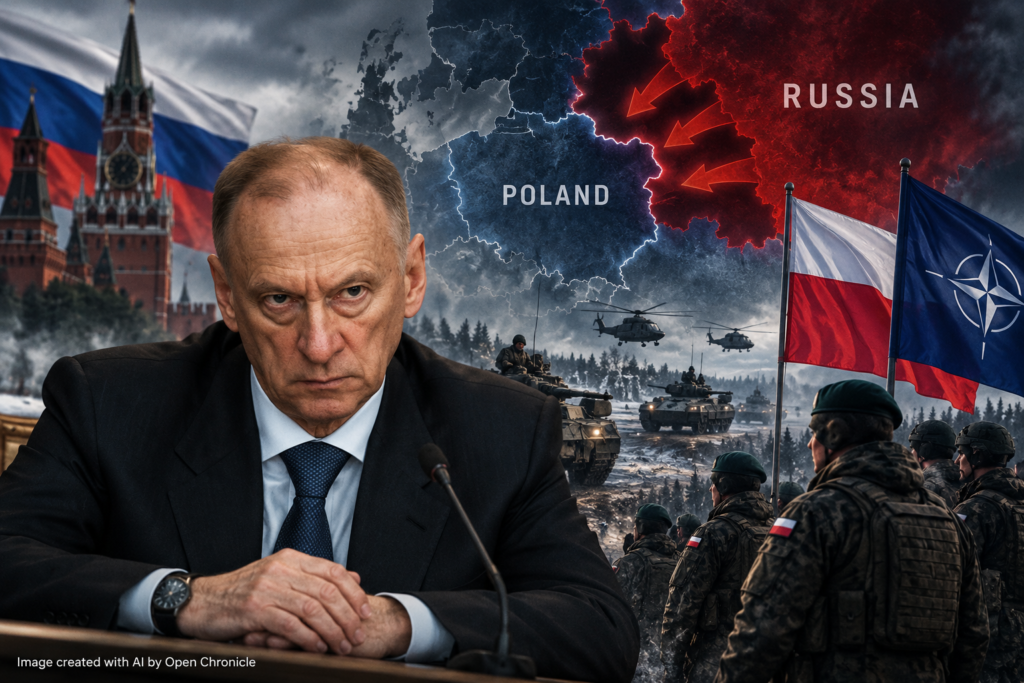
A senior adviser to Russian President Vladimir Putin has issued an extraordinary warning to Poland, saying Moscow would use its full military capabilities if Warsaw entered into direct hostilities with Russia and claiming that the Polish state could “cease to exist” within days.
Nikolai Patrushev, a former secretary of Russia’s Security Council and one of the Kremlin’s most influential security figures, made the remarks in response to comments by Polish Foreign Minister Radosław Sikorski about the balance of military power between Russia and NATO.
“If Poland engages in military action against Russia, our country will use the entire arsenal of forces and means at its disposal, and Polish statehood will cease to exist within two or three days,” Patrushev said in an interview with the Russian newspaper Argumenty i Fakty.
Patrushev did not explicitly say that Russia would use nuclear weapons. His reference to Moscow’s “entire arsenal” was broader and was not accompanied by details about what weapons he had in mind.
Patrushev responds to Sikorski
The Russian official accused Sikorski of underestimating Moscow’s military capabilities, describing the Polish foreign minister’s assessment as “amateurish.”
Patrushev also claimed that Russian forces are not employing their full military potential in Ukraine, where Moscow continues the war it launched with its full scale invasion in February 2022.
His comments followed remarks by Sikorski at the Yalta European Strategy conference in Kyiv.
“If Russia attacked us and we took our gloves off, I think we would defeat Russia quite quickly,” Sikorski said, pointing in particular to the advantage held by NATO in air power. He subsequently clarified that he was referring to a confrontation between Russia and NATO, rather than a bilateral war between Russia and Poland alone.
The distinction is significant. Poland has been a NATO member since 1999, meaning an attack on Polish territory could trigger consultations and potentially collective defence measures under the North Atlantic Treaty.
Tensions rising along Poland’s border
The exchange comes amid growing concern in Warsaw over Russian military activity close to Polish territory.
On Sunday, a Russian drone struck a passenger train near Yahodyn in Ukraine’s Volyn region, roughly two kilometres from the Polish border. The locomotive was damaged, but no passengers were reported injured.
The incident attracted particular attention because another train carrying prominent Western political and security figures had travelled along the same railway shortly beforehand.
Among those travelling through the area were former British Prime Minister Boris Johnson, former Swedish Prime Minister Carl Bildt and other Western officials. Former CIA director David Petraeus was aboard another train in the area. Ukrainian railway officials said it was possible that the diplomatic train had been the intended target, although that has not been independently established.
Russia said its strikes targeted railway infrastructure used to transport military supplies from Europe.
Another drone attack struck a vehicle near a petrol station close to the border, contributing to temporary disruption at the Yahodyn Dorohusk crossing. Poland has since begun reinforcing protection around several border crossings with Ukraine.
Poland prepares for possible escalation
Polish Prime Minister Donald Tusk has warned that Warsaw expects Russia to intensify military operations near Ukraine’s western borders.
Poland is strengthening protective infrastructure at key crossings including Dorohusk, Medyka and Korczowa. Polish military engineers are constructing blast protection and observation positions as authorities respond to the increased threat near the frontier.
The latest incidents have added to concern that the geographical boundary between the war in Ukraine and NATO territory is becoming increasingly sensitive.
For Poland, which has become one of Ukraine’s principal logistical routes for Western military and humanitarian assistance, developments along the border carry particular strategic importance.
Europe says attacks are intended to intimidate
European officials have also interpreted the recent Russian strikes near NATO territory as an attempt to pressure Ukraine’s Western supporters.
EU foreign policy chief Kaja Kallas said the attack on the passenger train appeared intended to frighten Western governments and discourage them from travelling to Ukraine or continuing their support for Kyiv.
German Defence Minister Boris Pistorius similarly described the train strike as a deliberate escalation intended to intimidate Europe, while arguing that European governments should avoid being provoked and continue demonstrating their ability to defend themselves.
The Kremlin has not accepted those interpretations and maintains that Russian military operations are directed against targets connected to Ukraine’s war effort.
A dangerous escalation in rhetoric
Patrushev’s remarks significantly sharpen the language surrounding the already tense relationship between Moscow and Warsaw.
Poland has emerged as one of the strongest European supporters of Ukraine while expanding its own armed forces and strengthening NATO’s eastern flank. Russia, meanwhile, has repeatedly criticised Warsaw’s military support for Kyiv and NATO’s growing presence in Eastern Europe.
Neither Patrushev’s claim that Poland could be eliminated as a state within two or three days nor Sikorski’s assertion that NATO could defeat Russia quickly constitutes an independently verifiable military forecast. Both statements were made in the context of an escalating political and security confrontation.
What is clear is that the rhetoric is intensifying at the same time that Russian military operations are taking place increasingly close to Poland’s frontier, raising the stakes for both Moscow and NATO as the war in Ukraine continues.