
By Open Chronicle with agencies
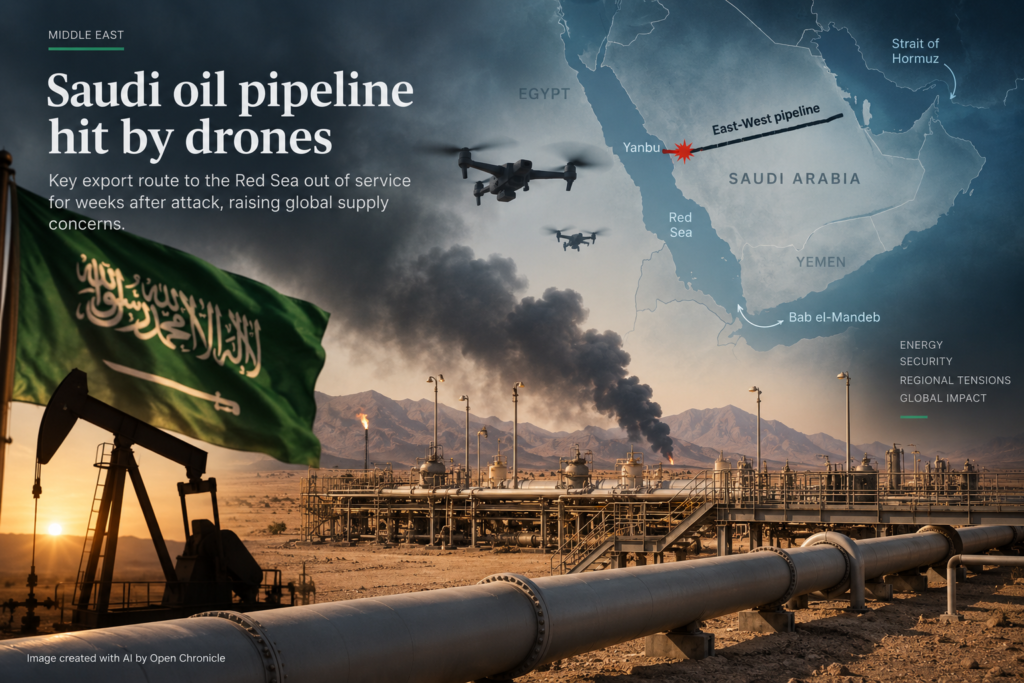
A major Saudi Arabian oil pipeline damaged in a drone attack is expected to remain largely out of operation for several weeks, adding new pressure to global energy markets as the kingdom struggles to maintain crude exports amid disruption across key Middle Eastern shipping routes.
Two regional officials familiar with the situation said repairs to the East West Pipeline could take between three and five weeks, including work on a major pumping station damaged in the attack.
Oil prices rose by more than 2% as markets reacted to the prospect of further supply disruption. Brent crude climbed to around $109 a barrel amid growing concern over Saudi Arabia’s ability to move oil to international markets.
East West Pipeline becomes increasingly critical
Saudi Arabia has become increasingly dependent on the East West Pipeline as tensions with Iran disrupt shipping through the Strait of Hormuz, the narrow waterway connecting the Persian Gulf with international markets.
The approximately 1,200 kilometre pipeline carries crude from Saudi Arabia’s oil producing regions in the east of the country to Yanbu on the Red Sea coast.
From there, crude can be loaded onto tankers without having to pass through the Strait of Hormuz.
That alternative route has become strategically important as attacks and military tensions have affected navigation through the Gulf.
Saudi authorities halted operations after Thursday’s drone attack, which Riyadh has attributed to Iran backed militias operating from Iraq.
Iraqi authorities have condemned attacks launched from their territory and have opened an investigation into the incident.
Repairs could take up to five weeks
Officials briefed on the damage told the Associated Press that repairs could require between three and five weeks.
One official said part of the pipeline might be able to operate while repairs continue, although it remains unclear how much crude could be transported under such conditions.
That uncertainty is particularly significant because of the volumes recently moving through the system.
According to an analysis by Norway based energy research company Rystad Energy, the pipeline had been transporting a weekly average equivalent to between 2.6 million and 4 million barrels per day since late August.
A complete shutdown would therefore remove a substantial export route from the market.
Rystad said Brent crude reaching around $109 a barrel indicated that traders were increasingly pricing in the possibility of a significant supply loss.
Saudi Arabia squeezed between Hormuz and the Red Sea
The damage creates a particularly difficult strategic problem for Saudi Arabia.
Disruption around the Strait of Hormuz has already reduced the reliability of the kingdom’s traditional export routes through the Persian Gulf. The East West Pipeline provides the principal overland alternative by moving crude directly to the Red Sea.
But the security environment there is also deteriorating.
Iran backed Houthi forces in Yemen have expanded their presence around strategically important Red Sea shipping routes. According to Yemeni government and Houthi officials, the group has captured the Greater and Lesser Hanish islands.
The islands lie roughly 160 kilometres north of the Bab el Mandeb Strait, another of the world’s most important maritime chokepoints.
Bab el Mandeb connects the Red Sea with the Gulf of Aden and the wider Indian Ocean, making it essential for shipping travelling between Europe, the Middle East and Asia.
Houthi advances add another layer of pressure
The Houthi expansion creates another challenge for Saudi Arabia because crude arriving at Yanbu still depends on secure navigation through the Red Sea to reach many international customers.
The group has been attacking Saudi oil infrastructure and maritime interests for more than a month, according to the information provided.
Its growing presence near Bab el Mandeb also brings Houthi controlled territory closer to Djibouti, which hosts major foreign military facilities, including the principal permanent United States military base in Africa.
The combination of instability around Hormuz and Bab el Mandeb means that pressure is now affecting both sides of the Arabian Peninsula.
That is particularly important for global energy markets because the two waterways sit along some of the most important oil and commercial shipping routes in the world.
Saudi oil production has already fallen sharply
The pipeline disruption comes after Saudi oil production had already been significantly affected by the wider regional conflict.
According to International Energy Agency figures cited in the information provided, Saudi production fell to around 6 million barrels per day in August, compared with almost 10 million barrels per day in September of the previous year.
The reduction is particularly significant because Saudi Arabia is the world’s largest crude oil exporter and traditionally possesses substantial spare production capacity that can help stabilise global markets during supply disruptions.
Damage to the East West Pipeline therefore affects more than Saudi export logistics. It also raises questions about how quickly additional Saudi crude could reach international customers if global supplies tighten further.
Global oil markets face growing uncertainty
The latest attack highlights the vulnerability of energy infrastructure as the regional confrontation expands across land and sea.
Saudi Arabia developed the East West Pipeline partly to reduce its dependence on the Strait of Hormuz. With that alternative now damaged, Riyadh faces simultaneous pressure on its Gulf and Red Sea export routes.
How much oil can continue moving through the pipeline during repairs will consequently be closely watched by traders and governments.
If significant volumes remain unavailable for several weeks while disruption persists around Hormuz and the Red Sea, the consequences could extend well beyond Saudi Arabia, placing additional pressure on crude prices, shipping costs and global energy supplies.