
By Open Chronicle with agencies
European Commission President Ursula von der Leyen has announced plans for a new Congress of Europe in 2027, bringing together thinkers, writers, artists, scientists, citizens and civil society to develop a vision for the continent’s future.
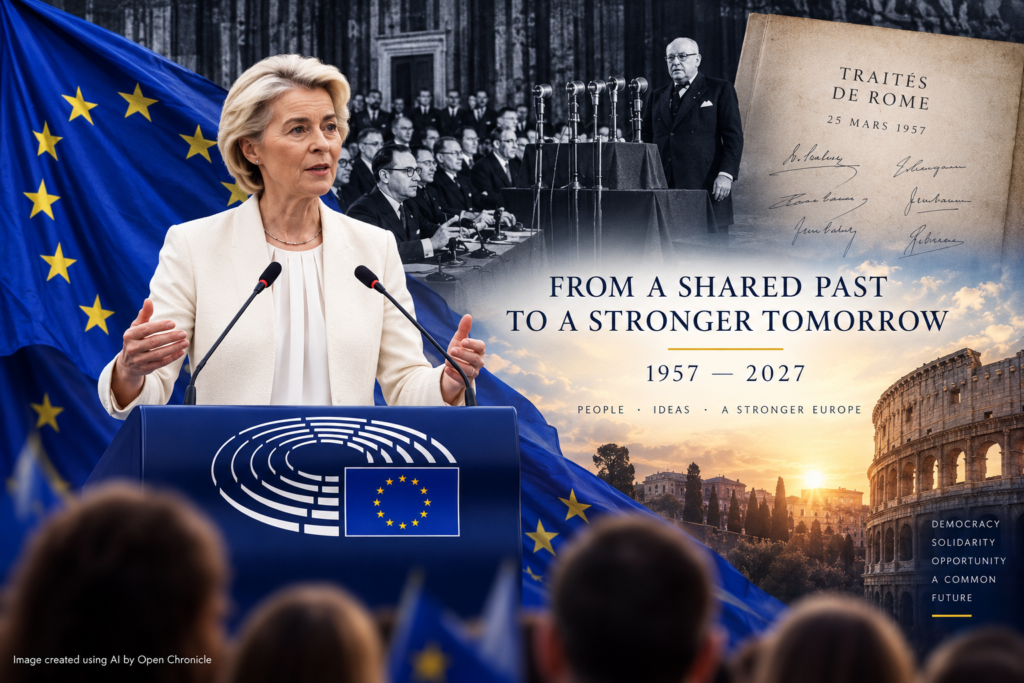
The initiative, announced during von der Leyen’s State of the Union address before the European Parliament in Strasbourg, will coincide with the 70th anniversary of the Treaties of Rome, signed on 25 March 1957.
The treaties established the European Economic Community and Euratom and became a crucial foundation for the European integration process that eventually produced today’s European Union.
Von der Leyen presented the proposed congress as an opportunity to look beyond immediate political crises and encourage Europeans to think more ambitiously about what the continent should become.
The Commission had already framed the 2026 State of the Union around Europe assuming greater responsibility for its own future in an increasingly fragmented geopolitical environment.
Bringing Europe’s thinkers together
According to von der Leyen, the Congress of Europe will seek to gather some of the continent’s leading voices from fields extending well beyond traditional politics.
Thinkers, writers, artists and scientists would participate alongside citizens and representatives of civil society.
The objective, she said, is to develop a vision capable of inspiring a new generation of Europeans and of reigniting what she described as the European imagination.
Rather than focusing exclusively on institutional reforms or economic policy, the initiative appears intended to encourage a broader discussion about Europe’s identity, values and long term direction.
Looking back to the Congress of Europe of 1948
Von der Leyen connected the proposal to a pivotal moment in Europe’s postwar history.
The original Congress of Europe was held in The Hague in May 1948, as political leaders, intellectuals and activists considered how a continent devastated by the Second World War could build a new system of cooperation.
The gathering became one of the important milestones in the wider European movement that preceded the creation of the institutions from which European integration subsequently developed.
Von der Leyen invoked that history to argue that Europe once again needs the capacity to imagine its future rather than simply react to successive crises.
Decades after the beginnings of European integration, she said, millions of people continue to see Europe as a promise.
“We often forget how powerful that promise remains,” she told lawmakers.
Seventy years after the Treaties of Rome
Holding the congress in 2027 would give the initiative considerable historical symbolism.
On 25 March 1957, Belgium, France, Italy, Luxembourg, the Netherlands and West Germany signed the Treaties of Rome.
The European Economic Community created by the agreements sought progressively closer economic integration among its members, establishing the foundations of the common market and helping shape the institutions that ultimately evolved into the European Union.
Seventy years later, von der Leyen wants the anniversary to serve not simply as a commemoration of European history, but as an opportunity to consider the continent’s next chapter.
Europe and the next generation
The emphasis on younger Europeans also fits a recurring theme in von der Leyen’s previous speeches.
In her 2023 State of the Union address, for example, she argued that younger generations would have to confront fundamental questions about war, climate change, artificial intelligence, employment and housing, while deciding what kind of Europe they wanted to inherit.
The proposed Congress of Europe takes that argument further by seeking to give the next generation a role in defining Europe rather than merely inheriting institutions built by previous generations.
Von der Leyen said the goal was to allow the next generation to “write its own history.”
The initiative would also encourage Europeans to remember the origins of the integration project: nations that had repeatedly fought one another choosing instead to build a common future.
Rethinking Europe at another turning point
The announcement comes as the EU confronts questions that could significantly shape its development over the coming decades.
Defence and strategic autonomy, technological competition, artificial intelligence, energy security, enlargement, migration, economic competitiveness and the future of European democracy are increasingly interconnected.
Von der Leyen’s current Commission has placed particular emphasis on reducing strategic dependencies and increasing Europe’s ability to determine its own future. Ahead of the 2026 State of the Union, the Commission described the international environment as increasingly fragmented and presented a more competitive, resilient and less dependent Europe as a central objective.
The proposed Congress of Europe would approach that debate from a different direction.
Instead of beginning with individual policies, budgets or legislation, it would ask a larger question: what kind of Europe should emerge from the transformations now taking place?
Seventy years after the Treaties of Rome, von der Leyen is seeking to turn an anniversary of Europe’s past into a discussion about its future.