
By Open Chronicle with agencies
European Commission President Ursula von der Leyen has proposed creating a European emergency security mechanism inspired by NATO’s consultation system, arguing that the European Union needs a faster and more coordinated way to respond to hybrid threats that fall below the threshold of conventional armed attack.
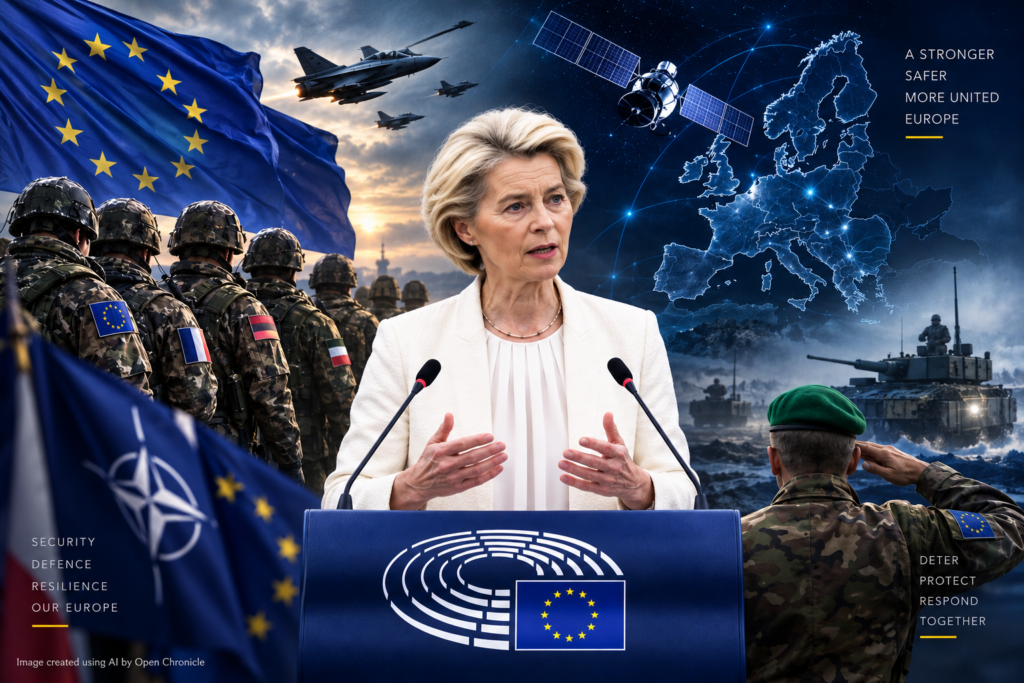
Speaking before the European Parliament in Strasbourg during her State of the Union address, von der Leyen said Europe requires its own framework for responding when the security of one of its 27 member states is threatened.
She presented the idea as a European complement to NATO’s Article 4, under which an ally can request consultations when it believes its territorial integrity, political independence or security is threatened. NATO confirms that Article 4 is a consultation mechanism and does not itself amount to the collective defence commitment contained in Article 5.
A European “Article 4”
Von der Leyen argued that existing European security structures were created for a different era and are increasingly being tested by threats that blur the distinction between peace and open conflict.
“Europe needs its own hybrid countermeasures playbook,” she said, according to the information presented in the speech. She called for agreement on how governments should respond to incidents that remain below the level of armed aggression but nevertheless pose a clear threat to national security.
“I believe it is time for Europe to have its own Article 4, or an Emergency Security Protocol,” she said.
Under the proposed mechanism, an EU member state facing a serious security incident could activate the protocol, bringing the other member states together to coordinate a European response.
Such a framework could become particularly relevant to incidents involving cyberattacks, sabotage, disinformation campaigns, interference with critical infrastructure and other forms of hostile activity that may be difficult to classify as conventional military attacks.
Hybrid threats are changing
Von der Leyen warned that the nature of hybrid warfare itself is becoming more dangerous.
“Our systems were designed for a different world,” she said, adding that the hybrid threats facing Europe are becoming “less and less hybrid and less and less threats.”
Her comments reflect growing concern within European institutions about hostile actions that can damage national security without necessarily crossing the threshold that would trigger a conventional military response.
The proposed mechanism would therefore seek to close the space between a purely national reaction and the much more serious collective defence arrangements available through NATO.
NATO’s existing Article 4 allows any ally to bring a security concern before the North Atlantic Council. Decisions within NATO are subsequently reached by consensus.
New European security strategy
Von der Leyen also announced plans for a new European security strategy to be developed together with EU foreign policy chief Kaja Kallas.
The strategy is expected to address the changing security environment confronting the Union and how member states can coordinate their response to emerging threats.
The Commission president’s proposal would not replace NATO. Instead, she explicitly presented the emerging European security architecture as complementary to the transatlantic alliance.
That distinction is important because 23 of the EU’s 27 member states are also NATO members, while European defence initiatives increasingly have to account for the capabilities and structures already operating within the alliance.
New instrument for critical military capabilities
Von der Leyen also announced plans for a new European Instrument for Strategic Enablers, which she said would be fully aligned with NATO.
Strategic enablers are capabilities that allow armed forces to operate effectively at scale, even though they may attract less attention than combat aircraft, warships or armoured vehicles.
The war in Ukraine has demonstrated their importance, von der Leyen argued.
She highlighted air and missile defence, strategic transport and aerial refuelling, as well as capabilities in space and cyberspace.
These assets can determine whether European forces are capable of deploying quickly, sustaining operations and responding effectively to a major security crisis.
Lessons from Ukraine
Russia’s war against Ukraine has transformed European thinking about defence, industrial capacity and preparedness.
For Brussels, the conflict has demonstrated that credible defence depends not only on the number of soldiers or weapons available, but also on logistics, intelligence, air defence, communications, cyber capabilities and the ability to move forces and equipment across Europe.
Von der Leyen’s proposed strategic enablers instrument appears intended to address some of those gaps while strengthening cooperation between European governments.
The approach also fits into the Commission president’s broader argument that Europe needs greater capacity to act independently while maintaining its close relationship with NATO.
“Europe will defend every square metre”
Von der Leyen concluded the security section of her address with an unequivocal commitment to territorial defence.
“Europe will defend every square metre of its territory,” she said.
Her proposals nevertheless remain proposals rather than an EU equivalent of NATO’s treaty guarantees. Their precise legal basis, activation procedure, decision making rules and the measures available to member states would need to be established before such a mechanism could operate.
NATO Article 4 itself requires allies to consult when one believes its territorial integrity, political independence or security is threatened. It should not be confused with Article 5, which establishes NATO’s collective defence obligation following an armed attack.
Von der Leyen’s initiative seeks to create a European mechanism for the increasingly important territory between those two situations: security incidents serious enough to demand a collective response, but which may not constitute an armed attack.
If developed, the Emergency Security Protocol could therefore become a significant component of the EU’s attempt to adapt its security architecture to cyberattacks, sabotage, foreign interference and other threats increasingly shaping Europe’s strategic environment.