
By Open Chronicle with agencies
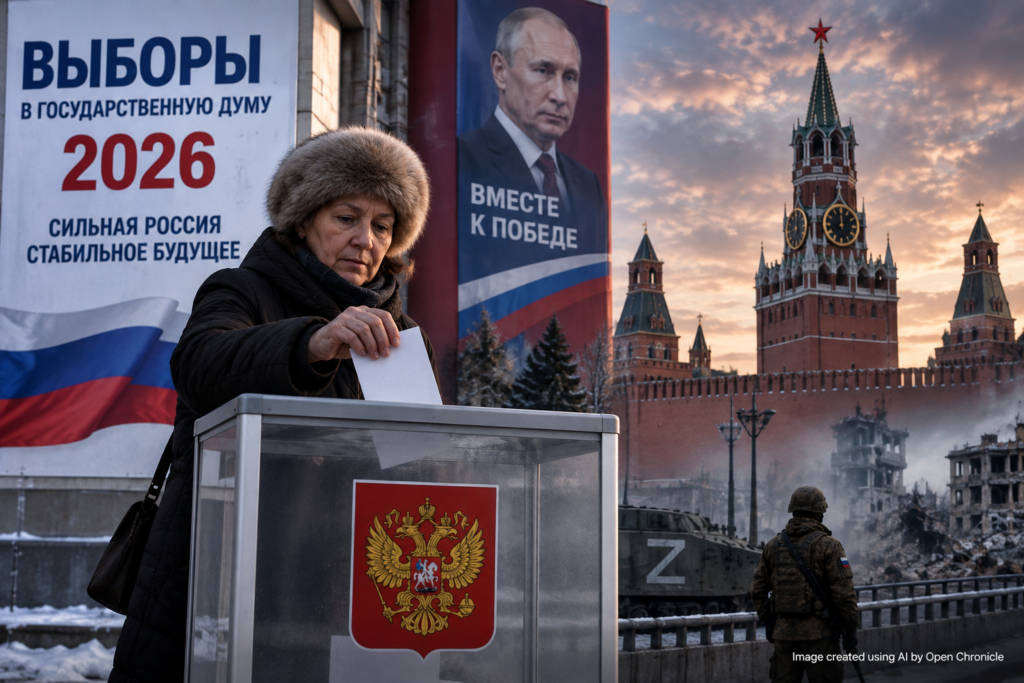
Russians began voting on Friday in a three-day parliamentary election, the country’s first since Moscow launched its full-scale invasion of Ukraine in February 2022, with the war increasingly affecting daily life, economic conditions and the political environment inside Russia.
Polling stations opened first in Russia’s Far East before voting spread westward across the country. Voters are choosing all 450 members of the State Duma, the lower house of parliament, with preliminary results expected after polls close on Sunday.
President Vladimir Putin has presented the election as a demonstration of national unity and support for Russia’s military campaign. His United Russia party is expected to retain its dominant position in parliament, where it currently controls about two-thirds of the seats. The political environment, however, offers voters few alternatives openly opposed to the war.
Russia’s first parliamentary election since the invasion
The election takes place more than four and a half years after Russian forces launched their full-scale invasion of Ukraine.
Unlike previous parliamentary campaigns, the war now forms the backdrop to virtually every major political and economic issue confronting the country.
United Russia remains the dominant political organisation, while the Communist Party, Liberal Democratic Party, A Just Russia and New People continue to operate within a political system broadly supportive of the Kremlin’s wartime policies.
The liberal Yabloko party, which has opposed the war, was removed from the nationwide party ballot following a Supreme Court ruling. Some individual Yabloko candidates remain in constituency races, including candidates campaigning on explicitly anti-war platforms.
Other prominent critics of the war have been imprisoned, barred from political activity or gone into exile.
The Kremlin argues that restrictions introduced during the conflict are necessary for national security. Critics and independent observers say the measures have sharply reduced political competition and freedom of expression.
Voting extends into occupied Ukrainian territory
Moscow is also conducting voting in Ukrainian territories it claims to have annexed, including parts of Donetsk, Luhansk, Zaporizhzhia and Kherson.
Russia declared the annexation of those four regions in 2022 after internationally rejected referendums, although it does not fully control any of them. Crimea, which Russia annexed in 2014, is also participating in the election.
Ukraine rejects Russian sovereignty over all five territories and considers voting organised there by Moscow illegal. The annexations are not recognised by most of the international community.
The inclusion of the occupied territories gives the parliamentary vote an additional international dimension beyond Russia’s domestic politics.
Putin links the vote to the war
Putin has explicitly connected participation in the election with Russia’s military campaign.
In an address ahead of voting, he appealed for unity and argued that participation would demonstrate public support for Russian troops and the country’s wartime objectives. Reuters reported that the Kremlin views the election partly as a measure of public attitudes toward a conflict that has lasted far longer than originally expected.
The election therefore offers the Kremlin more than another parliamentary majority. It provides an opportunity to demonstrate political stability despite the costs of the conflict.
Those costs have become increasingly visible inside Russia.
Ukrainian drones bring the war deeper into Russia
Ukraine has expanded long-range drone operations against targets inside Russia, particularly oil refineries, storage facilities, logistics centres and military infrastructure.
The attacks have disrupted parts of Russia’s refining network and contributed to periodic fuel shortages. A severe fuel crisis peaked in June, eased temporarily and returned during August, according to reporting on conditions ahead of the election.
Warehouses operated by major Russian online retailers Wildberries and Ozon have also been hit, creating losses for businesses and independent merchants dependent on the platforms.
The attacks have changed the psychological geography of the conflict.
For many Russians far from the Ukrainian border, the war was once experienced largely through television, military recruitment, sanctions and the absence of relatives serving in the armed forces. Increasingly frequent drone alerts, disruptions and attacks on economic infrastructure have made the consequences more immediate.
Russia’s wartime economy comes under pressure
Russia’s economy initially proved more resilient than many Western governments expected following the introduction of sweeping sanctions in 2022.
Massive military expenditure stimulated industrial production, while energy exports continued generating substantial government revenue.
Four years later, however, the economic picture has become more complicated.
Russia is confronting slower growth, high borrowing costs, labour shortages, inflationary pressures and a widening government deficit. Military expenditure continues to consume enormous resources, while the government has increased taxes and domestic borrowing to finance its commitments.
Official unemployment remains exceptionally low at around 2.2 percent, partly reflecting labour shortages, while defence industries continue supporting employment and investment in some regions.
Russia has also benefited from elevated global oil prices, which have provided Moscow with additional revenues and helped cushion some of the pressure on government finances.
That makes the picture more nuanced than a straightforward economic crisis. Russia continues to possess substantial resources and industrial capacity, but economists increasingly warn about the long-term cost of sustaining a heavily militarised economy.
Signs of public fatigue
The economic pressures and expanding Ukrainian attacks appear to have affected public sentiment, although measuring opinion inside Russia during wartime is difficult.
Polling cited in reporting ahead of the election showed Putin’s approval rating remaining high but declining from previous levels. The independent Levada Center placed his approval at 76 percent in August, compared with 87 percent in September 2025.
Such figures require caution. Wartime censorship, restrictions on dissent and the potential risks associated with expressing opposition can affect polling conditions.
At the same time, surveys and political reporting have indicated growing interest among some Russians in negotiations to end the conflict. Reuters reported this week that some polling has shown more than 60 percent favouring peace negotiations, although attitudes can vary substantially depending on how questions are phrased.
The Kremlin continues to insist that Russia can sustain the conflict and achieve its objectives.
A rare warning from inside the Russian establishment
Concerns about the economic trajectory have also emerged from figures within Russia’s establishment.
Andrei Klepach, formerly chief economist at the state development corporation VEB.RF, warned earlier this year that Russia was falling behind economically and technologically as the costs of the conflict accumulated.
Klepach argued that Russia would struggle in a prolonged economic war of attrition and warned that continued pressure could eventually contribute to a social crisis.
He was dismissed from VEB.RF in August after his comments became public. The bank did not publicly provide a reason for his departure. Independent Russian media cited sources linking his removal to the critical assessment, although that attribution has not been officially confirmed.
His remarks were significant because they came from an economist who had spent years inside Russia’s state economic establishment.
Moscow intensifies its own campaign against Ukraine
Russia, meanwhile, has continued escalating attacks against Ukrainian cities and infrastructure.
Moscow has expanded the use of missiles and drones, including newer jet-powered systems, while Ukraine continues to face shortages of some air defence interceptors.
Russian forces have also intensified attacks on Black Sea ports and logistics infrastructure associated with Ukrainian agricultural exports. Grain and other agricultural commodities remain an important source of revenue for Kyiv.
Putin has acknowledged that Ukrainian attacks have damaged Russian energy and logistical infrastructure but maintains that the Russian economy can withstand the pressure.
He has portrayed Ukraine’s long-range strikes as an escalation that justifies further Russian retaliation.
Kyiv argues that Russian energy and logistics facilities supporting the military are legitimate targets and that its long-range campaign is intended to reduce Moscow’s capacity to finance and sustain the invasion.
An election about more than parliament
United Russia’s continued dominance of the State Duma is widely expected, meaning the more revealing questions may concern turnout, regional voting patterns and the level of public engagement.
The Kremlin is seeking to demonstrate that Russia remains politically stable and that society continues to support the state despite years of warfare, Western sanctions and increasing Ukrainian attacks inside Russian territory.
For opponents of the Kremlin, the election instead illustrates how dramatically Russia’s political environment has changed since the invasion.
The country’s principal openly anti-war party has been excluded from the nationwide party ballot, prominent opposition figures are imprisoned or abroad, and wartime legislation has significantly narrowed the boundaries of permissible political dissent.
Yet the election is taking place at a moment when the consequences of the war are becoming harder for ordinary Russians to avoid.
Fuel shortages, inflation, drone attacks, labour shortages and higher taxes are bringing economic and security pressures closer to daily life, even as increased oil revenues and military spending continue to provide the Kremlin with significant resources.
The composition of Russia’s next parliament may therefore contain few surprises. The more consequential question is what the vote reveals about a society entering another year of a war that increasingly reaches far beyond the battlefield.